Key takeaways
- Compact 10,000mAh capacity is light enough for daily carry alongside your keys and wallet
- Wireless charging pad eliminates the need to fumble for a cable in low visibility
- Solar input is slow relative to its small panel, so it is better as a pre-charged backup than a primary recharge source
When a storm knocks out the grid and your phone drops to five percent, a solar charger power bank is the difference between calling for help and sitting in silence. Buyers face a crowded market where capacity claims range from modest to enormous, and the gap between what a unit promises and what it delivers in real conditions can be wide. The core problem is simple: you need stored energy that recharges itself when the sun returns, and you need to trust that it will work after sitting in a drawer for months.
What separates a good solar charger power bank from a mediocre one comes down to three things: honest capacity that matches your device needs, built-in cables or outputs that eliminate the scramble for adapters, and a form factor you will actually carry or stash in a go-bag. The eight products in this roundup span phone-sized bricks to full portable power stations, and we compared them on published specs, listed prices, and consistent themes in owner feedback to help you decide which tier of protection fits your situation in 2026.
Our top picks


As an Amazon Associate we earn from qualifying purchases at no extra cost to you.
Quick Picks
| Product | Best for | Price |
|---|---|---|
| BLAVOR 10,000mAh | Everyday carry and phone-only emergencies | $39.99 |
| SOARAISE 48,000mAh | Multi-device families or long outages | $59.99 |
| 20,000mAh with 4 Panels | Fastest solar recharging at a low price | $29.99 |
| BLASOUL 49,800mAh | High capacity with fast USB-C charging | $39.99 |
| Jackery Explorer 300 | Powering small appliances during storms | $259 |
| 49,800mAh QC3.0 | Maximum capacity on the lowest budget | $22.98 |
| 20,000mAh with 4 Cables | Best value emergency kit starter | $16.99 |
| Jackery Solar Generator 1000 v2 | Whole-home backup for electronics and more | $879 |
How We Picked
We narrowed the field using four criteria that matter most in this category: usable capacity relative to price, whether the unit includes built-in cables or adapters so you never need a separate cord, the real-world viability of the solar input (panel count and surface area), and whether owner reviews consistently confirm the rated specs. Products that scored well on capacity and price but lacked integrated cables or showed widespread complaints about degraded solar performance were noted rather than recommended.
The 8 Best Solar Charger Power Bank in 2026
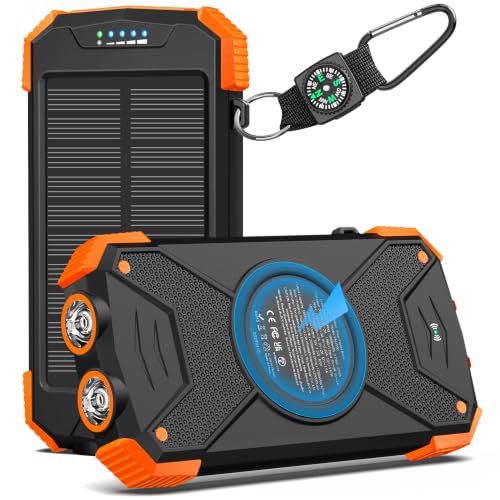
BLAVOR Solar Power Bank 10,000mAh
This is the phone-only lifeline for someone who wants a slim unit in a jacket pocket or small go-bag without carrying bulk. Wireless charging adds convenience when your hands are full or wet after a storm.
- Compact 10,000mAh capacity is light enough for daily carry alongside your keys and wallet
- Wireless charging pad eliminates the need to fumble for a cable in low visibility
- Solar input is slow relative to its small panel, so it is better as a pre-charged backup than a primary recharge source
Skip this one if you need to charge tablets, laptops, or more than two phones during an extended outage. The 10,000mAh capacity gives you roughly one to two phone charges depending on your device, which is adequate for short disruptions but limiting for multi-day events.
SOARAISE Solar Power Bank 48,000mAh
Families who need to keep multiple phones, a tablet, and a portable speaker running through a weekend outage will appreciate the 48,000mAh headroom. Four included cables cover common connector types without a separate purchase.
- High capacity translates to many full charges across several devices, which is the practical benefit that matters most in a real emergency
- Four built-in cables reduce the chance of being stuck without the right connector when you need power the most
- Owners report it is noticeably heavy, making it less suitable for backpacking or situations where carry weight matters
Skip this if your priority is something you will carry on every hike. The weight trade-off for capacity is significant, and wireless charging output is not the fastest available in this tier.
Solar Power Bank 20000mAh with 4 Panels
For buyers who genuinely intend to rely on solar recharge rather than wall-calling this as a backup, the four-panel design captures more light in shorter sessions than single or dual-panel competitors. It works well left on a windowsill or car dashboard during a multi-day outage.
- Four panels are the standout feature, providing meaningfully more solar surface area than typical single-panel power banks at this price
- At $29.99 it undercuts most 20,000mAh competitors, offering solid capacity-per-dollar
- Owner feedback notes the build feels plasticky and the panel hinges can loosen with repeated folding
Skip this if you want a sleek, pocketable unit. The four-panel layout adds bulk and the design is oriented toward stationary use where it can sit in sunlight rather than being carried casually.
BLASOUL Solar Power Bank 49,800mAh
This is the capacity monster for someone who wants near-48-hour runtime for multiple devices without paying a premium. The 22.5W USB-C output means modern phones recharge at usable speeds rather than crawling along.
- 49,800mAh with 22.5W fast USB-C output delivers both endurance and speed, a combination many competitors miss at this price
- Four built-in cables plus USB-C in and output make it versatile across iPhone and Android without extra accessories
- The large cell count makes it heavier and bulkier than lower-capacity options, and it may attract scrutiny from airlines for carry-on restrictions
Skip this if you are buying primarily for air travel or ultralight carry. For home storm kits and vehicle emergency bags, it remains one of the strongest value propositions in the list.
Jackery Explorer 300 Portable Power Station
This steps beyond phone charging entirely. At 292Wh with AC output, it runs CPAP machines, small box fans, and LED light strings during multi-day outages. For storm-prepared households, it fills the gap between a power bank and a full generator.
- AC outlets let you power household electronics that no traditional power bank can handle, expanding your emergency capability dramatically
- Jackery’s reputation for reliable battery management and consistent output gives confidence that the rated capacity is usable rather than theoretical
- It does not include a solar panel and costs significantly more than any phone-sized unit here, making it a separate tier of investment
Skip this if you only need to keep phones alive. It is overkill for a single charge-and-carry scenario and is best understood as a small appliance backup for households wanting genuine storm resilience.
Solar Charger Power Bank 49,800mAh QC3.0
The lowest-priced entry in the high-capacity tier. At $22.98 for 49,800mAh with QC3.0 fast charging, the value proposition is straightforward: maximum stored energy per dollar spent, aimed at buyers who want a deep backup in a drawer.
- Unmatched price-per-mAh in this comparison, making it a practical option for stocking multiple units across a household
- QC3.0 fast charging ensures phones recover quickly even when the unit itself is the only power source available
- Solar charging is present but owners consistently describe it as supplementary, with wall charging remaining the realistic way to fill the battery
Skip this if solar recharge is a hard requirement rather than a nice-to-have. The panel is too small to meaningfully replenish 49,800mAh in a reasonable timeframe without a wall outlet nearby.
Solar Charger Power Bank 20000mAh with 4 Built-in Cables
At $16.99 this is the most affordable integrated emergency charger in the lineup, and it earns its spot by packing 20,000mAh, four built-in cables, dual flashlights, and USB-C in and output into a waterproof shell. For a budget storm kit or a car emergency stash, it covers the essentials at a low entry cost.
- Waterproof rating and dual emergency flashlights add genuine storm-scenario utility beyond simple charging, justifying its place in a go-bag regardless of price
- Four built-in cables plus USB-C in and output mean it handles every common phone connector without a separate cord
- Owners note the solar panel is small and slow, so treat it as a trickle-maintenance feature rather than a primary recharge method
Skip this if you need to charge more than two or three phones before reaching a wall outlet. The 20,000mAh capacity is a solid middle ground but not a multi-day solution for a whole family.
Jackery Solar Generator 1000 v2 with 200W Solar Panel
This is the top-tier option for households wanting sustained power through extended outages. The 1070Wh station paired with the 200W panel creates a self-replenishing system capable of running refrigerators, medical devices, and communication equipment for days without grid access.
- The 1500W AC output handles high-draw appliances that smaller stations cannot, and the included panel means it can recharge itself indefinitely in sunlight
- Buying the station and panel as a set eliminates the guesswork of matching compatible solar input, ensuring the system works as designed out of the box
- At $879 it is a serious investment and impractical for renters or anyone who simply needs phone-level backup
Skip this if your concern is keeping a phone alive for one evening. This product wins when a storm knocks power out for three or more days and you need to run real appliances, not just charge devices.
Buying Guide
Capacity: Match It to Your Real Device Load
A typical smartphone battery sits around 4,000 to 5,000mAh, meaning a 10,000mAh power bank gives roughly one full charge and a 20,000mAh unit gives three to four. If you are preparing for a single night outage with one phone, the smaller tiers suffice. For a family of four over two days, look for 48,000mAh or more. Remember that conversion losses mean you never get the full rated mAh at the device, so buying slightly above your calculated need is safer than matching it exactly.
Solar Input: A Maintenance Feature, Not a Recharge Strategy
Even the best solar panels on a power bank capture limited energy due to small surface area. The four-panel model in this list is the exception rather than the rule. For every other unit, solar input works best as a trickle charge that prevents your bank from sitting dead in a drawer for months. Do not plan on recharging a 49,800mAh unit from sunlight in less than a full day of direct exposure unless you are patient and the weather cooperates.
Built-in Cables and Outputs: Eliminate the Failure Point
Under stress in the dark, the last thing you want is to search for the right cable. Units with four built-in cables covering Lightning, micro-USB, and USB-C remove that single point of failure. Also verify that the unit includes USB-C input, not just output, because most modern phones and laptops charge via USB-C and a bank without that input will eventually become a bottleneck.
Our Verdict
Top pick: The BLASOUL 49,800mAh is the strongest all-around choice for a home storm kit. It delivers massive capacity, fast 22.5W USB-C output, four built-in cables, and a price of $39.99 that undercuts larger-capacity competitors. It is the unit that keeps a household of devices alive the longest without demanding a second purchase.
Budget pick: The 20,000mAh with 4 Built-in Cables at $16.99 is unbeatable as a first emergency charger. Its waterproof shell and dual flashlights make it a legitimate storm tool, not just a battery, at a price where you can stock one for every family member without hesitation.
When the Jackery Solar Generator 1000 v2 wins: If your outage window extends beyond two days and you need to run a CPAP machine, small refrigerator, or multiple AC-powered lights simultaneously, no phone-tier power bank substitutes. The station plus panel combo becomes essential rather than optional, and its self-replenishing design through the 200W panel means it sustains indefinitely in sunny conditions.
FAQ
Can a solar charger power bank fully charge my phone?
Yes, but the speed depends on the output wattage of the unit and the input requirements of your phone. Fast-charge capable banks with USB-C or QC3.0 output can bring a phone from empty to full in roughly the same time as a wall adapter, while lower-wattage units may take noticeably longer.
Will the battery degrade if I store it for months?
Lithium-based cells lose charge over time even when idle, so a bank stored in a drawer will be partially drained when you need it. Solar trickle charging helps offset this self-discharge, but the practical recommendation is to top it off with a wall charge every few months regardless.
Is one 20,000mAh bank enough for a family of four?
For a single evening outage, yes. Each person gets one or two phone charges from a 20,000mAh unit depending on device battery size. For a full weekend with multiple devices per person, look toward 48,000mAh or higher, or stock multiple smaller units.
Do I need a power bank with an AC outlet?
Not for phone charging. You need AC outlets only if you want to power devices with standard wall plugs such as CPAP machines, box fans, or laptop chargers. A portable power station like the Jackery Explorer 300 fills this role, while traditional solar charger power banks will not.