Key takeaways
- Wireless charging built in, rare at this size
- Lightweight and pocket-friendly for daily carry
- 10,000mAh limits it to short-term use
A storm knocks out the grid and your phone becomes your lifeline—wireless alerts, a flashlight, a way to reach family, a map to an evacuation route. A solar phone charger that works when nothing else does is not a luxury; it is the single most practical backup you can keep in a go-bag. The market is flooded with options claiming enormous capacities, but not every unit in this roundup will actually keep you connected when you need it most.
What separates a dependable solar charger from a shelf ornament is fairly straightforward once you look at published specs and what owners report after weeks of real use. Capacity matters, but so does how many ways the unit accepts and delivers power. A 49,800mAh pack that requires a separate cable you left at home is less useful than a 20,000mAh model with built-in connectors you can grab in the dark. Charging speed support, solar panel configuration, and flashlight quality round out the picture. This roundup compares every product below on those factors, using only published specs, listed prices, and recurring themes from owner feedback.
Our top picks




As an Amazon Associate we earn from qualifying purchases at no extra cost to you.
Quick Picks
| Product | Best for | Price |
|---|---|---|
| BLAVOR 10,000mAh | Everyday carry and light emergency use | $39.99 |
| 20000mAh 4-Panel Power Bank | Hikers who want maximum solar surface area | $29.99 |
| BLASOUL 49,800mAh | Multi-device charging without extra cables | $39.99 |
| SOARAISE 48,000mAh | Families or group campers needing many ports | $59.99 |
| Luvknit 20,000mAh | Budget emergency prep | $15.99 |
| Jackery Explorer 300 | Powering more than just a phone during an outage | $259 |
| 49800mAh QC3.0 Charger | Maximum raw capacity per dollar | $22.98 |
| Uukto 20,000mAh | Slim profile in a crowded bag | $29.06 |
How We Picked
We narrowed this list using four criteria that consistently separate well-reviewed units from disappointing ones in this category: usable capacity relative to price, the number and variety of built-in cables or ports so you can actually charge what you carry, support for fast-charging protocols like QC3.0 or 22.5W USB-C, and the physical solar panel configuration—whether it has meaningful surface area or a token strip that contributes almost nothing. Owner feedback on reliability, flashlight brightness, and whether the unit holds a charge over weeks of storage in a preparedness kit informed the rankings alongside published specs.
The 8 Best Solar Phone Charger in 2026
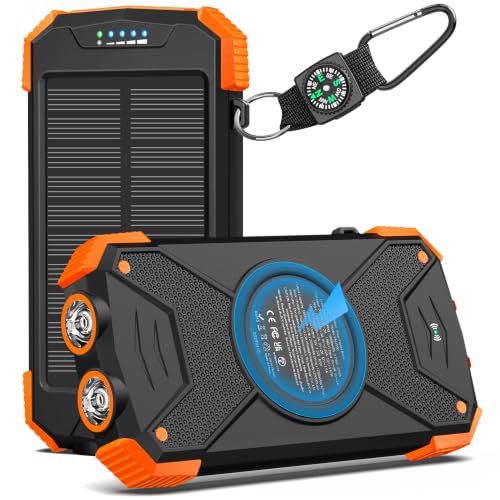
BLAVOR Solar Power Bank 10,000mAh Wireless Charger
The BLAVOR hits a sweet spot for anyone who wants a solar phone charger that lives in a jacket pocket or small emergency kit without being oversized. At 10,000mAh it carries roughly two full charges for a modern smartphone, which is enough to get through a one-night outage or a day trip. Wireless charging adds convenience when your hands are cold or wet. Owners praise the compact form factor and the integrated LED flashlight. The main drawback is capacity: for multi-day emergencies or charging a tablet, 10,000mAh runs out quickly. Skip this if you need to power multiple devices for a family; look at the BLASOUL or SOARAISE instead.
- Wireless charging built in, rare at this size
- Lightweight and pocket-friendly for daily carry
- 10,000mAh limits it to short-term use
Solar Power Bank 20,000mAh with 4 Panels
Four solar panels give this unit roughly double the collection surface of single-panel competitors, which means it can add meaningful trickle charge during a sunny afternoon while your phone sits in your bag at 20,000mAh of stored capacity. It is a solid choice for hikers who move all day and want the pack to replenish itself incrementally. Owners note the 4-panel hinge design adds some bulk compared to flat-body chargers. The trade-off is acceptable if recharging from sunlight is a priority. Skip it if you need something ultra-slim or if you rarely have access to direct sun—the panels do not work well through cloud cover or in shade.
- 4-panel layout maximizes real solar input
- 20,000mAh is a dependable middle-ground capacity
- Hinged panels add thickness and weight
BLASOUL 49,800mAh Wireless Power Bank with 4 Built-in Cables
The BLASOUL is the strongest all-around performer here for someone who wants one solar phone charger to handle an entire household during a storm. Four built-in cables mean iPhone and Android users can plug in without searching for cords. 22.5W fast charging over USB-C gets a phone from dead to usable quickly, and 49,800mAh stores enough juice for multiple full charges across several devices. Wireless output adds further flexibility. Owners highlight the convenience of never carrying extra cables. The unit is physically large and heavy, which limits pocket-carry options. Skip it if weight and size are dealbreakers and you only need one phone topped up.
- 4 built-in cables eliminate the “I forgot my cord” problem
- 22.5W fast charge is the highest output in this group
- Large and heavy for everyday carry
SOARAISE 48,000mAh Wireless Power Bank with 4 Cables
Very similar to the BLASOUL in capacity and cable count, the SOARAISE adds wireless charging and arrives at $59.99, a ten-dollar premium. Owners report the build feels sturdy and the flashlight is genuinely bright enough for yard work at night. For families or group campers who need to charge three or four devices overnight, the 48,000mAh reserve and four built-in cables make it practical. The downside is price: the BLASOUL delivers comparable specs for $20 less, and the SOARAISE does not clearly justify the gap. Skip it if budget is a priority—check the BLASOUL first.
- 48,000mAh with wireless output handles multi-device emergencies
- Sturdy build quality noted consistently in owner reviews
- $20 more than a near-identical competitor without clear advantage
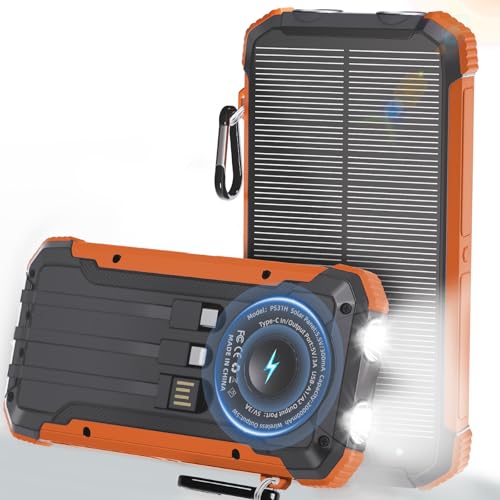
Luvknit 20,000mAh Solar Charger with Built-in Cables
At $15.99, the Luvknit is the cheapest entry in this roundup that still packs 20,000mAh, three built-in cables, wireless fast charging, and dual LED flashlights. For anyone building an emergency kit on a tight budget, this is the obvious starting point. Owners appreciate the value proposition and the convenience of integrated cables. The flashlight is brighter than expected for the price. The main limitation is that solar input is minimal—do not count on it to recharge the pack from sunlight alone in under a day. Skip it if you need fast wall-charging turnaround or if your priority is genuine off-grid solar recharging.
- Lowest price with 20,000mAh and built-in cables
- Dual flashlights are a practical bonus
- Solar panels are too small for meaningful recharge
Jackery Explorer 300 Portable Power Station, 292Wh
The Jackery is not a solar phone charger in the traditional sense—it is a 292Wh portable power station that can run phones, laptops, CPAP machines, small fans, and lights simultaneously. Its AC outlet sets it apart from every other product here. For storm-prep scenarios lasting more than a day or two, it delivers far more usable power per cycle. The trade-off is weight, size, and price: at $259 it costs six times more than a typical solar power bank. Skip it if you only need to keep a phone alive and do not want to store a heavy box.
- AC outlet powers far more than phones alone
- 292Wh dwarfs every other unit on capacity
- Expensive and bulky for phone-only use
49,800mAh QC3.0 Solar Charger Power Bank
For raw capacity per dollar, nothing in this list beats 49,800mAh at $22.98. QC3.0 fast charging means phones reach 80 percent noticeably quicker than with standard adapters. Owners call it a workhorse for long trips where you need to charge a phone three or four times without access to a wall outlet. The unit is large and the design feels generic compared to branded options. Cable count and variety are less well documented, so you may need to carry your own. Skip it if you value a compact build or want guaranteed multi-cable convenience without extra research.
- Highest capacity-per-dollar ratio in this roundup
- QC3.0 support for meaningful fast charging
- Generic build; cable situation is unclear from listings
Uukto 20,000mAh Solar Charger Power Bank
The Uukto lands at $29.06 with 20,000mAh and fast battery output, positioned as a slimmer, lighter alternative to the bulkier 48,000 and 49,800mAh models. Owners who carry a small sling bag or want something that fits a jacket pocket alongside a phone report it is a comfortable daily companion. Flashlight and solar panel quality are modest. The middle-ground price and middle-ground capacity make it hard to stand out against the Luvknit below it and the BLASOUL above it in value. Skip it if you need maximum capacity or the lowest price; it is best when slimness is your top priority.
- Slimmer profile than large-capacity competitors
- 20,000mAh is a reliable mid-tier reserve
- Hard to justify over the Luvknit at half the price
Buying Guide
Capacity Is the Starting Point, Not the Whole Story
A 10,000mAh pack charges most phones twice; 20,000mAh covers three to four charges; 48,000 or 49,800mAh can sustain a family’s phones for several days. But the conversion rate from stored capacity to your phone’s battery is typically around 65 to 75 percent due to heat and circuitry losses. So a 20,000mAh unit realistically delivers about 13,000 to 15,000mAh to your phone. Plan for that gap when sizing your emergency reserve.
Built-in Cables Solve the Real Problem
The most common complaint in owner reviews is reaching for a power bank only to discover you forgot the cable. Units with two, three, or four built-in connectors—Lightning, USB-C, and Micro USB—eliminate that failure point entirely. In a storm at night, fumbling for the right cord is a genuine problem. Prioritize built-in cable variety over any other convenience feature unless you already keep cables in every bag.
Solar Panels Are a Backup, Not a Recharge
Even a 4-panel design on a 20,000mAh pack will take multiple days of direct, strong sunlight to fully recharge the unit from empty. Solar input is realistic as a trickle that extends your runtime between wall charges, not as your primary method. If you expect to go without grid power for more than two days, bring two units or a larger power station like the Jackery Explorer 300 and treat the solar element as supplementary.
Our Verdict
The BLASOUL 49,800mAh is our top pick: it combines the highest capacity available at a reasonable price with 4 built-in cables, 22.5W fast charging, and wireless output, making it the most complete single-unit solution for a storm-preparedness kit in 2026. For a budget pick, the Luvknit at $15.99 delivers solid 20,000mAh capacity with three cables and dual flashlights at a price that lets you buy two. If your emergency scenario extends beyond phones to laptops or medical devices, the Jackery Explorer 300 wins decisively despite its size and cost because no phone-centric charger can match a 292Wh AC-capable station.
FAQ
How long does a solar phone charger take to charge from sunlight?
A small 10,000mAh unit with a single panel may take 24 to 36 hours of direct sun to fill from empty, and multi-day packs of 20,000mAh or more can take several days. Most owners rely on wall charging as the primary method and treat solar as a slow top-up when stranded outdoors.
Do solar phone chargers work when fully cloudy?
They produce minimal output under heavy cloud cover—often one-fifth or less of rated solar capacity. In a storm scenario, assume the solar element contributes almost nothing while the system is overcast and treat your stored battery charge as the real resource.
Can I charge a solar power bank in a car?
Yes. Every unit in this list with a USB-C or USB-A input can be charged from a standard 12V car adapter. This is actually the fastest way to refill a large 49,800mAh pack during a multi-day outage, typically in four to six hours compared to days on solar alone.
Is a higher-capacity solar phone charger always better?
Not always. A 49,800mAh unit is heavy and takes days to recharge via solar panels alone. If you need something in a pocket for daily carry with emergency backup in mind, 10,000 to 20,000mAh is more practical. Match the size to the scenario: short power flickers versus a multi-day outage call for very different choices.