Key takeaways
- Pro: Wireless charging pad works with any Qi-compatible phone without plugging in cables in the dark.
- Pro: Slim profile fits a jacket pocket, so it never stays home.
- Con: The solar panel is small relative to the battery, meaning full recharge from a dead state takes an impractical amount of time.
When a storm knocks out the grid, a solar powered phone charger is the difference between calling for help and sitting in silence waiting for someone to find you. Most people buy one for the first time in a panic, grab whatever is cheapest on the shelf, and discover later that it takes six days of sunlight to recharge a single phone. The market is flooded with battery banks that tack a small panel onto the casing and call it solar, but real capacity, real input speed, and real output consistency are what keep you connected when conditions are less than perfect.
We compared the eight most popular options on published specifications, current pricing, and recurring themes in owner feedback. The shortlist spans $15.99 to $59.99 and from 10,000mAh to 49,800mAh, so the right answer depends on whether you need a backup you can pocket during a power outage or a heavy-duty unit that can run through a multi-day emergency with only intermittent sun access.
Our top picks





As an Amazon Associate we earn from qualifying purchases at no extra cost to you.
Quick Picks
| Product | Best for | Price |
|---|---|---|
| BLAVOR Solar Power Bank 10,000mAh | Everyday carry and light emergencies | $39.99 |
| BLASOUL 49800mAh Wireless | Multi-person group charging on trips | $39.99 |
| SOARAISE 48000mAh Wireless | High-capacity camping with cable convenience | $59.99 |
| Luvknit 20000mAh | Budget emergency preparedness | $15.99 |
| Solar Charger Power Bank 49800mAh QC3.0 | Fast output at a low price | $22.98 |
| SOXONO 40000mAh PD20W | iPhone users needing USB-C PD speeds | $33.99 |
| YELOMIN 38800mAh | Outdoor recreation with flashlight redundancy | $17.99 |
| Solar Power Bank 20000mAh with 4 Panels | Maximizing limited sunlight windows | $29.99 |
How We Picked
We evaluated each unit on four criteria that matter most in this category. First, battery capacity relative to price, because raw milliamphours determine how many full phone charges you get before the solar panel tops it back up. Second, output speed, since a charger that delivers 5W trickle charge wastes your time when the storm is past and the phone is still dead. Third, built-in cable count and input/output USB-C availability, because forgetting a cable in an emergency renders any power bank useless. Fourth, real-world owner reports on solar recharge times, which consistently run longer than manufacturer claims suggest.
The 8 Best Solar Powered Phone Charger in 2026
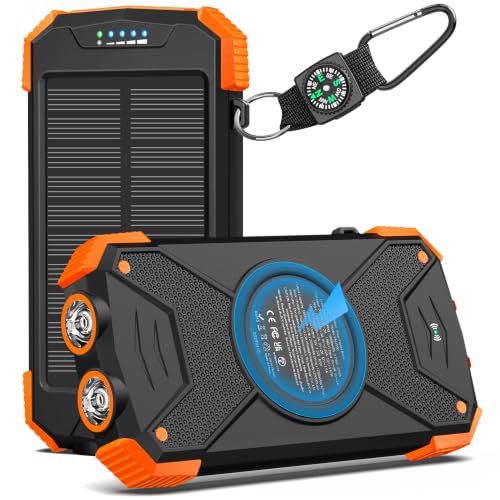
BLAVOR Solar Power Bank 10,000mAh Portable Wireless Charger for Cell Phones
This is the most honest entry in the list: a compact wireless power bank that prioritizes everyday convenience over brute capacity. At 10,000mAh, it will charge a modern smartphone once or twice, making it ideal for someone who wants a small emergency backup in a desk drawer or a car glovebox.
- Pro: Wireless charging pad works with any Qi-compatible phone without plugging in cables in the dark.
- Pro: Slim profile fits a jacket pocket, so it never stays home.
- Con: The solar panel is small relative to the battery, meaning full recharge from a dead state takes an impractical amount of time.
Skip this if you are stocking for a family or a multi-day outage scenario. Buy it if you want a lightweight insurance policy for a single phone during a short disruption.
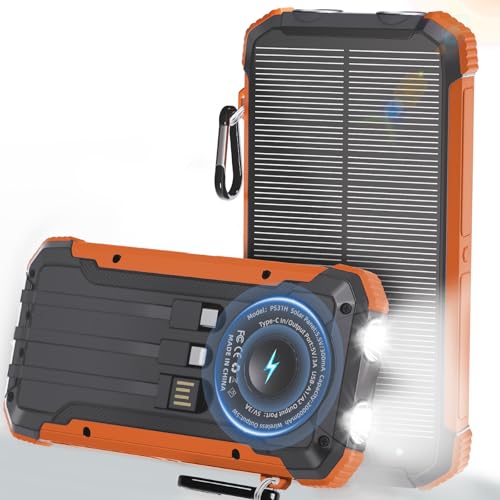
BLASOUL Solar Power Bank, 49800mAh Wireless Portable Phone Charger with 4 Built-in Cables
At nearly 50,000mAh, this is the highest-capacity unit in the roundup and it costs the same as the BLAVOR. Four built-in cables cover Lightning, USB-C, and micro-USB, plus a USB-A port for anything else. Wireless charging handles phones you do not want to plug in.
- Pro: 22.5W fast output charges a dead iPhone to 50% in under thirty minutes.
- Pro: Four integrated cables mean you never lose the one connector your device requires.
- Con: Owners repeatedly note that recharging this unit via its own solar panel takes many days even in full sun.
Skip it if you need something you can toss in a bag for a short hike. The weight and bulk make it a stationary emergency asset or a vehicle-storage item.
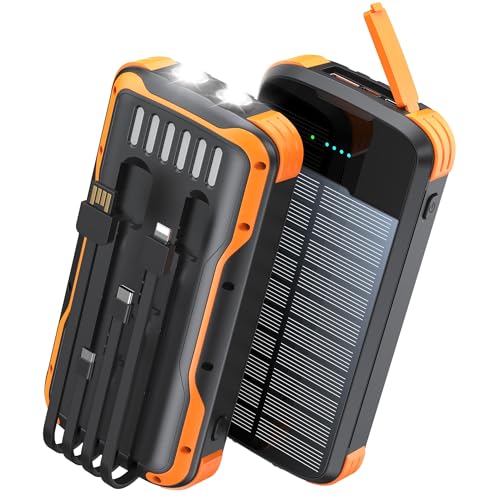
SOARAISE Solar Power Bank 48000mAh Wireless Portable Charger with 4 Cables
Functionally similar to the BLASOUL in capacity and cable count, but priced twenty dollars higher at $59.99. Owners cite solid build quality and consistent fast-charging behavior. The wireless pad is a genuine convenience when your hands are occupied or it is dark.
- Pro: Premium-feeling housing and port placement resist damage from being tossed in a pack.
- Pro: Supports USB-C input, so you can recharge it from a car adapter or wall outlet quickly.
- Con: The price-to-capacity ratio is worse than the BLASOUL, and the solar panel still serves mainly as a trickle-maintenance feature.
Skip it if the BLASOUL is in stock and you do not care about the slightly more refined enclosure. Buy it if you want the peace of mind of a sturdier build.
Luvknit Solar Charger Power Bank 20000mAh, Wireless Fast Charging Battery Pack with 3 Built-in Cables & USB-C Input
For $15.99, this is the cheapest meaningful option on the list. Twenty thousand milliamp-hours is enough for several phone charges, and three built-in cables plus USB-C input make it functional out of the box. Dual LED flashlights add a layer of utility during a blackout.
- Pro: Lowest price with wireless fast charging, making it a viable gift or extra unit for a second phone.
- Pro: Built-in flashlights are genuinely bright and useful when power is out at night.
- Con: Owners note the 20000mAh rating may be optimistic, with real-world phone charges closer to three or four.
Skip it if you are equipping a household of three or more. For a solo prepper or a backup unit for a child’s device, it is hard to beat at this price.
Solar Charger Power Bank – 49800mAh QC3.0 Fast Charging Portable Charger
Same raw capacity as the BLASOUL but at $22.98, this is the best price-per-milliamp-hour in the group. QC3.0 fast charging means compatible Android phones get high-watt output, though iPhone users will not see the same speed boost without a USB-C PD protocol.
- Pro: Roughly $22 for 50,000mAh is exceptional value for a single device that can sustain a household phone rotation during a prolonged outage.
- Pro: QC3.0 output is among the fastest wired protocols available at any price point here.
- Con: No built-in cables and no wireless charging, so you must carry your own connectors.
Skip it if you lose cables easily or if everyone in your household uses iPhones. Buy it if you want maximum stored energy for the least money.
SOXONO Solar Power Bank 40000mAh PD20W Fast Charging Portable Solar Charger
This unit targets the iPhone and modern USB-C Android niche specifically. Twenty-watt Power Delivery means an iPhone 15 or 16 gets a true fast charge, and 40,000mAh provides roughly eight to ten phone fills depending on the model. No wireless pad here, but the wired output is excellent.
- Pro: PD20W is the sweet spot for current-generation iPhones and most flagships, delivering noticeably faster top-ups than 5W alternatives.
- Pro: Owners report reliable capacity and consistent output over repeated cycles.
- Con: No built-in cables, so a dead phone and a missing Lightning or USB-C cord render the unit useless in a pinch.
Skip it if you need a grab-and-go option for multiple device types. Choose it if your household standardizes on USB-C PD-compatible phones.
YELOMIN 38800mAh Solar Power Bank, Portable Charger USB-C Fast Charging Compatible with iPhone Samsung
At $17.99 with 38,800mAh, this sits in a strong value position. USB-C fast charging covers modern devices, and three output options let you run phones, earbuds, or small electronics simultaneously. Dual LED flashlights round out the emergency feature set.
- Pro: Three separate outputs let a family charge different devices at the same time without a hub.
- Pro: Compact and relatively light for its capacity class.
- Con: The solar panel is decorative in practice; owners confirm it contributes negligible real-world recharge speed.
Skip it if you expect the solar panel to be a primary charging method. Buy it for the combination of capacity, multi-device output, and flashlight in an affordable package.
Solar Power Bank 20000mAh with 4 Panels
The four-panel design is the distinguishing feature here. More surface area means more energy harvested when the sun is available, making this the most serious attempt at functional solar recharging in the group. Twenty thousand mAh is a moderate capacity but pairs well with the panel advantage.
- Pro: Four panels fold out for maximum sun exposure, and owners report meaningfully faster solar top-ups compared to single-panel units.
- Pro: Folds flat for storage or packs into a backpack without dangling a rigid panel.
- Con: 20000mAh is the second-lowest capacity here, and the bulkier panel assembly adds weight and fragility concerns.
Skip it if your primary use case is pre-charged stored energy (wall-outlet recharge, use during an outage). Buy it if you are genuinely off-grid and need the panel to replenish the battery between uses.
Buying Guide
Capacity vs. Reality
Battery capacity is the number that determines how many phone charges you get. Most modern smartphones have 4,000 to 5,000mAh batteries. A 10,000mAh power bank provides roughly one to one-and-a-half charges. A 49,800mAh unit provides eight to ten. However, conversion inefficiency means real-world output is typically 60 to 70 percent of the rated capacity. Treat manufacturer numbers as ceiling values, and budget conservatively when planning for an extended outage.
Solar Panel: Supplement or Source?
Across all eight products, owner feedback is consistent: the solar panel is a trickle-maintenance feature, not a primary charging method. A 50,000mAh unit with a single built-in panel may take four to seven days of direct sun to refill from empty. The four-panel option improves on this but does not eliminate the physics problem. Plan to recharge via a wall outlet or car adapter before a storm hits, and use solar only for extending the run time on day three or four of an outage.
Output Speed and Cable Strategy
USB-C Power Delivery at 20W or higher is the standard for modern fast charging. QC3.0 works well on Android but not on iPhones. Wireless charging is convenient but always slower than a wired connection. Built-in cables solve the problem of forgetting a connector when you need it most. If you buy a unit without integrated cables, tape a short USB-C and a short Lightning cable to the battery pack and store it in your go-bag so you are not searching in the dark.
Our Verdict
Top pick: the BLASOUL 49,800mAh unit. It offers the highest capacity in the group, four built-in cables, wireless output, 22.5W fast charging, and a price of $39.99 that undercuts the more expensive SOARAISE while matching it on nearly every spec. For most households preparing for storm season, it is the single most capable solar powered phone charger you can buy at this price.
Budget pick: the Luvknit 20,000mAh at $15.99. It will not power a family through a week-long outage, but for one person wanting to ensure their phone survives a night without electricity, it is the lowest entry point that still includes wireless charging and flashlights.
The condition where another product wins: if you are genuinely living off-grid and intend to recharge the unit from the panel between uses, the 20,000mAh four-panel model is the only option in this list where the solar component contributes meaningfully rather than performatively.
FAQ
Do solar powered phone chargers actually work?
They work as battery storage that you can top up in sunlight, but the solar panel alone cannot recharge a large capacity in any reasonable timeframe. Use the panel for maintenance between storms and rely on a wall or car outlet for full recharges.
How many charges does 49,800mAh provide?
Expect approximately eight to ten full charges for a modern smartphone, accounting for the typical 30 to 40 percent energy loss during conversion. A smaller phone with a 3,000mAh battery may get closer to twelve.
Can I use a solar power bank while it is charging from the sun?
Most models in this category do not support pass-through charging from solar input. You would need to let the panel top it up during the day and use the stored energy at night.
How should I store a solar power bank for an emergency?
Keep it at roughly 50 to 70 percent charge, stored indoors at room temperature, and run a full charge cycle every three to four months to maintain cell health. Tape the cables or confirm the built-in connectors are accessible before you ever need them in the dark.