Key takeaways
- Pros: Clear Renogy documentation and support; reliable LED status readout for basic monitoring.
- Con: 10A ceiling limits expansion headroom for anyone planning a larger array.
A storm knocks your power out, and your backup system is only as reliable as its weakest link. In most off-grid and emergency solar setups, that weak link is the charge controller. It regulates how much current flows from your panels into your battery bank, and a mismatch between your panel voltage and the controller’s input rating can destroy a battery in days. Worse, cheap units that cannot properly read your battery chemistry will undercharge lead-acid or overcharge lithium, both of which shorten service life dramatically.
The good news is that solar charger controller options in 2026 span a wide range of prices and capabilities, and the differences between them are well documented in published specifications and owner reviews. What separates a reliable unit from a risky one comes down to three things: correct amperage headroom for your panels, appropriate regulation type (PWM versus MPPT) for your voltage spread, and firmware profiles that match your specific battery chemistry. The eight products below represent the best options we found across those criteria.
Our top picks


![[Upgraded] 30A PWM Solar Charge Controller with Auto Parameter LCD Display](https://m.media-amazon.com/images/I/41opvkWthjL._SL500_.jpg)


As an Amazon Associate we earn from qualifying purchases at no extra cost to you.
Quick Picks
| Product | Best for | Price |
|---|---|---|
| Renogy Wanderer 10A PWM | Small 12V systems under 150W | $24.99 |
| Victron SmartSolar MPPT 50A | Large 12/24V off-grid banks | n/a |
| 30A PWM with USB and LCD | Budget multi-device charging | $8.99 |
| Renogy Wanderer Li 30A PWM | LiFePO4-specific 12V setups | $32.99 |
| [Upgraded] 30A PWM LCD | Value upgrade over basic 30A units | $9.99 |
| Upgraded 100A MPPT | 24/36/48V systems on a budget | $45.99 |
| Victron SmartSolar 30A Bluetooth | Premium mid-range monitoring | n/a |
| PWM 20A for LiFePO4 | Simple lithium 12V emergency kits | $19.99 |
How We Picked
We narrowed this list using four criteria drawn from published specs and aggregated owner feedback: rated amperage matched to realistic panel output, regulation efficiency where panel voltage exceeds battery voltage, explicit battery chemistry profiles (lithium versus lead-acid), and build quality indicators like LCD accuracy and heat management. Products without clear chemistry documentation or with widespread complaints about display reliability were excluded.
The 8 Best Solar Charger Controller in 2026
Renogy Wanderer 10A PWM
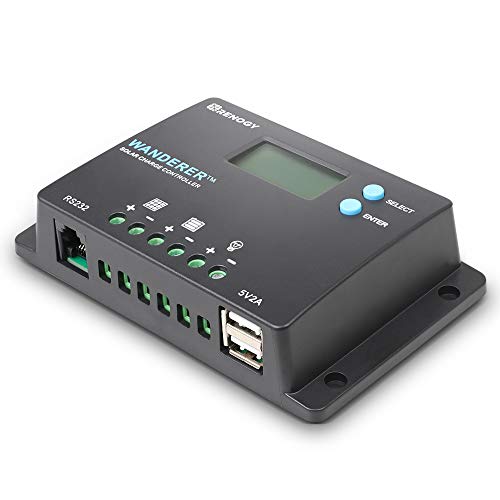
This is the go-to entry point for anyone running a single 100-watt or smaller panel into a 12V battery. The PWM regulation is efficient enough when panel voltage closely matches battery voltage, which is common on compact setups. Renogy’s reputation for documentation and support is a genuine advantage over no-name alternatives at this price. Owners consistently praise the straightforward wiring and the LED indicators that make status checks easy without pulling out a multimeter. The 10A rating, however, caps your panel array at roughly 120 watts on 12V, so anyone planning to expand later will outgrow it fast. Skip this if your total panel wattage exceeds 150 or if you are pairing it with a high-voltage panel through long cable runs.
- Pros: Clear Renogy documentation and support; reliable LED status readout for basic monitoring.
- Con: 10A ceiling limits expansion headroom for anyone planning a larger array.
Victron Energy SmartSolar MPPT 100V 50A
For anyone building a serious 12V or 24V system with multiple panels and a large battery bank, this unit delivers the kind of MPPT conversion efficiency that PWM simply cannot match when panel voltage sits well above battery voltage. Victron’s app lets you monitor and adjust settings wirelessly, a feature owners of smaller systems often say is overkill but that becomes indispensable once you have more than one unit or a complex bank. The price is steep relative to budget PWM options, and it is unavailable for direct comparison at any listed price in this roundup. Skip this if your system is under 200W or if your panel voltage does not meaningfully exceed your battery voltage, because the efficiency gain over PWM shrinks to marginal.
- Pros: High-efficiency MPPT conversion; Bluetooth app monitoring and firmware updates.
- Con: Significant price premium over PWM units with no listed price for direct comparison.
30A PWM Solar Charge Controller with USB and LCD
At under nine dollars, this unit offers a 30A rating, an LCD screen, dual USB outputs, timer settings, and adjustable load modes. For a storm kit where you need to charge phones or run small DC loads alongside battery replenishment, that feature set is hard to beat on paper. Owner feedback highlights the display brightness and the convenience of integrated USB, though several note the USB ports are limited to low current and not suitable for fast charging. The LCD quality and parameter accuracy vary between units in ways that make it less reliable for precise tuning. Skip this if you need calibrated voltage readings or if you are pairing lithium batteries that demand strict charge-profile accuracy.
- Pros: Unbeatable feature list for under nine dollars; integrated USB and timer functions.
- Con: LCD accuracy and parameter precision vary between units per owner reports.
Renogy Wanderer Li 30A PWM
This is the 12V lithium-specific version of Renogy’s Wanderer line, and the chemistry profile is the whole reason it exists. LiFePO4 batteries require a charge voltage window that differs meaningfully from lead-acid, and using a generic controller risks undercharging the cells or triggering protection cutoffs repeatedly. Renogy addresses this with dedicated lithium firmware, which owners confirm eliminates the cycling issues that plague mismatched setups. The 30A rating supports up to roughly 390 watts of panel input on 12V. The limitation is that it is 12V only, so anyone running 24V systems must look elsewhere. Skip this if your bank is lead-acid (you are paying for profiles you will not use) or if you need 24V operation.
- Pros: Dedicated LiFePO4 charge profiles eliminate common lithium mismatch problems.
- Con: 12V-only restriction rules out 24V or higher bank configurations.
[Upgraded] 30A PWM with Auto Parameter LCD
Sitting at $9.99, this unit is functionally similar to the $8.99 option above but with auto-parameter detection that reduces manual configuration errors. Owners report the auto-detection works reliably for standard lead-acid setups, though some note it occasionally misreads voltage on panels with very open-circuit values near the upper range. The LCD gives you real-time charging status without guesswork, and the 30A rating handles typical small-to-mid arrays. Where it falls short is long-term durability feedback; a subset of owners report display failures after a year of outdoor exposure. Skip this if your system lives in a damp or high-UV environment without an enclosure, or if you need verified lithium charge profiles.
- Pros: Auto-parameter detection simplifies setup for lead-acid beginners.
- Con: Outdoor durability feedback is mixed, with some display failure reports.
Upgraded 100A MPPT 12/24/36/48V
For larger banks at 24V, 36V, or 48V, MPPT efficiency matters enormously, and at $45.99 this unit undercuts premium brands by a wide margin. The 100A rating and 100V input support substantial panel arrays, and the multi-voltage compatibility makes it versatile for expansion. Owners praise the value proposition, though some note the build quality and software interface are noticeably below Victron’s level, with less granular monitoring data. The LCD provides essential readings but lacks the app ecosystem that makes Victron units so convenient for tuning. Skip this if you need detailed historical logging, remote firmware updates, or if your budget allows the premium option and you value long-term support.
- Pros: 100A MPPT at a fraction of premium-brand pricing; wide voltage compatibility.
- Con: Monitoring and software depth are basic compared to established MPPT brands.
Victron SmartSolar 100V 30A Bluetooth
This is Victron’s mid-range controller, and it occupies the sweet spot between affordability and feature depth for 12/24V systems in the 200 to 400 watt range. The Bluetooth interface lets you configure charge curves, update firmware, and monitor real-time data from a phone, which owners say is transformative for systems you cannot access easily (roof-mounted arrays, vehicle setups). The 30A rating and 100V input give generous headroom without oversizing. The price is not listed here, but it sits well below the 50A sibling. Skip this if your array is small enough that PWM handles it efficiently, because the premium over a $25 PWM unit will not pay for itself in energy harvest.
- Pros: Bluetooth monitoring and firmware updates; excellent charge curve flexibility.
- Con: Price premium is hard to justify for very small or voltage-matched systems.
PWM 12V 20A for LiFePO4
At $19.99, this is the most affordable dedicated lithium option on the list. The 20A rating suits panels up to roughly 260 watts on 12V, and the LiFePO4 profile is appropriate for the growing number of emergency kits built around these cells. Owners appreciate the compact size and the straightforward wiring, making it a solid choice for a car or small van setup. The limitation is that 20A is a ceiling you hit faster than on a 30A unit, and the feature set is minimal (no USB, no timer). Skip this if your panel array might exceed 250 watts or if you want load-management features beyond basic battery charging.
- Pros: Lowest price for a dedicated LiFePO4 profile; compact and simple to wire.
- Con: 20A rating limits panel input headroom compared to 30A alternatives.
Buying Guide
PWM vs. MPPT: When Each Makes Sense
PWM (pulse-width modulation) controllers pass current from panel to battery at whatever voltage the panel produces, which means they work best when your panel’s operating voltage sits close to your battery’s charge voltage. On a 12V system with a 100W panel that has an open-circuit voltage near 18-20V, a PWM unit wastes very little energy. MPPT (maximum power point tracking) converts excess voltage into extra current, harvesting 20-30% more power when panel voltage significantly exceeds battery voltage. If your panels total 40V or more and you are charging a 12V battery, MPPT pays for itself in increased harvest. For 24V and 48V systems, MPPT is almost always the right call.
Matching Amperage and Voltage Ratings
Never size a controller by panel wattage alone. Calculate the short-circuit current (Isc) of your full array and add a 25% safety margin. A 10A controller with a 12A array can overheat or fail during cold-weather peaks when panel current rises above rated values. Equally critical is input voltage: a 100V controller handles series strings of three panels in cold conditions, but a 30V controller will trip or burn if your array’s open-circuit voltage exceeds its limit on a winter morning. Always check Voc with a temperature coefficient adjustment, not just the nominal rating.
Battery Chemistry Profiles Matter
Lead-acid, AGM, gel, and lithium each require different absorption voltages and cutoff thresholds. Using a lead-acid profile on LiFePO4 cells means the controller may not push voltage high enough to fully charge them, or may hold float voltage too high and stress the cells. Dedicated lithium profiles (like those on Renogy Wanderer Li or the 20A PWM) set absorption at the correct 14.2-14.6V range for LiFePO4 and skip float entirely, since lithium batteries do not benefit from it. If your emergency kit uses lithium cells, do not use a generic controller without a lithium-specific mode.
Our Verdict
The Victron SmartSolar 100V 30A Bluetooth is the best overall solar charger controller for most homeowners and preppers who want reliable MPPT efficiency, wireless monitoring, and long-term software support without oversizing their budget. For those building a minimal 12V storm kit on a tight budget, the 30A PWM with USB and LCD at $8.99 delivers a complete feature set that handles phone charging and basic battery regulation without compromise on cost. One exception worth noting: if you are running a 48V system and cannot justify premium-brand pricing, the Upgraded 100A MPPT at $45.99 is the only viable value option on this list that covers higher voltages with real MPPT efficiency.
FAQ
Can I use any solar charger controller with any battery type?
No. Lead-acid, AGM, gel, and lithium chemistries all require different charge voltages and cutoff points. Using a mismatched profile can undercharge cells (reducing usable capacity) or overcharge them (causing damage or safety shutoffs). Always verify your controller supports the specific chemistry you are using, or select a model with adjustable voltage thresholds you can set to manufacturer recommendations.
What happens if my solar charger controller is undersized?
An undersized controller will either trip its overcurrent protection and stop charging intermittently, or it will operate outside its thermal limits and degrade components over time. In the worst case, a controller rated for too low an input voltage can fail catastrophically when panel open-circuit voltage spikes on a cold, clear morning.
Do PWM controllers need less panel wattage than MPPT?
Not exactly. A PWM controller limits panel voltage to battery voltage, which means some panel wattage is effectively wasted if the panel’s operating voltage is much higher than the battery’s charge voltage. You can connect the same panel wattage to either type, but an MPPT unit will harvest more of that rated power in real-world conditions.
How many solar charger controllers do I need for a multi-array setup?
One properly sized controller can handle multiple panels wired in series or parallel as long as the combined voltage and current stay within its ratings. You only need multiple controllers if you have separate arrays with different orientations, different battery banks, or voltage ranges that exceed a single unit’s input window.