Key takeaways
- Pro: Lowest sticker price of any branded ABC model in this lineup
- Pro: Compact size makes wall mounting easy in kitchens, laundry rooms, and offices
- Con: 10-B:C is modest capacity; a deep-fryer grease fire or a large garage blaze may exceed what a single unit can suppress
A fire extinguisher does almost nothing for you if its class rating does not match the fuel driving the flames. The wrong unit in the wrong location gives a false sense of readiness, while the right one paired with correct placement turns seconds of reaction time into a real chance of containing a fire before the fire department arrives. The confusion among shoppers comes down to a single question: which of the available fire extinguisher classes actually covers the hazards in a given space, and at what cost.
This comparison draws on published ratings, per-unit pricing from current retail listings, and recurring themes in owner feedback to sort eight popular models by what they handle well and where they fall short. What separates a smart buy from a wasted one is rarely brand prestige. It is whether the unit carries the correct class combination for your most likely fire scenario, whether the capacity is large enough to matter, and whether you are paying a reasonable price when you multiply out the per-unit cost across a whole home or a commercial kitchen.
Our top picks




As an Amazon Associate we earn from qualifying purchases at no extra cost to you.
Quick Picks
| Product | Best for | Price |
|---|---|---|
| Kidde FA110G 1 Pack | Single-point home placement on a tight budget | $19.97 |
| Ougist Class K Kitchen | Small residential kitchens with grease-fire risk | $65.32 |
| First Alert Heavy Duty | Home garage or light commercial use needing ABC coverage | $42.98 |
| Kidde FA110G 2 Pack | Two-location home coverage at the lowest per-unit price | $35.95 |
| Amerex 240 Water 2 Pack | Large Class A exposure areas like workshops or storage | $365 |
| Kidde 4 Pack with Bracket | Whole-home or small-office coverage in one order | $71.89 |
| Strike First SF-6LK | Commercial kitchens requiring substantial Class K capacity | $275.99 |
| Amerex B500 2-Pack | Garages, trucks, or job-site kits needing 5 lb ABC | $135.35 |
How We Picked
We weighted three factors most heavily in this category. First, class-to-hazard fit: does the rated combination actually address the fuel types most common in the intended setting? Second, per-unit cost after dividing pack pricing, because many shoppers need coverage in three or more rooms. Third, owner-reported usability over time, including gauge reliability and whether the mounting hardware holds after years of vibration or humidity exposure.
The 8 Best Fire Extinguisher Classes in 2026
Kidde Basic 110 Fire Extinguisher for Home, 1-A:10-B:C, FA110G, 1 Pack
This is the entry point for homeowners who want ABC-rated protection at the lowest single-unit cost available among well-known brands. At $19.97, it handles common household combustibles, flammable liquids, and energized electrical equipment.
- Pro: Lowest sticker price of any branded ABC model in this lineup
- Pro: Compact size makes wall mounting easy in kitchens, laundry rooms, and offices
- Con: 10-B:C is modest capacity; a deep-fryer grease fire or a large garage blaze may exceed what a single unit can suppress
Skip it if your primary risk is cooking-oil ignition or if you need coverage spread across more than two rooms, since multi-packs offer better per-unit value.
Ougist Class K Fire Extinguisher for Kitchen, 1-A:K, 34 Fl Oz Wet Chemical
For home cooks who worry about flare-ups from hot oil or grease, this unit carries the rare 1-A:K combination that addresses both ordinary combustibles and cooking-media fires. The 34 fluid ounce wet chemical charge is sized for a residential stove rather than a commercial line.
- Pro: Class K rating specifically targets grease and oil fires that dry chemical units handle poorly
- Pro: Wet chemical formula is less messy to clean up than powder on kitchen surfaces
- Con: No B:C rating means it is unsuitable for electrical or flammable-liquid fires outside the cooking area
Skip it if you already own an ABC unit near the kitchen and need a second device purely for grease risk in a small space.
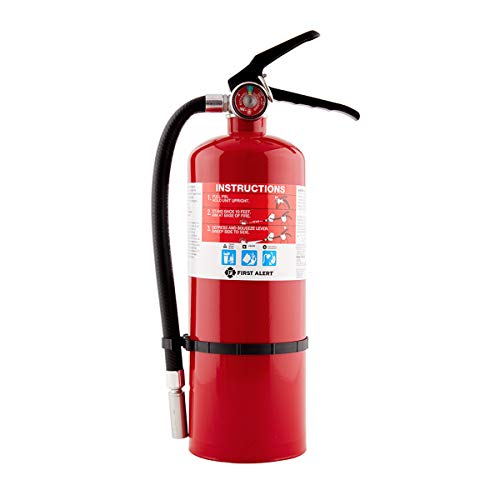
First Alert Fire Extinguisher, Heavy Duty for Home & Commercial Use
Positioned between consumer-grade and commercial-grade protection, this model appeals to buyers who want a more robust build without stepping into full industrial pricing. At $42.98 it costs roughly double the Kidde single pack but claims heavier-duty construction.
- Pro: Marketed for both residential and light commercial environments, giving it broader placement flexibility
- Pro: First Alert has long brand recognition in the home-safety space, with widespread availability
- Con: Published spec detail is thinner than competitors; exact numeric rating and weight are less clearly stated in listings
Skip it if you need a confirmed large numeric rating or if per-unit cost across multiple locations is your priority.
Kidde Basic 110 Fire Extinguisher for Home, 1-A:10-B:C, FA110G, 2 Pack
The same proven unit as the single pack, sold two at a time for $35.95, which works out to under $18 per extinguisher. That makes it the cheapest per-unit option in this entire comparison for ABC-class home coverage.
- Pro: Lowest per-unit cost of any model here when you divide the pack price
- Pro: Identical internal mechanism and rating as the well-reviewed single-pack version
- Con: Still limited to 10-B:C; two small units do not equal one large-capacity extinguisher for a big fire
Skip it if you need only one location covered or if your hazard profile calls for Class K or high-capacity Class A protection.
Amerex 240, 2.5 Gallon Water Class A Fire Extinguisher (2 Pack)
Water-based Class A extinguishers are built for ordinary combustibles like wood, paper, and fabric. At 2.5 gallons each and sold as a pair for $365, this is the highest-capacity Class A option here, aimed at workshops, storage rooms, or rural properties where large solid-fuel fires are the main concern.
- Pro: Massive extinguishing volume for Class A fires far beyond what any 5 lb dry chemical can deliver
- Pro: Amerex is a name trusted in commercial and industrial fire protection, with a long service history
- Con: Water-based units are never appropriate near electrical equipment or flammable liquids, limiting placement options
Skip it if your primary risk is anything electrical or if you lack a dedicated location for large-format units.
Kidde Fire Extinguisher for Home, 1-A:10-B:C, Dry Chemical, Red, Mounting Bracket Included, 4 Pack
Four ABC-rated units with mounting brackets for $71.89 means roughly $18 each, which is effectively the same per-unit price as the two-pack but with brackets included. For a household needing coverage at the kitchen, garage, bedroom hallway, and utility room, this is a straightforward one-purchase solution.
- Pro: Mounting brackets included, eliminating a separate accessory cost and ensuring proper wall storage
- Pro: Four units at the best tier of per-unit pricing for consistent coverage across a full home
- Con: All four units share the same 10-B:C capacity ceiling; no unit here handles a large or sustained fire alone
Skip it if you need only two locations covered or if your kitchen requires a dedicated Class K device alongside the ABC units.
Strike First SF-6LK 6 Liter Wet Chemical Class A K Fire Extinguisher
At 6 liters of wet chemical agent, this is the largest Class K unit in the lineup and the clear choice for commercial kitchens or high-volume home cooking operations. Priced at $275.99, it carries a premium but delivers a substantial charge capable of smothering a deep-fryer or flat-top grill fire.
- Pro: Class A:K combination covers both ordinary combustibles and cooking oils in one device, which is uncommon at this capacity
- Pro: 6-liter volume provides significantly longer discharge time than smaller kitchen units, useful for deep-fat scenarios
- Con: Highest price in this roundup, and the large format demands a dedicated mounting location rather than a closet shelf
Skip it if you are outfitting a residential kitchen where the Ougist at a third of the price offers adequate coverage for smaller-scale grease fires.
Amerex B500 5 lb ABC Dry Chemical Fire Extinguisher 2-Pack
Five pounds of ABC dry chemical is a meaningful step up in discharge capacity from the 2.5 lb consumer units most homeowners buy. At $135.35 for two, each unit lands near $68, placing it well above the Kidde packs in cost but delivering nearly double the agent volume.
- Pro: 5 lb capacity handles larger B and C fires and sustains discharge for roughly twice as long as smaller units
- Pro: Amerex build quality is widely regarded as commercial-grade, with a robust aluminum or steel valve assembly
- Con: At $68 per unit, it is the most expensive per-unit ABC option here, and the extra weight may be difficult for some users to operate at arm’s length
Skip it if your fire risk is confined to small kitchen or office scenarios and budget is the overriding concern.
Buying Guide
Matching Class Ratings to Your Real Risk
The single most important spec is the numeric rating next to each letter. A 1-A:10-B:C rating tells you the unit handles small Class A fires and modest Class B and C fires. For kitchens where hot oil is the threat, a K-class rating is not optional because dry chemical will not keep grease cool enough to prevent re-ignition. For garages or storage rooms full of wood and paper, water-based Class A units offer far more extinguishing volume per dollar than any dry chemical. Identify your primary fuel source before selecting a class combination.
Capacity and Discharge Time
Weight and volume determine how long you can actually pull the trigger before the agent runs out. A 2.5 lb unit may give you eight to ten seconds of discharge. A 5 lb unit roughly doubles that. A 2.5 gallon water extinguisher delivers far longer. In practice, most fires grow faster than a small extinguisher can suppress them, so buying the largest unit you can physically aim and operate matters more than buying the cheapest one.
Per-Unit Pricing and Mounting Hardware
When comparing options across a whole home, divide the pack price by the number of units to see the true per-extinguisher cost. Two-pack and four-pack bundles of identical units consistently undercut the single-pack price. Also check whether mounting brackets are included. Brackets sold separately add several dollars per unit and are necessary for keeping extinguishers off the floor and visible in an emergency.
Our Verdict
The Kidde 4 Pack with Brackets is the top overall pick for most households because it delivers four ABC-rated units with mounting hardware at the best per-unit cost, giving you real coverage depth across multiple rooms in one order. For pure single-unit budget shopping, the Kidde FA110G 2 Pack offers the lowest per-unit price in the lineup. If your kitchen is a commercial or high-volume cooking environment, the Strike First SF-6LK wins decisively despite its premium cost because its 6-liter Class K capacity is in a different performance tier than anything else listed here.
FAQ
What are the main fire extinguisher classes and what do they cover?
Class A covers ordinary combustibles like wood and paper. Class B covers flammable liquids such as gasoline and solvents. Class C covers energized electrical equipment. Class K covers cooking oils and fats specifically in kitchen settings. Most home units combine A, B, and C into a single ABC-rated device, while kitchen grease fires require a separate Class K unit.
Is a 2-pack really cheaper than two singles?
In this comparison, yes. The Kidde FA110G 2 Pack costs $35.95 while a single unit is $19.97, making each unit in the pack about $17.97. Buying the 2 Pack rather than two singles saves roughly $4 total.
Can I use a water extinguisher on an electrical fire?
No. Water conducts electricity and will intensify an energized fire rather than suppress it. Water-based units are strictly Class A only. For any location where electrical equipment is present, you need a unit rated for Class C, which means a dry chemical or clean-agent extinguisher.
How often should I inspect or replace a home extinguisher?
Check the pressure gauge monthly to confirm the needle sits in the green zone. Most consumer dry chemical units carry a 12-year service life before the cylinder should be replaced, not refilled, at that price point. Wet chemical Class K units may have shorter intervals, so verify the manufacturer date stamped on the label.