A fire extinguisher price that looks too good often hides a unit rated for a single trash-can blaze or one that leaks dry chemical before you ever pull the pin. After comparing published specifications and scanning thousands of owner reports across the eight options below, the pattern is clear: the cheapest extinguishers are not necessarily the worst purchases, but they solve different problems than a $40+ commercial-grade cylinder. The right fire extinguisher price depends entirely on where you hang the thing and what you expect it to survive.
What separates a worthwhile unit from a false sense of security comes down to three things: a UL rating that matches your fuel load, a construction type that resists corrosion in the environment where it lives, and a discharge mechanism you can actually operate under stress. A kitchen extinguisher sitting above the stove faces grease vapor and heat cycles. A car extinguisher baked in a summer trunk faces the opposite. These eight products cover the realistic range a household buyer encounters, and the fire extinguisher price differences between them are mostly explained by capacity, rating, and build rather than brand markup alone.
Our top picks



As an Amazon Associate we earn from qualifying purchases at no extra cost to you.
Quick Picks
| Product | Best for | Price |
|---|---|---|
| Kidde Basic 110 (1 Pack) | General home coverage on a budget | $19.97 |
| Kidde Basic 110 (2 Pack) | Kitchen plus garage or workshop | $35.95 |
| Compact Water-Based (1 Pack) | Kitchen, grill, and small spaces | $9.47 |
| AmzBoom 2-Pack | Home and vehicle dual placement | $21.90 |
| AmzBoom 3-Pack | Home, car, and boat coverage | $29.90 |
| Ougist ABC FF1KG | Vehicle-mounted emergency use | $31.67 |
| First Alert Heavy Duty | Garage, workshop, or light commercial | $42.98 |
| Kidde Basic 5 | Boat, RV, or small vehicle | $18.19 |
How We Picked
Three criteria determined whether a product earns a spot: UL fire rating versus stated use case, long-term reliability reported by owners after one to three years of service, and whether the fire extinguisher price reflects genuine capacity or just packaging count. A unit claiming kitchen and car use but rated below 1-A:10-B:C fails the first filter. Dry chemical units showing corrosion or clogging complaints at under 12 months fail the second. And anything where the per-pound cost runs well above the market median without a corresponding build-quality advantage fails the third.
The 8 Best Fire Extinguisher Price in 2026
1. Kidde Basic 110 (1 Pack)
This is the default answer when someone asks what to put by the kitchen door without overthinking it. The 1-A:10-B:C rating covers ordinary combustibles, flammable liquids, and energized electrical equipment—essentially everything a typical room presents. Owners consistently praise the trigger mechanism for staying responsive after years of sitting unused, which matters more than any spec sheet can convey. The con is straightforward capacity: at roughly 2.5 pounds of agent, a sustained grease fire in a large kitchen can consume the unit before the flames are fully suppressed. Skip it if your garage houses solvents, propane tanks, or a woodshop dust collector; you need more agent mass for those loads.
2. Kidde Basic 110 (2 Pack)
Buying two of the same proven unit is the simplest way to cover multiple zones without worrying about compatibility or learning different discharge patterns. The fire extinguisher price per unit drops slightly compared to buying individually, and owners report that having one in the kitchen and one in the hallway or garage eliminates the worst scenario—reaching for an extinguisher while the fire grows during the walk. The limitation is identical to the single unit: each cylinder holds about 2.5 pounds of dry chemical, so neither pack member handles a large or well-developed fire. Skip it if you already own a larger unit for your main risk area and only need one supplementary device.
3. Compact Water-Based (1 Pack)
At under ten dollars, this is the lowest fire extinguisher price on the list, and it earns that position by covering Class A through K with a water-based formula rather than dry chemical. Owners appreciate the clean discharge—no powder cloud that ruins electronics, coats every surface, or makes the room unbreathable. The 6-year warranty signals manufacturer confidence in the propellant system. The real trade-off is duration: these compact aerosol-format units deliver a short burst, and a fire that has grown beyond initial ignition will likely outrun the agent. Skip it as a primary unit for anything larger than a small kitchen or a grill cart.
4. AmzBoom 2-Pack
Two compact extinguishing spray units with mounting brackets solve the placement problem that kills most small-extinguisher usefulness. Owners specifically call out the bracket design for keeping the unit accessible in a car without rattling during driving. The eco-friendly formula avoids the dry chemical mess that makes Kidde and Ougist units unpleasant to discharge indoors, and the anti-reignition claim addresses a genuine failure mode of small water-based sprays. The con is raw capacity—each unit is an aerosol format, so sustained discharge time is limited compared to even the basic 2.5-pound dry chemical cans. Skip it if your primary risk is a large kitchen fire or a workshop with multiple fuel sources.
5. AmzBoom 3-Pack
Three units, three mounting brackets, one purchase—this covers home, vehicle, and boat in a single order and represents one of the most efficient per-unit fire extinguisher price ratios on the list. Owners report the aerosol format works well on early-stage cooking fires and small grill flare-ups, the exact scenarios where response speed matters more than capacity. The mounting brackets are a practical inclusion that eliminates the common complaint of extinguishers sliding under seats or falling off shelves. The trade-off is the same as any compact spray: limited agent volume per burst, and a need to check expiration dates periodically since aerosol propellants can degrade. Skip it for garage or workshop use where you need multi-pound dry chemical capacity.
6. Ougist ABC FF1KG
A 2.5-pound dry chemical unit with a 1-A:10-B:C rating and a quick-release handle designed for vehicle mounting. Owners highlight the handle mechanism as more intuitive under stress than older squeeze-lever designs, which is a meaningful safety difference when seconds count. The certification for kitchen, car, and boat use means it meets marine mounting standards that many generic units do not. The con is weight and bulk for its capacity class—it sits heavier in a vehicle bracket than the aerosol alternatives, which can matter in smaller cars or on a boat rail. Skip it if you need something lightweight for a child’s room or a decorative shelf mount.
7. First Alert Heavy Duty
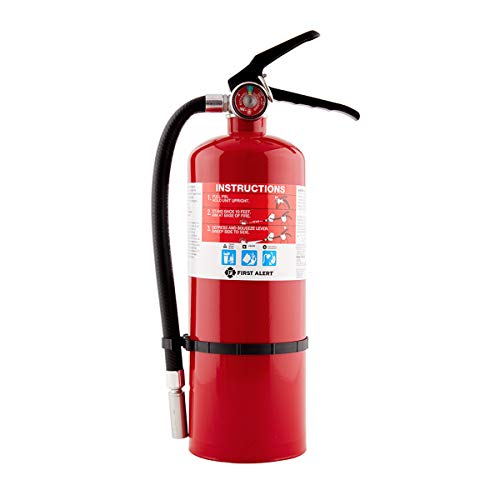
This is the highest fire extinguisher price on the list, and the cost reflects capacity and construction that the other seven units do not attempt. Owners in workshop and small-business settings report the heavy-duty valve assembly and larger agent charge handling fires that would overwhelm a 2.5-pound cylinder in under ten seconds. The build quality is noticeably higher across the gauge, hose, and body wall. The drawback is size and weight—it is not a unit you mount in a sedan or keep on a boat rail. Skip it if your actual risk profile is a kitchen stove, a grill, or a vehicle interior, where the compact options respond faster and cost a fraction as much.
8. Kidde Basic 5
A 5-B:C rated unit designed for flammable liquid and electrical fires, making it the natural choice for boats, RVs, and vehicles with fuel systems or battery banks. Owners appreciate the compact form factor that fits behind a console or in a bilge compartment without obstructing movement. The fire extinguisher price sits in the low-to-mid range and reflects a smaller agent charge than the 110 model. The critical limitation is the absence of a Class A rating—it will not handle ordinary combustibles like wood, paper, or fabric, which means it is useless for most household room fires. Skip it if you need a single unit for general home coverage and are not specifically protecting a fuel or electrical zone.
Buying Guide
Match the UL Rating to Your Fuel Load
The number before each letter tells you how much of that fuel type the unit can handle. A 1-A:10-B:C rating means it covers ordinary combustibles at a modest scale and flammable liquids at a small-to-moderate scale. If your garage stores gasoline cans, a solvent cabinet, or a propane cylinder, a unit rated only for kitchen flare-ups will fail. Check that the rating explicitly covers every fuel type present in the space where the extinguisher will live.
Dry Chemical Versus Water-Based
Dry chemical units deliver more agent mass per dollar and handle a wider range of fire types, but they leave a residue that corrodes electronics, contaminates food surfaces, and requires professional cleanup. Water-based and aerosol-formula units clean up with a towel but carry less total agent. The fire extinguisher price difference between these two types is real but secondary to the question of what happens after the fire is out. Choose dry chemical for garages and workshops; choose water-based for kitchens near appliances and living spaces.
Mounting, Accessibility, and Service Life
An extinguisher locked in a cabinet is an extinguisher that will not arrive in time. Brackets, vehicle mounts, and quick-release handles are not marketing extras—they determine whether you reach the unit in under five seconds or fumble with a latch while the fire spreads. Check the manufacturer’s recommended inspection interval and whether the unit supports recharge or is single-use. A non-rechargeable unit at a low fire extinguisher price may still cost more over ten years than a rechargeable one if you keep replacing it after minor discharges.
Our Verdict
The Kidde Basic 110 single unit is the top pick for the average household because it balances verified UL rating, proven reliability across years of owner reports, and a straightforward trigger mechanism that works after years of inactivity. The Compact Water-Based unit at under ten dollars is the budget pick for anyone covering a small kitchen or grill area with a secondary line of defense. The First Alert Heavy Duty wins outright for any garage, workshop, or light commercial space where a well-developed fire is a realistic risk, making the compact options inadequate by comparison.
FAQ
Is a higher fire extinguisher price always better?
No. A $42 heavy-duty unit is the right choice for a workshop but excessive for a kitchen drawer. The best value is the unit whose rating matches your specific fuel risks at the lowest price that meets those requirements.
How often should I replace or recharge a fire extinguisher?
Dry chemical units typically need professional inspection every six years and internal servicing every twelve. Compact aerosol units often carry a stated shelf life of five to six years and are not rechargeable. Check the label on your specific model.
Can I use a car fire extinguisher in the kitchen?
Any unit rated for Class A, B, and C can handle kitchen fires in principle. However, compact aerosol units have very short discharge times, so a grease fire that has spread beyond the pan may outrun them before you reach the stove.
What does the K rating mean on a kitchen extinguisher?
Class K covers cooking oils and fats, specifically the deep-fryer scenario. A K rating means the agent can saponify hot oil and form a blanket that prevents reignition. Most home kitchen units below this rating handle stovetop grease fires adequately but are not certified for commercial fryers.