Key takeaways
- Pro: Cost per unit is lower than buying singles, making it easy to maintain coverage in two rooms.
- Pro: Compact cylinder weighs little enough for most household members to handle without hesitation.
- Con: Mounting brackets are not included, so you need to budget for hardware or wall hooks.
A fire extinguisher is not something you want to be shopping for while smoke fills your kitchen. The decision needs to happen before the emergency, when you have time to think about ratings, placement, and whether one unit or six makes sense for your layout. Most buyers who search for a kidde fire extinguisher are not looking for exotic features — they want something that meets UL ratings for common household fires, fits a bracket near a stove or garage door, and does not surprise them with a corroded valve the one day it matters.
What separates a good purchase from a wasted one comes down to three things: the fire rating matching your actual risk profile, the quantity appropriate for your square footage and entry points, and whether you accept the trade-offs of dry chemical agents. A 1-A:10-B:C unit handles a grease fire or a small electrical blaze. A 3-A:40-B:C model is a different class of tool for a larger space. Buying a six-pack of basic units when you needed one full-home extinguisher is a common mistake, and vice versa.
Our top picks


As an Amazon Associate we earn from qualifying purchases at no extra cost to you.
Quick Picks
| Product | Best for | Price |
|---|---|---|
| Kidde Basic 110, 2 Pack | Apartment kitchens and small homes | $35.95 |
| Kidde Basic 110, 1 Pack | Single-point coverage on a tight budget | $19.97 |
| Kidde Basic 110, 6 Pack | Whole-home or multi-room placement | $107.84 |
| Kidde Dry Chemical, 4 Pack | Garage and workshop coverage with mounts | $71.89 |
| Kidde Full Home, 3-A:40-B:C | Larger homes needing higher fire ratings | $49.94 |
| Kidde Kitchen + Home Set | Kitchen grease fires plus general home use | $39.97 |
| Kidde Auto 10 | Vehicle emergency kits | $20.96 |
| Kidde Pro 210 Commercial | Small commercial or home office spaces | $54.97 |
How We Picked
We compared published UL ratings, pack pricing per unit, agent type, and mounting options across the full Kidde lineup. Owner feedback on durability of seals over multi-year storage and ease of inspection was weighted alongside spec sheets. The criteria that matter most in this category are: whether the rating covers the fire classes you will realistically face, whether the quantity and price ratio makes sense for your layout, and whether the physical design supports quick grab-and-go under stress rather than fumbling with a stiff pull pin.
The 8 Best Kidde Fire Extinguisher in 2026
Kidde Basic 110, 2 Pack, FA110G
This pair is the most practical entry point for a two-zone home — one for the kitchen, one for the garage or laundry area. At roughly eighteen dollars per unit, it sits well below single-pack pricing without sacrificing the 1-A:10-B:C rating that covers ordinary combustibles, flammable liquids, and energized electrical equipment.
- Pro: Cost per unit is lower than buying singles, making it easy to maintain coverage in two rooms.
- Pro: Compact cylinder weighs little enough for most household members to handle without hesitation.
- Con: Mounting brackets are not included, so you need to budget for hardware or wall hooks.
Skip this if you need a higher total fire rating for a large open-plan space or a commercial setting.
Kidde Basic 110, 1 Pack, FA110G
The cheapest way to add a rated extinguisher to one specific location. For a studio apartment, a dorm room, or a single-room rental where code compliance or landlord requirements call for one unit, this is the obvious call. Under twenty dollars removes any hesitation about covering one zone.
- Pro: Lowest absolute cost in the lineup for a single point of protection.
- Pro: Same 1-A:10-B:C rating as the multipacks, so no spec compromise.
- Con: Per-unit price is the highest in the basic line; buying two singles costs more than the 2 Pack.
Skip this if you have more than one room to cover — the multipacks deliver better value.
Kidde Basic 110, 6 Pack, FA110G
A whole-home strategy in a single purchase. Six units at roughly eighteen dollars each lets you place one near every exit, in the kitchen, garage, and utility room. For homeowners who want to eliminate gaps in coverage without shopping per room, this is the volume play.
- Pro: Best per-unit pricing in the basic line, undercutting every smaller pack.
- Pro: Redundancy means a failed inspection on one unit does not leave a room unprotected.
- Con: Higher upfront cost and more storage space needed before mounting.
Skip this if you live in a small space where one or two units already cover all realistic scenarios.
Kidde Dry Chemical, 4 Pack, with Mounting Bracket
Four units with brackets included. This matters because mounting hardware is where buyers frequently under-budget — a loose extinguisher on a garage floor is useless. The 1-A:10-B:C rating matches the FA110G line, so this pack appeals to buyers who want the bracket convenience in one transaction for a four-zone setup like a kitchen, garage, workshop, and mudroom.
- Pro: Brackets included, saving the cost and time of sourcing compatible mounts separately.
- Pro: Four-pack price per unit is competitive with the six-pack basic, without the commitment to six cylinders.
- Con: Red color coding and bracket design may not suit visible indoor placement where a sleeker unit is preferred.
Skip this if you already own brackets or prefer the six-pack for lower per-unit cost across a larger footprint.
Kidde Full Home, 3-A:40-B:C, KD176-340ABC
Three times the Class A rating and four times the Class B rating of every basic unit in this roundup. This is the kidde fire extinguisher to buy when your home has high fuel loads — a wood stove, a detached garage full of stored materials, or a large open floor plan where a small extinguisher would be overwhelmed before you got close. Still a single unit, still dry chemical, still under fifty dollars.
- Pro: Fire rating far exceeds any basic model in this group, handling larger or faster-spreading fires.
- Pro: Reasonable weight for the capacity; owners report manageable two-handed operation.
- Con: Larger cylinder demands more mounting clearance and is harder to store in tight cabinets.
Skip this if your rooms are small and your realistic risk is a pan fire or an outlet overload — the basic line is sufficient and cheaper.
Kidde Kitchen + Home Fire Extinguisher Set, RESSP+FA110G
A two-unit set combining a kitchen-specific extinguisher (711A) with a standard FA110G for general rooms. The kitchen unit targets grease and cooking fires where a standard dry chemical model might not address the fuel source as effectively. For buyers who want purpose-matched tools without guessing between ratings, this set removes the decision.
- Pro: Two different extinguisher types for two different risk profiles in one purchase.
- Pro: Kitchen unit addresses the most common residential fire source with a targeted design.
- Con: Higher cost than buying two FA110G units, justified only if you value the differentiated kitchen response.
Skip this if your kitchen does not see high-heat frying or if you already own a dedicated grease-fire tool.
Kidde Auto 10, 10-B:C, M10G
Not a home extinguisher at all — this is a vehicle-specific unit rated for flammable liquids and electrical fires common in car emergencies. Smaller and lighter than household models, designed to be stored in a trunk or under a seat without shifting. The 10-B:C rating means it will not handle a Class A fire like burning upholstery or carpet effectively, so it is a specialist, not a replacement for a home unit.
- Pro: Compact enough for vehicle storage without occupying cargo space.
- Pro: Rated for the most likely vehicle fire scenario: fuel or electrical ignition.
- Con: No Class A rating means it cannot address ordinary combustibles like seat foam or dashboard plastics.
Skip this if you need an all-purpose extinguisher — pair it with a household unit rather than relying on it alone.
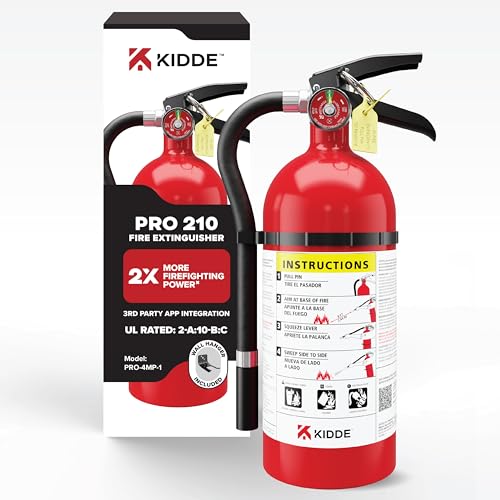
Kidde Pro 210 Commercial, 2-A:10-B:C, PRO-4MP-1
A step above the home line in both durability and fire rating. The 2-A:10-B:C rating sits between the basic FA110G and the full-home KD176. Commercial-rated units typically feature metal valve assemblies and corrosion-resistant finishes, which matter in garages, workshops, or small offices where an extinguisher sits idle for years and then must perform. At fifty-five dollars, it is the most expensive single unit here but the one built for the longest service life.
- Pro: Higher Class A rating than any basic model, with commercial-grade construction.
- Pro: Better suited to harsh or dusty environments where a standard home unit might degrade.
- Con: Heavier and bulkier than a household cylinder, making placement and quick handling harder for smaller-statured users.
Skip this if your need is purely residential with low fuel load — the basic line covers that adequately at half the cost.
Buying Guide
Understanding Fire Ratings
UL ratings on a kidde fire extinguisher use a number-letter combination. The Class A number (1, 2, or 3) indicates how much ordinary-combustible fire the unit can handle — higher means more water-equivalent extinguishing capacity. The Class B number (10 or 40) reflects coverage area in square feet for flammable liquid fires. If you cook with oil frequently, the difference between 10-B:C and 40-B:C is meaningful. Do not overspend on a 40-B:C rating for a garage where the only flammable liquid is a half-used can of paint.
Dry Chemical Agent Trade-offs
Every model in this roundup uses dry chemical agent. It works on all three fire classes, which is why it dominates the home market. The trade-off is residue: powder gets everywhere, coats surfaces, and can damage electronics if discharged near them. If your extinguisher sits next to a server rack or a home office setup, factor in cleanup cost. If it sits near a grill or in a detached garage, the residue concern is minimal.
Pack Strategy and Placement
Fire safety guidance recommends one extinguisher per floor near an exit and one in the kitchen. Count your floors, your garage, your workshop, and your vehicle — that gives you the number you actually need. Multipacks reduce per-unit cost, but only if you will mount and maintain every unit. A stored extinguisher in a closet is not the same as a mounted one at eye level near a door.
Our Verdict
For most homeowners, the Kidde Basic 110 2 Pack at $35.95 delivers the best balance of coverage and cost — two rated units, two zones covered, without the commitment of a six-pack. Budget pick: the single 1 Pack at $19.97 for anyone covering one room right now. If your home has a wood stove, a large garage, or an open floor plan where a small extinguisher would be outmatched, the Kidde Full Home 3-A:40-B:C at $49.94 is the one that changes the outcome.
FAQ
How often should I replace a Kidde fire extinguisher?
Kidde recommends replacing disposable units once the date on the label passes twelve years, or earlier if the gauge reads low or the seal shows damage. Inspect the pressure gauge monthly — a needle outside the green range means the unit is unreliable regardless of age.
Is a 1-A:10-B:C rating enough for a kitchen fire?
For a pan fire on a single burner, yes — it is the standard minimum recommended by fire safety guidance. If your cooking involves deep frying or high-volume oil use, a kitchen-specific unit like the 711A in the Kitchen + Home Set is more targeted to grease fires.
Can I use a car extinguisher at home?
The Auto 10 is rated 10-B:C with no Class A rating, so it cannot effectively address a wood, paper, or fabric fire. It belongs in a vehicle or as a supplement near fuel storage, not as your primary home unit.
Why do multipacks cost less per unit than singles?
Packaging, distribution, and retail handling costs are amortized across more units. The Kidde Basic 110 in a six-pack drops to roughly eighteen dollars per extinguisher versus nearly twenty for a single, making volume purchases the rational choice when you have the zones to cover.