Key takeaways
- Pro: Very affordable at $83.99, making protection accessible for single-station setups.
- Pro: Lightweight and compact — no floor space required.
- Con: Simulated sine wave output; active PFC power supplies in newer systems may not tolerate the waveform during a switchover event.
A power outage during a storm can corrupt files, damage hardware, and knock your router offline — which means your cloud backup, your smart home hub, and your work session all die at once. A battery backup for computer systems (formally called an uninterruptible power supply, or UPS) bridges that gap. Smaller units give you minutes to save work and shut down cleanly; larger ones keep a router and modem running through a brief outage.
The market is crowded, and the specs matter more than most buyers realize. Cheaper standby units switch to battery only after a momentary drop, which can crash sensitive equipment. Higher-end line-interactive models with AVR handle brownouts without draining the battery. Sinewave output is critical for active PFC power supplies found in most modern gaming and workstation builds. We compared the eight models below on published specifications, listed prices, and recurring themes in owner feedback to sort genuinely useful options from the ones that look impressive on paper but disappoint in daily use.
Our top picks



As an Amazon Associate we earn from qualifying purchases at no extra cost to you.
Quick Picks
| Product | Best For | Price |
|---|---|---|
| APC BE600M1 | Basic desktop shutdown protection | $83.99 |
| CyberPower CP1500PFCLCD | Active PFC systems, full sine wave | $239.95 |
| CyberPower ST425 | Lowest-cost surge + battery backup | $59.95 |
| APC BX1500M | Mid-range line-interactive with LCD | $189.99 |
| APC BE650G1 | PC + monitor combo on a budget | $109.99 |
| CyberPower EC850LCD | Eco-mode efficiency for light loads | $119.95 |
| APC BE425M | Router and small electronics only | $62.50 |
| CyberPower CP1500AVRLCD3 | Feature-rich tower with smart software | $199.95 |
How We Picked
We focused on four criteria: output waveform type (pure sine wave versus simulated), whether the unit includes automatic voltage regulation to handle brownouts without draining the battery, total wattage capacity relative to typical home office loads, and the ratio of battery-backed outlets to surge-only outlets. We also weighed owner-reported reliability and the quality of bundled shutdown software. A UPS that cannot cleanly communicate with your operating system during a long outage is just an expensive power strip.
The 8 Best Battery Backup for Computer in 2026
APC BE600M1
This entry-level standby UPS is the minimum viable option for anyone who wants their desktop to shut down gracefully during a blackout. At 600VA/330W, it can support a modest PC and monitor long enough for an orderly shutdown. The unit is compact enough to slide under a desk, and owner feedback consistently highlights its plug-and-play simplicity.
- Pro: Very affordable at $83.99, making protection accessible for single-station setups.
- Pro: Lightweight and compact — no floor space required.
- Con: Simulated sine wave output; active PFC power supplies in newer systems may not tolerate the waveform during a switchover event.
Skip this unit if your PC uses an active PFC supply above 400W or if you need runtime beyond a shutdown.
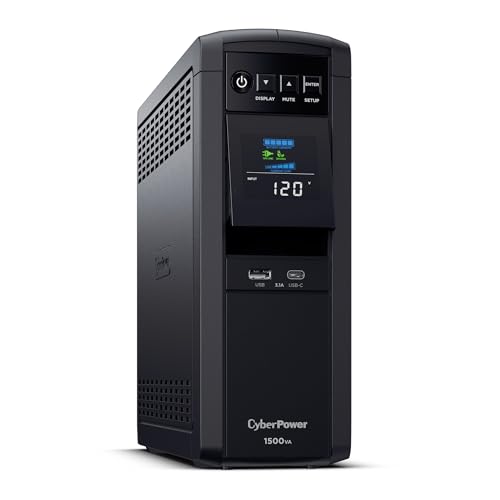
CyberPower CP1500PFCLCD
This is the go-to recommendation for workstation owners with active PFC power supplies. Its 1000W pure sine wave output means sensitive electronics never see a degraded waveform. With 12 outlets split between battery-backed and surge-only banks, you can protect the entire desk cluster. The mini tower form factor houses a larger battery than sub-1000VA units, and UL certification adds a layer of consumer safety assurance.
- Pro: Pure sine wave output compatible with virtually all modern PC power supplies.
- Pro: AVR corrects brownouts without using battery, extending battery life over the unit’s lifespan.
- Con: Heaviest and among the most expensive here at $239.95; overkill for a laptop-only setup.
Skip if your load is under 300W or you only need shutdown runtime for a single device.
CyberPower ST425
At $59.95, this standby UPS is the cheapest way to add battery-backed shutdown capability to a router, modem, or light desktop. The 425VA rating supports a small load for a few minutes — enough to trigger a clean shutdown. It is essentially a surge strip with a tiny battery, and that is exactly what some buyers need.
- Pro: Lowest price in this roundup; no reason to spend more for basic shutdown.
- Pro: Small enough to sit on a shelf beside your router without dominating the space.
- Con: Simulated sine wave and minimal capacity mean it is unsuitable for any mid-range or gaming PC.
Skip if you need more than 225W of capacity or if your equipment requires a clean waveform.
APC BX1500M
A strong middle option between the budget standby units and premium sine-wave towers. The BX1500M is line-interactive with AVR, so it corrects voltage sags and surges without switching to battery. The 1500VA/900W rating handles a full desktop, monitor, and peripherals. The LCD panel displays real-time load percentage and estimated runtime, which reduces guesswork during an event.
- Pro: AVR and line-interactive design protect battery health and extend its usable lifespan.
- Pro: LCD readout provides instant situational awareness without opening software.
- Con: Simulated sine wave output; owners with active PFC supplies report occasional compatibility issues during transfer.
Skip if your power supply is labeled active PFC and you want guaranteed waveform compatibility.
APC BE650G1
Positioned as a slightly beefier alternative to the BE600M1, this unit offers 650VA/390W — enough for a compact PC and a single monitor during a shutdown event. The “G” series includes basic surge protection on all outlets. At $109.99 it sits in a difficult spot: noticeably pricier than the BE600M1 while offering only a marginal capacity increase.
- Pro: Adequate wattage for a typical office PC and monitor combination.
- Pro: Trusted APC build quality and widely available replacement batteries.
- Con: Price premium over the BE600M1 is hard to justify for the single-model VA bump.
Skip unless your load consistently sits between 330W and 390W; otherwise the cheaper BE600M1 covers you.
CyberPower EC850LCD
The Ecologic line targets efficiency-conscious buyers. This standby UPS includes an LCD screen showing load and battery status, plus an eco-mode that cuts power to unused outlets when the primary device enters standby. The 850VA rating gives it a bit more headroom than the sub-500VA options while staying compact.
- Pro: Eco-mode reduces phantom power draw from idle peripherals, trimming your electric bill.
- Pro: Clear LCD panel eliminates the need for software just to check status.
- Con: Still a standby topology with simulated sine wave; brownouts will trigger battery use.
Skip if you need line-interactive AVR or sine wave output; this is a shutdown-only device.
APC BE425M
The most compact and affordable UPS in the APC lineup reviewed here. At 425VA/225W and $62.50, it is purpose-built for keeping a router and cable modem alive during short outages so you retain internet access. It can also handle a laptop on a desk for a graceful shutdown.
- Pro: Tiny footprint; fits behind a shelf or on a narrow media console.
- Pro: Reliable APC shutdown software compatible with Windows, macOS, and Linux.
- Con: Only 225W capacity — a desktop PC with a discrete GPU will overload it immediately.
Skip for any desktop load; this is a networking and small-electronics device.
CyberPower CP1500AVRLCD3
The third-generation CP1500AVRLCD3 is the intelligent upgrade pick. It retains line-interactive AVR with a 1500VA rating, adds a redesigned LCD panel, and ships with PowerPanel Business software that supports scheduled shutdowns, SNMP monitoring, and integration with virtualization platforms. For a small office or home lab that needs more than a single PC protected, the software ecosystem is the differentiator.
- Pro: Advanced software allows graceful shutdowns across multiple machines and network devices.
- Pro: Strong 1500VA/AVR combination handles brownouts without touching the battery.
- Con: Simulated sine wave output at this price point; the CP1500PFCLCD offers a true sine wave for roughly $40 more.
Skip if waveform purity is non-negotiable; pay the small premium for the PFCLCD model instead.
Buying Guide
Match the Waveform to Your Power Supply
Modern desktops and many workstations use active PFC power supplies. These supplies expect a clean sine wave on the AC input. Simulated (or stepped) sine wave output from budget standby UPS units can cause buzzing, premature component wear, or outright shutdown during a transfer event. If your power supply is labeled “active PFC” or “universal,” look for a unit explicitly stating pure sine wave output. For older supplies without PFC, a simulated wave is acceptable for short shutdown runtime.
Understand VA Versus Watts and Sizing Your Load
Every UPS in this roundup lists a VA rating and, in most cases, a watt rating. The watt number is what actually limits your connected equipment. A 600VA/330W unit cannot support a 400W PC regardless of the VA figure. Add up the nameplate or measured draw of everything you intend to plug into battery-backed outlets, then select a UPS whose watt rating exceeds that total by at least 20 percent. This margin prevents the unit from hitting overload during a startup surge and reduces stress on the inverter.
Line-Interactive and AVR Extend Battery Life
Standby UPS units switch to battery the instant input voltage drops below threshold. Line-interactive units with automatic voltage regulation boost or trim the incoming voltage using an internal transformer, reserving the battery for actual outages only. In regions with frequent brownouts, this distinction can double the effective battery lifespan because the cells cycle far less often. If your home experiences voltage sag during storms, AVR is not optional — it is the primary durability feature.
Our Verdict
The overall best battery backup for computer protection in this lineup is the CyberPower CP1500PFCLCD at $239.95. Its pure sine wave output, 1000W capacity, AVR, and 12-outlet layout cover virtually any home office load with margin to spare. For buyers on a strict budget who just need shutdown protection for a basic desktop, the APC BE600M1 at $83.99 delivers that core function without wasted features. If you already own an APC BX1500M or are drawn to its LCD and brand trust, it remains a capable alternative — just confirm your power supply tolerates simulated sine wave output before committing.
FAQ
Will a UPS protect my computer during a lightning strike?
A UPS with surge protection absorbs moderate voltage spikes and clips transient surges to a safe level. However, a direct lightning strike delivers energy far beyond what any consumer UPS can block. For serious storm protection, install a whole-home surge protector at the breaker panel and ensure your home grounding is intact. The UPS protects against induced surges and secondary spikes but is not a substitute for proper grounding.
How do I know if my power supply needs pure sine wave?
Check the label or specification sheet of your power supply for “active PFC” or “universal input.” If either term appears, pure sine wave output from the UPS is strongly recommended. Simulated wave output will often cause a high-pitched buzz from the supply’s components and, in some cases, an immediate shutoff during the transfer window. Units without PFC, common in low-end OEM desktops, do not require a sine wave.
How long will the battery actually last during an outage?
Runtime depends entirely on the wattage of your connected load relative to the UPS capacity. A 1000W unit carrying 200W of equipment might deliver 30 to 45 minutes; the same unit at 800W may last under 10 minutes. Manufacturers publish runtime curves on their spec sheets. If extended runtime matters, look for models with external battery pack compatibility or plan to size your UPS well above your actual draw.
Can a UPS keep my internet on during a power outage?
Yes, if your router and cable or fiber modem run on power from the UPS’s battery-backed outlets. Even a small 425VA unit like the APC BE425M can keep a typical router and modem combination online for 30 minutes or more. The critical factor is that your ISP’s signal reaches your home without powered repeaters that also go dark; in most cable and fiber deployments, the modem and router alone are sufficient to maintain an active connection.