Key takeaways
- Use outdoors only. Smokers produce carbon monoxide. Never use them in a garage, shed, tent, enclosed porch or any indoor space, even with the door open.
- Keep clearance. Place the smoker on a non-combustible, level surface and keep it away from walls, railings, eaves, overhanging branches and anything that can burn. Follow the clearance distances in the manual.
- Handle ash safely. Let ash cool fully and store it in a metal container with a lid before disposal.
- Use proper power. Plug into a grounded outdoor outlet, preferably GFCI protected. Use only an outdoor rated extension cord of the gauge the maker states, and keep cords off wet ground. If you are unsure about wiring, ask a licensed electrician.
- Keep a fire extinguisher nearby. A multipurpose extinguisher suited for grease fires should be within reach, and supervise the smoker while it is lit.
- Watch for storms. Cover or move the smoker away from high winds and lightning, and do not use it in heavy rain unless the maker allows. Keep pellets dry.
- Food safety. Use a probe thermometer and follow the safe internal temperatures given by food safety agencies.
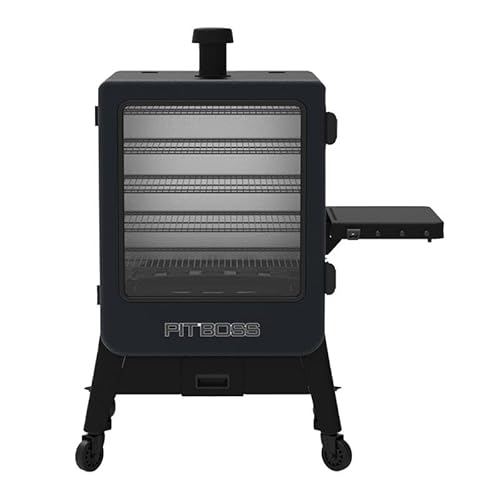
If you want set-and-forget smoking in a small footprint, a vertical pellet smoker is the right shape, and the best choice for most backyards is a mid-range cabinet model from a maker with a widely available parts and pellet supply, such as Pit Boss, Camp Chef or Louisiana Grills. Budget cabinets suit occasional cooks, while premium cabinets suit people who smoke weekly and want tighter temperature control and heavier steel.
Vertical pellet smokers stack racks inside an upright cabinet. A hopper feeds wood pellets to a fire pot, an electric controller keeps the temperature, and smoke rises through the racks. Compared with horizontal pellet grills, they use less ground space, carry more food by volume, and are less suited to searing. They also suit long cooks like brisket, ribs, pork shoulder, sausage and jerky.
Our top picks


As an Amazon Associate we earn from qualifying purchases at no extra cost to you.
Vertical Pellet Smokers at a Glance
Specifications change by model year, so treat these as the types of features each maker typically lists, and read the current spec sheet before buying.
| Model line | Best for | Stated features (typical) | Limits |
|---|---|---|---|
| Pit Boss vertical pellet smokers | Value-minded buyers wanting large cooking area | Multiple porcelain-coated or steel racks, digital controller, large hopper, window on some versions | Thinner steel on entry versions; controller quality varies by model |
| Camp Chef XXL Pro vertical pellet smoker | Cooks who want pellet convenience with a bigger frame | Maker lists a large capacity, digital controller and pellet-fed fire | Heavier and pricier than basic cabinets |
| Louisiana Grills vertical pellet smoker | Buyers who value a heavier build and cabinet door | Cabinet design with several racks, digital controller, meat probe on some versions | Fewer retail options in some regions |
| Dyna-Glo vertical pellet smoker | Budget buyers wanting a basic cabinet | Simple controller, several racks, front door | Controller and seal quality can vary; confirm which model you are getting |
| Masterbuilt and similar mid-range cabinets | Buyers already in a brand ecosystem | App or Wi-Fi control on select models, as listed by the maker | Model lines change often |
How Vertical Pellet Smokers Work
An auger moves pellets from the hopper to a fire pot where an electric igniter starts them. A fan feeds air, and the controller cycles the auger to hold your set temperature. Smoke and heat then rise past the racks. Many models have a drip tray or a heat baffle to spread heat and manage grease. Because the fire is in a separate chamber, the upper racks often cook a little differently from the lower ones, so rotating food or placing delicate cuts in the middle is common advice from pitmasters.
What to Look For
Cooking area and rack count
Makers usually list total cooking area in square inches and rack count. A large number is useful only if the racks space well for the food you cook. Check rack spacing for a whole turkey or a large brisket, and look at whether racks are removable for cleaning.
Temperature range and controller
Most pellet smokers list a range from low smoke temperatures up to a few hundred degrees. A digital controller with a meat probe port helps, and Wi-Fi apps are useful for long cooks. Independent reviewers often note that controllers on cheaper cabinets can swing more than premium ones, so look at reviewer notes on temperature stability.
Build quality and insulation
Thicker steel and a tight door seal keep temperatures steadier in cold or windy weather. Cheaper units can leak heat around the door, burning more pellets. Stainless steel interiors resist rust better than painted ones, but check the maker’s list of which parts are stainless.
Hopper size
A bigger hopper lets you run for many hours without refilling. Makers list hopper capacity in pounds. For overnight cooks, a larger hopper and a hopper-low alert, where fitted, are handy.
Pellet quality and storage
Use food-grade wood pellets made for cooking, not heating pellets. Damp pellets jam augers, so store them in a dry airtight container. Most makers say that mixing pellet brands is fine, but follow the manual.
Grease management
Grease is the main fire risk in any smoker. Clean the drip tray, fire pot and cabinet floor regularly, as the manual directs. Removable grease trays and a clear path for drainage save time.
Budget, Mid-Range and Premium Tiers
Budget: Basic cabinets from brands like Dyna-Glo or entry Pit Boss models. They are good for learning, but expect lighter steel, thinner doors and simpler controllers.
Mid-range: Larger Pit Boss, Louisiana Grills and Camp Chef models with heavier steel, better door seals and improved controllers. This tier suits most backyard cooks who smoke a few times a month.
Premium: Heavier insulated cabinets and commercial-style units, often with Wi-Fi control and multiple probes. They cost more, hold temperature better in cold weather, and suit regular smoking and catering for gatherings.
Pick X If You Are…
| If this is you | Pick | Why |
|---|---|---|
| New to smoking and watching the budget | Entry Pit Boss or Dyna-Glo cabinet | Low cost of entry, simple controls |
| Feeding a crowd regularly | Camp Chef XXL Pro or a large Pit Boss cabinet | Large cooking capacity listed by the maker |
| Smoking in cold or windy weather | Heavier, insulated or double-wall cabinet | Better heat retention, fewer pellets burned |
| Wanting app monitoring | Models with Wi-Fi control | Check temperature and alerts from indoors |
| Limited patio space | Compact vertical cabinet | Small footprint with several racks |
| Wanting to sear steaks | A hybrid pellet grill or separate grill | Vertical cabinets are designed for low and slow |
Safety, Placement and Care
- Use outdoors only. Smokers produce carbon monoxide. Never use them in a garage, shed, tent, enclosed porch or any indoor space, even with the door open.
- Keep clearance. Place the smoker on a non-combustible, level surface and keep it away from walls, railings, eaves, overhanging branches and anything that can burn. Follow the clearance distances in the manual.
- Handle ash safely. Let ash cool fully and store it in a metal container with a lid before disposal.
- Use proper power. Plug into a grounded outdoor outlet, preferably GFCI protected. Use only an outdoor rated extension cord of the gauge the maker states, and keep cords off wet ground. If you are unsure about wiring, ask a licensed electrician.
- Keep a fire extinguisher nearby. A multipurpose extinguisher suited for grease fires should be within reach, and supervise the smoker while it is lit.
- Watch for storms. Cover or move the smoker away from high winds and lightning, and do not use it in heavy rain unless the maker allows. Keep pellets dry.
- Food safety. Use a probe thermometer and follow the safe internal temperatures given by food safety agencies.
Care and Maintenance
- After several cooks, vacuum ash from the fire pot and the cabinet floor.
- Wipe or scrape racks and clean the grease tray.
- Empty the hopper if it will sit unused for a long time to prevent damp pellets.
- Inspect the door seal and replace worn gaskets.
- Use a fitted cover when not in use to protect the controller and cabinet.
Alternatives
- Horizontal pellet grills. Models from Traeger, Weber and others work for both smoking and grilling, with a larger footprint and better searing options.
- Electric vertical smokers. Simple, plug-in and consistent, though they provide less wood flavor than pellet or charcoal.
- Charcoal vertical smokers or drum smokers. Strong flavor and low cost, but they need more tending than a pellet unit.
- Gravity-fed charcoal cabinets. Offer long burn times with charcoal for those who prefer that flavor but want less tending.
First Cook Tips
Before the first cook, many makers ask owners to run a burn-in at a set temperature to clear manufacturing residue and season the cabinet; follow the manual for exact times. Start with forgiving cuts such as pork shoulder or chicken thighs to learn how your rack positions behave. Use a separate probe thermometer to confirm what the built-in sensor shows, since placement can differ. Keep the door closed as much as possible, because each opening drops the temperature and slows the cook. Keep notes on pellet type, set temperature and cook times for repeatable results.
Frequently Asked Questions
Are vertical pellet smokers better than horizontal ones?
They are better for space and low-and-slow smoking, since they stack racks upright. Horizontal pellet grills are more flexible for grilling and searing. Choose based on whether you mainly smoke or also grill.
How much space do I need around the smoker?
Follow the clearance in the manual, which typically asks for open space around and above the cabinet. Keep it away from walls, decks and anything flammable, and never use it in a garage or under a covered porch.
Do pellet smokers need electricity?
Yes. The auger, fan and igniter run on household current. This is a consideration during outages, so owners in storm-prone areas sometimes keep a charcoal smoker or a safe, ventilated outdoor power source as a backup, and never run a generator near the cooking area or indoors.
What pellets should I use?
Use pellets labeled for cooking, made from hardwoods like hickory, oak, apple or cherry. Avoid heating pellets or those with additives. Store them dry in a sealed container.
How often should I clean it?
A quick ash clean-out every few cooks and a deeper grease clean at intervals suggested in the manual keeps airflow healthy and reduces grease buildup. Heavy use calls for more frequent cleaning.
Can I leave it running overnight?
Many people do long cooks, but supervise carefully, make sure the hopper has enough pellets and that nothing flammable is near. Follow the maker’s instructions and use remote probes where you can.