Key takeaways
- 3,000W peak easily covers most household essentials during an outage
- Fast AC input means you can recharge between storm cells without a generator
- Weight makes it impractical for solo transport upstairs or into a vehicle trunk without effort
When a storm knocks out your grid or you are two days deep into a backcountry trail with a dead phone, the difference between a useful anker battery backup and a useless one comes down to three things: whether its output wattage matches what you actually plug in, whether its capacity is large enough to last through the outage you are planning for, and whether you can carry it to where you need it without regret. These questions are not abstract. A 288Wh station will keep a CPAP machine running through one night but cannot handle a space heater. A 25,000mAh power bank will revive a laptop once but cannot serve as a whole-home bridge.
We compared every Anker battery backup currently available by published specs, street prices, and aggregated owner feedback to separate the units that genuinely solve problems from those that merely look impressive on a spec sheet. The result is a ranking that reflects what matters during an emergency: real-world runtime, pass-through charging behavior, weight trade-offs, and whether the price you pay buys capacity or just branding. Below you will find the full list, each with a concrete recommendation or warning about when to skip it.
Our top picks


As an Amazon Associate we earn from qualifying purchases at no extra cost to you.
Quick Picks
| Product | Best for | Price |
|---|---|---|
| Anker SOLIX S2000 | Whole-home backup during storms | $649.99 |
| Anker SOLIX C300 | Weekend camping with solar recharging | $329.99 |
| Anker Laptop Power Bank 25K | Travelers who need laptop juice | $104.99 |
| Anker SOLIX F3800 | Extended off-grid or whole-house outage | $1,999.99 |
| Anker Prime Power Bank | Power users with multiple devices | $179.98 |
| Anker Power Bank 20K | Everyday carry with zero cable hassle | $59.98 |
| Anker MagGo 10K | iPhone users who hate cables | $69.99 |
| Anker SOLIX C300 DC | Budget outdoor power on a trail | $199.99 |
How We Picked
For this category we evaluated four criteria in order of importance. First, wattage-to-capacity balance: a station is only useful if its peak output exceeds the draw of your critical devices, so we checked whether each unit can realistically power the loads its marketing implies. Second, price per watt-hour, which tells you whether you are paying for energy storage or for form factor. Third, portability constraints, because a 40-pound station is no help if you cannot lift it into your car during an evacuation. Fourth, charging flexibility, including AC input speed, solar input compatibility, and whether pass-through charging lets you use the unit while it refills. Products that scored poorly on any single criterion were ranked below competitors that cleared all four.
The 8 Best Anker Battery Backup in 2026
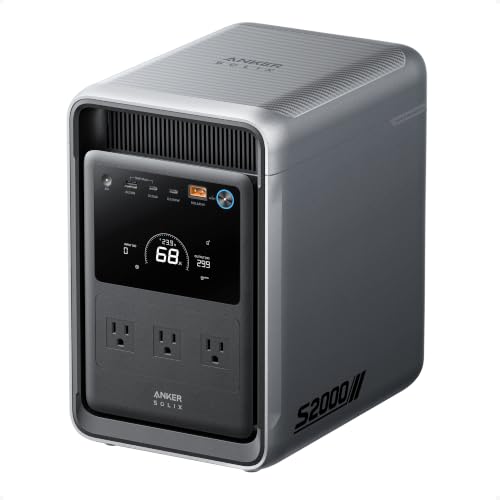
Anker SOLIX S2000 Portable Power Station
The S2000 is the strongest value in Anker’s home-backup line. Its 2,010Wh capacity can run a refrigerator for roughly a full day on a single charge, and the 3,000W peak output handles a microwave or window AC unit without tripping. Owners consistently praise the fast AC recharging speed, noting it refills in hours rather than the full overnight cycles older stations require. The unit is heavy, but that is inherent to the capacity class.
- 3,000W peak easily covers most household essentials during an outage
- Fast AC input means you can recharge between storm cells without a generator
- Weight makes it impractical for solo transport upstairs or into a vehicle trunk without effort
Skip it if you only need to charge phones and laptops; the S2000 is oversized for that task and you would pay a premium for capacity you will never use.
Anker SOLIX C300 Portable Power Station
The C300 sits in an awkward middle ground. At 288Wh it matches the capacity of many mid-range power banks but adds AC outlets and solar input for a few hundred dollars more. For campers who need to run a small fan, a projector, or recharge a drone fleet at basecamp, it delivers real utility. The solar generator pairing is the reason to buy it over a simpler power bank, because you can top up from a panel in the sun. Owners report solid build quality but note the AC output ceiling limits what you can run.
- AC and DC outputs plus solar input make it versatile at basecamp
- Compact enough to fit in a car cup holder area or backpack side pocket
- Capacity is only 288Wh, so it drains quickly if you plug anything above 100W
Skip it if you need more than one night of runtime off-grid; the DC version at half the price handles the same capacity for lighter loads.
Anker Laptop Power Bank
With 165W total output spread across multiple ports, this power bank can simultaneously fast-charge a laptop and a phone at full speed. The 25,000mAh capacity provides a full charge to most modern ultrabooks plus two or three phone top-ups. Travelers appreciate that it fits airline carry-on limits. The trade-off is bulk; this is not a pocketable unit and it is noticeably heavier than smaller power banks you would toss in a jacket pocket.
- 165W total output means no waiting for one device to finish before another starts
- Cabin-legal capacity eliminates the anxiety of airport security confiscation
- Bulk and weight make it a poor choice for ultralight hikers or pocket carry
Skip it if you only charge phones and earbuds; a smaller, lighter unit will serve you better without the unnecessary mass.
Anker SOLIX F3800 Portable Power Station
The F3800 is Anker’s ceiling for portable home backup at 3,840Wh. It can run a full household’s essential circuits through a multi-day outage if paired with a transfer switch. For storm emergencies where you might lose power for two or three days, this is the anker battery backup that keeps a well, fridge, furnace blower, and lights alive simultaneously. The price is steep and the unit is genuinely heavy, but no smaller option provides this runtime class.
- Nearly double the capacity of the S2000 for extended outages without recharging
- High wattage output handles heavy-draw appliances like sump pumps
- At $1,999.99 it costs over three times the S2000 for roughly double the capacity
Skip it if outages in your area rarely exceed 24 hours; the S2000 covers that scenario at a far lower cost.
Anker Prime Power Bank
The Prime’s headline is 300W total output, the highest of any Anker power bank. That means it can drive a power-hungry laptop at full charge speed or split output across multiple high-draw devices. The 26,250mAh capacity is generous for a unit this form factor. It is aimed squarely at professionals who carry a laptop, tablet, and phone and refuse to be tethered to a wall outlet. The premium price reflects the output headroom.
- 300W output is unmatched in the portable power bank class
- Multi-port simultaneous charging eliminates the need for separate adapters
- $179.98 is expensive relative to its capacity when compared to the Laptop Power Bank below it
Skip it if your laptop charges at 65W or less; the Laptop Power Bank at $104.99 gives you sufficient output for half the price.
Anker Power Bank 20K Built-in USB-C Cable
The built-in USB-C cable is the entire selling point here. No forgotten dongles, no tangled cords in your bag, no searching your pack for the right cable when your phone dies mid-commute. At $59.98 it is the cheapest way to carry a meaningful charge, and 20,000mAh is enough for several full phone recharges. The cable is tethered, so it does not detach if you prefer your own, but for most people that is a feature, not a flaw.
- Integrated cable removes the single most common failure point of power bank use
- Lowest entry price in this list for a unit that still handles two full phone charges
- No AC output or high-wattage laptop charging; it is strictly a phone and tablet solution
Skip it if you need to power anything beyond USB devices; this is not a station replacement.
Anker MagGo Power Bank
The MagGo snaps to a MagSafe-compatible iPhone and charges it wirelessly at 15W while you keep using the phone. For commuters and parents juggling a stroller, this hands-free convenience is genuinely valuable. The 10,000mAh capacity provides roughly one full phone charge plus a partial second, which is enough for a day of heavy use. It is the smallest and lightest option here, making it the default for anyone who carries a phone all day.
- Qi2-certified magnetic attachment means no cable management at all
- Smallest and lightest option, easily forgettable in a pocket or purse
- 15W wireless output is slower than wired charging, so top-ups take longer
Skip it if you have an Android phone or need to charge a laptop; it is designed around the Apple ecosystem and its output ceiling reflects that niche.
Anker SOLIX C300 DC Portable Power Station
The DC version of the C300 strips the AC inverter and solar charge controller, delivering the same 288Wh capacity and 300W output at $199.99 instead of $329.99. If all you need is DC power for camping lanterns, a 12V compressor fridge, drone batteries, or car accessories, you save over a hundred dollars for functionality you will never use. It is the smarter buy for a specific subset of outdoor users who have no need for AC outlets at basecamp.
- Same 288Wh capacity as the standard C300 at 60 percent of the price
- DC-only design is lighter and has fewer failure points than AC inverter models
- No AC output means you cannot run a standard household plug without a separate adapter
Skip it if you want the flexibility to run an AC-powered device at some point; the price gap narrows that option away from you.
Buying Guide
Capacity: Watt-Hours vs. Amp-Hours
Stations list capacity in watt-hours; power banks list milliamp-hours. You cannot compare them directly. To convert, multiply the mAh rating by the cell voltage (typically 3.6V for lithium-ion) then divide by 1000. A 25,000mAh power bank stores roughly 90Wh, while the S2000 stores 2,010Wh. For storm emergencies, calculate your total overnight draw in watt-hours: multiply each device’s wattage by hours needed, then add ten percent for inverter losses. Choose a station whose capacity meets or exceeds that number.
Output Wattage: Peak vs. Continuous
Anker stations publish a peak wattage (the S2000’s 3,000W) that represents a short burst for motor-start loads like refrigerators or well pumps. Continuous output is lower. If you plug in a 1,500W space heater, the station will sustain it only if continuous rating covers that draw. Always verify which number the spec sheet refers to. For power banks, total output is shared across ports; a 165W unit may deliver 100W to one port and only 30W to another simultaneously.
Recharge Speed and Solar Input
A station that takes 12 hours to refill is a liability during back-to-back storms. The S2000 and F3800 support fast AC input that cuts recharge time dramatically. For off-grid use, check solar input maximum wattage: the C300 accepts a modest panel load, while the F3800 supports much larger arrays. If you rely on solar, match the panel to the input ceiling or you waste money on capacity you cannot absorb.
Our Verdict
Top pick: the Anker SOLIX S2000 at $649.99. It hits the sweet spot where capacity, output, and recharge speed all make sense for a real home emergency, and no unit in Anker’s lineup delivers that combination at a lower price. Budget pick: the Anker Power Bank 20K at $59.98. If your storm kit priority is keeping phones alive for 72 hours, nothing cheaper does it with fewer points of failure. The condition under which another product wins: if outages in your region routinely stretch beyond two days and you need to run a furnace, well pump, and refrigerator simultaneously, the F3800 is the only choice here with sufficient headroom to avoid running a generator.
FAQ
Can an Anker power station run a space heater?
Only the F3800 and S2000 have peak output high enough to start a typical 1,500W space heater, and even then sustained runtime is short because heaters drain capacity fast. A 2,010Wh station running a 1,500W heater provides barely over one hour of heat, which is useful for a brief cold snap but not a multi-day solution.
Are these power banks safe for air travel?
Most airlines cap lithium-ion batteries at 100Wh in carry-on without special approval, with 160Wh allowed under some conditions. The Laptop Power Bank at roughly 90Wh and the MagGo at roughly 37Wh are clearly within limits. The Prime at approximately 95Wh is borderline; check your airline’s specific policy before flying.
Can I charge an Anker station from my car’s 12V outlet?
The C300 DC supports 12V input directly. The larger stations accept DC input but typically require a dedicated car charger accessory rated for their wattage ceiling. Verify the specific DC input voltage and current range before plugging into a vehicle socket.
What is the difference between the C300 and the C300 DC?
Both store 288Wh and output 300W, but the standard C300 includes AC outlets and a solar charge controller. The DC version removes the inverter and solar controller, cutting the price by $130. If you only use DC-powered camping gear, the C300 DC gives you identical energy storage for significantly less money.