Key takeaways
- Pro: Affordable entry point with four battery-backed outlets
- Pro: PowerChute software enables automated safe shutdown
- Con: Simulated sine wave may not suit sensitive equipment
A storm knocks out power and your router dies, your PC hard-crashes mid-write, and your NAS file system corrupts before the backup generator even kicks in. That gap — the first five to thirty minutes of an outage — is exactly what a quality ups backup fills. The best units give you clean runtime on battery, automatic voltage regulation that smooths brownouts without touching the battery cells, and enough outlets to cover a router, modem, and desktop simultaneously.
What separates a dependable ups backup from a cheap one that fails when you need it most is topology (standby versus line-interactive versus double-conversion), wattage headroom over your actual load, and whether the unit outputs a pure sine wave or a simulated one. Sensitive electronics like NAS drives and gaming PCs with active PFC power supplies need the real thing. The eight models below span entry-level standby units to mid-range line-interactive systems, and the differences in protection quality become very visible when you compare specs side by side.
Our top picks


As an Amazon Associate we earn from qualifying purchases at no extra cost to you.
Quick Picks
| Product | Best for | Price |
|---|---|---|
| APC BE600M1 | Router and NAS on a budget | $83.99 |
| CyberPower CP1500PFCLCD | High-end gaming PC or workstation | $239.95 |
| CyberPower ST425 | Modem and light office gear | $59.95 |
| APC BX1500M | Home office with AVR needs | $189.99 |
| APC BE425M | Single router or small electronics | $62.50 |
| CyberPower CP1500AVRLCD3 | Multi-monitor desktop with LCD monitoring | $199.95 |
| CyberPower EC850LCD | Energy-conscious home office | $119.95 |
| APC BE650G1 | PC and peripherals with surge protection | $109.99 |
How We Picked
We narrowed the field by three criteria that matter most for storm-season use. First, topology and output waveform: units with automatic voltage regulation and pure or stepped-sine output protect sensitive hardware far better than basic standby boxes. Second, VA-to-watt ratio and real runtime at moderate load — a unit rated 1500VA but only 600W usable is misleading. Third, owner-reported reliability over multiple storm cycles, because battery degradation and inverter failures show up in feedback long before specs change.
The 8 Best Ups Backup in 2026
APC BE600M1
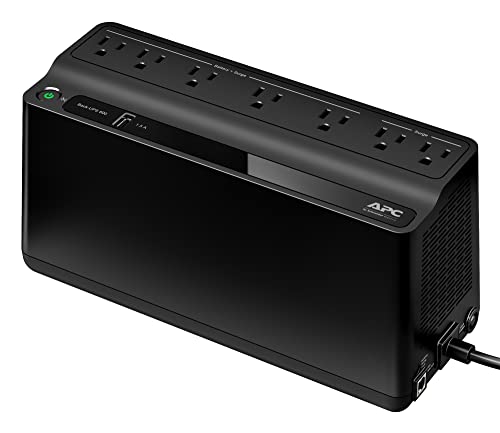
This standby unit covers a router, cable modem, or entry-level NAS without fuss. The 600VA/330W rating handles a typical network stack comfortably, and eight outlets (four battery-backed) mean you can daisy-chain more than one device. Owner feedback highlights the compact footprint and the included PowerChute software for graceful shutdowns. The main drawback is the simulated sine wave output, which some active-PFC power supplies in NAS enclosures dislike. If your load exceeds 300W under any condition or your equipment demands clean power, skip this and look at a line-interactive model above.
- Pro: Affordable entry point with four battery-backed outlets
- Pro: PowerChute software enables automated safe shutdown
- Con: Simulated sine wave may not suit sensitive equipment
CyberPower CP1500PFCLCD
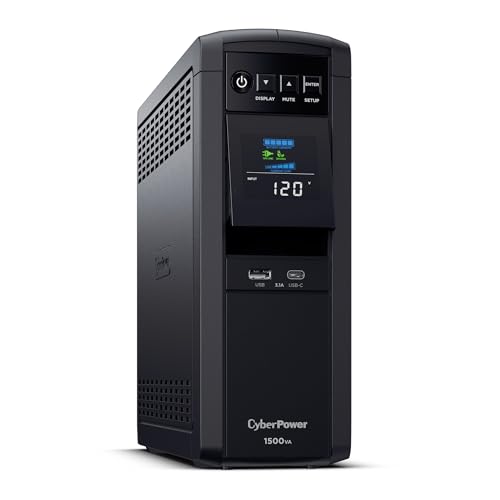
The standout ups backup in this group for anyone running a high-end desktop or workstation. Pure sine wave output, 1500VA/1000W capacity, twelve outlets, and automatic voltage regulation make it the closest thing to double-conversion protection at a consumer price. Owners with active-PFC supplies report no issues that plague simulated-sine units. The LCD panel shows load percentage and estimated runtime. At $239.95 it costs more than twice the APC BE600M1, but the waveform quality alone justifies the gap if your hardware is expensive. Skip it if you only need router-level protection and do not want to pay for headroom you will not use.
- Pro: Pure sine wave output safe for active-PFC supplies
- Pro: Twelve outlets with six battery-backed for real flexibility
- Con: Premium price relative to standby alternatives
CyberPower ST425
At $59.95 this is the cheapest way to keep a broadband modem alive through a short outage. The 425VA/225W standby topology is adequate for networking gear drawing under 200W. It ships with surge protection and a basic LCD status display. Owner reports confirm reliable performance for routers and ONTs specifically. The trade-off is minimal battery capacity — expect only a few minutes at meaningful load. If you need to save work on a computer or keep a NAS online, this unit will not last long enough. Choose it only for single low-draw devices where the goal is staying connected, not staying running.
- Pro: Lowest cost entry in the roundup
- Pro: Simple operation with no software required
- Con: Battery runtime drops fast under even moderate load
APC BX1500M
A line-interactive unit with AVR that corrects minor voltage sags without draining the battery, which extends runtime during brownouts common in storms. The 1500VA/900W rating covers a gaming PC with a monitor. The front LCD shows input voltage, load, and battery status at a glance. Owners praise the build quality and the four battery-backed outlets. The waveform is stepped-sine rather than pure, so very sensitive audio gear or medical equipment may notice hum. If your priority is home-office continuity and you do not need a pure sine output, this hits a strong balance of capacity and protection at $189.99.
- Pro: AVR corrects brownouts without switching to battery
- Pro: LCD provides real-time voltage and load readings
- Con: Stepped-sine waveform limits compatibility with some gear
APC BE425M
Designed for the smallest possible job: keep a single router or a Wi-Fi access point alive. The 425VA/225W rating and two battery-backed outlets make it a one-device solution. It is physically tiny, sits flat on a shelf, and costs just $62.50. Owner feedback confirms it handles 30-50W router loads for well over fifteen minutes. There is no AVR and no software interface beyond basic beeping alarms. If your network stack includes a modem plus a router plus a switch, the two battery-backed outlets become a constraint. For one critical device, though, it does the job at minimal cost.
- Pro: Compact size and lowest wattage capacity matched to tiny loads
- Pro: Reliable standby switchover with no configuration needed
- Con: Only two battery-backed outlets limit device coverage
CyberPower CP1500AVRLCD3
A refresh of a long-running platform with the same 1500VA/1000W line-interactive topology and AVR as the APC BX1500M, but CyberPower pairs it with a slightly larger LCD and included software that gives per-outlet load monitoring. The simulated sine wave is adequate for most PCs and monitors but not ideal for equipment with PFC supplies. At $199.95 it sits just above the APC equivalent. Owners like the software suite for scheduling and event logging. Skip this if pure sine output matters to your hardware; the CP1500PFCLCD above is the better upgrade path.
- Pro: Detailed LCD with per-outlet status readout
- Pro: Bundled software enables event logging and graceful shutdown
- Con: Simulated sine wave not ideal for active-PFC power supplies
CyberPower EC850LCD
The “Ecologic” branding refers to an energy-efficient mode that shuts down non-essential outlets when the primary load drops below a threshold, saving standby power over months of ownership. The 850VA/480W line-interactive design suits a small office PC with one monitor. AVR keeps the battery out of short brownouts. Owner reviews note the green savings can offset a meaningful portion of the unit’s cost over several years. The simulated sine output and moderate capacity make it unsuitable for high-draw gaming rigs or multi-monitor setups. If energy waste is your concern and your load stays under 400W, this is a thoughtful pick at $119.95.
- Pro: Automatic load shedding reduces idle energy consumption
- Pro: AVR extends battery life during frequent minor surges
- Con: 480W ceiling limits it to light desktops only
APC BE650G1
Sitting between the BE600M1 and the BX-series, this standby unit offers 650VA/390W with eight outlets and a compact tower form factor. The slightly higher wattage over the BE600M1 means a small desktop and monitor can survive a brief outage if you shut down quickly. No AVR is present, so voltage fluctuations draw on battery immediately. Owners appreciate the straightforward setup and the familiar APC software. At $109.99 it costs more than the BE600M1 for a marginal capacity gain, which makes the BX1500M a better value jump if your budget stretches. Choose this only when the extra 60W matters and AVR is not a priority.
- Pro: Eight outlets provide good device coverage for the size
- Pro: Familiar PowerChute software for scheduled shutdowns
- Con: No AVR means battery cycles during every brownout
Buying Guide
Match Waveform to Your Hardware
If your PC or NAS uses an active power-factor-correction supply (common in units rated above 400W output), a simulated or stepped-sine ups backup can cause the PSU to overheat, shut off, or buzz. Pure sine wave models like the CP1500PFCLCD eliminate that risk. For routers, switches, and older desktops, simulated sine is fine and cheaper.
Calculate True Wattage Headroom
VA ratings are inflated relative to real watts. Divide the VA number by the power factor listed in specs (often 0.6 for standby units, 0.7 for line-interactive) to get usable wattage. Then add 25 percent headroom so the inverter is not running at its ceiling during the switchover moment when inrush current spikes.
Prioritize AVR for Storm-Prone Areas
During severe weather the grid rarely drops cleanly to zero; it sags, surges, and flickers repeatedly. A standby unit hits battery on every fluctuation, shortening battery life. Line-interactive models with AVR correct those swings electronically and reserve battery for actual blackouts. In a storm-emergency context, AVR is not optional — it is the feature that keeps your battery available when you truly need it.
Our Verdict
The CyberPower CP1500PFCLCD is the top pick for anyone protecting expensive hardware during storms — pure sine wave, generous capacity, and twelve outlets cover the widest range of scenarios in this roundup. The CyberPower ST425 wins as the budget pick when the goal is simply keeping a modem or router online for the few minutes until your generator starts. If your priority is brownout tolerance over waveform purity, the APC BX1500M edges ahead thanks to its AVR and LCD feedback at a lower price than the CyberPower flagship.
FAQ
Can a UPS damage my equipment?
A mismatched waveform can cause an active-PFC power supply to behave erratically or shut down. Beyond that, a failing ups backup with degraded batteries or a stalled inverter transfers load without regulation, which is worse than a direct wall connection during a surge event.
How long does a UPS battery last?
Most sealed lead-acid UPS batteries hold usable charge for three to five years depending on ambient temperature and cycle frequency. Heat accelerates degradation, so storing the unit in a cool, dry space extends its life noticeably.
Do I need a UPS for my router?
If you rely on Wi-Fi during outages for communication, cell boosters, or security cameras that route through local storage, a small standby unit keeps the router alive for the fifteen to thirty minutes that matter most before a generator or power restoration.
Is line-interactive better than standby for storm use?
Yes, in most cases. Storms cause repeated voltage dips before full failure. A line-interactive unit with AVR handles those dips without consuming battery cycles, preserving runtime for the blackout that follows the storm front through.