Key takeaways
- Ready Hour freeze-dried food is designed for emergencies…
- The world is unpredictable
- Includes up to 120 total servings
The question every household eventually faces is simpler than it sounds: if a storm knocks out power for five days, what do you actually eat? Not what looks good on a prepper forum, but what feeds two adults and a kid without running a stove, filtering water through a life straw, or relying on a propane camping stove that runs out by day three. Emergency food fills that gap — shelf-stable, calorie-dense, and requiring minimal preparation when the grid is dark and the roads are impassable.
What separates a worthwhile emergency food supply from a costly shelf ornament is threefold. First, shelf life must be genuinely long — 25 years or more — or you will discard and replace the stock before a real event ever strikes. Second, the calorie-to-cost ratio matters because a family of four needs roughly 8,000 calories per day, and not every bucket delivers that density. Third, nutritional balance determines whether your family stays sharp and energetic or becomes irritable and sluggish after 48 hours of eating nothing but starchy filler. We compared every product in this roundup against published specs, current prices, and patterns in owner feedback to identify which options actually solve the problem.
Our top picks


 Ready Hour 120 Serving Entree Bucket-Freeze Dried
- Ready Hour freeze-dried food is designed for emergencies…
- The world is unpredictable
- Includes up to 120 total servings
 Ready Hour
- Ready Hour Freeze dried fruits and veggies are…
- The world is unpredictable
- Includes 56 total servings


As an Amazon Associate we earn from qualifying purchases at no extra cost to you.
Quick Picks
| Product | Best for | Price |
|---|---|---|
| READYWISE 120 Serving Bucket | Best overall balanced nutrition | $97.99 |
| Augason Farms Lunch & Dinner Kit | Best meal variety | $76.99 |
| READYWISE 72 Hour Kit | Best budget starter | $20.99 |
| Augason Farms 45 Day Supply | Best long-term supply | $123.76 |
| Ready Hour 120 Serving Entree Bucket | Best premium entree selection | $149.99 |
| Ready Hour Fruit & Veggie Mix | Best micronutrient coverage | $64.99 |
| READYWISE Protein Bucket | Best protein source | $178.19 |
| Chicken of the Sea Tuna | Best zero-prep protein | $8.92 |
How We Picked
We evaluated each product on four criteria drawn from published specifications and consistent themes in owner reviews. Shelf life stability determines whether your investment outlasts multiple storm seasons without degradation. Caloric density per dollar tells you how many actual meals you get for the money spent. Preparation complexity measures what infrastructure you need beyond the bucket itself — water, heat, cooking vessels. Nutritional completeness looks at whether the product contributes meaningful protein, fiber, or vitamins rather than filling you with empty calories.
The 8 Best Emergency Food in 2026
READYWISE Emergency Survival Food Supply Favorite Sample Bucket 120 Serving
This is the bucket most buyers should reach for first if they have not previously stocked any emergency food. It covers breakfast, lunch, dinner, and snacks in a single package, making it a genuine all-in-one solution for one to two people over roughly ten days. READYWISE’s freeze-drying process preserves more nutrients than air-dried alternatives, and owners consistently note the meals taste closer to actual restaurant food than most competitors.
- Pro: Balanced macronutrient profile across 120 servings with real vegetables, grains, and proteins included.
- Pro: Single bucket simplifies inventory management — one container, one location, no guesswork.
- Con: Per-serving cost adds up over long-term storage compared to building a supply from cheaper individual components.
Skip this if you already own multiple buckets and only need to fill a nutritional gap, such as protein or produce.
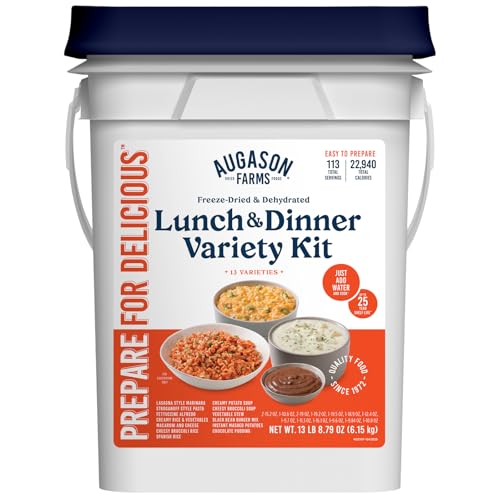
Augason Farms Lunch & Dinner Variety Kit 4 Gallon Bucket
Augason Farms built its reputation on meal variety, and this kit leans into that strength with lunch and dinner entrées that cover a wider flavor range than most single-brand buckets. The 4-gallon size keeps the footprint manageable for a closet shelf or under-bed storage. Owners report that the texture holds up well after years of storage when rehydrated with warm water.
- Pro: Excellent variety prevents menu fatigue during extended outages.
- Pro: Compact bucket footprint suits apartments and small storage spaces.
- Con: Caloric density per serving runs lower than entrée-focused competitors, so you eat more servings to feel full.
Skip this if your primary concern is calories-per-dollar for a large family.
READYWISE Emergency Food Supply Meals 72 Hour Survival Kit, 30 Servings
At roughly the price of a takeout dinner, this kit removes the entry barrier entirely. It covers three full days for one person or a long weekend for a couple. The real value here is psychological — having something on the shelf changes behavior more than having nothing does. Owners who later expanded into full buckets consistently started with this kit.
- Pro: Lowest cost of any product on this list; near-zero barrier to first purchase.
- Pro: Adequate for the acute first 72 hours when most storms pass or supply chains restore.
- Con: Only 30 servings; a family of four exhausts this in less than one day.
Skip this as your only supply. Treat it as a stepping stone toward a larger bucket.
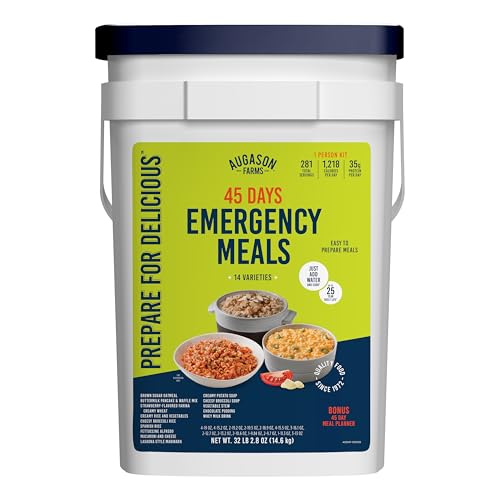
Augason Farms 45 Day Emergency Food Supply Kit
This is the serious long-term option for households that want a single purchase covering multiple weeks. The 45-day figure assumes one adult at a moderate caloric intake, so a family of four would divide that into roughly eleven days. Owners appreciate the built-in water purification tablets and the included manual can opener, small touches that matter when everything else is inaccessible.
- Pro: Extended supply duration reduces purchase frequency and long-term cost.
- Pro: Includes accessories like water purification tablets and a can opener that competitors leave as afterthoughts.
- Con: Single-person design means families need multiple kits, pushing total cost well above the sticker price.
Skip this if household size exceeds two and budget allows only one purchase.
Ready Hour 120 Serving Entree Bucket
Ready Hour positions this as a premium entrée experience, and the menu skews toward hearty comfort foods like stews, casseroles, and pasta dishes that hold morale during a multi-day outage. Freeze-dried preparation means you can rehydrate with cold water if fuel is unavailable, a genuine advantage during winter storms. The bucket design includes a Mylar inner liner that reseals.
- Pro: Cold-water rehydration capability eliminates dependence on cooking fuel.
- Pro: Resealable Mylar liner protects unused portions after opening the bucket.
- Con: Highest price per serving on this list at nearly $1.25 per entrée.
Skip this if budget is the binding constraint; the READYWISE 120-serving bucket delivers comparable nutrition at a lower cost.
Ready Hour Fruit & Veggie Mix
This product addresses the single most common gap in emergency food supplies: produce. Freeze-dried fruits and vegetables retain most of their vitamin content and add critical fiber that grain-and-protein buckets lack. At 30-year shelf life in a flood-safe container, it solves the micronutrient problem without requiring refrigeration or a garden.
- Pro: Fills the produce and fiber gap that entrée buckets leave open.
- Pro: Flood-safe container design adds resilience in exactly the scenarios where storms cause the most damage.
- Con: Does not provide meaningful calories on its own; functions only as a supplement to a primary supply.
Skip this if you have not yet acquired a primary calorie source; it is a complement, not a foundation.
READYWISE Emergency Survival Food Supply Protein Bucket, 296 Servings
Protein is the hardest macro to source in a shelf-stable emergency format, and READYWISE tackles it head-on with 296 servings of freeze-dried meats, eggs, and dairy. For active households or anyone in cold weather where protein supports thermoregulation, this bucket becomes a force multiplier alongside any entrée supply. The per-serving cost drops to well under sixty cents, making it surprisingly economical.
- Pro: Enormous serving count at a low per-serving price makes long-term protein storage feasible.
- Pro: Versatile additions — eggs and shredded meats blend into rice, pasta, or soup bases from other buckets.
- Con: Lacks variety on its own; buyers will need entrée or grain components for complete meals.
Skip this if you already own the READYWISE 120-serving bucket, which includes some protein in its mix.
Chicken of the Sea Wild Caught Chunk Light Tuna
This is not a freeze-dried prepper product, and that is precisely its advantage. No rehydration, no water purification, no waiting. You crack the can and eat. For the acute phase of any emergency — the first hours when adrenaline spikes and no one wants to boil water — ten cans of ready-to-eat protein at under nine dollars represents unmatched convenience. Shelf life is shorter than freeze-dried options, but rotation makes that manageable.
- Pro: Zero preparation required; the single most convenient protein option on this list.
- Pro: Lowest absolute cost at $8.92 for ten 5-ounce cans; trivial to rotate.
- Con: Can weight and volume make bulk storage impractical for long-term supplies.
Skip this as a primary emergency food source. It works best as a grab-and-go layer in a multi-product stockpile.
Buying Guide
Shelf Life and Storage Conditions
Published shelf-life ratings for freeze-dried emergency food typically run 25 to 30 years, but that number assumes storage in a cool, dry, dark environment between 50 and 70 degrees Fahrenheit. A garage that hits 110 degrees in July will degrade nutrient content and alter texture years earlier than the label suggests. Owners in humid climates consistently report bucket-seal failures as the primary spoilage cause, so look for Mylar inner liners with oxygen absorbers rather than bare plastic pails.
Caloric Density and Household Sizing
An average adult needs roughly 2,000 calories per day. Multiply that by household size and the number of days you want coverage for, then divide into the total servings the bucket provides. This quick calculation reveals whether a 120-serving bucket actually covers your family for the duration you need. Many buyers underestimate their real requirement and end up rationing too aggressively, which erodes morale faster than hunger itself.
Preparation Requirements and Fuel Independence
Not all emergency food needs heat. Some freeze-dried meals rehydrate adequately with cold water, though owners note the texture is less appealing. If your household has no propane, no camp stove, and no generator, cold-water capability becomes a deciding factor. Canned options like the Chicken of the Sea tuna need no preparation at all but carry weight and shorter shelf life.
Our Verdict
The READYWISE 120 Serving Favorite Bucket is the top pick for most households because it solves the complete-nutrition problem in one container at a reasonable price. For buyers on a strict budget, the READYWISE 72 Hour Kit at under $21 is the single best first step you can take today. If your region experiences extended power outages lasting more than a week, the Augason Farms 45 Day Supply earns its place as the long-duration workhorse, even accounting for its higher total cost when scaled to family size.
FAQ
How much emergency food does a family of four actually need?
For a basic one-week supply, plan for roughly 56,000 total calories across all household members. Divide that by the average calories per serving in your chosen product to determine how many buckets or cans you need. This is why many buyers find themselves purchasing three to five buckets rather than one.
Does freeze-dried food taste as good as it looks in marketing photos?
Owner reviews consistently place freeze-dried meals above canned goods on taste when prepared correctly with hot water, but they rank below freshly cooked food. The gap narrows significantly with brands that include seasoning packets and real vegetables rather than plain grains.
Can I rotate emergency food through my regular kitchen use?
Yes, and experienced buyers recommend it. Using freeze-dried entrées for one camp dinner per quarter keeps stock fresh without waste. Canned tuna rotates naturally through sandwich lunches. This practice costs nothing and ensures you actually know how to prepare each item before an emergency forces your hand.
What is the difference between freeze-dried and dehydrated emergency food?
Freeze-drying removes moisture at low temperature and preserves more nutrients, flavor, and rehydration speed. Dehydration uses heat, which degrades some vitamins and yields a denser product that requires longer soaking. Freeze-dried options generally cost more per serving but deliver better taste and nutrition over a 25-year storage window.