Key takeaways
- Ready Hour freeze-dried food is designed for emergencies…
- The world is unpredictable
- Includes up to 120 total servings
Storm season does not give you a warning. When the power drops and roads go underwater, your emergency food kit is the difference between getting by and scrambling for anything edible. The best options pack real calories into sealed buckets, store for years, and taste close enough to normal meals that your family actually finishes them during a crisis.
The market is crowded, though, and not every kit delivers on its promises. Some under-calorie per serving so you are hungry by day three. Others rely on cheap fillers that turn mushy or bland after a few months on the shelf. Comparing published specs and owner feedback across these eight options separates genuinely useful kits from expensive shelf-ware that looks good in a listing but disappoints when you need it most.
Our top picks

 Ready Hour 120 Serving Entree Bucket-Freeze Dried
- Ready Hour freeze-dried food is designed for emergencies…
- The world is unpredictable
- Includes up to 120 total servings


As an Amazon Associate we earn from qualifying purchases at no extra cost to you.
Quick Picks
| Product | Best for | Price |
|---|---|---|
| READYWISE 120-Serving Sample Bucket | Balanced everyday meals | $97.99 |
| Augason Farms Lunch & Dinner Kit | Lunch and dinner variety | $76.99 |
| Ready Hour 120-Serving Entree Bucket | Long-term entree storage | $149.99 |
| Augason Farms 2-Week Kit | Short-term household prep | $54.97 |
| Augason Farms 45-Day Kit | Extended family supply | $123.76 |
| READYWISE 72-Hour Kit | Bug-out bags and grab-and-go | $20.99 |
| READYWISE 132-Serving Bucket | High serving count per dollar | $84.99 |
| READYWISE Protein Bucket | Protein-focused nutrition | $178.19 |
How We Picked
We narrowed these eight kits using four criteria that matter most in this category: total servings relative to price so you can calculate a true cost-per-calorie, published storage life from the manufacturer, variety and realism of the meal lineup, and the volume of owner feedback praising or criticizing taste and ease of preparation. Kits that checked only one box fell out of consideration quickly.
The 8 Best Emergency Food Kits in 2026
READYWISE 120-Serving Sample Bucket
This is the go-to recommendation for a household that wants a real meal rotation without committing to a single brand’s full product line. At 120 servings for under $98, the per-serving cost lands in a comfortable middle ground. Owners consistently praise the breakfast options and the fact that many meals require only hot water. The variety is the biggest strength here, spanning entrees, sides, and desserts. The main drawback is that some entrees skew toward mild seasoning, which can feel repetitive after a full week. Skip this if you need a larger caloric base or a protein-heavy plan for outdoor recovery work.
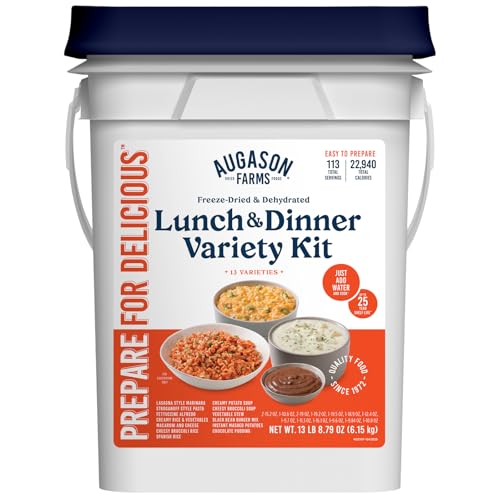
Augason Farms Lunch & Dinner Kit
If you already own a separate breakfast bucket and want to round out midday and evening meals without overlap, this kit fills that gap well. The four-gallon bucket format keeps storage compact, and the $76.99 price tag makes it a low-risk addition to an existing setup. Owners highlight the soups and stews as standouts, noting they rehydrate cleanly with good texture. The downside is limited variety across categories; some families report cycling through similar flavor profiles. Skip this if you are building from zero and need breakfast coverage as well.
Ready Hour 120-Serving Entree Bucket
This bucket targets buyers who prioritize complete main-course meals with more adventurous menu options. The $149.99 price is the highest per-serving in this group, but owners point to portion sizes and seasoning depth that justify the premium. Preparation instructions are clear, and many meals come with included pouches or toppings that elevate the result beyond typical freeze-dried fare. The trade-off is the upfront cost, which is hard to swallow when a comparable serving count is available for less. Skip this if budget is your primary constraint or if you prefer simpler, no-frills meals.
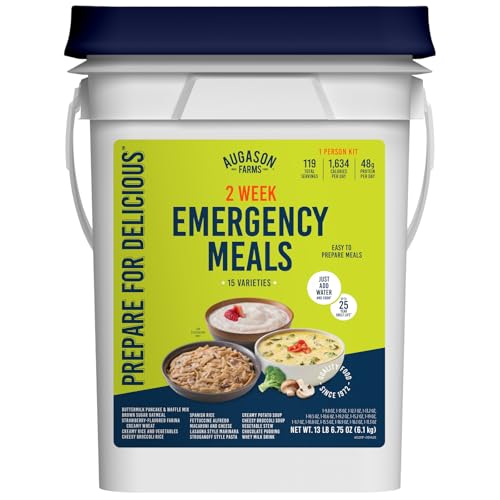
Augason Farms 2-Week Kit
At just under $55, this is one of the most affordable starting points for a family that wants a realistic two-week buffer without breaking the budget. The calorie-per-serving breakdown tends to be adequate for sedentary households stuck indoors during a storm. Owners appreciate the compact packaging and straightforward prep. The limitation is variety; some meals repeat, and the overall menu feels narrower than pricier kits. Skip this if you need more than a short-term supply or if your household includes adults with higher caloric needs doing physical recovery work.
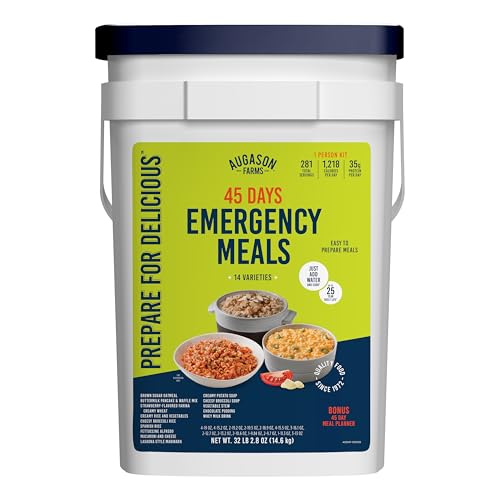
Augason Farms 45-Day Kit
This is the pick for households that want a single purchase covering an extended recovery window. The $123.76 price is competitive for a 45-day supply, and owners report that the calorie content sustains a family without requiring supplement. Storage life claims are among the longer published figures here. The downside is sheer bulk; the bucket collection takes meaningful floor space, and rotating through the full menu before expiration requires planning. Skip this if your storage area is tight or if you prefer building a longer supply incrementally with smaller buckets.
READYWISE 72-Hour Kit
Thirty servings for under $21 makes this the most budget-friendly entry point in the group, and it is sized correctly for a bug-out bag or a vehicle emergency stash. Owners call out the lightweight footprint and the fact that meals need minimal water, which matters in an evacuation. The obvious limitation is duration; 72 hours is a bridge, not a plan. The menu also lacks variety given the small serving count. Skip this if you need a primary household supply rather than a backup or grab-and-go layer.
READYWISE 132-Serving Bucket
For pure servings-per-dollar value, this bucket is hard to beat. At $84.99 for 132 servings, the per-serving cost undercuts nearly every competitor here. Owners confirm the calorie content per serving is sufficient for a standard adult, and the mix of breakfast and lunch options provides reasonable variety. The weakness is that this is labeled a survival bucket rather than a curated meal plan, so you will need to supplement with sides or snacks to keep meals interesting over time. Skip this if you want a turnkey menu with minimal additional purchasing.
READYWISE Protein Bucket
Two hundred ninety-six servings at $178.19 positions this as a high-calorie-density option for households doing physically demanding recovery work or anyone who struggles with the carb-heavy profiles of standard freeze-dried meals. Owners specifically praise the protein content per serving and note that satiety is noticeably higher than a typical breakfast bucket. The con is the price ceiling; not every buyer needs to spend this much, and the menu is narrower than a general-purpose kit. Skip this if your family is largely sedentary during the storage window or if cost per serving is your deciding metric.
Buying Guide
Servings vs. Caloric Density
A “serving” in emergency food is a marketing unit, not a guarantee of satiety. When comparing emergency food kits, look for the published calorie range per serving rather than the raw count alone. A 120-serving bucket with 300-calorie meals is a real supply; one with 150-calorie portions is closer to a snack stash. Multiply servings by calories and divide by price to get a true cost-per-calorie figure that reveals whether a cheap bucket is actually cheap.
Storage Life and Rotation
Manufacturers publish shelf-life numbers under ideal sealed, cool, and dark conditions. Once you open a bucket, the clock accelerates. If your household is small, a single large bucket may not be rotated through before quality drops. Smaller buckets you can open and close sequentially keep food fresher longer. Treat published storage life as a maximum, not a plan, and build a simple rotation schedule so older servings get consumed first.
Variety and Psychological Fatigue
Emergency food is not just fuel; it is comfort during a stressful event. Owners who report dissatisfaction almost always cite monotony as the trigger, not safety. If every meal is a similar texture and flavor, family members stop eating enough. Look for kits with at least three or four distinct meal categories, and consider combining buckets from different manufacturers rather than relying on a single brand for the full menu.
Our Verdict
For most households building a primary emergency food kit, the READYWISE 120-Serving Sample Bucket offers the best balance of variety, price, and owner satisfaction. The budget pick is the READYWISE 72-Hour Kit for anyone who needs a starting layer or evacuation stash at the lowest cost. If your situation demands high protein output for physical recovery work, the READYWISE Protein Bucket wins decisively despite its premium price.
FAQ
How many servings does a family of four need for a week?
Three meals per day times four people equals 84 servings as a minimum baseline. Add snacks and seconds and you land closer to 100-120 servings per week. A single 120-serving bucket covers a family of four for roughly one week of primary meals, assuming you supplement with pantry items.
Do freeze-dried emergency food kits taste good?
Modern freeze-drying preserves texture and flavor far better than old military rations. Most owner reviews on these kits rate taste as acceptable to genuinely enjoyable, especially breakfast items and soups. The most common complaint is mild seasoning rather than bad taste, so keeping a few packets of hot sauce or salt nearby helps a lot.
Can I store emergency food kits in a garage?
Extreme heat degrades freeze-dried food faster than almost anything else, so a garage that swings between hot summer and cold winter is not ideal. A climate-stable interior closet, basement, or pantry is better. If a garage is your only option, choose smaller buckets you can bring inside if temperatures spike.
How do I know if a kit is expired?
Trust your senses over the printed date. Open a serving and check for off odors, unusual color, or a powdery texture that should be granular. Freeze-dried food that looks and smells normal is safe well past its published date, though texture and nutrition degrade gradually. If anything smells rancid, discard it.