Key takeaways
- Pro: Combines tire inflator, jumper cables, tow strap, first aid, flashlight, and gloves in one organized bag
- Pro: Digital compressor eliminates the guesswork that plagues analog gauges at night
- Con: The 12-foot jumper cable length may fall short for larger trucks or SUVs with front-mounted batteries
A flat tire on a dark back road or a dead battery at the worst possible moment doesn’t wait for you to feel prepared. The right car emergency kit eliminates the scramble — you already know where the jumper cables, the flashlight, and the first-aid supplies are, and you don’t have to wonder whether you packed them last week or last winter. What separates a worthwhile kit from a disappointing purchase is component quality relative to the price you pay and whether the included tools actually handle the scenarios a driver is most likely to face.
This roundup compares eight car emergency kits on published specs, asking prices, and consistent themes in owner feedback. Some include digital tire inflators and heavy-duty tow straps; others focus on a compact first-aid module or a standalone escape tool. None of these products are interchangeable, so the goal here is to match your specific situation to the kit that covers your gaps without padding the list with redundant or flimsy extras you would never use.
Our top picks


As an Amazon Associate we earn from qualifying purchases at no extra cost to you.
Quick Picks
| Product | Best for | Price |
|---|---|---|
| Everlit Survival Car Emergency Kit | All-in-one roadside coverage | $69.95 |
| AUTODECO Portable Car Safety Kit | Lowest-cost entry point | $17.99 |
| AUTODECO Roadside Assistance Kit with Jumper Cables | Balanced mid-range basics | $36.09 |
| 142 PCS Emergency Roadside Kit | Highest component count | $39.99 |
| AUTODECO Roadside Kit with Safety Hammer | Compact practicality | $28.79 |
| Mini First Aid Kit 150 Piece | Supplementing a bare kit | $8.99 |
| Jump Starter with Air Compressor Car Emergency Kit | Power without another vehicle | $149.99 |
| Amazon Basics Emergency Escape Tool 2 Pack | Crash escape redundancy | $8.88 |
How We Picked
We ranked these kits on three criteria: scope of roadside coverage (does the package address at least two common failure modes such as flat, dead battery, or injury), build quality signals from published specs and owner reports on material durability, and price-to-component efficiency — whether the asking amount buys you tools you will actually deploy rather than filler items that bloat a count without adding practical value.
The 8 Best Car Emergency Kit in 2026
Everlit Survival Car Emergency Kit
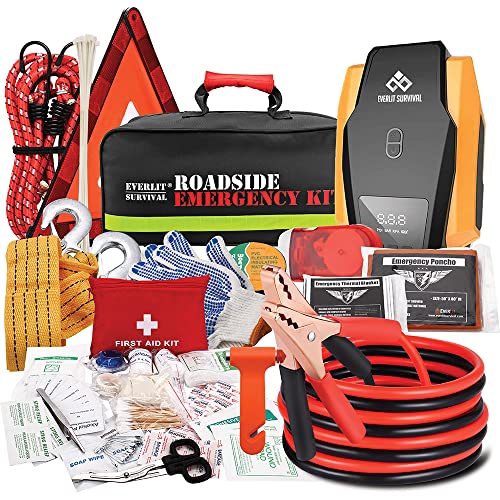
This kit targets drivers who want a single bag that covers the broadest realistic roadside scenarios. Owner feedback frequently highlights the digital auto air compressor as the standout component, noting its accuracy compared to dial gauges bundled in cheaper sets. The 12-foot jumper cables reach most modern sedan battery placements without repositioning.
- Pro: Combines tire inflator, jumper cables, tow strap, first aid, flashlight, and gloves in one organized bag
- Pro: Digital compressor eliminates the guesswork that plagues analog gauges at night
- Con: The 12-foot jumper cable length may fall short for larger trucks or SUVs with front-mounted batteries
Skip this if your vehicle already has a built-in TPMS and a functional jack; you would be paying for compressor and cable redundancy.
AUTODECO Car Roadside Emergency Kit
The most affordable option here suits budget-conscious drivers who want basic visibility and communication aids without committing to a full tool suite. It works well as a starter kit for a second or rarely driven vehicle.
- Pro: Lowest entry cost in this roundup, making it easy to justify stocking in every household car
- Pro: Compact and lightweight, fits behind a seat or in a small trunk pocket without taking up meaningful space
- Con: Owners note the included first-aid supplies are thin on bandage sizes and antiseptic options compared to dedicated kits
Skip this if you regularly drive rural routes where a flat tire means a long wait; the lack of a functional jack interface or tire repair tools becomes a real limitation fast.
AUTODECO Car Emergency Roadside Assistance Kit with Jumper Cables Tire Inflator
This mid-tier option is for drivers who want the two most common rescue tools — jumper cables and a tire inflator — without the premium attached to the Everlit set. Owner reports praise the overall build consistency of the carry bag.
- Pro: Covers dead battery and low-pressure scenarios simultaneously, addressing two of the three most frequent roadside calls
- Pro: The bag design keeps items sorted by function, reducing the fumble factor in cold or low-light conditions
- Con: The tire inflator is a manual foot-pump style rather than a digital compressor, meaning real physical effort and slower inflation
Skip this if you are physically limited or drive an SUV with large tires; a foot pump will feel inadequate against a 33-inch sidewall.
142 PCS Emergency Roadside Kit for Car with Jumper Cables
This kit appeals to drivers who equate component count with preparedness and want a wide array of small items — reflective triangles, rain ponchos, multipurpose tools — packed together. It is especially fitting for families who carpool with teenagers and want every minor scenario addressed.
- Pro: The 142-piece spread includes items other kits omit, such as spare bulbs and a hand-crank flashlight with no battery anxiety
- Pro: Jumper cables are gauged adequately for standard four-cylinder and V6 vehicles per spec sheets
- Con: Several items are single-use consumables (ponchos, small alcohol wipes) that create a high count but low practical depth
Skip this if you prefer a streamlined kit you can grab in under five seconds; rummaging through many small compartments defeats the purpose when rain is falling.
AUTODECO Car Roadside Emergency Kit with Jumper Cables, Tow Straps, Safety Hammer
This compact set adds a safety hammer — a tool genuinely valuable for breaking a side window in a submerged or jammed-door scenario — to a standard jumper-and-tow package. It suits urban drivers in areas with flash-flood risk or older door mechanisms.
- Pro: Includes a spring-loaded safety hammer and seatbelt cutter, a life-safety feature most similarly priced kits lack
- Pro: Tow strap is rated adequately for standard sedans and hatchbacks, per published load specs
- Con: The first-aid component is minimal, essentially a few adhesive strips and gauze pads rather than a treatable kit
Skip this if you are on remote highway routes where a serious injury is more likely than a window jam; pair it with a dedicated first-aid kit instead.
Mini First Aid Kit 150 Piece Waterproof EVA Hard Shell Case
This is not a full roadside kit but a focused supplement, ideal for anyone whose existing car emergency kit has a thin or damaged medical module. The hard-shell EVA case survives being crushed under trunk cargo.
- Pro: The 150-piece count covers lacerations, abrasions, and minor burns across multiple bandage sizes without relying on filler items
- Pro: Waterproof sealed case protects contents from humidity, road salt spray, and accidental spills — common failure points in fabric-pouch kits
- Con: Provides zero roadside mechanical aid; it solves only the medical layer of emergency preparedness
Skip this if your budget covers only one purchase; a full kit from the list above serves you better as a standalone item.
Jump Starter with Air Compressor Car Emergency Kit for Women, Men, Teen
The premium choice here is for drivers who want true self-sufficiency: a lithium jump starter eliminates dependence on another vehicle with a healthy battery. The integrated air compressor covers both dead-battery and low-tire emergencies in one device.
- Pro: Lithium jump starter delivers instant cranking power without a donor car, a genuine safety upgrade for solo drivers or nighttime breakdowns
- Pro: Built-in compressor with a digital pressure readout handles tire inflation without any separate purchase
- Con: Requires periodic recharging; a dead jump starter in a cold garage recreates the original problem at the worst timing
Skip this if your vehicle is newer with low battery failure risk; the premium over the mid-range kits is only justified when self-cranking capability matters to you.
Amazon Basics Emergency Escape Tool Window Breaker and Seatbelt Cutter 2 Pack
A two-pack means you can place one within driver reach and one in a rear-door pocket for passengers. This is a single-purpose tool priced low enough to justify keeping in every vehicle without hesitation.
- Pro: Spring-loaded tungsten tip shatters tempered side glass reliably, per consistent owner confirmation across reviews
- Pro: Protective wall bracket included, preventing accidental triggering inside a rattling glovebox or seat pocket
- Con: Addresses only the entrapment scenario; contributes nothing to tire, battery, or injury emergencies
Skip this if you need one purchase to cover multiple failure modes; use it as a supplement to a broader kit rather than a substitute.
Buying Guide
Jump Cables: Gauge Length and Clamp Quality
Cable length should match your vehicle layout — sedans with rear-mounted batteries get by with 10 feet, while trucks and SUVs with front-mounted posts often need 12 or more. Clamps with copper jaws and wide spring tension grip corroded terminals far better than thin steel-alloy versions, which slip and spark.
Tire Repair vs. Inflation Tools
A compressor or foot pump addresses low pressure but cannot seal a puncture. If you drive on roads with high debris or puncture frequency, a plug kit or sealant inflator combo covers more failure modes than inflation alone.
Organization and One-Hand Accessibility
The best kit you cannot find in the dark is useless. Look for kits with elastic loops, labeled pockets, or a carry handle that lets you deploy items one-handed while sheltering under an umbrella or steadying yourself on a shoulder.
Our Verdict
The Everlit Survival Car Emergency Kit is the top overall pick — it delivers digital inflation, adequate jumper cables, tow support, first aid, and lighting in one organized package for under seventy dollars. The AUTODECO Portable Safety Kit earns the budget slot at roughly a quarter of that price for drivers who simply need a minimal visibility and communication layer. However, the Jump Starter with Air Compressor wins outright for solo drivers or those in areas where cell coverage is unreliable and waiting for a donor vehicle is not a viable option.
FAQ
Do I really need a car emergency kit if I have roadside assistance?
Roadside assistance averages 30 to 60 minutes of wait time depending on weather and demand, so a kit keeps you safe and functional during that gap rather than standing helpless in cold rain or near traffic.
How often should I check or replace kit contents?
Inspect batteries, first-aid expiration dates, and the charge level of any electronics twice a year — once before winter and once before summer road-trip season. Replace anything that looks degraded rather than waiting for an emergency to test it.
Is a tire inflator better than a can of fix-a-flat sealant?
A inflator restores pressure without chemicals and works on slow leaks, while sealant temporarily plugs a puncture but can unbalance wheels and complicate later repairs. A digital inflator covers more scenarios over its service life.
Should a kit include a fire extinguisher?
A small Class ABC extinguisher is worthwhile for vehicles over ten years old or those that tow trailers, where electrical faults and heated brakes present real risk. It is rare in bundled kits due to cost and mounting complexity, so it is usually an add-on purchase.