For most backyards, a solar fountain with a separate small solar panel and a built-in battery suits buyers who want water movement on cloudy days, while a simple panel-on-pump floating or bird bath fountain suits buyers who only want sparkle in full sun at a budget price. Which is best depends on where the water feature sits, how sunny that spot is, and whether you want it to keep running in the evening.
Our top picks


As an Amazon Associate we earn from qualifying purchases at no extra cost to you.
Solar Water Fountains at a Glance
| Type | Best for | Key traits | Limits |
|---|---|---|---|
| Floating solar fountain (direct-drive) | Small ponds and large bird baths | Panel sits on the unit; pump runs only when sunlight hits the panel | Stops in shade or at dusk; light weight can drift in wind |
| Solar bird bath fountain kit | Garden bird baths up to modest basin size | Compact pump with a small panel and several spray heads | Output is small; may not suit deep or wide basins |
| Solar fountain with battery backup | Patios and yards with partial shade | Separate panel charges a built-in battery so the fountain can run later | Heavier, more parts, higher cost tier |
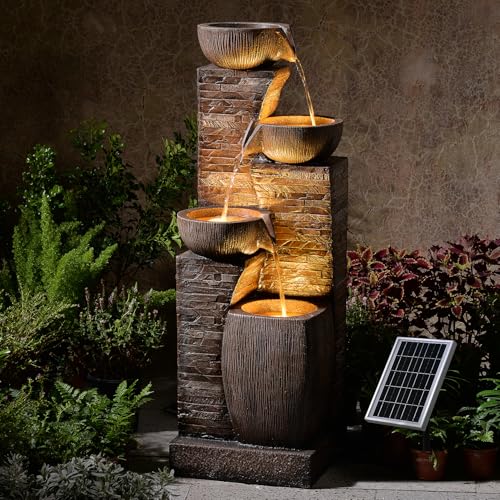
| Solar-powered tiered or statuary fountain | Decorative focal points | Resin, stone-look or metal basin with a hidden pump and panel | Pump size limits the water height; basin refills needed |
| Solar pond pump kit (such as ones from Aquascape or similar makers) | Ponds and larger water features | Pump rated by flow, with a separate panel | Needs correct panel sizing and placement |
How Solar Fountains Work
A solar fountain uses a photovoltaic panel to run a small DC pump. In a direct-drive design, the pump runs only while the panel receives light. Output rises and falls with the sun, so the spray can pulse on partly cloudy days and stop at night. Battery-backed designs store some energy to extend running time or to keep the flow steady. Makers usually describe performance for full direct sun, so real results in shade or in winter will be lower. Reviewers who cover garden gear often point out that panel placement matters more than any single spec.
Choosing by Location
- Full sun, open yard: A direct-drive floating or panel-on-pump unit is simple and low cost.
- Partial shade: Choose a model with a separate panel on a cable so the panel can sit in the sun while the fountain sits in a shaded spot.
- Covered patio: Solar may not work at all; consider a plug-in or low-voltage fountain.
- Bird bath: Look for a low-flow pump with a gentle spray so birds are not splashed away, and a basin deep enough for the fountain to function.
Direct-Drive Floating Fountains
Floating fountains are the most common budget option. They sit on the surface of a pond or bird bath, with the panel on top and a pump below. Makers list a spray pattern or several nozzle heads, and often a small height. They are easy to move, require no plumbing and have no wires. The trade-off is that they stop when the sun does, and wind can push them around, so a small tether or weight is sometimes needed. Water that is too shallow may allow the pump to run dry, so follow the minimum water depth in the manual.
Separate-Panel Kits
Kits that put the panel on a cable are more flexible. You can place the panel on a post, fence or roof edge, point it toward the sun, and keep the pump discreetly in a bird bath or small pond. Reviewers tend to prefer these for fountains in awkward spots, because shade over the basin does not cut power. Check the cable length, which is often a few feet, and make sure the connector is water resistant according to the maker.
Battery-Backup Models
Battery-backed fountains store solar energy and release it to the pump, often with a switch for on, off or auto modes. They keep working through brief clouds and can run into the evening, depending on the battery size. Because lithium or nickel-metal-hydride batteries wear out, look for a model that lets you replace the battery or that states a battery life. In regions with freezing winters, bring the battery and pump indoors, as the maker advises.
Decorative and Tiered Fountains
If the fountain is a centerpiece, a resin or metal tiered design with a hidden solar pump gives a finished look. These are heavier and typically need a level surface. The pump in these kits is usually small, so the water output is gentle. Check the weight, basin capacity, and whether the panel can be separated from the fountain to catch more sun.
Pond Pump Kits
For ponds, a solar pump kit rated by flow rate can power a fountain head or a waterfall. Aquascape and other pond-equipment makers list flow rates and panel pairings. These are typically a mid-range or premium tier. Size the system to the pond: a bigger pond or taller fountain needs more panel area. Solar pumps alone usually do not provide the steady circulation and filtration fish ponds need, so consult the maker or a pond specialist if you keep fish.
Budget Tier Trade-offs
- Budget: Floating or panel-on-pump fountains. They work in full sun and cost little, but output is basic and the parts are light plastic.
- Mid-range: Separate-panel kits and battery-backed fountains with multiple spray heads.
- Premium: Larger pond pump systems or decorative fountains with stronger pumps, bigger panels and better materials.
Fit, Care and Safety Notes
- Clean the panel with a soft cloth every few weeks; dust and pollen cut output.
- Rinse the pump intake and nozzle regularly; algae and debris cause clogging. A pump filter or sponge, if included, needs periodic cleaning.
- Do not run the pump dry; keep water above the minimum level in the manual.
- Bring batteries and pumps indoors before freezing weather unless the maker says otherwise.
- Keep all electrical connections away from standing water beyond what the maker allows, and keep small parts away from children and pets.
- Use only the maker’s batteries and chargers.
- Stagnant water can breed mosquitoes; moving water helps but regular cleaning and refilling are still needed.
Sizing the Panel and Pump
Makers often state the pump flow and the panel wattage separately, and the pairing matters. A larger panel can run a stronger pump or spray head, but only if the pump is designed to use that power. A small panel on a strong pump will pulse and stall. For a bird bath, a gentle low-flow pump is usually enough, while a tall fountain head or a waterfall needs a bigger system. Consider how many hours of direct sun the panel will actually receive, which may be far fewer than daylight hours, and tilt the panel toward the sun’s path. Where the maker allows it, an extension cable lets you keep the panel in the open while the fountain sits under trees.
Pick X If …
| If you want … | Pick | Why |
|---|---|---|
| The simplest, lowest-cost option for a sunny bird bath | Floating or panel-on-pump fountain | No wires or assembly |
| A fountain in a shaded spot | Separate-panel kit | Panel can sit in the sun |
| Water running after sunset or on cloudy days | Battery-backup model | Stored energy keeps the pump going |
| A decorative focal point | Tiered or statuary solar fountain | Looks finished, hides the pump |
| A larger pond feature | Solar pond pump kit | Stated flow rate and panel sizing |
Alternatives to Consider
- Plug-in low-voltage fountain pump. A weatherproof outdoor outlet gives steady flow without depending on sun.
- Bubbler or small waterfall. A bubbler uses less pressure and makes gentle sound.
- Solar fountain with a USB charging option. Some models allow charging from a USB source on dull days.
Frequently Asked Questions
Do solar fountains work on cloudy days?
Direct-drive models often slow down or stop under heavy cloud, because the pump relies on live sunlight. Battery-backed models can keep running for a while from stored energy. Makers usually state performance for direct sun only.
How long do solar fountain pumps last?
Lifespan depends on water quality, how often the pump is cleaned, and how much dry running occurs. Small brushless pumps are generally advertised as longer lasting than brushed motors. Check the warranty period the maker states.
Can I use a solar fountain in a bird bath?
Many kits are designed for that, with low-flow pumps and gentle sprays. Keep the water depth above the pump’s minimum, and clean the basin often to keep birds healthy. Remove the fountain if the spray seems to scare the birds.
Will a solar fountain work all winter?
Not usually. Short days, low sun angles and freezing temperatures reduce output and can damage pumps and batteries. Most makers advise storing the pump and battery indoors before a hard freeze.
Why does my fountain keep clogging?
Algae, leaves and fine sediment can block the pump intake or spray head. Clean the intake, rinse the nozzle, and remove debris from the water regularly. A fine mesh filter, where included, helps.
Is a solar fountain safe around pets and children?
The low-voltage pumps used in these products are designed for outdoor garden use, but small parts and open water still need supervision. Follow the manual’s warnings and keep batteries out of reach.