Our Short List of 3

- Battery: 25,000 mAh lithium-polymer
- Solar panels: 4 foldable panels
- Outputs: 3 USB ports (USB-C and USB-A), up to 3A fast charge
- Extras: built-in flashlight
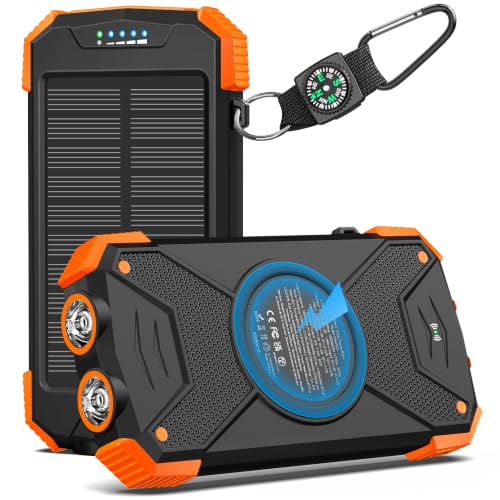
- Battery: 10,000 mAh lithium-cobalt
- Solar input: single panel, 1.15 watts maximum
- Outputs: USB-C (20W), USB-A, and 10W Qi wireless charging; 3 devices at once
- Water resistance: IPX5

- Panel output: 28 watts, 25.4 percent conversion efficiency
- Battery: none, direct charging only
- Ports: 2 USB-C and 1 USB-A, 5V/3A each, 5V/4.8A combined
- Water resistance: IP44 (junction box not waterproof)
All 4 Picks at a Glance
| Product | Specs | Action |
|---|---|---|
| Hiluckey Solar Charger 25000mAh |
| Check price on Amazon |
| BLAVOR Solar Power Bank 10,000mAh |
| Check price on Amazon |
| BigBlue 28W Solar Panel Charger |
| Check price on Amazon |
 BioLite SolarPanel 5+ |
| Check price on Amazon |
Our Top Picks
A dead phone turns a breakdown into a much bigger problem. When the car will not start or a storm knocks out power along your route, the phone is how you call for help and find the nearest open services. A solar charger kept in the car covers the gap: it stores charge like a normal power bank, then refills itself from daylight whenever the car is parked in the sun.
The five picks below suit car kits rather than backpacks: two high-capacity solar power banks for the glove box or trunk, a folding panel that charges devices directly at a rest stop, a slim panel with a small built-in battery, and a compact bank with wireless charging. All specifications come from published listing and manufacturer data.
As an Amazon Associate, we earn from qualifying purchases.
Table of Contents
- Quick Answer
- Hiluckey Solar Charger 25000mAh
- BLAVOR Solar Power Bank 10,000mAh
- BigBlue 28W Solar Panel Charger
- BioLite SolarPanel 5+
- Suscell Solar Power Bank 38800mAh
- How to Choose
- Who Should Skip
- FAQ
- Conclusion
Quick Answer
For most car kits, the Hiluckey 25000mAh is the best all-round pick: four folding panels, three outputs and enough stored charge for several phone refills. The BLAVOR 10000mAh is the smaller glove-box option with wireless charging. Drivers who want daylight charging without a battery should take the BigBlue 28W panel; the BioLite and Suscell cover slim and high-capacity niches.
Hiluckey Solar Charger 25000mAh
- Battery: 25,000 mAh lithium-polymer
- Solar panels: 4 foldable panels
- Outputs: 3 USB ports (USB-C and USB-A), up to 3A fast charge
- Extras: built-in flashlight
The Hiluckey is the anchor pick for a car kit. Its 25,000 mAh lithium-polymer battery holds enough charge for several full phone refills, and unlike single-panel banks it carries four foldable solar panels, so a spread across the hood or roof at a rest stop collects far more sunlight than a typical small panel. Three outputs — one USB-C and two USB-A — charge up to 3 amps, so driver and passenger can top up at once.
For car storage, the folded size matters: at about 6.2 by 3.5 by 1.4 inches and roughly 1.2 pounds, it fits a glove box or trunk organizer without crowding out the kit. A built-in flashlight covers night-time jobs like finding the jack points. Recharge it from the car’s USB port before trips and let the panels maintain it between drives; solar input on any bank this size is a maintainer, not a fast refill.
Choose the Hiluckey as the charger that lives in the car full time.
BLAVOR Solar Power Bank 10,000mAh
- Battery: 10,000 mAh lithium-cobalt
- Solar input: single panel, 1.15 watts maximum
- Outputs: USB-C (20W), USB-A, and 10W Qi wireless charging; 3 devices at once
- Water resistance: IPX5
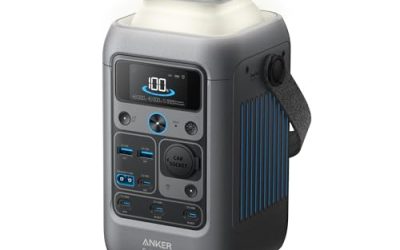
The BLAVOR PN-W05 is the compact option, sized for a glove box or center console rather than a trunk kit. Its 10,000 mAh lithium-cobalt battery covers one phone several times over. What sets it apart is the Qi wireless charging pad on its face: a phone with a dead battery and a forgotten cable can still charge, which is exactly the failure mode a car kit exists for. A USB-C port with 20W output handles cabled fast charging.
The rest of the design suits a car that sits outdoors. The case is IPX5 waterproof, dustproof, and shockproof, with dual flashlights and a compass carabiner in the box. The built-in solar panel peaks at 1.15 watts, and BLAVOR itself frames solar as the backup method: refill by cable as the main routine, and let the panel trickle energy back while the car is parked in daylight. At 9.3 ounces, it disappears into a console until needed.
Pick the BLAVOR for a commuter car where the likely emergency is one dead phone, not a family of devices.
BigBlue 28W Solar Panel Charger
- Panel output: 28 watts, 25.4 percent conversion efficiency
- Battery: none, direct charging only
- Ports: 2 USB-C and 1 USB-A, 5V/3A each, 5V/4.8A combined
- Water resistance: IP44 (junction box not waterproof)
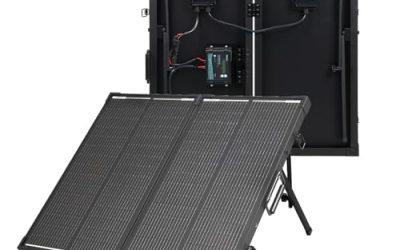
The BigBlue takes the opposite approach to the power banks: there is no battery at all. Four folding panels deliver up to 28 watts directly to whatever is plugged in, through two USB-C ports and one USB-A port, each rated at 5 volts and 3 amps with a 5-volt, 4.8-amp combined ceiling. Published conversion efficiency is 25.4 percent, the highest figure in this roundup: spread it on the roof or hood in full sun and a phone charges at something close to wall speed.
Two honest limits shape how it fits a car kit. First, it only works while the sun is out, so it complements a stored battery rather than replacing one. Second, BigBlue advises against using it behind a windshield: glass cuts the sunlight reaching the cells, so deploy it outside the car. It folds to about 11 by 6.3 by 1.3 inches, weighs 1.48 pounds, and carries an IP44 rating on the panels (the junction box is not waterproof).
Choose the BigBlue if your kit already has a battery bank and lacks a way to refill it during a long, sunny stranding.
BioLite SolarPanel 5+
- Panel output: 5 watts, monocrystalline
- Battery: 3,200 mAh lithium-ion, built in
- Ports: 1 USB-A output, micro-USB input
- Alignment: integrated sundial and 360-degree kickstand
The BioLite SolarPanel 5+ is the slim, deliberate option. A rigid 5-watt monocrystalline panel carries a small 3,200 mAh lithium-ion battery in its frame, so it stores a phone top-up instead of demanding that the phone sit in the sun. That battery is roughly one phone charge — a get-home tool, not a multi-day supply — but the panel is only 0.94 inches thick and weighs 13.76 ounces, so it slides behind a seat where a bulky bank would not live.
Its standout feature is the Optimal Sun System: an integrated sundial shows whether the panel is aimed at the sun, and a 360-degree kickstand holds the angle on uneven ground. At a roadside turnout, that aid is the difference between a panel that is working and one that is merely outside. Output is a single USB-A port, input is micro-USB for pre-charging from the car, and the body is IPX4 splash resistant.
Pick the SolarPanel 5+ for a small car or minimalist kit with a very thin storage slot.
Suscell Solar Power Bank 38800mAh
The Suscell is the capacity-first budget pick. Its maker-rated 38,800 mAh battery is the largest headline figure in this roundup; treat that as the maker’s rating rather than a promise of that much usable energy at the phone, since conversion losses apply to every bank here. What is concrete: two USB-A output ports rated up to 2.4 amps, a built-in solar panel for maintenance charging, and a dual LED flashlight for night use at the roadside.
The trade-offs are in the details the listing does not publish. Weight and dimensions are not stated for this model, and there is no USB-C port, so newer phones charge over USB-A cables only. For a trunk kit checked a few times a year, those gaps are acceptable; the job is stored energy and a light, kept in the car permanently. Store it charged and top it up on a schedule.
Specs
- Battery: 38,800 mAh (maker-rated)
- Solar panel: single built-in panel, wattage not stated
- Outputs: 2 USB-A ports, up to 2.4A
- Extras: dual LED flashlight
- Dimensions: not stated
- Weight: not stated
- Model: S1008D
- Tier: budget
Choose the Suscell for a second car or spare kit where USB-C speed does not matter.
How to Choose
Start with the storage question, because it decides the product type. A solar power bank — the Hiluckey, BLAVOR, and Suscell here — stores energy and works at night or in rain; a pure panel like the BigBlue only works in daylight but never goes flat in storage. Most car kits want a bank as the foundation, with a panel added only if long sunny strandings are realistic.
Next, be realistic about solar speed. Small built-in panels produce around a watt; they maintain a charge across days but do not refill a large battery in an afternoon. The four-panel Hiluckey and the 28-watt BigBlue collect far more, and even they need direct sun outside the windshield. Charge by cable as the routine, and treat sunlight as the backup.
Then match capacity to the household. One driver and one phone need 10,000 mAh; a family road-trip car should carry 25,000 mAh or more. Finally, store any lithium bank in the glove box, console, or trunk — never loose on a sun-baked dashboard, where cabin heat is hardest on the cells — and top it up twice a year, on the same schedule as checking the spare tire.
Who Should Skip
Skip solar chargers entirely if what you actually need is to restart the car: none of these products jump-starts a vehicle battery. Skip the BigBlue panel as your only charger if your emergencies happen at night or in winter storms, since it stores nothing. Skip the BioLite if you need to run several devices — its battery holds about one phone charge. And skip keeping any of these on the dashboard; heat and theft both argue for the glove box.
FAQ
Can a solar charger jump-start a dead car battery?
No. Every product in this roundup outputs USB power for phones and small electronics. Jump-starting a vehicle takes a dedicated jump pack with a high-current 12-volt output, a separate product class. A solar bank’s job in a breakdown is keeping your phone alive so you can call for help.
Will a solar panel charge through the windshield?
Poorly. Glass blocks part of the sunlight, and BigBlue explicitly advises against using its panel behind a windscreen. A bank’s small panel on the dashboard gains some maintenance charge on a bright day, but for real charging, set the panel outside the car in direct sun and keep the phone or bank shaded to limit heat.
How often should a car-kit solar charger be topped up?
Every three to six months. Lithium batteries self-discharge slowly in storage, and a bank forgotten for two years may be flat when needed. Charge it from the car’s USB port or a wall outlet on a fixed schedule — the same routine as checking the spare tire — and let the solar panel offset the drain in between.
Is it safe to leave a solar power bank in a hot car?
Short periods are normal use, but a parked car in summer is the harshest storage a lithium battery faces, and heat accelerates cell aging. Store the bank in the glove box, console, or trunk rather than on the dashboard, and bring it indoors during extreme heat waves if the car sits unused.
Conclusion
Build the car charging kit around a stored battery. The Hiluckey 25000mAh is the default pick for most drivers, the BLAVOR suits a small commuter car and cable-free charging, and the Suscell maximizes capacity on a budget. Add the BigBlue 28W panel if daylight refills matter, or the BioLite SolarPanel 5+ if the kit has to stay slim. Charge it before you need it, and check it twice a year.
Product and ASIN Reference
| Product | ASIN |
|---|---|
| Hiluckey Solar Charger 25000mAh (HI-S025) | B0F37J94H4 |
| BLAVOR Solar Power Bank 10,000mAh (PN-W05) | B07FDXDB3W |
| BigBlue 28W Solar Panel Charger (B401DD) | B01EXWCPLC |
| BioLite SolarPanel 5+ (SPA0200) | B08SHZGFXZ |
| Suscell Solar Power Bank 38800mAh (S1008D) | B07Y9PYVJV |
More from Amazon
Programs that pair well with the guide above. Offers and eligibility are set by Amazon and may change.
Free shipping on eligible items, Prime Video and more. Eligible new members can start with a free trial.
Start a Prime free trialAudiobooks and podcasts to listen to on the go. Eligible new members can start with a free trial.
Try Audible freeAd-free music streaming. Eligible new subscribers can start with a free trial.
Try Music Unlimited freeA free business account with business pricing and bulk-buying tools for work, shop or home office.
Create a business accountAs an Amazon Associate we earn from qualifying purchases.