Our Short List of 3
- Best for: Owners adding a first panel to maintain and top up a single house battery.
- Maximum power: 100 watts
- Cell type: N-type monocrystalline
- Conversion efficiency: up to 25 percent (maker figure)
- Open-circuit voltage: 21.47 volts

- Best for: A set-and-forget roof array on a motorhome that sits outside year-round.
- Maximum power: 200 watts (2 x 100W monocrystalline panels)
- Charge controller: 30A PWM
- Maximum voltage: 27.4 volts
- Connector type: MC4

- Best for: Boondockers who park the motorhome in shade and carry the panel out into the sun.
- Maximum power: 300 watts
- Folded size: 20 x 38 in
- Weight: 15.3 lb
- Charge controller: 20A, separate unit
All 5 Picks at a Glance
| Product | Specs | Action |
|---|---|---|
| Renogy 100W Portable Solar Panel Kit with 20A Charge Controller |
| Check price on Amazon |
| ECO-WORTHY 200 Watts 12 Volt/24 Volt Solar Panel Kit |
| Check price on Amazon |
| DOKIO 300W Portable Foldable Solar Panel Kit |
| Check price on Amazon |
 ZOUPW 200W Portable Solar Panel |
| Check price on Amazon |
 ECO-WORTHY 200W Portable Solar Panel |
| Check price on Amazon |
Key takeaways
- Compare the best solar chargers for motorhomes by wattage, controller type, folded size and battery fit, from roof kits to foldable camp panels.
Buying solar for a motorhome is really two decisions made at once. The first is electrical: will the panel charge your house batteries directly through a charge controller, or will it feed a portable power station that handles regulation itself? The second is physical: will the panel live on the roof full time, or fold into a storage bay and come out only when you park somewhere sunny for a while?
This roundup serves Class A owners adding a permanent roof array, Class B and C owners who want a portable panel they can aim at the sun, and boondockers stretching time between generator runs. Every pick was chosen from the product names and specifications published on the Amazon product pages, favoring stated wattage, controller details and folded dimensions over marketing claims.
Quick Picks
As an Amazon Associate we earn from qualifying purchases.
| Product | Best for | Key spec from title |
|---|---|---|
| Renogy 100W Portable Solar Panel Kit with 20A Charge Controller | A first portable panel for a Class C house battery | 100W N-type suitcase with pre-installed 20A PWM controller |
| ECO-WORTHY 200 Watts 12 Volt/24 Volt Solar Panel Kit | A permanent roof install on a Class A or C | 2 x 100W mono panels with 30A PWM controller |
| DOKIO 300W Portable Foldable Solar Panel Kit | Parking in shade and setting the panel out in sun | 300W foldable at 15.3 lb with separate 20A controller |
| ZOUPW 200W Portable Solar Panel | Feeding a portable power station at camp | 200W with 23.5 percent efficiency and IP67 rating |
| ECO-WORTHY 200W Portable Solar Panel | A lighter second panel for weekend trips | 200W foldable with MC4 output and adjustable kickstand |
How to Choose
Match the panel to what it will charge
A panel that clips straight onto house batteries needs a charge controller between the panel and the bank, and the controller has to match your battery chemistry. A panel feeding a portable power station usually needs no separate controller, because the station regulates input itself, but its voltage has to sit inside the station’s accepted input range. Check the open-circuit voltage on the listing against your station’s limit before ordering, and check whether the kit’s controller lists lithium, AGM and flooded support if you plan to wire it to the house bank instead.
Decide between roof-mounted and portable panels
Roof panels charge while you drive and while you are away from the rig, but they sit flat, collect dirt and lose output when you park in shade. Portable panels fold into a bay, come out at camp and can be tilted toward the sun and moved as shadows shift, which often recovers more energy per rated watt. Many motorhome owners end up with both: a modest roof array for maintenance charging and one foldable panel for long stays. Decide which job you are buying for first, because the mounting hardware, cable lengths and storage needs are completely different.
Compare rated watts with real charging goals
Rated wattage is measured under standard test conditions, and a flat or partly shaded panel delivers less. As a planning rule, a 100W panel suits battery maintenance and small daily loads like lights and phone charging, 200W covers a typical day of lights, fans, a water pump and device charging for many couples, and 300W or more starts to matter when a compressor refrigerator runs around the clock. Treat maker estimates of daily watt-hours as best-case figures based on several hours of direct sun, and size up if your trips are in winter or at northern latitudes.
Measure storage space and check the cable run
A foldable panel only earns its keep if it fits the bay you actually have, so compare the folded dimensions and weight on the listing with your storage compartment before buying. Then trace the cable path: portable kits include cables of fixed length, often around ten feet, and the panel has to reach from a sunny patch of ground to the battery bay or power station without stretching across a walkway. Longer runs need extension cables with the right connectors, and every extra connection is a place for voltage drop, so plan the layout on paper first.
The 5 Best Options
Renogy 100W Portable Solar Panel Kit with 20A Charge Controller
- Best for: Owners adding a first panel to maintain and top up a single house battery.
- Maximum power: 100 watts
- Cell type: N-type monocrystalline
- Conversion efficiency: up to 25 percent (maker figure)
- Open-circuit voltage: 21.47 volts
Owners adding a first panel to maintain and top up a single house battery.
Renogy sells several generations of 100W suitcase kits under similar names, so confirm the listing shows the N-type model and the pre-installed controller before ordering.
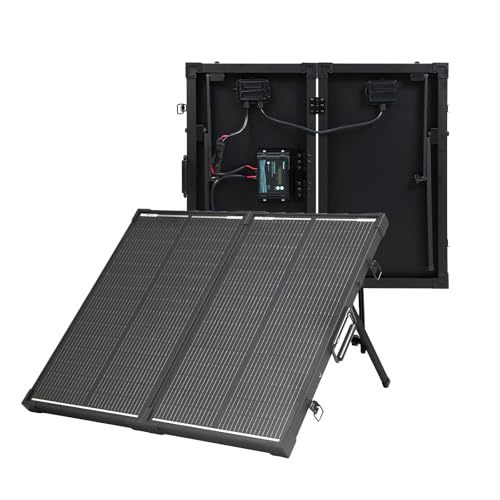
This suitcase kit is the low-commitment way into solar for a motorhome that has none. Two rigid sections fold together with a handle, the Voyager 20A PWM controller comes pre-installed on the back, and the included cable ends in alligator clips with a 15 amp fuse, so it connects to a house battery in minutes with no drilling and no wiring project. The N-type cells carry a maker-stated efficiency of up to 25 percent, and at 17.4 pounds it is easy to move between the storage bay and a sunny spot beside the rig.
ECO-WORTHY 200 Watts 12 Volt/24 Volt Solar Panel Kit
- Best for: A set-and-forget roof array on a motorhome that sits outside year-round.
- Maximum power: 200 watts (2 x 100W monocrystalline panels)
- Charge controller: 30A PWM
- Maximum voltage: 27.4 volts
- Connector type: MC4
A set-and-forget roof array on a motorhome that sits outside year-round.
The listing’s weight fields are inconsistent, so confirm the shipping weight and your roof’s load capacity, and budget separately for roof sealant and a cable entry gland.
This is the permanent-install option: two rigid 100W monocrystalline panels, a 30A PWM charge controller, Z mounting brackets, tray cables and branch connectors in one box. The panels use aluminum frames with an IP65 rated junction box, and the listing rates them for strong wind and snow loads, which suits a panel that will live on the roof in all weather. Because the kit supports both 12 volt and 24 volt systems, it also works for larger motorhomes with a 24 volt bank. Nothing folds, so it charges during drives and storage alike.
DOKIO 300W Portable Foldable Solar Panel Kit
- Best for: Boondockers who park the motorhome in shade and carry the panel out into the sun.
- Maximum power: 300 watts
- Folded size: 20 x 38 in
- Weight: 15.3 lb
- Charge controller: 20A, separate unit
Boondockers who park the motorhome in shade and carry the panel out into the sun.
The controller is separate, so you need a dry mounting spot for it near the batteries, and fabric foldables should be stored flat and dry rather than left out in storms.
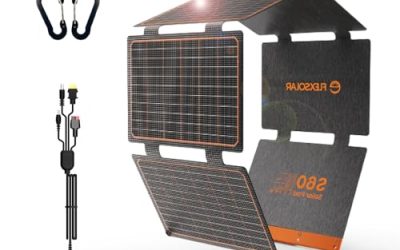
Three hundred watts is where a portable panel starts covering a compressor refrigerator plus lights and devices, and this DOKIO kit delivers that output in a fabric foldable that weighs 15.3 pounds and folds to roughly 20 by 38 inches. The 20A controller is a separate unit rather than panel-mounted, which keeps it inside the battery bay and out of the weather, and the cable set includes SAE to XT60, JY60 to DC and XT60 to alligator clip leads, so it can charge house batteries directly or feed many power stations.
ZOUPW 200W Portable Solar Panel
- Best for: Motorhome owners whose power station is the center of their electrical setup.
- Maximum power: 200 watts
- Cell efficiency: 23.5 percent
- Cell type: monocrystalline silicon
- Water resistance: IP67
Motorhome owners whose power station is the center of their electrical setup.
There is no charge controller for direct battery charging in this version, so battery-bank owners should look at the controller kits in this roundup instead.
This panel is built for the power-station route rather than direct battery charging. It folds to about 25 by 21 inches, carries an IP67 rating, and its control box offers USB-A and USB-C outputs alongside the MC-4 output, so phones and tablets can charge straight from the panel while the station fills. A built-in solar angle guide helps you tilt it toward the sun without guesswork. The listing is explicit that charging a 12V battery directly requires a separate controller, which is honest framing worth noting before you buy.
ECO-WORTHY 200W Portable Solar Panel
- Best for: Weekend and seasonal travelers who want one foldable panel that works with almost any power station.
- Maximum power: 200 watts
- Efficiency: 23 percent (maker figure)
- Output: MC4 with 59 in cable
- Included adapters: MC4 to XT60, DC7909 and DC8020
Weekend and seasonal travelers who want one foldable panel that works with almost any power station.
Published voltage figures for this panel family vary between sources, so check the open-circuit voltage on the listing against your power station’s input limit before ordering.
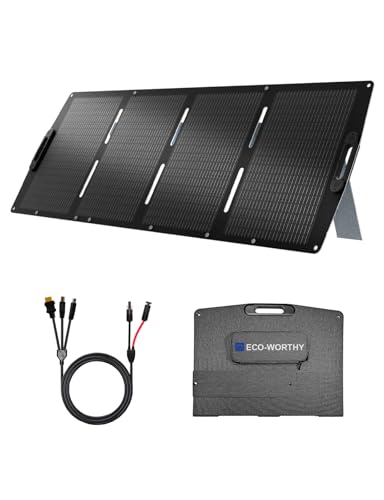
ECO-WORTHY’s foldable 200W panel is the flexible middle option: MC4 output with a 59 inch cable and adapters for XT60, DC7909 and DC8020 in the box, which covers most portable power stations without extra purchases. The maker states 23 percent efficiency and an IP65 rating, and an adjustable kickstand holds the panel at an angle instead of leaving it flat on the ground. It folds down into a carry format that suits a motorhome bay, and at 200 watts it is a sensible second panel alongside a small roof array.
Which One Fits Your Situation
You boondock for days at a time
Pick the DOKIO 300W kit. Long off-grid stays are where rated watts and placement freedom matter most, and a 300W foldable you can carry into full sun will out-produce a smaller roof panel parked under trees. Its separate controller keeps the charging hardware inside the bay, and the alligator clip cable means it can also rescue a low chassis battery in a pinch.
Your motorhome already has a power station
Pick the ZOUPW 200W panel, or the ECO-WORTHY 200W portable if your station uses a less common input. Both are built around station charging rather than battery wiring: the ZOUPW adds USB outputs and an angle guide, while the ECO-WORTHY includes the three most common adapter cables in the box. Either way, verify the panel’s open-circuit voltage against your station’s stated input range first.
You want a permanent roof setup
Pick the ECO-WORTHY 200 watt roof kit. It is the only pick here designed to be bolted down and forgotten, with brackets, tray cables and a 30A controller included, and panels rated for highway wind and snow loads. It keeps the house bank maintained in storage and charges while you drive, which portable panels cannot do. Plan the roof layout around vents and the air conditioner before drilling anything.
You mostly take weekend trips
Pick the Renogy 100W suitcase kit. For two or three nights, your batteries start full and the job is maintenance plus phones, lights and a fan, which 100 watts handles in decent sun. The pre-installed controller and clip-on cable mean setup takes minutes, and the rigid suitcase survives being slid in and out of a bay every weekend better than fabric panels.
Common Mistakes
- Buying a panel without checking its open-circuit voltage against the power station’s input limit, which can shut charging down or damage the station.
- Wiring a panel straight to house batteries with no charge controller, which overcharges the bank and shortens battery life.
- Judging by rated watts alone and ignoring that flat roof mounting, heat and partial shade all cut real output well below the label figure.
- Choosing a foldable panel before measuring the storage bay, then discovering it only fits on the bed.
- Leaving the included cable stretched across a walkway or campsite path, where it becomes a trip hazard and gets driven over.
Frequently Asked Questions
Can a solar charger run a motorhome air conditioner?
Not directly. Panels charge batteries or a power station, and an air conditioner draws far more than any single panel here produces, so running one takes a large battery bank, a suitable inverter and usually several hundred watts of solar. These chargers handle lights, fans, pumps, refrigeration support and device charging, and they extend how long a bigger system lasts off grid.
Do I need a charge controller between the panel and my house batteries?
Yes, unless the panel feeds a power station that regulates its own input. A controller stops overcharging, blocks reverse current at night and matches the charge profile to your battery chemistry. Two picks in this roundup include a controller, the DOKIO’s is a separate unit, and the station-focused panels leave regulation to the station, so check which arrangement you are buying.
How many watts does a motorhome actually need?
It depends on your daily loads. Battery maintenance and light use can work with 100 watts, a typical couple running lights, fans, a pump and devices often lands near 200 watts, and a compressor refrigerator running full time pushes the target toward 300 watts or more. Add up your own daily watt-hours from appliance labels, then size the panel above that figure to cover cloudy days.
Can I leave a portable panel outside in the rain?
Most panels here carry an IP65 or IP67 rating and tolerate rain while deployed, but controllers, control boxes and cable junctions are usually the weak points, and fabric foldables age faster when stored wet. Bring portable gear in during storms, let it dry before folding it away, and keep separate controllers inside the battery bay where the listing intends them to live.
More from Amazon
Programs that pair well with the guide above. Offers and eligibility are set by Amazon and may change.
Free shipping on eligible items, Prime Video and more. Eligible new members can start with a free trial.
Start a Prime free trialAudiobooks and podcasts to listen to on the go. Eligible new members can start with a free trial.
Try Audible freeAd-free music streaming. Eligible new subscribers can start with a free trial.
Try Music Unlimited freeA free business account with business pricing and bulk-buying tools for work, shop or home office.
Create a business accountAs an Amazon Associate we earn from qualifying purchases.