Key takeaways
- Pro: Combines jumper cables, air compressor, first aid, and flashlight in one case.
- Pro: Digital tire inflator simplifies pressure readings for less-confident users.
- Con: Components are consumer-tier; not ideal for repeated heavy-duty use.
A dead battery on a rainy shoulder or a flat tire at night on an unlit highway is not the moment to discover your trunk contains nothing but a stale granola bar and an old floor mat. A roadside emergency kit is the one piece of gear that turns a potentially dangerous situation into an inconvenience. The difference between a kit that gets you moving and one that leaves you calling a tow truck comes down to component quality, item count relative to price, and whether the included tools actually match the failures most drivers encounter.
The eight options in this roundup range from bare-bones pouches under twenty dollars to all-in-one systems pushing a hundred. Owner feedback consistently flags the same failure points across the category: jumper cables too thin to handle a modern SUV alternator, tire inflators that overheat after ten minutes, and first-aid components with expiration dates already passed at purchase. What separates the better kits from the rest is transparency in listing exact cable gauges, amp ratings, and included item counts — which is why specs and published reviews carry so much weight in this guide for 2026.
Our top picks


As an Amazon Associate we earn from qualifying purchases at no extra cost to you.
Quick Picks
| Product | Best for | Price |
|---|---|---|
| Everlit Survival Car Emergency Kit | All-in-one coverage with an air compressor | $69.95 |
| AUTODECO Portable Car Safety Kit (Black) | Minimum-budget backup for short commutes | $17.99 |
| AUTODECO Emergency Kit with Jumper Cables & Inflator | Mid-range jump-start and inflation combo | $36.09 |
| 142 PCS Emergency Roadside Kit | Highest item count per dollar | $39.99 |
| VCANENERGY Jump Starter & Air Compressor Kit | Heavy vehicles and multi-function portability | $99.99 |
| Car Emergency Kit with Portable Air Compressor | Balanced coverage for first-time kit buyers | $63.99 |
| WORKKOOL Safety Triangles (3 Pack) | Supplementing an existing kit with DOT-approved visibility | $22.99 |
| AUTODECO Car Safety Kit with Jumper Cables & Tow Strap | Compact trunk fit with essential mechanical tools | $28.79 |
How We Picked
We narrowed this category using four criteria drawn from published specifications and aggregated owner ratings. First, completeness against the most common roadside failures: dead battery, flat tire, low-visibility hazard, and minor first-aid needs. Second, component quality signals, particularly wire gauge on jumper cables and PSI ratings on inflators, because thin-gauge cables and underpowered compressors are the most frequent complaint in this price band. Third, value density — the number of usable items relative to cost. Fourth, form factor: a kit too bulky for a sedan trunk or too flimsy to survive a winter storm is a kit you will leave at home.
The 8 Best Roadside Emergency Kit in 2026
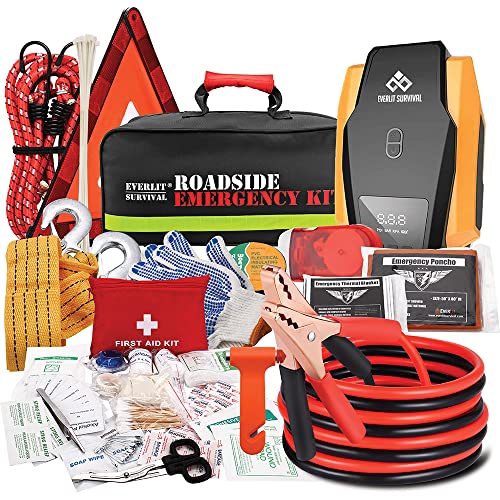
Everlit Survival Car Emergency Kit
This kit targets drivers who want a single purchase that covers jumping, inflating, and first-aid without sourcing add-ons. The included 12-foot jumper cables and digital air compressor address the two most frequent roadside needs, while gloves and a flashlight round out the basics. Owner feedback praises the compressor’s accuracy and the kit’s organized carrying case. The main limitation is depth: while the item count is solid, individual components are consumer-grade, meaning heavy-duty use on trucks or repeated seasonal deployment may expose wear faster than standalone tools would.
- Pro: Combines jumper cables, air compressor, first aid, and flashlight in one case.
- Pro: Digital tire inflator simplifies pressure readings for less-confident users.
- Con: Components are consumer-tier; not ideal for repeated heavy-duty use.
Skip it if you already own a quality compressor or cables and need only a first-aid or visibility add-on.
AUTODECO Portable Car Safety Kit (Black)
At under eighteen dollars, this is the entry-level safety net for drivers who commute short distances in fair-weather climates or need a second kit for a rarely used vehicle. Owner reviews note it covers basics like a flashlight and warning triangle but lacks jumper cables or a compressor, so it handles visibility and minor first-aid only. The compact black pouch fits glove boxes and door pockets easily, making it practical as a backup layer. Its simplicity is both the selling point and the ceiling.
- Pro: Lowest cost in this roundup for a basic safety foundation.
- Pro: Small enough to store in a glove box or center console.
- Con: No power tools; cannot address dead batteries or flat tires alone.
Skip it if your vehicle is older or you drive areas with limited cell reception where you must self-recover.
AUTODECO Car Emergency Kit with Jumper Cables & Tire Inflator
This mid-range option pairs jumper cables with a tire inflator, covering the two failures most likely to strand a driver. It suits anyone who wants mechanical capability without approaching premium pricing. Published specs and owner comments highlight the compact packaging that keeps both tools accessible without consuming trunk space. The trade-off is component capacity: the included cables and inflator are adequate for sedans and crossovers but may struggle with larger vehicles or severely underinflated tires.
- Pro: Combines the two most critical mechanical tools at a sub-forty-dollar price.
- Pro: Compact footprint suits smaller vehicles with limited storage.
- Con: Power ratings suit passenger cars better than trucks or SUVs.
Skip it if you drive a heavy vehicle or frequently travel highways far from help, where cable gauge and compressor power matter more.
142 PCS Emergency Roadside Kit
This kit wins on sheer item count, packing jumper cables, first-aid supplies, tools, and safety gear into a single carrying case. It appeals to families or drivers who want one box that addresses most minor scenarios without thinking. Owner feedback consistently notes the value density but also flags that not every item is high-quality; some accessories feel like filler. The jumper cables are the headline inclusion, and their presence at this price makes the overall package competitive for anyone building from scratch.
- Pro: Highest item count in this roundup at $39.99.
- Pro: Jumper cables included, covering the most common single failure point.
- Con: Variable component quality; some items exist only to inflate the count.
Skip it if you prefer fewer, better tools over a large assortment of single-use accessories.
VCANENERGY Jump Starter & Air Compressor Kit
This is the most capable standalone unit in the group, combining a portable jump starter with an air compressor and positioning itself for cars, trucks, and SUVs. It targets drivers who want to handle multiple vehicle types or who need to jump-start without a second vehicle nearby. The jump-starter battery eliminates dependence on another car’s electrical system. At nearly a hundred dollars, it is the priciest option, but owner reviews confirm it handles heavier engines that cable-based kits sometimes cannot.
- Pro: Built-in battery allows jump-starting without another vehicle.
- Pro: Rated for trucks and SUVs, not just passenger cars.
- Con: Highest price in this roundup, limiting budget flexibility.
Skip it if you only drive a small sedan and have a neighbor willing to share cables; the premium may not justify itself.
Car Emergency Kit with Portable Air Compressor, First Aid, Jumper Cables
This balanced kit includes an air compressor, first-aid components, and jumper cables, hitting the same core trio as the Everlit option at a lower price. It suits first-time kit buyers who want to cover all bases without a steep entry cost. Owner feedback highlights the compressor’s utility and the kit’s organized layout. The limitation is that its jumper cables are shorter and the first-aid section is more minimal than the Everlit equivalent, making it a capable middle option rather than the deepest one.
- Pro: Core trio of tools at a price well under seventy dollars.
- Pro: Portable compressor handles multiple tire sizes in one session.
- Con: Jumper cables and first-aid components are thinner than premium rivals.
Skip it if you need maximum cable length or a more comprehensive first-aid section for family vehicles.
WORKKOOL Safety Triangles (3 Pack)
These DOT-approved warning triangles are not a full kit but a critical add-on for any existing setup. They address low-visibility situations where flares or reflective triangles prevent a secondary collision. The three-pack design means one for the front, one behind, and one spare, and the carry case keeps them stable in a trunk. Owner feedback confirms reliable stability on paved shoulders. The absence of sand or weighted bases means they may tip in strong wind or on soft ground.
- Pro: DOT-approved and highly visible, meeting legal requirements in many states.
- Pro: Compact carry case makes storage and retrieval fast in poor weather.
- Con: No sand or weight included; may topple in high wind or on gravel.
Skip it only if your existing kit already includes weighted, reflective triangles or LED warning beacons.
AUTODECO Car Safety Kit with Jumper Cables, Tow Strap & Safety Hammer
This compact kit covers mechanical and emergency-exit needs, including a safety hammer for breaking windows or cutting seatbelts during submersion scenarios. The tow strap adds recovery capability beyond jump-starting, making it relevant for drivers who frequent unpaved or snow-covered roads. At just under twenty-nine dollars, it is competitive for its scope. Owner comments note the tools are functional but the overall build feels lighter than the Everlit or 142-piece options, so component durability may vary.
- Pro: Includes a safety hammer and tow strap, covering recovery and emergency-exit needs.
- Pro: Compact size fits sedan trunks without consuming significant space.
- Con: Build materials feel lighter; durability under repeated heavy use is unproven.
Skip it if you need an air compressor or first-aid supplies in the same package.
Buying Guide
Jumper Cable Gauge and Length
Cable thickness determines whether a kit can deliver enough amperage to crank a modern alternator. Thinner cables work for compact cars but fail on larger engines or cold-weather starts. Length matters because you need to reach both vehicles at a safe angle without pinching cables in closing doors. Anything under twelve feet restricts parking flexibility, and cables that lack rubberized clamps are prone to corrosion.
Air Compressor Power Source and PSI Output
Most kits in this range draw power from a 12-volt cigarette-lighter outlet, which limits output to roughly one hundred fifty PSI — adequate for car tires but insufficient for large truck tires that start near ninety PSI and need top-ups. Digital units with auto-shutoff reduce the risk of overinflation. If you drive anything heavier than a crossover, verify the compressor’s duty cycle, because continuous use on larger tires causes consumer models to overheat and shut down.
Component Quality vs. Item Count
A high piece count sounds impressive but can mask filler items like single-use bandages or cheap flashlights that fail within a season. Check whether critical components — cables, compressor, first-aid medications — are branded or carry relevant safety certifications. A kit with fewer items but verified specs will outperform a padded assortment that adds bulk without real-world reliability.
Our Verdict
The Everlit Survival Car Emergency Kit is the top overall pick because it bundles the core four functions — jump-starting, inflation, first aid, and visibility — in a single organized case at a price that undercuts most premium competitors. For the tightest budget, the AUTODECO Portable Car Safety Kit at $17.99 is a reasonable backup for drivers who already have jumper cables in the trunk and need visibility tools on a second vehicle. If you regularly drive a truck or SUV, the VCANENERGY Jump Starter & Air Compressor Kit earns its premium by handling power demands that cable-based kits simply cannot.
FAQ
Do I need a roadside emergency kit if my car has a spare tire and jack?
A spare tire addresses punctures but not dead batteries, low-visibility hazards, or minor injuries. A kit with jumper cables and warning devices covers scenarios your jack cannot, and most manufacturers now exclude full-size spares in favor of repair kits.
How often should I replace or check my kit’s contents?
First-aid medications and adhesives degrade over time, and lead-acid jumper cables corrode with exposure. Inspect components every six months, replacing any first-aid items approaching their printed expiration date and checking cable clamps for rust or broken insulation.
Are DOT-approved safety triangles legally required?
Federal law mandates warning devices for commercial vehicles, and some states extend requirements to passenger cars during emergency stops. Even where not legally required, reflective triangles or LED beacons significantly reduce the risk of a secondary collision and cost far less than a tow.
Can a jump starter replace jumper cables entirely?
A portable battery jump starter eliminates the need for a second vehicle, which is its primary advantage. However, cables remain useful for charging another car’s alternator over a longer period and carry no internal battery that can lose its own charge in cold storage.