Key takeaways
- An RV changes the usual power-station question. Instead of asking how many phone charges a battery holds.
An RV changes the usual power-station question. Instead of asking how many phone charges a battery holds, you are asking whether a single box can carry a coffee maker, a microwave, a laptop and a fan through a night at a dispersed campsite, then refill from panels or a shore connection the next day. The keyword “best portable power station for RV” is really a sizing problem: enough watt-hours to last, enough AC output to start your appliances, and a recharge speed that fits how often you move.
This guide is for travelers who want a battery they can carry in and out of the rig, not a permanent install. Every pick below leans on the figures printed in its listing title, so the comparison stays on capacity, output, chemistry and charging claims you can verify yourself. In 2026 most large units use lithium iron phosphate cells, and that shows up across this lineup.
Quick Picks
Our top picks





As an Amazon Associate we earn from qualifying purchases at no extra cost to you.
| Product | Best for | Key spec from the title |
|---|---|---|
| Jackery HomePower 3600 Plus | Longest runtime in this group | 3584Wh, 3600W AC output |
| PECRON F3000LFP | Large appliances plus expansion | 3072Wh, 3600W, LiFePO4 |
| EcoFlow DELTA 3 Max | Quick top-ups between stops | 2048Wh, 2400W, 0-80% in 1.13 hr |
| Anker SOLIX C2000 Gen 2 | Fast wall recharging | 2048Wh, 2400W, full charge in 58 min |
| BLUETTI Elite 300 | Big capacity, small footprint | 3014.4Wh, 2400W, 4800W surge |
| DJI Power 2000 | Higher continuous output | 2048Wh, 3000W stable output |
| BLUETTI Elite 100 V2 | Weekend trailers and light loads | 1024Wh, 1800W, 10ms UPS |
How to Choose
Match watt-hours to your nightly loads
Add up what you run and for how long. A 60-watt fan for eight hours plus a 100-watt laptop session of four hours is roughly 880 watt-hours before conversion losses. Anything near 1,000Wh suits a weekend with modest loads; 2,000Wh and above gives room for a day of cooking and charging; 3,000Wh and above is where multi-day boondocking starts to look realistic without constant sun. Divide capacity by the combined watts you run to estimate hours, then shave off some for inverter losses.
Check continuous watts, not just surge
Continuous AC output decides what you can run at once. An 1,800W unit handles a microwave and a small kettle one at a time; 2,400W to 3,600W handles several loads together. Surge numbers matter for motors and compressors, but a large surge figure paired with modest continuous output still trips under sustained loads. A rooftop air conditioner is the classic test: its running draw and startup spike both need to fit under the rating.
Look at recharge routes
RV life means stop-and-go charging. Wall charging speed matters when a campground hookup is brief, so compare claims like 0-80% times. Also confirm solar input capacity and whether the unit can recharge from the vehicle, because driving days are free charging windows. A battery that refills in an hour is far more useful than a larger one that needs an overnight plug-in.
What to ignore, and where budget models cut corners
Ignore headline “peak” watts and port counts that exceed what you will plug in. Cheaper models often cut continuous output, limit expansion, or use chemistry with fewer charge cycles, so favor LiFePO4 listings when the unit will be cycled often. Mid-range models usually trade away capacity or output; premium ones add expansion, faster charging and higher surge ratings.
The 7 Best Options
Jackery HomePower 3600 Plus
The title lists 3584Wh and 3600W of AC output, the largest capacity in this group. That makes it a fit for travelers who want a single battery to carry an RV through several cloudy days or run kitchen appliances without rationing every watt. Because the output rating matches the highest figure here, it is also the one least likely to struggle when two larger loads run together, such as a toaster oven and a fan. Expect to position it once and leave it.
- Strength: 3584Wh gives the most stored energy of the seven.
- Strength: 3600W AC output can support heavier appliances at the same time.
- Trade-off: the title gives no weight or dimensions, so confirm it fits your storage bay and how you plan to carry it.
Skip it if you only camp for a night or two with light loads; a smaller unit will be easier to lift and store.
PECRON F3000LFP
Listed at 3072Wh with 3600W output and a LiFePO4 battery, this one targets buyers who want home-backup-class power inside a travel rig. The title also advertises fast charging and expandable capacity, so it can grow with your setup if your trips get longer or you add appliances later. That flexibility is the main reason to shortlist it over a fixed-capacity box. Its 3600W rating also puts it in the same output class as the largest model in this guide, which matters for buyers who plan to run an induction cooktop or similar heavy load.
- Strength: 3600W output with 3072Wh capacity covers large appliance combinations.
- Strength: LiFePO4 chemistry and stated expandability suit long-term, repeated use.
- Trade-off: the title shows no recharge-time figure, so you cannot compare charging speed directly with the others.
Skip it if you never plan to add capacity; the expansion headroom would simply go unused.
EcoFlow DELTA 3 Max
This model pairs 2048Wh of LFP storage with 2400W output, rising to 3400W in X-Boost mode according to the title. The standout claim is 0-80% charging in 1.13 hours, which appeals when your campground hookup window is short. It sits in the middle of the capacity range, so it suits couples who cook simply and move every few days rather than full-timers. The home-backup and RV wording in the listing also signals it can double as outage insurance once you are back in the driveway, which stretches its usefulness beyond travel season.
- Strength: the stated 0-80% in 1.13 hr helps with quick stops.
- Strength: the X-Boost listing to 3400W adds headroom for demanding tools.
- Trade-off: 2048Wh is well below the 3000Wh-class units for multi-day cooking.
Skip it if you need several days of autonomy without any recharging.
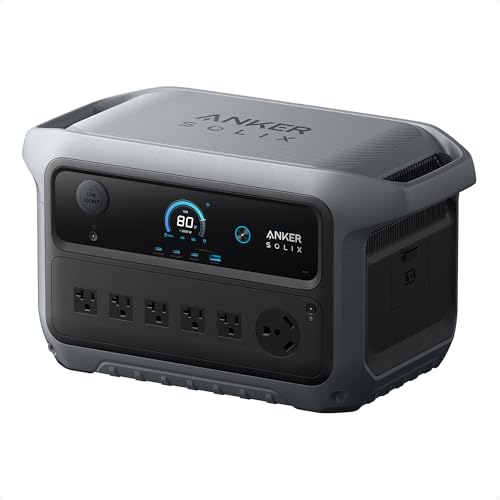
Anker SOLIX C2000 Gen 2
The title lists 2048Wh, 2400W with a 4000W peak, a LiFePO4 battery and a full charge in 58 minutes. It suits RVers who plug into shore power in short windows and want the battery refilled before they roll out again. The camping label in the title matches its role as a grab-and-go companion rather than a stationary backup. The 4000W peak figure suggests some tolerance for brief startup spikes, though sustained draws are bound by the 2400W rating, so size your appliances accordingly before you commit.
- Strength: the 58-minute full charge claim is among the fastest in this lineup.
- Strength: LiFePO4 cells support repeated cycling across a season.
- Trade-off: 2400W continuous output limits how many heavy loads run at once.
Skip it if your plan involves a microwave and a hair dryer running at the same moment.
BLUETTI Elite 300
Described in the title as the smallest 3kWh solar generator for RV use, it lists 3014.4Wh, 2400W with a 4800W surge, and LFP cells. It is for travelers who want near-3,000Wh capacity without giving up much floor space in a cramped cabinet or under a dinette seat. The surge figure also points to better handling of motor startups than the continuous number alone suggests. Buyers who care about packing efficiency, and who would otherwise need a bulkier 3kWh-class box, are the natural audience for this one, especially in smaller Class B or travel-trailer layouts.
- Strength: 3014.4Wh sits in the high-capacity tier.
- Strength: the 4800W surge claim helps with compressor and motor starts.
- Trade-off: 2400W continuous is lower than the 3600W units above.
Skip it if you need several large appliances running together all day.
DJI Power 2000
With 2048Wh of LFP storage and 3000W stable output, this is the higher-output choice among the 2kWh units. The title also mentions compact size and fast recharge, which fit an RV where every cubic foot counts. It is aimed at buyers who run power-hungry gear in short bursts rather than low loads for days on end. The 3000W figure sits just below the two 3600W units in continuous rating, so it is the logical pick when you want the lighter 2kWh class but refuse to give up output headroom for tools or a kettle.
- Strength: 3000W stable output exceeds the other 2048Wh models here.
- Strength: compact size and fast recharge claims help in tight storage.
- Trade-off: capacity tops out at 2048Wh, so heavy use drains it sooner.
Skip it if long runtime matters more than raw output.
BLUETTI Elite 100 V2
At 1024Wh and 1800W with a 3600W surge, this is the smallest in the set and the easiest to carry in and out of a camper. The title notes it is 35% smaller, charges 0-80% in 45 minutes and offers a 10ms UPS function, which suits a weekend trailer running lights, fans and electronics. It reads best as a starter or secondary battery. A small unit like this can also sit beside a larger fixed system and handle the laptop and phones so the main bank is not drawn down by small loads overnight.
- Strength: 0-80% in 45 minutes makes recharging quick.
- Strength: 10ms UPS switching keeps sensitive gear running during an outage.
- Trade-off: 1024Wh will not support all-day air conditioning or cooking.
Skip it if your rig carries heavy electrical loads.
Which One Fits Your Situation
Full-time boondocking with a big appliance load
Choose the Jackery HomePower 3600 Plus or the PECRON F3000LFP. Both pair roughly 3,000Wh-plus storage with 3600W output, so a day of cooking and charging has room to breathe.
Weekend trailer with light electronics
The BLUETTI Elite 100 V2 covers lights, fans and device charging at 1024Wh and is the least bulky option here, so it is easy to stash when the trip ends.
Short campground stops, long driving days
The Anker SOLIX C2000 Gen 2 and EcoFlow DELTA 3 Max both advertise quick wall charging, so a brief hookup refills a good share of the battery before you leave.
Tight storage bay, higher output
The DJI Power 2000 and BLUETTI Elite 300 are the picks when space is limited but you still want strong output or capacity.
Common Mistakes
- Buying by watt-hours alone and ignoring continuous AC output, then watching an appliance fail to start.
- Counting on a rooftop air conditioner to run for hours from a mid-size battery.
- Forgetting that solar recharge depends on panel wattage and sky conditions, not on the battery itself.
- Choosing the biggest unit when you rarely use more than a third of it.
- Running a gas generator inside the rig or an enclosed compartment as a backup; carbon monoxide builds up fast and can be fatal.
Sizing and Compatibility Checklist
- List the RV’s electrical loads by type. Separate 12V items such as lights and a vent fan from 120V items such as a coffee maker or microwave. Anything that heats food or water draws far more than a laptop.
- Handle the air conditioner separately. A rooftop unit has a large startup surge. Check the station’s surge rating against the air conditioner’s nameplate, and ask whether a soft-start device could lower the starting draw.
- Know your shore power rating. A 30-amp RV hookup is rated around 3,600 watts, which is a useful ceiling when judging whether a station could stand in for it. A 50-amp hookup is larger still.
- Check the inlet and outlet types. Confirm the station has the outlet types your appliances use, and whether a dedicated RV-style port is offered or an adapter is needed.
- Plan how it will recharge while moving. Look for a vehicle charging input and its maximum wattage, since a car socket usually supplies much less than a wall outlet.
- Measure the storage spot. Allow room for ventilation, and plan how it will be secured in transit so it cannot slide.
Who Should Skip These
Skip a portable station if you plan to run a rooftop air conditioner and an electric cooktop at once for hours, since that load calls for a permanently installed inverter and a much larger battery bank. Skip it too if you stay at full-hookup campgrounds nearly every night, because you would carry battery weight you rarely use. A good surge protector and a heavy-gauge extension cable may be the better spend in that case.
Setup and Care Tips
- Never operate a station in a closed storage bay without airflow.
- Strap it down or place it in a snug bin before driving.
- Keep panel cables dry and out of walkways at the campsite.
- Bring the unit into the cabin during hard freezes or extreme heat when possible.
Which One Should You Buy?
| If you… | Choose |
|---|---|
| Camp for a night or two with a laptop and lights | BLUETTI Elite 100 V2 |
| Want a mid-sized unit for a weekend trailer | Anker SOLIX C2000 Gen 2 or BLUETTI Elite 300 |
| Need to run kitchen appliances for several evenings | EcoFlow DELTA 3 Max or DJI Power 2000 |
| Live off-grid and want long-life LiFePO4 capacity | PECRON F3000LFP |
| Want the largest unit in this guide for heavy loads | Jackery HomePower 3600 Plus |
Whichever you shortlist, compare the stated AC output against the largest appliance on board and the usable watt-hours against one full evening of use. If the numbers only barely cover your needs, step up one size, because a station that runs near its limit every night ages faster and leaves no room for guests or cold-weather loads.
Related guides
- Portable Power Stations For Cpap During Power Outages
- How Long Does A Portable Generator Run On A Tank Of Fuel
- How To Prepare For A Power Outage Checklist And Gear
Frequently Asked Questions
How much capacity does an RV usually need?
For light loads and one or two nights, around 1,000Wh can work. For cooking and fans over several days, listings in the 2,000Wh to 3,500Wh range are more practical. Add up your own devices to be sure.
Can a portable power station replace a gas generator?
For many camping loads, yes, and it runs silently without fumes. Fuel generators release carbon monoxide, so they must never run inside a living space or enclosed storage area.
Does LiFePO4 matter?
Lithium iron phosphate cells are generally valued for long cycle life and stable behavior, which suits frequent RV use. Most units in this guide list LFP or LiFePO4 in the title.
Can I charge it while driving?
Many models accept vehicle charging, but the listings here do not all state it. Check the specifications of the exact unit before relying on it.