Key takeaways
- Compare six of the best portable power stations for blackouts by capacity, output, battery type and ports, with runtime math and safety tips.
For short blackouts, the BLUETTI Elite 30 V2 is the strongest all-round pick among these six portable power stations. It combines 288Wh of lithium iron phosphate (LFP) storage with a 600W AC rating, a 10ms UPS-style switchover and fast wall charging, so it can carry a router, lights, phones and a laptop through an evening outage. The rest of the list is mostly 300W-class units with roughly 237Wh to 296Wh of capacity. A “portable power station” is simply a battery with an inverter and outlets in one box, sized by watt-hours (how much energy it holds) and watts (how much it can deliver at once).
Quick List
- EnginStar 300W 296Wh Power Station – best for a budget-minded 300W blackout starter
- MARBERO 300W 237Wh – best for light loads and the smallest capacity of the 300W group
- BLUETTI Elite 30 V2 – best for the highest output and UPS-style switchover
- Westinghouse iGen400s – best for a branded 400W unit with a DC outlet and display
- EnginStar 300W Solar Generator (Two AC Outlets) – best for running two small AC devices at once
- Jackery Explorer 300 – best for a familiar name in the 293Wh class
Which One Is Right for You?
| If you… | Choose |
|---|---|
| want an outage setup that handles a laptop, router and lights with headroom to spare | BLUETTI Elite 30 V2 |
| want a known brand name and a proven 300W-class design | Jackery Explorer 300 |
| need to plug in two AC devices at the same time | EnginStar 300W Solar Generator (Two AC Outlets) |
| need a bit more headroom than 300W but only need a short run time | Westinghouse iGen400s |
| mainly charge phones, lights and a router and want the lowest-capacity option | MARBERO 300W 237Wh |
| want the most stored energy among the 300W models for the least complexity | EnginStar 300W 296Wh |
Capacity decides how long you can run something, while output decides what you can run at all. Four of the six sit between about 237Wh and 296Wh, which is enough for a night of basics but not for a refrigerator through a multi-day outage. The Westinghouse trades capacity for a higher watt rating, and the BLUETTI is the only one here that pushes well past the 300W class.
All 6 Picks in Detail
1. EnginStar 300W 296Wh Power Station – Best for a budget-minded 300W blackout starter
As an Amazon Associate we earn from qualifying purchases at no extra cost to you.

This EnginStar model is listed as a 300W, 296Wh portable power station with a pure sine wave AC outlet, aimed at camping, travel and emergency blackouts. For a first blackout kit it covers the essentials: phones, lights, a router, a small fan or a laptop. The listing also advertises solar-generator compatibility, though a panel is not part of the product name, so confirm what is in the box.
- 300W rated AC output with a pure sine wave inverter
- 296Wh lithium battery capacity
- Output ports listed in the title (confirm the exact port count on the product page)
- Solar charging input for recharging with a compatible panel (confirm voltage and wattage limits)
- Portable design for camping, travel and blackout use
- Battery chemistry not stated in the listing name; confirm on the product page
Pros:
- Pure sine wave output suits sensitive electronics
- Slightly more stored energy than most 300W rivals
Cons:
- Lesser-known brand, so check warranty and support terms
- Output is capped at 300W, so heaters and kettles are out
It is nearly identical on paper to the second EnginStar listing, so choose between them by the outlet layout and included accessories.
For a typical household, 296Wh works out to roughly 250Wh of usable energy after inverter losses, which is enough to run a modem and router for most of a day or recharge a laptop several times. Treat it as a comfort-and-communication backup, not a whole-home solution.
2. MARBERO 300W 237Wh – Best for light loads and the smallest capacity of the 300W group
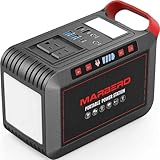
The MARBERO is a 300W, 237Wh camping and backup power station with a pure sine wave 110V AC outlet, USB-C, USB-A and DC ports according to its listing. At 237Wh it is the smallest of the 300W models here, which makes it a sensible choice if your outage plan is mostly about keeping phones, lights and a router alive rather than running larger appliances for long.
- 300W rated output with pure sine wave 110V AC outlet
- 237Wh lithium battery capacity
- USB-C, USB-A and DC outputs for small devices
- Solar generator positioning, with panel compatibility to confirm on the listing
- Lightweight camping and backup design
- Peak/surge rating and cycle life not stated in the listing name; confirm on the product page
Pros:
- Good mix of AC, USB-C, USB-A and DC ports for its size
- Smaller capacity can mean a lighter, easier-to-store unit
Cons:
- Least stored energy in the 300W group
- Battery chemistry is not stated in the listing name
Compared with the EnginStar units, it gives up roughly 60Wh of capacity for similar outputs.
That 60Wh difference matters in a long outage: at a steady 20W load, 237Wh lasts roughly ten hours before losses, while 296Wh lasts closer to twelve. If you only need an overnight bridge, the extra capacity may not be worth chasing.
3. BLUETTI Elite 30 V2 – Best for the highest output and UPS-style switchover

The Elite 30 V2 is listed as a 288Wh, 600W LFP power station with 1500W Power Lifting, a 10ms UPS function and 45-minute 0-80% fast charging. It is the most capable unit in this group in terms of output, and the LFP chemistry is generally associated with longer cycle life than the standard lithium-ion cells used in many budget stations. The 10ms switchover means that, when plugged in as a UPS, it can bridge a power loss quickly enough for many desktop electronics (confirm compatibility on the product page).
- 288Wh LFP (lithium iron phosphate) battery
- 600W rated AC output
- Power Lifting up to 1500W for some resistive loads (confirm the exact conditions on the product page)
- 10ms UPS switchover when wall power is lost
- Fast wall charging, 0-80% in about 45 minutes per the listing
- Solar input is available; confirm limits on the product page
Pros:
- Highest output of the six
- LFP chemistry and UPS function suit repeated blackout use
Cons:
- Capacity is similar to the 300W units, so higher power drains it faster
- Power Lifting does not mean it can run every high-wattage heater
It outclasses the Jackery Explorer 300 on output, though capacity is nearly the same.
Because capacity is only 288Wh, loading it near 600W gives well under half an hour of runtime. The extra output is best viewed as headroom for appliances with start-up surges, such as a small power tool or a mini fridge, rather than for sustained heavy use.
4. Westinghouse iGen400s – Best for a branded 400W unit with a DC outlet and display

The iGen400s is a 400W, 183Wh portable power station and solar generator with an LED display and a DC outlet. The 400W rating gives more headroom than the 300W group, but the 183Wh battery is the smallest here, so it is better for short bursts and light use than for stretching a long outage. The display, which shows input, output and charge status, is a practical feature when you are rationing a small battery.
- 400W rated output
- 183Wh battery capacity
- LED display for status monitoring
- DC outlet in addition to AC and USB ports (confirm the full port list)
- Solar generator positioning; confirm panel compatibility
- Battery chemistry and waveform not stated in the listing name; confirm before powering sensitive gear
Pros:
- Higher wattage than most of the 300W models
- Clear display makes it easier to manage a small battery
Cons:
- Lowest capacity in the group
- Higher output with small capacity drains the pack quickly
Versus the MARBERO, it gives you more wattage but less than a night’s worth of stored energy for heavier loads.
Its sweet spot is a short outage with a handful of phone charges, a lamp and perhaps a laptop. If you expect to need more than eight to ten hours of backup, the 288Wh to 296Wh options give more breathing room.
5. EnginStar 300W 296Wh Solar Generator (Two AC Outlets) – Best for running two small AC devices at once

The second EnginStar listing is a 300W, 296Wh lithium battery backup with two 110V pure sine wave AC outlets, aimed at camping, road trips and emergencies. Having two AC outlets means you do not need a power strip for a lamp and a laptop charger, though the combined load across both must still stay under 300W. It is otherwise close to the first EnginStar in capacity and output.
- 300W rated output across two pure sine wave 110V AC outlets
- 296Wh lithium battery
- Additional USB and DC ports are likely; confirm the full list on the product page
- Solar-generator style input; confirm panel wattage limits
- Portable design for camping and road trips
- Battery chemistry not stated in the listing name; confirm on the product page
Pros:
- Two AC outlets for convenience
- Same capacity as the first EnginStar
Cons:
- Total output is still 300W, shared across both outlets
- Brand support should be checked before purchase
Next to the Jackery Explorer 300, it offers a similar capacity with a different brand and port layout.
Two outlets help when you want a lamp and a fan or a laptop and a router running together. Add up the rated wattage of everything you plan to plug in, and keep the total below roughly 250W for a safety margin.
6. Jackery Explorer 300 – Best for a familiar name in the 293Wh class
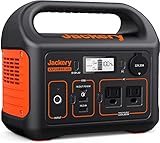
The Jackery Explorer 300 is listed as a 293Wh backup battery and solar generator, with the solar panel sold separately. It is a well-known design in the 300W class, and Jackery’s third-party coverage generally describes a 300W AC output with a higher surge rating, though you should confirm the exact figures on the product page. It suits people who want a recognizable brand and a simple, compact power station for light blackout duty.
- 293Wh battery capacity
- 300W-class AC output (confirm continuous and surge ratings)
- Solar panel not included, per the listing name
- Compact, handle-equipped design for camping and RV use
- Battery chemistry is generally lithium-ion for the original model; confirm on the product page
- Multiple port types, including USB and DC; confirm the list
Pros:
- Established brand with a long product history
- Roughly the same capacity as the EnginStar units
Cons:
- Lower output than the BLUETTI
- Panel must be bought separately for solar recharge
Compared with the BLUETTI Elite 30 V2, it offers similar capacity but a lower output ceiling.
If brand recognition and straightforward operation matter more than a UPS function, it is a sound pick. Plan to buy a compatible panel separately if you want to recharge it away from the grid.
Specs Compared
| Power station | Capacity | AC output | Battery type | Key extras |
|---|---|---|---|---|
| EnginStar 300W 296Wh Power Station | 296Wh | 300W, pure sine wave | Lithium (confirm chemistry) | Solar generator positioning |
| MARBERO 300W | 237Wh | 300W, pure sine wave 110V | Lithium (confirm chemistry) | USB-C, USB-A and DC ports |
| BLUETTI Elite 30 V2 | 288Wh | 600W, 1500W Power Lifting | LFP | 10ms UPS, 45-minute 0-80% charging |
| Westinghouse iGen400s | 183Wh | 400W | Confirm on listing | LED display, DC outlet |
| EnginStar 300W Solar Generator (Two AC Outlets) | 296Wh | 300W, two pure sine wave 110V outlets | Lithium (confirm chemistry) | Two AC outlets |
| Jackery Explorer 300 | 293Wh | 300W class (confirm) | Confirm on listing | Solar panel sold separately |
How We Chose These
This guide is a research-based comparison built from product listings. The six units come from current catalog listings, and we compared the numbers each listing states for capacity, AC output, waveform, battery chemistry and charging speed. We favored stations that specify a pure sine wave output, publish a clear watt-hour figure and offer enough ports to keep communication gear running. Where a listing did not state a value, we wrote “confirm on listing” rather than guess. We also used manufacturer and third-party specification summaries for BLUETTI and Jackery to cross-check capacity and output figures. Rankings reflect suitability for short residential blackouts, not extended off-grid living.
What to Look For
Watt-hours versus watts
Watt-hours (Wh) measure stored energy; watts (W) measure how much power the station can supply at one moment. A 300W, 296Wh unit can run a 100W load for roughly two and a half hours, because real-world runtime is typically about 80 to 90 percent of the nameplate capacity after inverter losses. The quick rule of thumb: usable hours equals capacity in Wh times 0.85, divided by the load in watts. A 293Wh station running a 60W laptop-and-router combination therefore lasts about four hours (293 x 0.85 / 60).
Worked example for a one-night kit. Suppose you want to cover a ten-hour overnight outage. List the loads: a router and modem at about 20W, one LED lamp at 8W for two hours, and two phone charges of about 15Wh each. That comes to roughly 200Wh for the router, 16Wh for the lamp and 30Wh for the phones, or about 246Wh in total. Divide by 0.85 to allow for inverter losses and you need around 290Wh, which is right where the 288Wh to 296Wh units sit. The 237Wh and 183Wh models would be tight, and you would need to switch the router off for part of the night. Add a safety margin of 20 percent if you can, because cold weather can reduce usable battery capacity.
Which devices a 300W-class unit can run
Good fits include phones (5 to 15W while charging), LED lamps (5 to 10W), a Wi-Fi router and modem (10 to 25W combined), a laptop (45 to 90W), a small fan (20 to 50W) and any health-related device only if its manufacturer confirms the power needs and you have another backup plan. Poor fits include space heaters, hair dryers, microwaves, electric kettles and window air conditioners, all of which draw 1000W or more. A full-size refrigerator can need a surge several times its running wattage, so these small stations are not a reliable fridge backup.
Battery chemistry and lifespan
LFP (lithium iron phosphate) batteries typically last several thousand charge cycles, while standard lithium-ion or NMC cells are often rated for around 500 cycles. For a blackout kit used a few times a year, either is acceptable, but LFP tends to hold up better with the occasional topping-off and sitting idle. Whatever the chemistry, recharge the station every three to six months so it is never found empty when the lights go out.
Charging options and UPS function
Wall charging time matters in storm season, when you may have only a short window of grid power. A unit that fast-charges to 80 percent in under an hour, as the BLUETTI listing states, is easier to prepare before a forecast storm. Solar recharge is a bonus rather than a plan: a 100W panel in good sun might add around 60 to 80Wh per hour, so a full recharge of a 300Wh station takes a clear day. A UPS function lets the station sit between the wall and sensitive equipment, switching over in milliseconds if power fails.
Safety rules for indoor use
Unlike gasoline generators, battery stations produce no exhaust, so they can be used indoors, but keep them on a hard, dry surface with the vents clear, away from heat sources and out of direct sun in a hot car. Never connect one to a household outlet to “backfeed” your home, which can injure utility workers and damage equipment. Check that the combined wattage of what you plug in stays under the rated output, and do not rely on a small station for life-support equipment.
Questions
How long will a 300Wh power station run a refrigerator?
Not long, and not reliably. A typical full-size refrigerator averages roughly 100 to 200W while running and has a startup surge, so a 300Wh station may run it for one to two hours at best. These units are better for communications, lighting and small electronics.
Is pure sine wave important?
For laptops, modern TVs and sensitive electronics, yes, because pure sine wave output closely matches grid power. Modified sine wave inverters can cause buzzing or fail to run some devices. All of the stations here advertise pure sine wave or are in a class that usually offers it, but confirm on each product page.
Can I charge a power station from my car?
Most can charge from a 12V car socket using a DC cable, though it is slow. It is a useful fallback when the grid is down, as long as you run the engine in a ventilated space outdoors.
How often should I recharge a stored power station?
Every three to six months is a safe interval for most lithium units. Store it somewhere cool and dry, away from extremes of heat, and top it up to roughly 60 to 80 percent for long-term storage if the manual recommends it.
Do I need a solar panel?
Not for short blackouts, since you can recharge from the wall when power returns. A panel helps in multi-day outages, but make sure the panel’s voltage and connector match the station’s solar input, and note that panels are often sold separately.
Is it safe to keep a power station charged all the time?
Most modern units are designed to sit on a charger or be stored with a partial charge, and many have battery management systems that stop charging when full. Still, it is better to follow the manufacturer’s storage guidance, keep the unit away from heat, and check it every few months. Never leave a damaged, swollen or hot battery plugged in; stop using it, move it away from anything flammable, and contact the maker. Also avoid charging in a closed cabinet, because batteries and chargers shed some heat while they work.
Update History
- October 20, 2026 – Initial publication; product set drawn from current catalog listings.
- Check the product page for current specifications and availability before buying.
Sources
- Manufacturer and third-party specification summaries for BLUETTI Elite 30 V2 and Jackery Explorer 300
- Retailer listing titles and specification fields for each power station