Key takeaways
- 20 feet: Plan on roughly 10 feet from anchor to each hand position. This is the easiest length to store and the least demanding option for a compact room.
- 30 feet: A practical choice for many home gyms. It produces useful waves without requiring a deep garage or long driveway.
- 40 feet: Adds working distance and rope mass while remaining easier to manage than a 50-foot model.
- 50 feet: Best where you have a clear, flat training lane. It is heavier, takes longer to coil, and can be awkward indoors.
Best Battle Ropes for Home and Garage Workouts
The best battle ropes for most home users are a 30- to 40-foot, 1.5-inch polyester rope with a protective sleeve and a fixed anchor point; choose a 50-foot rope for a large garage or outdoor space, or a 20-foot rope when floor area and storage are limited.
Quick picks by workout situation
| Situation | Recommended rope | Why it fits | Typical market range |
|---|---|---|---|
| Small room or apartment | 20 ft × 1.5 in | Needs less clearance and creates manageable resistance | $35–$75 |
| General home gym | 30–40 ft × 1.5 in | Good balance of wave length, fatigue, and storage | $45–$100 |
| Large garage or driveway | 50 ft × 1.5–2 in | Allows longer waves and greater total rope mass | $70–$160 |
| Beginner or lighter user | 30 ft × 1.0–1.5 in | Lower resistance and easier grip endurance | $30–$85 |
| Conditioning-focused experienced user | 40–50 ft × 2 in | Heavier rope demands more force and slows the waves | $90–$200 |
| Frequent outdoor use | 30–50 ft polyester with sleeve | Better resistance to abrasion than uncovered natural fiber | $60–$180 |
Length matters more than many buyers expect
Battle-rope length is measured from one handle to the other, with the anchor normally positioned at the midpoint. A 30-foot rope therefore gives you approximately 15 feet of working rope on each side of the anchor. You need enough room to stand comfortably at the ends without the handles touching a wall, vehicle, rack, or furniture.
Our top picks

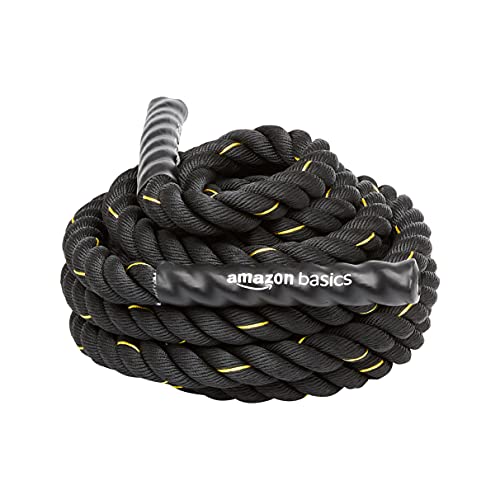


As an Amazon Associate we earn from qualifying purchases at no extra cost to you. Ratings are shown as listed on Amazon.
- 20 feet: Plan on roughly 10 feet from anchor to each hand position. This is the easiest length to store and the least demanding option for a compact room.
- 30 feet: A practical choice for many home gyms. It produces useful waves without requiring a deep garage or long driveway.
- 40 feet: Adds working distance and rope mass while remaining easier to manage than a 50-foot model.
- 50 feet: Best where you have a clear, flat training lane. It is heavier, takes longer to coil, and can be awkward indoors.
Length does not automatically mean better conditioning. A longer rope usually weighs more and requires more floor clearance, but the anchor, diameter, material, and wave technique also affect resistance. If your available lane is only 18 feet deep, a 50-foot rope is a poor fit even if you want a harder workout.
Diameter: match resistance to your training level
Diameter changes both rope weight and grip demand. The difference between 1.5 and 2 inches may look small, but the thicker rope contains substantially more material across its cross-section.
| Diameter | Approximate weight of a 30-ft rope* | Best for | Main drawback |
|---|---|---|---|
| 1 inch | 9–14 lb | Beginners, smaller hands, intervals, lighter equipment | Less total resistance and a thinner grip |
| 1.5 inches | 15–25 lb | Most home users and mixed fitness levels | Can still fatigue forearms quickly |
| 2 inches | 25–40 lb | Experienced users seeking heavy waves | More expensive, bulky, and demanding on hands and shoulders |
*Approximate ranges vary with braid construction, core, coating, and manufacturer.
For a first rope, 1.5 inches is usually the safest compromise. Choose 1 inch if grip endurance is a limiting factor or if several people with different fitness levels will use it. Choose 2 inches only when you already have a suitable anchor, adequate space, and the ability to control the rope without losing posture.
Head-to-head: common rope materials and coatings
Polyester
Polyester is the most versatile material for home and garage use. It has a relatively smooth, durable braid, resists moisture better than many natural fibers, and is available in a wide range of lengths and diameters. A polyester rope with a separate protective sleeve is a strong choice for concrete, asphalt, and rough garage floors.
Nylon
Nylon is strong and often feels slightly more flexible, but it can stretch more under load and may retain moisture. That stretch can soften the wave response, which some users like for general conditioning but others find less responsive. Dry it fully before storage, particularly after outdoor sessions.
Manila and other natural fiber
Natural-fiber ropes have a traditional texture and can offer a secure grip, but they shed fibers, absorb water, and degrade faster when repeatedly dragged across abrasive surfaces. They are better suited to dry indoor use or occasional outdoor sessions than to exposed garage or driveway storage.
PVC or vinyl-coated ropes
A coated rope is often easier to clean and can slide more smoothly across a floor. The coating is not invulnerable: repeated dragging over sharp concrete can cause cuts, splitting, or exposed braid. A coating protects against routine abrasion, not careless placement on broken pavement.
Anchor options: fixed, portable, and improvised
A rope is only as useful as its anchor. The anchor should resist pulling in the direction of the rope without loosening, rotating, or damaging the mounting surface.
- Wall or floor anchor: A properly installed steel eye or battle-rope anchor is the most stable option. Use the correct fasteners for wood studs, concrete, or another structural surface; drywall alone is not an adequate anchor.
- Power rack anchor: A rack-mounted attachment is convenient when the uprights are securely bolted or weighted. Check that the rope will not rub against sharp edges or interfere with other exercises.
- Heavy outdoor anchor: A substantial post, low tree trunk, or dedicated ground anchor can work outdoors if it cannot shift under repeated pulls. Avoid thin fence posts and decorative rails.
- Portable anchor: Some systems use a heavy sandbag or weighted base. These are useful for renters, but the base must be heavy enough to prevent sliding and should be inspected for seam damage.
Do not loop a rope around a sharp metal corner, vehicle hitch, or unstable piece of furniture. If you use a wraparound strap, place a protective sleeve between the strap and the rope, and inspect both contact surfaces before each session.
Storage and ownership costs
Battle ropes are bulky even when they are not especially heavy. A 30-foot, 1.5-inch rope may coil into a bundle roughly 18–24 inches across, while a 50-foot, 2-inch rope can require a substantially larger storage area. Measure the planned storage location before buying, especially if the rope will hang beside a garage door or under a low shelf.
A simple ownership calculation can clarify whether a cheaper rope is worthwhile. Suppose a $50 rope lasts 100 sessions: its equipment cost is $0.50 per session. A $120 rope lasting 300 sessions costs $0.40 per session, before considering replacement anchors or damaged sleeves. The more expensive option is not automatically better, but braid quality, a replaceable sleeve, and a reliable anchor can reduce long-term waste.
What usually wears first
- Protective sleeve: Look for fuzzing, thinning, holes, or exposed core where the rope contacts the anchor or floor.
- Handles: Foam grips can split or compress. Hard plastic handles may last longer but can become slippery when wet.
- End stitching: Frayed stitching or a loose end cap means the rope should be removed from service until repaired or replaced.
- Anchor hardware: Check for bent hardware, loose bolts, corrosion, and movement in the mounting surface.
Setup and maintenance that extend rope life
- Clear the lane. Remove sharp debris, loose mats, and objects that could catch the rope. The rope should travel in a straight line from the anchor.
- Inspect the contact point. Confirm that the anchor has no sharp edges and that the rope is not pinched.
- Begin with short intervals. Try 10–20 seconds of waves followed by 40–60 seconds of rest. This helps you learn the movement without immediately losing control.
- Clean after use. Wipe coated or synthetic rope with a damp cloth and mild soap when needed. Avoid harsh solvents and saturating the core.
- Dry before coiling. Moisture trapped in a tight coil can encourage odor and material degradation. Store the rope off the floor in a cool, dry place.
- Coil without kinks. Large, relaxed loops are preferable to tight bends. Do not leave the rope permanently folded at one sharp point.
Final buying recommendation
For most home and garage workouts, buy a 30- or 40-foot, 1.5-inch polyester battle rope with a durable sleeve, comfortable handles, and a mounting solution designed for your actual wall, rack, or outdoor anchor. Select 20 feet when space is the main constraint, 1 inch when grip fatigue is likely to limit you, and 50 feet or 2 inches only when you have the room and experience to control the added mass. The best battle ropes are not the longest or heaviest models; they are the ones that fit your training lane, anchor securely, and can be stored and maintained without becoming a hazard.