Key takeaways
- 22-inch kettle charcoal grill: Weber’s 2290 Rotisserie is the safest fit when you own a compatible Weber kettle. Its dedicated ring avoids the trial-and-error of adapting universal brackets.
- Three- or four-burner gas grill: Choose a universal kit with a 6–9 watt motor, an 8 mm or 10 mm stainless-steel rod, and adjustable brackets. Napoleon’s 69232 kit is a well-known example of this category.
- Large premium gas grill: A manufacturer-matched kit is preferable because the rear burner, hood height, and mounting holes are designed together. Broil King and Napoleon both sell grill-family-specific rotisserie accessories.
- Infrequent or budget use: A basic universal kit with a 4–6 watt motor can handle chickens and small roasts, provided the load is balanced and remains within the motor’s stated limit.
- Multiple grills or an outdoor kitchen: Buy a universal kit with long brackets, several mounting-hole positions, and a removable motor rather than a ring made for one grill model.
The best rotisserie kits for grills are the ones whose mounting brackets match your grill, whose motor can turn your usual roast without stalling, and whose spit rod leaves enough clearance for the lid; for most owners, a grill-specific kit is the easiest choice, while a universal kit offers better value when you own several grills.
Our top picks

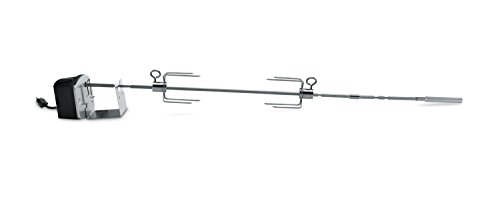
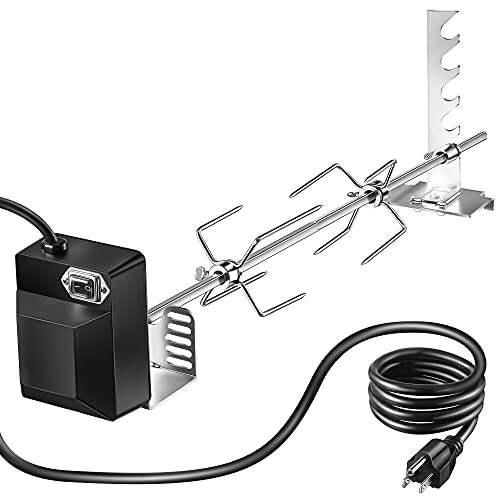

As an Amazon Associate we earn from qualifying purchases at no extra cost to you. Ratings are shown as listed on Amazon.
Quick picks by cooking setup
- 22-inch kettle charcoal grill: Weber’s 2290 Rotisserie is the safest fit when you own a compatible Weber kettle. Its dedicated ring avoids the trial-and-error of adapting universal brackets.
- Three- or four-burner gas grill: Choose a universal kit with a 6–9 watt motor, an 8 mm or 10 mm stainless-steel rod, and adjustable brackets. Napoleon’s 69232 kit is a well-known example of this category.
- Large premium gas grill: A manufacturer-matched kit is preferable because the rear burner, hood height, and mounting holes are designed together. Broil King and Napoleon both sell grill-family-specific rotisserie accessories.
- Infrequent or budget use: A basic universal kit with a 4–6 watt motor can handle chickens and small roasts, provided the load is balanced and remains within the motor’s stated limit.
- Multiple grills or an outdoor kitchen: Buy a universal kit with long brackets, several mounting-hole positions, and a removable motor rather than a ring made for one grill model.
Head-to-head comparison
The table below compares the useful differences between the main kit types. Exact contents vary by model and region, so confirm the manual before ordering, particularly for rod length and maximum load.
| Kit type or example | Typical grill compatibility | Motor capacity | Spit-rod dimensions | Forks included | Typical assembly time |
|---|---|---|---|---|---|
| Weber 2290 Rotisserie | Compatible 22-inch Weber kettle grills | Usually a low-voltage motor rated for a medium poultry or roast load; follow the model manual | Approximately 8 mm diameter; ring-specific length | Two four-prong forks | 15–30 minutes for the ring and motor bracket |
| Napoleon 69232 universal-style kit | Many gas grills with a suitable straight front-to-back opening | Commonly around 6–9 watts, depending on regional version | Typically about 8 mm diameter and roughly 100–110 cm long | Two adjustable four-prong forks | 20–40 minutes, including bracket alignment |
| Basic universal kit | Gas or charcoal grills with flat mounting surfaces | Usually 4–6 watts; best for chicken, vegetables, and smaller roasts | About 8 mm diameter; 85–100 cm is common | Two four-prong forks, sometimes with thumb screws | 20–45 minutes |
| Heavy-duty universal kit | Large gas grills and outdoor-kitchen openings | Usually 9–13 watts, with a higher stated load limit | Often 10 mm diameter and 100–120 cm long | Two heavy four-prong forks; counterweight may be optional | 30–60 minutes |
What to measure before buying
1. Measure the cooking width, not the advertised grill size
“Three-burner” and “22-inch” describe product families, not a universal rotisserie opening. Measure the straight distance between the inside faces of the grill’s side walls, then measure from the intended rod centerline to the closed lid. The food needs room to rotate without touching the cooking grates, lid, warming rack, or rear burner cover.
As a practical guide, a 90 cm rod may be suitable for many medium grills, while a 100–120 cm rod is more useful on large gas grills. A rod that is too long is inconvenient but workable; a rod that is too short cannot be safely supported by both brackets.
2. Check the motor-side clearance
The motor normally sits outside the grill and engages the square or shaped end of the rod. Measure the distance from the grill wall to nearby shelves, cabinets, or a side burner. A kit can fit the cooking chamber yet fail in practice because the motor collides with a cabinet or leaves the lid unable to open fully.
3. Match the fork and rod system
Most kits use two adjustable four-prong forks. They are adequate for chickens and compact roasts, but large or irregular cuts benefit from broad, rigid forks and a counterweight. A hollow, thin rod may flex under a heavy leg of lamb even when the motor has enough electrical power. Stainless steel is preferable for corrosion resistance and easier cleaning.
Decision matrix: which kit makes sense?
| Your situation | Best choice | Why | What to avoid |
|---|---|---|---|
| First rotisserie, occasional chicken | Grill-specific or basic universal kit | Fewer fit problems and adequate capacity | Oversized commercial-style motors and long rods |
| Weekly cooking for a family | 6–9 watt kit with stainless rod and locking forks | Better balance of durability, capacity, and cost | Plastic fork collars and weak thumb screws |
| Large roasts or two chickens | Heavy-duty 9–13 watt kit | More torque and a stiffer 10 mm rod reduce sag and stalling | Using a small motor at its maximum load |
| Limited storage or several grills | Universal kit with removable motor and telescoping or compact brackets | One system is easier to store and transfer | A permanent ring dedicated to one grill |
| Charcoal kettle cooking | Purpose-built kettle ring | Maintains lid geometry and keeps the rod at a useful height | Drilling or improvising brackets on a thin kettle wall |
Motor capacity: a useful reality check
Motor wattage is only a rough guide. Balance matters more than the number printed on the label. A 2.5 kg chicken mounted centrally may turn smoothly, while a badly skewed 1.5 kg roast can stall a motor because the load is constantly pulling downward on one side.
For example, suppose a kit is rated for 10 kg but your grill’s forks and rod are intended for a much smaller load. The safe working limit is the lowest limit in the system, not the motor’s headline rating. A sensible target is to use no more than about 60–70% of the stated maximum for routine cooking. A 5 kg combined food-and-fork load would therefore be a comfortable target for a kit rated at 7 kg, leaving margin for uneven shape and grease buildup.
Assembly and first-use checklist
- Dry-fit the brackets. Close the lid and rotate the empty rod by hand. This exposes contact points before food and heat are involved.
- Check rod level. The rod should sit level from motor side to handle side. A noticeable slope can shift the load toward one bearing.
- Secure the forks. Push both forks deeply into the meat and tighten their screws against the rod. Keep the food centered rather than placing it beside the motor.
- Test balance. Rotate the loaded rod by hand. If it repeatedly falls to one position, reposition the forks or add the kit’s counterweight if supplied.
- Start the motor before adding high heat. The slow rotation should be smooth and quiet. Clicking, juddering, or stopping indicates poor balance, excessive load, or a misaligned bracket.
- Keep the motor dry. Remove it before washing the rod, forks, or ring. Never immerse a mains-powered motor.
Ownership costs and parts that wear first
Entry-level universal kits commonly cost about $40–$90, mid-range manufacturer-matched kits about $80–$160, and heavy-duty systems roughly $150–$300. The initial price is only part of the comparison. A kit used twice monthly for three years gets about 72 uses: a $120 kit costs approximately $1.67 per use before electricity and replacement parts.
The first trouble spots are usually fork screws, plastic motor gears, the rod’s square drive end, and surface corrosion caused by storing wet stainless steel. Clean grease from the rod and forks after every cook, dry them completely, and store the motor indoors. Do not put a hot rod under cold water, which can warp thinner rods. Replacement forks and motors are often available for established grill brands; obscure universal kits may be cheaper initially but harder to repair.
Bottom line
Choose the Weber 2290 for a compatible 22-inch Weber kettle, a manufacturer-matched kit for a premium grill with dedicated mounting points, and a universal 6–9 watt kit for a typical gas grill. If you regularly cook large roasts, spend more on a rigid 10 mm rod, stronger forks, and a motor with comfortable capacity rather than relying on the maximum figure printed on the box. The best rotisserie kits for grills are not necessarily the most powerful—they are the ones that fit your grill precisely, turn a balanced load without strain, and remain easy to clean after the novelty wears off.