Key takeaways
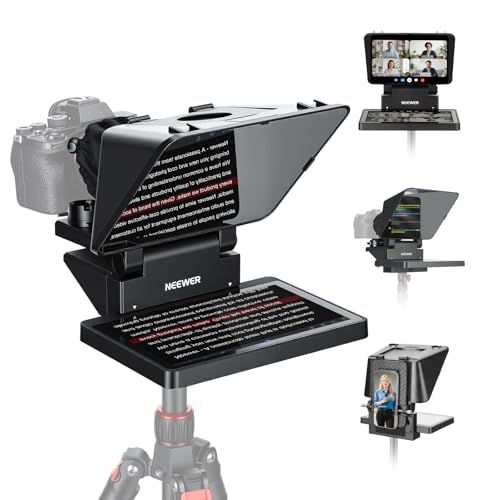
- Tablet / Smartphone cradle prompters: Models like the Glide Gear TMP100, Desview T3, and Parrot Teleprompter V2 use your iPad, Android tablet, or phone as the screen. They accept virtually any device from 7 to 12.9 inches. Camera compatibility is broad — most support DSLR, mirrorless, small cinema cameras, and even phones via included adapters. The tradeoff is you need a separate teleprompter app and brightness depends on your tablet.
- Built-in monitor prompters: Models like the Elgato Prompter and SmallRig x Desview T2 have an integrated 8-10 inch LCD with HDMI/USB input. You send text from a computer or phone via USB-C. These have narrower camera support, typically optimized for mirrorless, DSLRs, webcams, and phones up to a certain width. They are brighter and sharper than a tablet reflection, but you cannot swap in a larger screen later.
The best teleprompters for smooth, natural delivery in 2026 are the Elgato Prompter for solo creators using webcams and smartphones, the Glide Gear TMP100/150 series for DSLR and mirrorless cameras on a budget, and the Ikan PT-Elite series for studio setups that need larger glass and longer reading distances.
Your choice comes down to what you shoot with, how far you stand from the lens, and how fast you need to set up. A 10-inch beamsplitter is fine at a desk 2-3 feet away, but it becomes unreadable at 10 feet in a living room or small studio. Similarly, a tablet-based teleprompter works with almost any phone or camera, while a compact monitor-based prompter like the Elgato is faster to deploy but limits you to smaller cameras and phones.
Our top picks



As an Amazon Associate we earn from qualifying purchases at no extra cost to you. Ratings are shown as listed on Amazon.
How to Choose: The 6 Factors That Affect Delivery
1. Camera and Phone Compatibility
Teleprompters use two different display methods, and compatibility depends on which one they use:
- Tablet / Smartphone cradle prompters: Models like the Glide Gear TMP100, Desview T3, and Parrot Teleprompter V2 use your iPad, Android tablet, or phone as the screen. They accept virtually any device from 7 to 12.9 inches. Camera compatibility is broad — most support DSLR, mirrorless, small cinema cameras, and even phones via included adapters. The tradeoff is you need a separate teleprompter app and brightness depends on your tablet.
- Built-in monitor prompters: Models like the Elgato Prompter and SmallRig x Desview T2 have an integrated 8-10 inch LCD with HDMI/USB input. You send text from a computer or phone via USB-C. These have narrower camera support, typically optimized for mirrorless, DSLRs, webcams, and phones up to a certain width. They are brighter and sharper than a tablet reflection, but you cannot swap in a larger screen later.
If you switch between a Sony A7 series, a Canon R6/R7, and an iPhone 15/16 Pro, a tablet cradle model will cover all three without adapters. If you primarily record straight to a computer for YouTube, courses, or corporate updates with a webcam or small mirrorless camera, a built-in monitor prompter will give you a cleaner, faster workflow.
2. Glass Size and Readable Distance
Glass size determines how large the reflected text appears and how far away you can read it while still maintaining eye contact with the lens. Beamsplitter glass is typically 60/40 or 70/30 (reflection/transmission). A higher reflection ratio is easier to read but slightly darkens your camera image, requiring about 1/3 to 1/2 stop more light.
General market models fall into three size classes:
- Compact (7-9 inch glass): Readable to about 4-6 feet. Best for desktop setups where you are 24-36 inches from the lens. Keeps the rig light and portable.
- Standard (10-12 inch glass): Readable to about 8-10 feet with 80-120pt font. The sweet spot for most home studios and office recordings.
- Large (15-19 inch glass): Readable to 12-18 feet for standing presentations and interviews. Requires heavier tripods and counterweights.
For natural delivery, text should be readable without squinting or obvious eye movement. If your eyes visibly scan left to right, the glass is too small for your distance or your font is too small. Increase font size first before buying larger glass.
3. Mounting Options
- Tripod-mounted riser: Most common. The prompter sits on a tripod with the camera on a baseplate behind the glass. Stable but takes the most floor space. Glide Gear and Ikan use this design.
- On-camera / rail mounted: Compact prompters like the Desview T3 mount directly to 15mm rods or the camera’s tripod plate. Lighter and faster to move, but limited to smaller cameras.
- Desktop / monitor-mounted: The Elgato Prompter mounts directly to a monitor or on a small stand for webcam use. No tripod needed, but not suitable for large lenses or telephoto work.
- Freestanding / presidential: Glass and monitor on a separate stand beside the camera. Used for stage and conference setups, not typical for home studios.
4. Setup Time and Portability
Setup time is the difference between using your teleprompter daily or leaving it in a closet. Tablet cradle prompters with full shrouds and risers take 5-10 minutes to assemble, balance, and align the first time, then 2-3 minutes once you know the configuration. Integrated monitor prompters with tool-less clamps can be ready in under 60 seconds because there is no tablet to pair, no app to mirror, and no hood to velcro.
Portability depends on weight and breakdown size. A compact 10-inch rig folds to roughly the size of a laptop sleeve. A 15-inch studio rig with counterweights and a 12.9-inch iPad Pro does not travel well and typically stays in one room.
Spec Comparison: Popular 2026 Options
Specifications below reflect standard manufacturer listings for general market models available in 2026. Actual weights vary slightly by included adapters and hood material.
| Model / Type | Glass Size | Display Source | Max Camera + Lens Length | Rig Weight (without tripod) | Readable Distance (120pt font) | Setup Time (after first assembly) |
|---|---|---|---|---|---|---|
| Elgato Prompter (9-inch built-in) | 9 inches, 60/40 | 9″ 1024×600 integrated LCD via USB-C | Small mirrorless / webcam / phone; lenses up to ~85mm | ~1.6 kg / 3.5 lbs | ~5-6 feet | 45-90 seconds |
| Desview T3 (10-inch tablet) | 10 inches, 70/30 | Phone/Tablet 7-11 inches | Mirrorless/DSLR; flexible to ~120mm lens | ~1.2 kg / 2.6 lbs | ~8 feet | 2-3 minutes |
| Glide Gear TMP100 (10-inch tablet) | 10 inches, 70/30 | Tablet 7-11 inches | Mirrorless/DSLR/camcorder to ~150mm | ~1.8 kg / 4.0 lbs | ~8-9 feet | 3-5 minutes |
| Glide Gear TMP150 (15-inch tablet) | 15 inches, 70/30 | Tablet 10-15 inches | Mirrorless/DSLR/cinema to ~200mm | ~2.9 kg / 6.4 lbs | ~13-15 feet | 5-8 minutes |
| Ikan PT-Elite-Pro 15 (15-inch monitor) | 15 inches, 70/30 | 15″ integrated LCD with HDMI/SDI | Full studio cameras, ENG, large lenses | ~6.8 kg / 15 lbs | ~15-18 feet | 8-12 minutes, needs counterweight |
| Parrot Teleprompter V2 (compact tablet) | ~8 inches, 60/40 | Phone/Tablet up to 10.5 inches | Mirrorless/phone ultra-compact | ~0.7 kg / 1.5 lbs | ~5 feet | 90 seconds – 2 minutes |
Decision Matrix: Which Teleprompter Fits Your Situation
Match your shooting distance, camera, and frequency of use to the right class instead of buying the largest glass available.
| Your Situation | Recommended Class | Why |
|---|---|---|
| Solo creator at desk, webcam or Sony ZV-E10 / Canon R50, 2-4 ft distance, daily videos | Compact built-in monitor (Elgato Prompter type) | Fastest setup, no tablet needed, software scrolls with computer, keeps eye line tight at close range |
| YouTuber / course creator with mirrorless + 24-70mm lens, 6-10 ft distance, small room | Standard 10-12 inch tablet prompter (Glide Gear TMP100 / Desview T3) | Best balance of readability and portability, works with any tablet you already own, fits most tripods without counterweight |
| Two-person interviews, standing delivery, or large office studio, 10-15 ft distance | Large 15 inch tablet or monitor prompter (TMP150 / Ikan PT-Elite) | Only large glass remains readable at distance without obvious eye movement |
| Traveling shooter, phone + gimbal or lightweight mirrorless, needs backpack kit | Compact tablet/phone prompter (Parrot V2 / SmallRig type) | Under 1 kg, packs flat, assembles without tools, runs off phone battery |
| Corporate studio with dedicated tripod, operator controls speed | 15 inch monitor prompter with HDMI/SDI and wired controller | Brighter display, reverse and speed control for operator, more durable than tablet cradle |
Setup For Natural Delivery: Step-by-Step
A teleprompter looks unnatural when the text is too fast, too small, or too far, which forces you to chase words. Use this setup sequence to fix delivery before you blame the hardware:
- 1. Set distance first. Place the camera where framing is correct. Do not move the camera to make the prompter readable. Measure eye-to-glass distance. If it is over 9 feet, you need 12+ inch glass.
- 2. Set font size for that distance. At 3 feet, 60-70pt is comfortable. At 6 feet, use 90-100pt. At 12 feet, use 120-150pt. You should see 2-3 lines of text, not a full paragraph, to keep eye movement minimal.
- 3. Align lens to center of glass. Look through the camera. The lens should be centered behind the beamsplitter. If the camera is too low, you will appear to look slightly above the lens. Use the height adjustment on the riser until your reflected pupils align with the lens.
- 4. Adjust speed to speaking pace, not reading pace. Most apps default to 180-220 words per minute. Natural speaking is 130-160 wpm. Start at 140 wpm and use a Bluetooth remote or foot pedal so you can pause instead of trying to keep up with auto-scroll.
- 5. Dim the room behind the glass. Any light behind the beamsplitter washes out the text. Close the fabric shroud completely and dim lights directly behind the prompter.
- 6. Practice the 2-word buffer. Read two to three words ahead of what you are saying. This prevents the staccato word-by-word delivery that makes teleprompter use obvious.
Durability and Ownership Realities
Teleprompters have few moving parts, but three components wear first:
- Beamsplitter glass coating: The semi-reflective coating scratches if cleaned with paper towels or ammonia-based cleaners. Clean only with microfiber and lens-safe spray, wiping from the coated side lightly. Store with the included cloth cover to prevent dust abrasion. A scratched coating creates a hazy spot that shows in camera as a soft area.
- Hood and shroud: Fabric hoods with velcro lose light seal after repeated folding. The velcro collects dust and the elastic stretches. Keep the shroud zipped or velcroed even in storage to maintain shape. Replacement hoods in the general market range cost $20-$45 for compact models and $50-$90 for large models.
- Tablet cradle and clamp threads: Over-tightening the 1/4″-20 thumb screws strips the threads on lightweight aluminum frames. Hand-tighten only. If you mount a heavy iPad Pro 12.9, add a small counterweight behind the cradle so the clamp is not bearing all the weight at an angle.
Common mistakes that cause returns: buying a 10-inch prompter for a 12-foot conference room and finding it unreadable, expecting a compact prompter to support a 70-200mm lens without sagging, and using a glossy tablet at full brightness in a dark room which creates a double reflection on the glass. If your tablet creates ghosting, lower brightness to 70-80% and increase font weight to bold.
Consumables are minimal: microfiber cloths, lens cleaner, and occasionally a Bluetooth remote battery. Integrated monitor models add a power supply, but most run off USB power. Tablet models have no power requirement beyond the tablet itself, with typical tablet runtime of 4-7 hours of continuous scrolling before recharge.
Cost Per Use: Should You Buy Compact or Studio Grade?
General market pricing in 2026: compact phone/tablet prompters run about $90-$180, standard 10-12 inch tablet prompters $150-$300, integrated monitor prompters $250-$350, and large 15+ inch studio monitor prompters $500-$1,100 without tripod.
If you record twice a week, a $180 compact prompter used 100 times in a year costs about $1.80 per use. A $650 studio prompter used the same 100 times costs $6.50 per use, but may be necessary if your distance requires it. For creators who record infrequently, starting with a compact or standard model and upgrading only if distance demands it keeps cost per use low while confirming you will actually use a teleprompter regularly.
FAQ
Will a teleprompter make my video look like I am reading?
Only if setup is wrong. Keep the prompter close, increase font size so only a few words are visible per line, and control speed with a remote. The lens should be centered in the glass so your gaze stays on the lens, not slightly above it.
Can I use a teleprompter with just a smartphone?
Yes. Both phone-cradle prompters like Parrot and built-in models like Elgato include phone mounts. For phones, choose a model rated for phone width up to 85mm to accommodate cased phones, and use a teleprompter app that mirrors text correctly.
Do I need a special app?
Tablet and phone prompters require an app to display and scroll mirrored text. Popular options in 2026 include PromptSmart, BIGStage Teleprompter, and Teleprompter Premium, most with Bluetooth remote support. Built-in monitor prompters use desktop software included by the manufacturer and do not need a separate app.
Does beamsplitter glass affect video quality?
Slightly. A 70/30 glass transmits about 70% of light to the lens, so you may need to open aperture by 1/3 stop or add a small amount of light. High-quality glass with anti-reflection coating minimizes color shift and softness. Clean glass and proper exposure make the difference nearly invisible.