Key takeaways
- Calculate total footprint: Add 24 inches to the tub’s diameter/length for the external pump/heater unit plus 18-24 inches of clearance on at least two sides. A 71-inch round tub actually needs an 95 x 95 inch clear area minimum. An 85-inch square tub needs about 110 x 95 inches.
- Check weight and surface load: Water weighs 8.34 lbs per gallon. A 4-person tub with 210-250 gallons weighs 1,750-2,100 lbs when filled, plus 400-700 lbs for occupants. Most ground-level concrete patios and pavers handle this, but elevated wood decks often are rated for only 50-55 lbs per square foot. A 71-inch round tub spreads about 2,200 lbs over 27 sq ft = ~81 lbs/sq ft, which exceeds many decks. Verify deck capacity or place on the ground.
- Consider height and access: Most inflatables are 25-28 inches tall. This is lower than a hard-sided spa, so plan for where you will step in and out, especially if placing against a wall or railing.
- Power requirement: All models listed run on a standard 110-120V GFCI outlet. They draw 1,100-1,350W while heating. You need a dedicated outlet within the cord length (usually 7-8 meters for Intex, 7 meters for Bestway) and no extension cord.
The best inflatable hot tubs for most home patios in 2026 are the Bestway Coleman SaluSpa Miami and SaluSpa Hawaii for 2-4 person compact spaces, the Intex PureSpa Greystone Deluxe for better insulation and longer-season use, and the Bestway SaluSpa Helsinki or Vancouver for 5-7 person capacity when you have a larger deck or patio footprint.
Choosing correctly comes down to matching water capacity and inflated dimensions to your available space, then weighing heating time, insulation quality, energy use, and how well the materials handle sun, wind, and cold. An inflatable tub that fits your patio perfectly but takes 36 hours to heat or loses heat overnight will not get used.
Our top picks
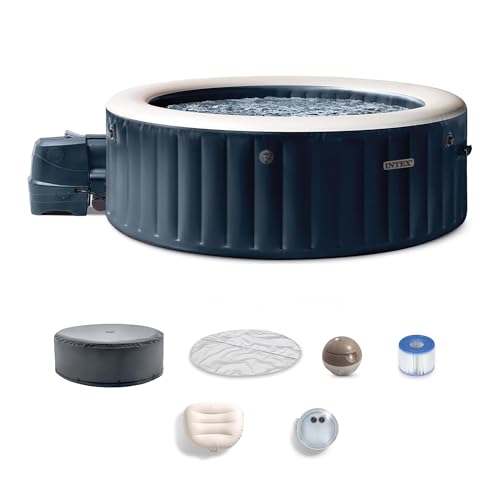
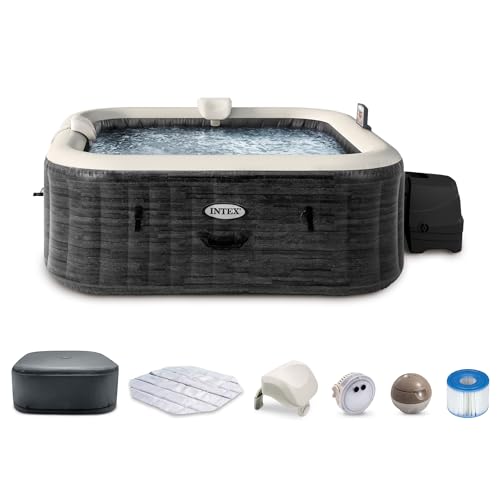


As an Amazon Associate we earn from qualifying purchases at no extra cost to you. Ratings are shown as listed on Amazon.
Measure First: How to Match Tub Size to Your Space
Inflatable hot tubs need more room than their listed diameter. You need clearance for the pump unit, safe entry and exit, and airflow around the motor.
- Calculate total footprint: Add 24 inches to the tub’s diameter/length for the external pump/heater unit plus 18-24 inches of clearance on at least two sides. A 71-inch round tub actually needs an 95 x 95 inch clear area minimum. An 85-inch square tub needs about 110 x 95 inches.
- Check weight and surface load: Water weighs 8.34 lbs per gallon. A 4-person tub with 210-250 gallons weighs 1,750-2,100 lbs when filled, plus 400-700 lbs for occupants. Most ground-level concrete patios and pavers handle this, but elevated wood decks often are rated for only 50-55 lbs per square foot. A 71-inch round tub spreads about 2,200 lbs over 27 sq ft = ~81 lbs/sq ft, which exceeds many decks. Verify deck capacity or place on the ground.
- Consider height and access: Most inflatables are 25-28 inches tall. This is lower than a hard-sided spa, so plan for where you will step in and out, especially if placing against a wall or railing.
- Power requirement: All models listed run on a standard 110-120V GFCI outlet. They draw 1,100-1,350W while heating. You need a dedicated outlet within the cord length (usually 7-8 meters for Intex, 7 meters for Bestway) and no extension cord.
Best Inflatable Hot Tubs Compared: Specs That Affect Fit and Use
These five models are widely available in 2026 and represent the main size and material classes. Specs are manufacturer listed for inflated size and capacity.
| Model | Shape / Capacity | Inflated Dimensions (W x H) | Water Capacity | Dry Weight | Heater Power | Wall Material | Jets / Bubbles |
|---|---|---|---|---|---|---|---|
| Bestway Coleman SaluSpa Miami | Round / 2-4 persons | 71 in x 26 in | 192 gallons (80% fill) | 68 lbs | 1,350W | DuraPlus 3-layer PVC | 120 AirJets |
| Bestway SaluSpa Hawaii AirJet | Round / 4-6 persons | 71 in x 26 in (larger wall model: 85 in x 28 in available) | 222 gallons | 75 lbs | 1,350W | DuraPlus 3-layer PVC + mosaic print | 140 AirJets |
| Intex PureSpa Greystone Deluxe | Square / 4 persons | 85 in x 28 in | 210 gallons | 103 lbs | 1,300W | Fiber-Tech + 3-ply laminated PVC | 170 bubble jets |
| Intex PureSpa Bubble Massage (6-person) | Round / 6 persons | 85 in x 28 in | 290 gallons | 92 lbs | 1,300W | Fiber-Tech PVC | 170 bubble jets |
| Bestway SaluSpa Helsinki AirJet | Round / 5-7 persons | 71 in x 26 in (interior wider due to drop-stitch) | 242 gallons | 89 lbs | 1,350W | Drop-stitch + DuraPlus with faux wood exterior | 180 AirJets |
Key takeaway: A “6-person” rating is based on shoulder-to-shoulder seating without much water. In practical use, a 71-inch tub is comfortable for 2-3 adults, an 85-inch tub for 4 adults. If you regularly host 4+ people, choose the 85-inch class or Helsinki/Vancouver size.
Setup, Heating Time, and Insulation: What Actually Differs
Setup time and process
All inflatables follow the same steps, and most owners finish in 45-90 minutes excluding inflation via the built-in pump. After unfolding, you connect the pump unit to the tub’s three connectors (air, water inlet/outlet), inflate walls with the pump’s air function, fill with a garden hose, then start heating and filtration. No tools are required. Fiber-Tech and Drop-stitch walls feel more rigid once inflated and hold shape better when leaning, while standard DuraPlus walls have more flex.
Heating time expectation
This is the biggest ownership surprise. The heaters raise water temperature by 1.5 to 2.5°F per hour depending on ambient temperature, starting water temperature, whether the insulated cover is on, and wind.
- Filling with cold tap water at 55°F to reach 104°F: Expect 24-36 hours in summer, 36-48 hours in 50-60°F weather.
- Filling with warm water or using a hose adapter to your water heater dramatically cuts initial heat time, though most manufacturers advise not exceeding 104°F inlet.
- AirJets cool water faster than still water. Running bubbles for 30 minutes can drop temperature by 2-4°F in cool air.
Insulation and heat retention
Inflatable tubs lose heat through the walls, cover, and ground. Differences that matter:
- Cover quality: Intex Greystone Deluxe includes a thicker insulated cover with buckle straps. Bestway models include an inflatable cover plus a fabric top. An additional thermal blanket floating on the water surface reduces overnight loss by 3-5°F.
- Ground insulation: Placing a foam thermal mat or interlocking foam tiles under the tub cuts heat loss into concrete by up to 30% and protects the bottom. This is essential for garage floors or cold patios.
- Wall construction: Fiber-Tech uses thousands of internal fibers to maintain shape and creates more consistent air gap insulation than standard 3-layer PVC. Drop-stitch (Helsinki) is the most rigid and dent-resistant but still air-filled, not foam-insulated.
For three-season use below 45°F, none of these tubs are rated for sustained freezing conditions without energy-saving features like Intex’s EnergySense or Bestway’s Freeze Shield, which automatically run the pump to prevent water freezing. They will still cost significantly more to run in winter.
Running Costs: A Worked Calculation
Energy use is predictable if you know your electricity rate and climate. Here is a realistic example for a 210-gallon tub in a mild climate:
- Heater: 1,300W, pump circulation: ~50W
- Assumption: Maintain 100-102°F, cover on when not in use, ambient average 65°F, 3 uses per week
- Heating duty cycle once at temperature: 6-9 hours per day in spring/fall, 3-5 hours per day in summer, 10-14 hours per day in late fall
Calculation for shoulder season (8 hours heating per day average): 1.3 kW x 8 hours = 10.4 kWh per day for heating + 1.2 kWh for filtration (24h x 0.05 kW) = 11.6 kWh per day. At $0.18 per kWh (US average 2026 range $0.15-0.25), that is $2.09 per day or about $62.70 per month. Add $10-15 per month for filter cartridges and chemicals.
Summer use only: With 4 hours heating per day, cost drops to ~ $31-38 per month plus chemicals. Winter continuous use in a region with nights below 40°F: Expect $85-130 per month, even with a thermal cover and ground mat, because heat loss is exponential.
To cut costs: keep the tub at 96-98°F between uses instead of turning it off completely, use a windbreak, and set filtration to the manufacturer’s minimum (typically 6-8 hours per day if not in EnergySense mode). Draining and refilling every 4-6 weeks also resets heating demand.
Weather-Resistant Materials and Ownership Realities
All major inflatables use UV-resistant PVC, but long-term durability depends on care rather than brand.
- What wears first: The air valve seals, the cover zipper/buckles, and the pump impeller. Pinhole leaks most often occur at seams near the pump connection points or where the tub contacts rough concrete. A vinyl patch kit is included with most models and fixes small punctures effectively.
- Sun and storm exposure: Prolonged direct sun degrades PVC over 2-3 seasons, causing fading and brittleness. Use a canopy, shade sail, or at least remove the cover’s sun exposure when not in use for weeks. In high wind, deflate or secure the cover with straps; an inflated empty tub can lift. Drain or lower water level before a major storm if the tub is in a flood-prone area, as floodwater can contaminate and float the unit.
- Consumables: Type S1 or Type VI filter cartridges (depending on model) need rinsing every 2-3 uses and replacement every 3-4 weeks. pH, alkalinity, and sanitizer (chlorine or bromine) must be balanced 2-3 times per week. AirJet tubs do not use real water jets, so they do not have jet pump maintenance.
- Common mistakes: Using an extension cord, placing on grass without a ground sheet (causes punctures and kills the lawn), over-tightening pump connections, and leaving the heater off in near-freezing weather while water is in the tub, which can freeze and crack pipes.
For general health and safety, keep water at or below 104°F, limit soaks to 15-30 minutes, stay hydrated, and consult a healthcare professional if you have cardiovascular conditions, are pregnant, or use medications affected by heat. Drain and clean the tub if water becomes cloudy or foamy despite chemical balance.
Decision Matrix: Which Tub Fits Your Situation
| Your Situation | Best Fit Type | Why |
|---|---|---|
| Small balcony/patio under 100 sq ft, 2 people, occasional use | 71-inch round, DuraPlus (Miami/Hawaii) | Lightest, smallest packed storage, lowest water bill, heats fastest due to lower volume |
| Medium patio 100-140 sq ft, 3-4 people, weekly use spring to fall | 85-inch square Fiber-Tech (Greystone Deluxe) | Better insulation and sturdier walls for frequent use, more legroom than round |
| Large patio/deck confirmed for weight, 4-6 people, want most space | 85-inch round 6-person or Helsinki 5-7 person | Highest capacity and seating diameter, drop-stitch holds shape under load |
| Cold climate or windy site, want lowest heat loss | Fiber-Tech or Drop-stitch + insulated cover + ground mat | Rigid walls plus better cover retain heat 20-30% better than basic PVC alone |
| Renter or need to store in winter | Any 71-inch DuraPlus model | Packs to under 25 x 24 x 22 inches, deflates in 20 minutes, lightest to move upstairs |
Care Steps to Extend Life Through Seasons
Set up and maintain in this order for the longest service life:
- Level the site and lay down a thermal ground mat and debris sheet. Trim any sharp gravel.
- Inflate to firm but not rock-hard. Overinflation in hot sun causes seam stress; PVC expands in heat.
- Fill to the marked minimum/maximum line, not above. Low water exposes the heater sensor, high water overflows when you enter.
- Balance water before first soak: adjust alkalinity to 80-120 ppm, pH to 7.2-7.8, then add sanitizer. Run filter for 24 hours before heavy use.
- After each use, run AirJets for 30 seconds to clear lines, wipe the waterline, and replace the cover with air bubbles off.
Frequently Asked Questions
Can I leave an inflatable hot tub up in winter?
You can if the model has freeze protection and you keep it heated and filtering. In regions where temperatures stay below 40°F for days, most owners winterize by draining, drying completely, and storing indoors. Water left in hoses will freeze and damage the pump even if the tub walls survive.
Do inflatable hot tubs need chemicals like a pool?
Yes, but in smaller doses. You need test strips, pH increaser/decreaser, alkalinity buffer, and chlorine or bromine granules. Without sanitizer, bacteria grow rapidly in warm water. Replace water every 6-8 weeks with regular use, or every 4 weeks with heavy use.
How long do inflatable hot tubs typically last?
With a ground mat, cover care, and proper chemical balance, 3-5 seasons is common for PVC models, often longer for Fiber-Tech and Drop-stitch if stored correctly. The pump unit usually fails before the tub itself, and replacement pumps are available by model series.