Key takeaways
- Pro: True pure sinewave output protects sensitive Active PFC systems.
- Pro: Generous 12-outlet capacity with Automatic Voltage Regulation.
- Con: Higher upfront cost compared to standard simulated sinewave units.
Severe storms, grid instability, and localized blackouts can instantly drop power to critical home gear, corrupting data, dropping communications, or damaging sensitive electronics. An uninterruptible power supply steps in instantly during these interruptions, smoothing out dangerous line fluctuations and providing immediate auxiliary energy. The core problem for homeowners and remote workers during a weather event is twofold: preventing abrupt hardware shutdowns and maintaining vital communication links like modems and routers long enough to coordinate emergency responses or shut down workstations gracefully.
What separates an outstanding ups power backup from an inadequate one comes down to wave type, line regulation capabilities, and capacity headroom. Low-tier standby models simply switch over when power cuts out entirely, often leaving your gear vulnerable to prolonged brownouts or dirty electrical current. Advanced units integrate automatic voltage regulation to correct voltage sags without tapping the internal cell, along with pure sinewave output for modern power supplies. Based on documented manufacturer specifications, retail pricing, and verified owner feedback, we evaluated eight top models to determine which units provide dependable resilience when storms hit.
Our top picks



As an Amazon Associate we earn from qualifying purchases at no extra cost to you.
Quick Picks
| Product | Best for | Price |
|---|---|---|
| CyberPower CP1500PFCLCD | High-End Workstations & Sensitive Tech | $239.95 |
| APC BE600M1 | Home Routers & NAS Drives | $83.99 |
| CyberPower ST425 | Basic Electronics & Budget Setups | $59.95 |
| APC BX1500M | Storm Heavy-Duty Backup | $189.99 |
| CyberPower CP1500AVRLCD3 | Standard Desktop Computing | $199.95 |
| CyberPower EC850LCD | Energy-Conscious Home Offices | $119.95 |
| CyberPower ST625U | Multi-Device Desktop Charging | $79.95 |
| APC BE425M | Entry-Level Modems & IoT Hubs | $62.50 |
How We Picked
To identify the best units, we analyzed manufacturer spec sheets and thousands of customer reviews against several key criteria. First, we looked at output waveform quality and capacity, ensuring units can support their intended electrical loads without unexpected tripping. Next, we prioritized the presence of Automatic Voltage Regulation (AVR), a vital feature for storm-prone regions experiencing frequent sags and surges. Finally, we evaluated port layouts, physical form factor, and long-term battery replacement feasibility relative to overall retail price.
The 8 Best Ups Power Backup in 2026
CyberPower CP1500PFCLCD
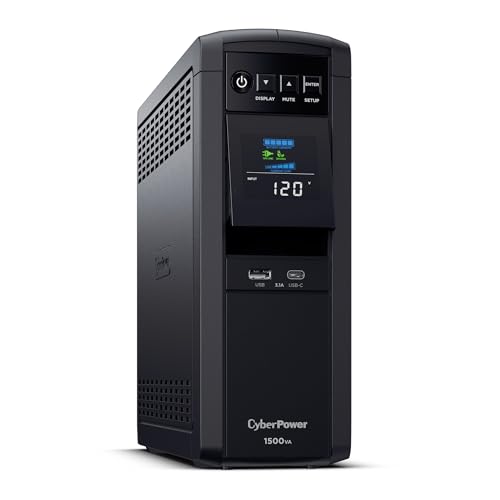
The CyberPower CP1500PFCLCD is designed for modern desktop computers, servers, and sensitive audiovisual equipment utilizing Active PFC power supplies. Delivering pure sinewave output across 12 outlets via a 1500VA/1000W capacity, it prevents the electrical interference and abrupt shutdowns common to stepped-wave backups. The mini-tower design displays precise real-time load and runtime metrics right on the front LCD screen, making it a standout choice for home offices.
- Pro: True pure sinewave output protects sensitive Active PFC systems.
- Pro: Generous 12-outlet capacity with Automatic Voltage Regulation.
- Con: Higher upfront cost compared to standard simulated sinewave units.
Skip it if you only need to keep basic networking hardware alive during a storm, as the premium pure sinewave output exceeds the needs of standard routers.
APC BE600M1
The APC BE600M1 is built specifically for compact networking centers, external hard drives, and lower-draw personal computers. With a 600VA/330W rating, it targets the critical window after an outage begins, providing ample runtime to save open work or keep your internet modem alive during localized grid events. Its low-profile flat footprint sits discreetly beneath desks or alongside entertainment centers.
- Pro: Dedicated USB charging port keeps smartphones powered independently.
- Pro: Space-saving flat design fits tight media consoles.
- Con: Lacks an LCD screen for detailed diagnostic metrics.
Skip it if you run a full gaming PC or high-end workstation, as its modest wattage rating will trigger an overload during heavy compute spikes.
CyberPower ST425
The CyberPower ST425 provides low-cost, bare-bones standby power protection for entry-level electronics. Delivering basic standby backup protection with surge-suppression functionality, it is designed for smart speakers, alarm base stations, and lower-tier networking hubs that require uninterrupted utility flow during brief interruptions. Its simple plug-and-play layout appeals to users looking for baseline safety on a tight budget.
- Pro: Highly affordable entry price for essential utility backup.
- Pro: Compact, lightweight chassis fits anywhere.
- Con: Standby topology lacks automatic voltage regulation for line conditioning.
Skip it if your home experiences frequent voltage drops and brownouts, since it must switch directly to battery rather than actively cleaning power fluctuations.
APC BX1500M
The APC BX1500M is an aggressive workhorse designed to handle power-hungry desktop computers, multi-drive arrays, and sensitive displays. Sporting a 1500VA/900W capacity, this mini-tower incorporates active voltage management alongside an informative LCD interface that details immediate battery health, voltage incoming, and estimated runtime under current loads. It delivers dependable resilience during severe seasonal weather cycles.
- Pro: Beefy 900W load threshold easily runs multi-monitor setups.
- Pro: Automatic Voltage Regulation stabilizes dirty utility power cleanly.
- Con: Stepped approximation waveform may cause audible hums in sensitive audio equipment.
Skip it if your computer requires a pure sinewave power feed, as this unit outputs an approximated stepped wave on battery mode.
CyberPower CP1500AVRLCD3
The CyberPower CP1500AVRLCD3 is targeted at users demanding large power reserves alongside continuous line conditioning without paying for specialty wave shapes. Offering a robust 1500VA rating, this intelligent unit regulates low and high voltages seamlessly to extend cell longevity. A tilt-capable LCD display makes it simple to read diagnostic statuses regardless of whether the unit sits on a desk or floor.
- Pro: Robust AVR functionality prevents needless battery usage during sags.
- Pro: Clean LCD interface provides immediate access to system vitals.
- Con: Simulated sinewave profile may limit compatibility with select sensitive gear.
Skip it if you operate high-end enterprise servers that strictly require pure sinewave inputs to run continuously.
CyberPower EC850LCD
The CyberPower EC850LCD focuses on reducing idle energy consumption for home offices while protecting mid-tier computer loads. With an 850VA rating, this unit features dedicated ECO-mode surge outlets that cut phantom power to peripheral devices when the primary PC shuts down. The clear LCD readout gives real-time clarity on power utilization, making it an intelligent pick for green-minded spaces.
- Pro: Energy-saving outlets cut unnecessary standby vampire draw.
- Pro: Built-in LCD panel unusual for this compact flat form factor.
- Con: Wide adapter plugs may obscure neighboring outlets on the top layout.
Skip it if you have severe line voltage swings, as this unit relies on standby technology rather than active line correction.
CyberPower ST625U
The CyberPower ST625U offers everyday defense for household workspaces, personal audio systems, and consumer modems. Rated at 625VA, this standby model includes convenient built-in front-facing USB charging ports, allowing you to charge mobile devices straight from the battery during sustained outages. It balances approachable pricing with practical everyday usability.
- Pro: Integrated USB ports allow easy smartphone and tablet top-offs.
- Pro: Dependable switchover speeds keep routers and network storage awake.
- Con: Basic standby unit without an onboard digital diagnostic display.
Skip it if you manage mission-critical servers, as it lacks both active voltage control and an interactive LCD monitoring screen.
APC BE425M
The APC BE425M provides an ultra-compact barrier against surges and short dropouts for individual networking appliances and low-draw home accessories. Offering a 425VA/225W rating, it occupies minimal space behind entertainment consoles or in home utility closets, preventing your internet connection from resetting when the electrical panel blinks. It serves as an economical insurance policy for crucial network connectivity.
- Pro: Exceptionally small chassis fits easily in utility and media closets.
- Pro: Right-angle power plug prevents blocking adjacent wall sockets.
- Con: 225W threshold restricts use to strictly low-draw equipment.
Skip it if you want to power a full desktop monitor and computer combination, which can rapidly surpass its maximum load limit.
Buying Guide
Topology: Standby vs. Line-Interactive
The internal topology defines how an uninterruptible power source reacts when grid power falters. Standby units pass incoming utility current directly to equipment, monitoring for an outage before switching over to the internal cell in milliseconds. While cost-effective, they lack Automatic Voltage Regulation (AVR). Line-interactive models, by contrast, use specialized transformers to correct minor brownouts and over-voltages continuously without switching to the battery. For locations prone to storm activity or fluctuating power grids, line-interactive systems significantly preserve battery longevity.
Output Waveforms: Pure vs. Simulated Sinewave
Standard household wall power flows as a smooth, continuous pure sinewave. Lower-cost battery backups produce a “simulated” or “stepped” sinewave that approximates this curve with squared electrical steps. While standard appliances and simple transformers handle simulated sinewaves effortlessly, modern high-efficiency computers using Active Power Factor Correction (PFC) power supplies may buzz, overheat, or shut down unexpectedly on stepped waves. Choosing a pure sinewave unit ensures complete compatibility with sensitive consumer electronics and professional workstations.
Sizing Wattage and Runtime Needs
Never size a backup device based purely on its Volt-Ampere (VA) rating; total wattage is the critical ceiling. To find the right capacity, sum the peak power consumption of every component that must stay operational during an outage and add a twenty to thirty percent headroom cushion. If the goal is safely saving work and shutting down within five minutes, a capacity closely matching your load is sufficient. If maintaining network communication through an extended blackout is paramount, pairing a lower total load with a higher-capacity unit yields vastly longer runtimes.
Our Verdict
For high-performance computing, the top pick is the CyberPower CP1500PFCLCD ($239.95), which blends a substantial 1000W capacity with true pure sinewave output and active AVR to safeguard sensitive electronics flawlessly. For shoppers looking to keep critical modems or personal electronics online on a tight budget, the CyberPower ST425 ($59.95) represents the best budget pick. However, if your setup requires heavy wattage handling up to 900W for standard workstations and you don’t require pure sinewave compatibility, the APC BX1500M ($189.99) wins on pure value-per-watt.
FAQ
Will a UPS keep my internet running if the power goes out?
Yes, provided your local internet service provider retains power at their distribution node during the outage. Connecting your modem, Wi-Fi router, and fiber optical network terminal to a dedicated backup can easily provide hours of uninterrupted network access due to their low electrical draw.
How often does an internal UPS battery need replacement?
Most sealed lead-acid units have a typical service life of three to five years depending on ambient temperature and cycling frequency. Units operating in high heat or subject to constant power drops will experience cell degradation faster. Most major manufacturers offer user-replaceable battery cartridges to extend the hardware’s operational lifespan.
Can I plug a surge strip into a battery backup?
Manufacturers generally advise against plugging traditional surge protectors into a UPS output. Doing so can confuse the internal load monitoring, void warranties, and potentially trip the overload protection prematurely. If you need more outlets, choose a unit equipped natively with sufficient ports.
What is the difference between VA and Watts?
Watts represent the real, usable power consumed by equipment to perform work, while Volt-Amperes (VA) measure apparent power based on voltage multiplied by current. In alternating current circuits, real power is always equal to or less than apparent power due to power factor inefficiency. Always verify your gear’s combined wattage fits within the model’s published watt ceiling.