Key takeaways
- Pro: Higher discharge capacity suits areas with stored fuels or chemicals
- Pro: Durable shell withstands incidental bumps in a workshop setting
- Con: Noticeably heavier than home-only units, which slows quick grab-and-go access
Most homeowners discover too late that the fire extinguisher mounted in their kitchen closet is either too small to knock down a grease flare-up or too bulky to grab in a dark hallway. Choosing from the available fire extinguisher sizes means matching the unit’s rated capacity to the actual rooms you need to protect, the weight you can lift under stress, and the number of locations you want covered on a realistic budget.
The eight models below span the range from compact single-canister units to multipack wall-mount bundles. What separates a good pick from a mediocre one is not simply the price tag but how well the rating, mounting hardware, and quantity align with your household layout. A two-pack that leaves your garage unprotected defeats the purpose, while an oversized commercial extinguisher on every shelf adds cost without improving coverage where it matters most in 2026.
Our top picks


As an Amazon Associate we earn from qualifying purchases at no extra cost to you.
Quick Picks
| Product | Best for | Price |
|---|---|---|
| First Alert Heavy Duty | Garage or workshop | $42.98 |
| Kidde FA110G Single | First single-unit purchase | $19.97 |
| 5 lb ABC Dry Chemical (mount) | Whole-floor coverage | $54.99 |
| Kidde 4-Pack FA110G | Multi-room residential | $71.89 |
| Kidde 6-Pack FA110G | Large homes or small offices | $107.84 |
| Kidde 2-Pack FA110G | Kitchen and one hallway | $35.95 |
| Ougist 2.5 lb FF1KG | Vehicle or boat | $31.67 |
| 5 lb ABC Dry Chemical (two-pack) | Dual-location wall mounting | $106.99 |
How We Picked
We compared published ratings, listed prices, and recurring owner feedback across each model. The three criteria that matter most in this category are the UL rating relative to physical weight, whether mounting hardware is included, and value per unit when you need coverage in multiple rooms. A model with strong specs but no bracket loses points because installation friction causes people to leave extinguishers loose under the sink.
The 8 Best Fire Extinguisher Sizes in 2026
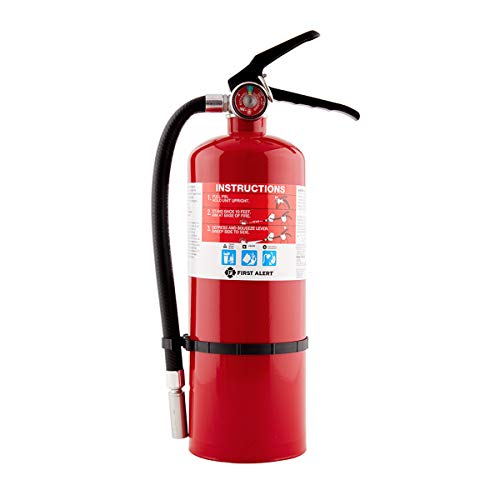
First Alert Fire Extinguisher, Heavy Duty for Home & Commercial Use
This unit targets the garage, workshop, or small commercial space where a basic kitchen extinguisher would run out of agent too quickly. Owners appreciate the substantial charge capacity for its weight class, which handles larger fuel loads better than compact household models. The rugged construction survives temperature swings in unconditioned spaces.
- Pro: Higher discharge capacity suits areas with stored fuels or chemicals
- Pro: Durable shell withstands incidental bumps in a workshop setting
- Con: Noticeably heavier than home-only units, which slows quick grab-and-go access
Skip it if your only exposure risk is a stovetop grease fire; a lighter, cheaper unit will cover that scenario without the extra bulk.
Kidde Basic 110 Fire Extinguisher for Home, FA110G, 1 Pack
The lowest-cost entry point into having any extinguisher at all. Its compact footprint fits tight kitchen cabinets and under-sink spaces where bulkier models do not. For someone replacing an expired unit or outfitting a small apartment, this is the most affordable path to rated coverage.
- Pro: Lightest option for the money; easy to mount or store
- Pro: Standard 1-A:10-B:C rating covers the most common household fire classes
- Con: Single canister means no backup if one is discharged or expires
Only skip it if you already know your layout requires coverage in two or more separate rooms, where a multipack offers better value.
5 lb ABC Dry Chemical Fire Extinguisher with Wall Mount, 2A:10B:C Rated
A step up in rated capacity that balances discharge power against manageable weight. The included wall mount removes a common installation barrier, and the 2A rating roughly doubles the fire-class coverage of basic household models. It suits a homeowner who wants meaningful protection without commercial-grade bulk.
- Pro: Wall mount bracket ships in the box, so mounting is immediate
- Pro: 2A:10B:C rating covers larger fuel loads than compact home units
- Con: At five pounds of agent, it demands more arm strength than the lighter models
Skip it if you need extinguishers in several rooms on a tight budget; the per-unit value of a multipack is harder to beat.
Kidde Fire Extinguisher for Home, 4 Pack
Designed for the multi-room residential layout: kitchen, hallway, garage, and bedroom each get a rated unit without buying four singles. The mounting bracket included with each canister means every location gets proper wall installation rather than a shelf sit-down.
- Pro: Lowest per-unit cost among all multipack options on this list
- Pro: Bracket included with every canister for proper installation
- Con: Same compact rating as the single pack, so it suits routine household risks rather than high-fuel-load areas
Skip it if your primary concern is a workshop or garage with stored solvents; a heavier commercial-grade unit delivers more agent per discharge there.
Kidde Basic 110 Fire Extinguisher for Home, FA110G, 6 Pack
The bulk-buy option for larger homes, duplexes, or small office floors where you want rated coverage in every corridor and utility room. At six units, the per-canister price drops to the lowest figure in the group, and the redundancy means one expired or discharged unit never leaves you unprotected.
- Pro: Best per-unit value across all eight models
- Pro: Six canisters cover an entire floor plan or a multi-unit rental property
- Con: Large initial outlay compared to buying one or two units
Skip it if your home has fewer than four rooms that could realistically start or encounter a fire; you would be paying for coverage you do not need.
Kidde Basic 110 Fire Extinguisher for Home, FA110G, 2 Pack
A sensible middle ground for households that need two rated points, most commonly the kitchen and a garage or basement stairwell. You double your coverage without the commitment of four or six units.
- Pro: Two locations covered for a modest price increase over the single
- Pro: Light enough to carry upstairs or stash behind a driver’s seat
- Con: Per-unit savings are marginal compared to the 4-pack; you are paying a small premium for flexibility
Skip it if your layout calls for three or more mounting points; the 4-pack costs only marginally more per unit.
Ougist ABC Fire Extinguisher for Home & Vehicle, FF1KG
The only model on this list explicitly certified for vehicle and boat use. Its quick-release handle is designed for one-hand operation while the other grips a steering wheel or tiller. Compact dimensions fit behind a seat, in a glove compartment, or in a marine locker.
- Pro: Certified for kitchen, car, and boat applications in a single unit
- Pro: Quick-release handle suits one-handed operation in emergencies
- Con: Smaller agent charge means shorter effective discharge time than the 5 lb models
Skip it as your sole home extinguisher; it works best as a dedicated vehicle or marine companion to a wall-mounted household unit.
5 lb ABC Dry Chemical Fire Extinguisher with Wall Mount (Two-Pack)
Identical specs to the single-unit version above, but sold as a pair at a premium. This suits homeowners who want matching wall-mount coverage on two floors or in two separate structures, such as a main house and a detached garage.
- Pro: Two full-coverage 2A:10B:C units with brackets for coordinated installation
- Pro: Heavier discharge capacity handles workshop or garage fuel loads
- Con: Highest total price on this list without a proportionally higher rating per unit
Skip it if a single wall-mount unit plus a compact multipack would cover your rooms at lower total cost.
Buying Guide
Matching Rating to Risk
The UL rating printed on the label tells you how much fire the extinguisher can handle. A 1-A rating covers a small wood-fire scenario; a 2-A doubles that. If your garage stores paint cans or a small engine, a 1-A unit may run out of agent mid-discharge. Compare ratings against the fuel loads actually present in each room before choosing among fire extinguisher sizes.
Weight and Reach Under Stress
Fifteen to twenty-five pounds of total weight is manageable for most adults in a hurry. Heavier commercial units demand two-handed operation and a firmer stance. If elderly family members or young adults may need to operate the extinguisher, prioritize lighter models even if the rating is slightly lower.
Mounting and Maintenance Access
Brackets and quick-release handles are not cosmetic features. A wall-mounted unit is retrieved faster than one stored in a cabinet, and a quick-release bracket lets you detach the canister with one hand for annual inspections or recharging. Check whether mounting hardware ships in the box or must be purchased separately.
Our Verdict
For most homeowners the 4-Pack Kidde FA110G delivers the best balance of rated coverage, per-unit value, and included mounting hardware. If budget is the only concern, the single Kidde FA110G at $19.97 removes any excuse for having no extinguisher at all. If your primary need is vehicle or marine safety, the Ougist FF1KG wins on certification scope alone.
FAQ
What is the most common fire extinguisher size for homes?
Two- to five-pound ABC dry-chemical units dominate the residential market. They fit standard kitchen cabinets, weigh under ten pounds total, and carry ratings sufficient for the most common household fires.
How many extinguishers does a typical home need?
Most safety guides recommend at least one per floor plus one in the garage. A two- or three-bedroom home usually needs three units, which makes a multipack more practical than individual purchases.
Do fire extinguisher sizes affect their shelf life?
No. The agent charge size and the maintenance interval are independent properties. Most dry-chemical units last five to twelve years before service is required regardless of weight class.
Can a car extinguisher substitute for a kitchen one?
Only in a pinch. Vehicle-rated units typically carry less agent, so they may not fully suppress a grease fire that has spread across a stovetop. Keep a dedicated kitchen unit and treat the car model as supplemental coverage.