Key takeaways
- Pro: Discharges cleanly with no powder, gas cloud, or corrosive film.
- Pro: UL Listed, so the stated rating is independently verified.
- Con: The price is a significant multiple of any dry-chemical alternative here.
A vehicle owner pulling out of a garage after a wiring short, or a homeowner reaching for a unit to mount inside a server closet, has the same core problem: they need a fire extinguisher that won’t destroy the thing it’s protecting. Water and traditional dry chemical powders leave residue that corrodes electronics, ruins upholstery, and contaminates food prep surfaces. A clean agent fire extinguisher displaces oxygen and breaks the combustion chain without leaving a trace, which is why this category exists at all.
What separates a genuinely useful unit from a shelf ornament is a combination of UL rating, discharge mechanism, portability, and refillability. A $20 vehicle extinguisher with a 5-B:C rating is perfectly adequate for a small car fire, while a $330 HalGuard PRO built for automotive dashboards offers a clean-agent formula that won’t short-circuit your ECU. This roundup compares eight products that people shopping for a clean agent fire extinguisher frequently encounter, so you can match the right tool to the scenario you’re actually protecting.
Our top picks


As an Amazon Associate we earn from qualifying purchases at no extra cost to you.
Quick Picks
| Product | Best For | Price |
|---|---|---|
| H3R HalGuard PRO (HP100R) | Vehicles with sensitive electronics | $330 |
| Kidde Auto 10 (M10G) | Larger cars and trucks on a budget | $20.96 |
| Kidde Auto 5 (M5G) | Compact car and motorcycle storage | $17.99 |
| MaxOut Compact (1.0 lb) | Off-road vehicles, UTVs, and boats | $120 |
| Kidde Basic 110 (FA110G, 1 Pack) | Single-home wall mounting | $19.97 |
| Kidde Basic 110 (FA110G, 2 Pack) | Kitchen plus garage coverage | $35.95 |
| Amerex 322 CO2 (5 lb) | Electrical and flammable-liquid workshops | $298 |
| Ougist Class K (34 Fl Oz) | Small commercial or home kitchens | $65.32 |
How We Picked
We filtered this category on four criteria: UL listing status (unlisted units should not be trusted in life-safety situations), clean or near-clean discharge residue (the defining reason most buyers search for a clean agent fire extinguisher in the first place), realistic mounting and portability for the stated use case, and refillability or total cost of ownership over the unit’s service life. Price was used as a sorting signal, not a quality proxy.
The 8 Best Clean Agent Fire Extinguisher in 2026
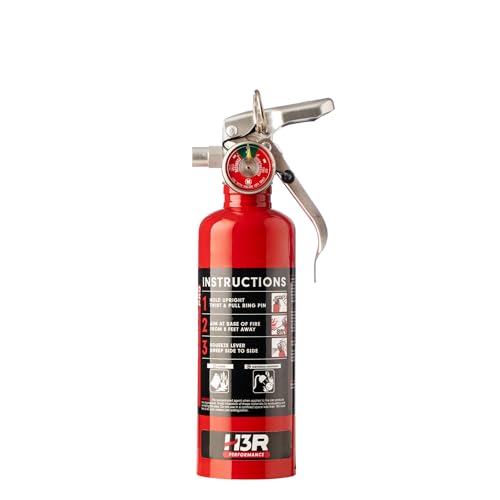
H3R HalGuard PRO (HP100R) — 1.25 lb Red
This is the closest match to a true clean agent fire extinguisher on our list: HalGuard uses a halon-alternative formula that leaves zero residue, making it the obvious pick for anyone whose vehicle houses expensive electronics, racing data loggers, or custom audio. The 1.25 lb package mounts behind a seat or on a dash bracket without dominating the cabin.
- Pro: Discharges cleanly with no powder, gas cloud, or corrosive film.
- Pro: UL Listed, so the stated rating is independently verified.
- Con: The price is a significant multiple of any dry-chemical alternative here.
Skip it if your budget stretches only to a basic ABC dry chemical and you can tolerate residue cleanup.
Kidde Auto 10 (M10G) — 10-B:C
The 10-B:C rating is the strongest raw fire-fighting score among the vehicle-focused options in this roundup, which means it covers larger fuel-loads in trucks and SUVs. Kidde’s automotive line is widely stocked, and owner feedback consistently notes the trigger mechanism holds pressure well over years in a glovebox. It uses dry chemical, so expect powder cleanup afterward.
- Pro: Highest B:C rating of any vehicle unit here.
- Pro: Priced well under half the cost of dedicated clean-agent options.
- Con: Dry chemical leaves residue that can damage electronics and finishes.
Skip it if the protected area contains sensitive circuits you cannot afford to contaminate.
Kidde Auto 5 (M5G) — 5-B:C
A half-pound lighter and a few dollars cheaper than the Auto 10, this unit fits where the M10G won’t: motorcycle saddlebags, small compact cars, under-seat storage in coupes. The 5-B:C rating is adequate for an engine-bay flash fire in a smaller vehicle but noticeably thinner than the M10G’s margin.
- Pro: Compact form factor that disappears into tight storage spaces.
- Pro: Lowest absolute price of any UL-listed vehicle extinguisher on this list.
- Con: Half the B:C rating of its sibling, so margin for error is slimmer.
Skip it for any vehicle with a V8, turbo diesel, or aftermarket fuel system.
MaxOut Compact (1.0 lb)
MaxOut positions this as an off-road and marine option, and the Purple K dry chemical formula is a legitimate step up from standard BC powder — finer particle size, shorter discharge time, better knockdown on flammable liquids. The included mounting bracket survives vibration on Jeeps, UTVs, and small boats.
- Pro: Purple K discharges faster than standard dry chemical of similar size.
- Pro: Refillable, so the cost-per-use drops over the unit’s life.
- Con: Still a dry chemical; it is not a clean agent fire extinguisher by residue standards.
Skip it if zero-residue discharge is a hard requirement for your application.
Kidde Basic 110 (FA110G) — 1 Pack
The 1-A:10-B:C rating covers the three most common household fire classes, and the red canister mounts to a wall with the included bracket. Owner feedback highlights ease of inspection (a pressure gauge visible through a plastic shroud) and the ability to discharge, invert, and store again if the canister retains charge.
- Pro: Multi-class rating makes it a versatile single-home solution.
- Pro: Under $20 per unit at the time of writing.
- Con: Dry chemical everywhere; not suitable for server rooms or electronics closets.
Skip it for any space where residue is unacceptable; look at the HalGuard or CO2 options instead.
Kidde Basic 110 (FA110G) — 2 Pack
Identical hardware to the single pack, sold at roughly $16 less than buying two separately. The practical use case is straightforward: one near the kitchen exit, one in the garage or hallway, so you never have to cross a fire to grab a tool.
- Pro: Multi-unit discount makes full-home coverage affordable.
- Pro: Same 1-A:10-B:C rating as the single pack, no spec compromise.
- Con: Two identical units in a single style may not cover the most at-risk spot (cooking grease) as well as a dedicated Class K.
Skip it if your primary risk is a kitchen grease fire; add the Ougist Class K instead.
Amerex 322 CO2 (5 lb)
Carbon dioxide is the original clean agent fire extinguisher in spirit: it displaces oxygen, leaves no residue, and is safe around energized equipment up to 600 volts. The 5 lb cylinder is the most common workshop size and pairs well with flammable-liquid storage. Discharge is loud and the horn can cause cold-burn on bare hands, which is a known trade-off.
- Pro: Absolutely zero residue after discharge.
- Pro: Amerex build quality is industrial-grade, with a wide service network for hydrostatic testing.
- Con: Heavy for its rating and impractical to mount in a vehicle.
Skip it in confined, unventilated spaces; CO2 asphyxiation risk is real at that volume.
Ougist Class K (34 Fl Oz)
Wet chemical is the only agent that saponifies cooking oil, forming a foam blanket that prevents re-ignition. At 34 fl oz, this unit is sized for a home range or a small food-cart rather than a commercial hood. The price under $70 is competitive for UL-listed Class K hardware.
- Pro: Addresses grease-fire chemistry that ABC powder cannot.
- Pro: Compact and lightweight enough for home kitchen under-sink storage.
- Con: Only 34 fl oz; coverage area is limited to a single burner or small fryer.
Skip it for a full commercial kitchen; local code will require a larger, hood-connected system.
Buying Guide
Understand What “Clean” Actually Means
True clean agents (halon, HalGuard, FE-36) interrupt combustion at the molecular level and evaporate without trace. CO2 is clean but suffocates. Dry chemical is not clean at all — the powder is corrosive to circuit boards and abrasive to finishes. When you search for a clean agent fire extinguisher, confirm the agent type on the label, not just the marketing copy.
Match the UL Rating to Your Real Fire Risk
A 5-B:C unit will handle a small engine-bay spill; a 10-B:C gives you margin for a truck fuel-line fire. In kitchens, 1-A:10-B:C covers trash and grease splash, but only a Class K rating handles a deep-fryer event. Over-rating costs a few extra pounds of canister; under-rating costs you seconds you won’t get back.
Mounting, Inspection, and Refillability
A fire extinguisher bolted to a bracket you can see daily is more likely to be checked for pressure than one buried in a compartment. Refillable units (all Kidde vehicle models, MaxOut, Amerex) can be serviced indefinitely; disposable units must be replaced after any discharge or when the gauge drops into the red. Factor the long-term cost into the purchase decision.
Our Verdict
Top pick: The H3R HalGuard PRO (HP100R) is the only product here that delivers a genuine clean agent fire extinguisher experience in a vehicle form factor. If your priority is protecting electronics and finishing with zero cleanup, it earns its premium.
Budget pick: The Kidde Auto 5 (M5G) at $17.99 gives you a UL-listed, pressure-gauged extinguisher small enough to forget about until you need it. For a commuter car with no aftermarket electronics, it is hard to beat at that price.
Conditional winner: If your primary risk is a workshop full of energized equipment and solvent-soaked rags, the Amerex 322 CO2 outperforms every other option on this list for zero-residue suppression, even though it carries a much higher price tag.
FAQ
Is a CO2 extinguisher the same as a clean agent fire extinguisher?
Not exactly. CO2 leaves no residue, so it shares the “clean” benefit, but true clean agents use a halon-alternative chemical that interrupts combustion without relying solely on oxygen displacement. CO2 also carries an asphyxiation hazard in tight spaces that clean agents do not.
Can I use a dry chemical extinguisher on electronics?
You can, but the powder will almost certainly destroy exposed circuit boards and cannot be fully removed from fans, connectors, or keyboard switches. If electronics are the protected asset, choose a HalGuard, FE-36, or CO2 unit instead.
How often should a vehicle extinguisher be inspected?
Check the pressure gauge monthly and replace or service the unit per the manufacturer’s interval, typically every six to twelve years for stored-pressure models. Extreme heat inside a parked vehicle can accelerate seal degradation, so inspect more frequently if you live in a hot climate.
Does a clean agent fire extinguisher work on a grease fire?
Clean agents are rated for B-class liquid fuels, but cooking oil fires (Class K) require the saponification reaction that only wet chemical provides. A HalGuard or CO2 unit will knock down flames momentarily but cannot form the soap foam that prevents re-ignition.