
Our Top Picks
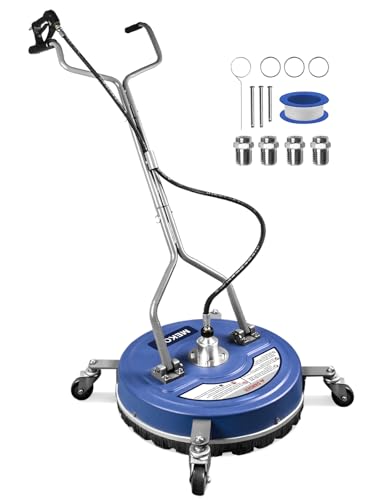 MEKOH 20” Heavy-Duty Pressure Washer Surface Cleaner with20 x 20 x 65 inches17.3 PoundsCheck on Amazon
 Westinghouse Universal 16.5” Pressure Washer Surface Cleaner Attachment16.5 x 16.5 x 4 inchesCheck on Amazon
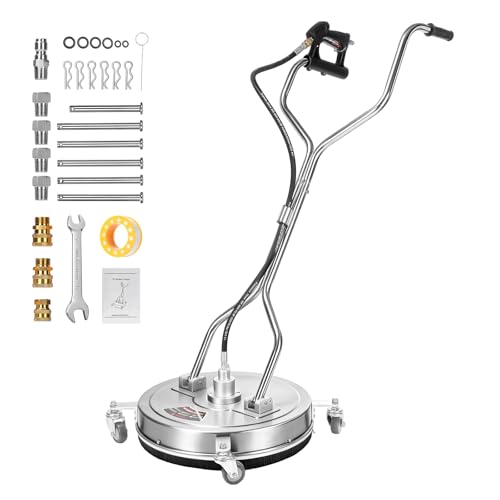 GEARWAVE 20" Pressure Washer Surface Cleaner with 420 Inch20 x 20 x 60 inches24 poundsCheck on Amazon
 JANZ 14'' Pressure Washer Surface Cleaner14 Inch Silvery White14 x 14 x 5 inches7 poundsCheck on Amazon
 WOJET 20'' Commercial Pressure Washer Surface Cleaner with20 Inch20 x 20 x 63 inches27 poundsCheck on Amazon

The best surface cleaner for most pressure washers is the Westinghouse Universal 16.5″ Stainless Steel Surface Cleaner Attachment. Its 16.5-inch swath, 4,400 PSI maximum rating and standard 1/4-inch quick-connect plug line up with the 2,000–3,200 PSI, 1.4–2.5 GPM electric and gas machines most homeowners actually own, and stainless construction holds up better than the painted steel housings common at the budget end. If you run a gas washer at 2.5 GPM or more across a long driveway, the 20-inch MEKOH Heavy-Duty covers roughly 40 percent more ground per pass and is the better buy. If price is the deciding factor, the Hourleey 14″ delivers four wheels and a stainless deck for a budget outlay. If you want the fewest passes humanly possible, the JANZ 24″ Dual Handle Pro is the widest unit here.
Everything below is compared on the six things that actually decide whether a surface cleaner works for you: cleaning width, pressure rating, swivel construction, splash control, nozzle access and compatibility with your machine’s output. You also get the ownership side — what wears out first, what replacement parts cost, and the coverage math that tells you whether a 20-inch head saves you fifteen minutes or forty.
Top 3 Picks
Best overall: Westinghouse Universal 16.5″ Stainless Steel Surface Cleaner Attachment. The 16.5-inch swath is the sweet spot between coverage and the flow demand a residential machine can actually feed. A 4,400 PSI ceiling means it will not be the weak link on a gas washer, while the standard 1/4-inch connector drops straight onto the vast majority of consumer guns and wands.
Best budget: Hourleey 14″ Pressure Washer Surface Cleaner. Four wheels, a stainless steel deck and a 14-inch swath at the entry price tier. It is the right first surface cleaner for a homeowner with a small patio, a walkway and a 1.4–1.8 GPM electric washer.
Best premium: JANZ 24″ Dual Handle Pro. The widest head in this roundup. If you maintain a long driveway, a parking pad and a shop apron, the reduced pass count is worth the premium tier, and the dual-handle design lets you push with both arms instead of steering one-handed.
Quick Comparison
Two of the twelve entries below are not pressure washer attachments at all — the MRS. MEYER’S and The Laundress sprays are indoor multi-surface cleaners. They are included because outdoor cleaning jobs almost always generate indoor follow-up work: patio furniture cushions, door hardware, railings and window sills that a 4,500 PSI attachment has no business touching.
| Product | Best for | Key specs | Price tier |
|---|---|---|---|
| MEKOH 20″ Heavy-Duty | Large driveways, high-output gas washers | 20″ swath; 4,500 PSI max; 1/4″ quick connect; 4 wheels; heavy-duty housing | Premium |
| Westinghouse Universal 16.5″ | Most homeowners, mixed surfaces | 16.5″ swath; 4,400 PSI max; 1/4″ connector; stainless steel body | Mid-range |
| GEARWAVE 20″ | Big concrete on a mid-range budget | 20″ swath; 4,500 PSI max; 4 wheels; 1/4″ quick connect | Mid-range |
| JANZ 14″ | Small patios, low-GPM electric washers | 14″ swath; compact housing; 1/4″ quick connect class | Mid-range |
| WOJET 20″ Commercial | Commercial and continuous duty | 20″ swath; 4,500 PSI max; 4 wheels; commercial-grade build | Premium |
| Hourleey 14″ | Budget concrete and patio work | 14″ swath; stainless steel; 4 wheels; 1/4″ quick connect | Budget |
| JANZ 20″ Dual Handle | Long sessions, less operator fatigue | 20″ swath; dual-handle design; 1/4″ quick connect class | Premium |
| JANZ 24″ Dual Handle Pro | Maximum coverage per pass | 24″ swath; dual handle; pro-duty build | Premium |
| TOR 14″ | Entry-level stainless steel | 14″ swath; 4,000 PSI max; stainless steel; 4 wheels | Budget |
| Westinghouse PWSC12 12″ | Tight spaces, low-output washers | 12″ swath; 3,000 PSI max; 1/4″ connector | Budget |
| MRS. MEYER’S Multi-Surface Cleaner, Lavender, 16 fl oz, 3 Pack | Indoor surfaces and post-wash touch-up | 3 × 16 fl oz bottles; spray format; multi-surface formula | Budget |
| The Laundress All Purpose Surface Cleaner, No. 247 | Fragrance-led indoor cleaning | 15.5 fl oz; single bottle; No. 247 fragrance | Budget |
How We Chose
These picks were assembled from published listing specifications and established category knowledge, not from hands-on trials. Four filters did most of the work. First, stated specs: swath width, maximum pressure rating, connection type, wheel count and housing material, since those five numbers determine whether a unit will physically fit your machine and your job. Second, category fit — a 24-inch commercial head is a poor recommendation for someone with a 1.2 GPM electric washer, no matter how good the head is, because the machine cannot feed it enough flow to keep the bar spinning at speed. Third, use case: driveway versus patio versus commercial contract work pull toward different widths and wheel configurations. Fourth, upgrade path and serviceability — whether nozzles and swivels can be replaced, and whether the unit is priced so that a first-time buyer is not over-buying before they know how often they will use it.
1. MEKOH 20″ Heavy-Duty – Best for Large Driveways with High-Output Gas Washers
As an Amazon Associate we earn from qualifying purchases at no extra cost to you.

This is the unit you buy when the machine behind it is a gas washer in the 3,000–4,000 PSI range flowing 2.5 GPM or better, and when the job list starts with a driveway measured in thousands of square feet. A 20-inch head with four wheels and a 4,500 PSI maximum rating is the classic commercial-lite configuration: wide enough to cut your pass count dramatically compared with a 14-inch unit, and rated well above the output of a typical residential gas washer so the attachment is never the limiting factor in the system.
Who it suits, concretely: someone with 1,500 square feet or more of concrete, a gas machine they already own, and a realistic expectation of cleaning that concrete two to four times a year. It also suits light commercial work — a small parking area, a rental turnover, a farm shop apron.
Key specs
- 20-inch cleaning swath
- 4,500 PSI maximum pressure rating
- 1/4-inch quick-connect inlet, the most common fitting on consumer and prosumer guns
- Four-wheel carriage for stability across expansion joints and uneven slabs
- Heavy-duty housing and skirt designed for gas-class output
Strengths
The headline strength is throughput. A 20-inch head with a 25 percent overlap pattern gives you roughly 15 inches of effective cleaning width per pass. At a comfortable surface-cleaner walking pace of about 40 feet per minute, that is around 50 square feet per minute of theoretical coverage, or about 3,000 square feet per hour before real-world losses. In practice you should assume 50–60 percent of that, which still lands near 1,800 square feet per hour — roughly 40 percent more than a 14-inch head delivers with the same effort.
The four-wheel carriage matters more than buyers expect. Two-wheel surface cleaners have a tendency to tip forward on expansion joints and driveway lips, which lifts the skirt, throws spray sideways and leaves a stripe you have to go back over. Four wheels keep the deck parallel to the slab, which is the single biggest factor in getting an even finish.
The 4,500 PSI ceiling also means headroom. Running a 4,500 PSI-rated attachment on a 3,200 PSI machine keeps the swivel and seals well inside their design envelope, which is where long service life comes from.
Pros
- 20-inch swath cuts cleaning time substantially on large slabs
- 4,500 PSI rating leaves headroom on typical gas washers
- Four-wheel design resists tipping and striping on uneven concrete
- Standard 1/4-inch quick connect fits most guns without adapters
- Built for repeated, heavy seasonal use rather than occasional patio work
Cons
- Premium price tier for what is still a single-purpose attachment
- Needs roughly 2.5 GPM or more to perform properly; a 1.4 GPM electric washer will leave it under-driven
- Bulkier to store and heavier to lift onto a shelf than a 14-inch unit
- Overkill for anyone whose total hardscape is under about 600 square feet
How it compares
The nearest alternative here is the GEARWAVE 20″, which matches the width, the 4,500 PSI rating and the four-wheel layout at the mid-range tier. The MEKOH justifies its premium through build specification and duty expectation rather than through a wider swath — if you clean concrete twice a year, the GEARWAVE is the rational buy; if you are on the machine weekly, the MEKOH is the one built for that. The WOJET 20″ Commercial sits in the same width class with a commercial orientation, which is the pick when the work is paid rather than personal.
2. Westinghouse Universal 16.5″ – Best for Most Homeowners and Mixed Surfaces

The 16.5-inch Westinghouse is the unit that fits the widest range of real-world setups, which is why it takes the overall pick. It carries a 4,400 PSI maximum rating — high enough that it will not be the weak link even on a strong gas washer — while its 16.5-inch swath is narrow enough that a 1.8–2.5 GPM machine can still spin it at a productive speed. The stainless steel construction is the other half of the argument: stainless resists the corrosion that eats painted steel decks after a few seasons of wet storage.
Who it suits: the homeowner with one electric or gas washer in the 2,000–3,200 PSI range who needs to clean a driveway, a patio, a walkway and a garage apron with one attachment, and who would rather buy once than replace a cheap unit every other year.
Key specs
- 16.5-inch cleaning swath
- 4,400 PSI maximum pressure rating
- 1/4-inch connector, the standard fitting on most consumer pressure washer guns
- Stainless steel body and deck
- Universal attachment format — no proprietary gun or wand required
Strengths
The swath is the reason this wins. Sixteen and a half inches is genuinely the middle of the market: with a 25 percent overlap you are cleaning about 12.4 inches per pass, which at 40 feet per minute works out to roughly 41 square feet per minute theoretical, or about 2,500 square feet per hour before efficiency losses. Budget for 1,400–1,500 square feet per hour in practice. That is a real improvement over a 14-inch head without demanding the 2.5+ GPM that a 20-inch head wants.
Stainless construction changes the ownership math. The parts that fail first on any surface cleaner are the swivel bearing, the seals and the deck itself. A painted steel deck rusts from the inside wherever the coating is chipped, and it chips constantly from grit thrown up by the spinning bar. Stainless sidesteps that failure mode entirely and typically outlives the machine it is attached to.
The universal format is underrated too. Because it uses the standard 1/4-inch quick connect rather than a proprietary fitting, it moves with you if you replace your washer, and it works on a friend’s machine if you lend it out.
Pros
- 16.5-inch swath balances coverage against flow demand better than 14″ or 20″ heads
- 4,400 PSI rating gives headroom on gas machines and no downside on electric
- Stainless steel resists the corrosion that kills painted decks
- Standard 1/4-inch connector — no adapters, no proprietary gun
- Mid-range tier for premium-adjacent construction
Cons
- Not the widest option; a 20-inch head still covers more ground per pass
- Stainless is not immune to damage — dropping it on a corner can still bend the skirt
- No dual-handle configuration, so long sessions rely on a standard gun
- Will feel under-driven on washers below roughly 1.4 GPM
How it compares
Against the MEKOH 20″ Heavy-Duty, this is the more conservative and more universally compatible choice: you give up about 3.5 inches of swath and 100 PSI of headroom, and in exchange you get a head that performs properly on a broader range of machines, including mid-output electric washers. Against the Hourleey 14″, it costs more but cleans about 25 percent faster per pass and uses stainless throughout rather than at the deck only. For most buyers, the 16.5-inch Westinghouse is the point where spending a little more stops being optional and starts being sensible.
3. GEARWAVE 20″ – Best for Big Concrete Jobs on a Mid-Range Budget
The GEARWAVE 20″ is the value play on a wide head. It carries the same headline numbers as the premium 20-inch units — a 20-inch swath, a 4,500 PSI maximum rating and a four-wheel carriage — but sits in the mid-range price tier. For a homeowner with a genuinely large slab and a gas washer, this is where the coverage-per-dollar calculation lands best.
Who it suits: someone with 1,000–2,500 square feet of concrete, a gas pressure washer flowing 2.5 GPM or better, and a budget that does not stretch to premium-tier hardware. Also a reasonable second unit for someone who wants a wide head as a backup without paying premium money for it.
Key specs
- 20-inch cleaning swath
- 4,500 PSI maximum pressure rating
- Four-wheel carriage
- 1/4-inch quick-connect inlet
- Mid-range price tier for wide-head coverage
Strengths
The four-wheel, 20-inch combination is the single biggest time-saver in this category, and the GEARWAVE delivers it at a price point that undercuts the premium 20-inch units. With 25 percent overlap you get roughly 15 inches of effective swath; at 40 feet per minute that is about 50 square feet per minute, or around 3,000 square feet per hour theoretical and 1,700–1,800 square feet per hour in practice. A 1,200 square foot driveway that takes about 55 minutes with a 14-inch head drops to roughly 40 minutes here — and the difference compounds if you clean twice a year.
Four wheels also give you the stability benefit: the deck stays parallel across expansion joints, which is what prevents the tiger-striping that two-wheel units are notorious for. And because the head is rated to 4,500 PSI, it has headroom on the 3,000–3,500 PSI gas machines it is most likely to be paired with.
Pros
- 20-inch swath at a mid-range tier — the best coverage-per-dollar in this list
- 4,500 PSI rating suits gas washers with output to spare
- Four wheels reduce tipping and striping on jointed concrete
- Standard 1/4-inch quick connect
- Wide enough to make short work of large slabs
Cons
- Requires roughly 2.5 GPM or better to spin properly — not for low-output electric washers
- Mid-range build means less margin on swivel and seal life under continuous commercial use
- Heavier and bulkier to store than a 14-inch unit
- No dual-handle option for reducing operator fatigue
How it compares
The direct rival is the MEKOH 20″ Heavy-Duty. They match on width, pressure rating and wheel count; the MEKOH’s premium tier buys build quality and a longer expected service life under hard use. If you clean your own driveway a few times a year, the GEARWAVE gets you the same 20-inch productivity for less. If the unit lives in a trailer and works every week, the premium spend is justified. The WOJET 20″ Commercial is the third member of the 20-inch class and sits above both on duty expectation.
4. JANZ 14″ – Best for Small Patios and Low-GPM Electric Washers

The JANZ 14″ is the compact option from a brand that has built its reputation on surface cleaners specifically rather than as a side line. At 14 inches it is sized for the jobs a narrow head does better: patios, walkways, stoops, garage aprons, and anything with planters, steps or furniture in the way. The listing does not headline a maximum PSI figure, so treat this as a general-purpose consumer unit intended for typical residential machine output rather than as a gas-class attachment.
Who it suits: the homeowner with a 1.4–2.0 GPM electric pressure washer and 300–800 square feet of hardscape. Also a good choice for anyone whose cleaning area is broken up by obstacles, where a 20-inch deck simply cannot fit into the corners and around the legs.
Key specs
- 14-inch cleaning swath
- Compact housing, easier to manoeuvre around planters, steps and furniture
- Standard 1/4-inch quick-connect class fitting
- Suited to typical residential electric and light gas machine output
Strengths
A 14-inch head is the right size when flow is limited. The rule of thumb that governs this category is that the head diameter has to be matched to the machine’s flow rate, not its pressure. A 14-inch head is comfortably driven by roughly 1.4–2.0 GPM, which is where most residential electric washers live. Put a 20-inch head on that same machine and the bar slows down, the cleaning becomes uneven and you end up doing more passes than the wider deck was supposed to save.
Manoeuvrability is the second strength. A 14-inch deck gets into the strip between a garage wall and a parked car, around a fire pit, and along the edge of a planting bed without hosing the flowerbed. Coverage works out to about 35 square feet per minute theoretical with a 25 percent overlap at a 40 feet per minute pace — around 2,100 square feet per hour theoretical and 1,100–1,300 square feet per hour realistic, which is plenty for a typical patio job.
Pros
- 14-inch swath matches low-GPM electric washers properly
- Compact and manoeuvrable around obstacles, steps and planters
- Lighter and easier to store than a 20-inch deck
- From a brand focused on surface cleaners as a product category
- Mid-range tier for a compact, purpose-built unit
Cons
- Roughly 30–40 percent slower per pass than a 20-inch head on open concrete
- No headline maximum PSI figure in the listing — confirm the rating before pairing it with a high-output gas washer
- Smaller decks mean more passes and more overlap discipline on big slabs
- Mid-range price for a compact size
How it compares
The obvious cross-shop is the Hourleey 14″, which matches the width at the budget tier and adds a stainless steel deck and four wheels. If price is the priority, the Hourleey wins. The JANZ justifies its mid-range tier on brand focus and finish rather than on a specification advantage. Against the TOR 14″, the JANZ is the more polished of the two; the TOR is the one to buy when the budget is genuinely tight. If your machine is a 1.4 GPM electric unit, all three are correctly sized — and all three will beat a 20-inch head on that machine.
5. WOJET 20″ Commercial – Best for Commercial and Continuous-Duty Use

The WOJET 20″ Commercial is the unit in this list most explicitly aimed at people who clean for money. The listing positions it as commercial, with a 20-inch swath, a 4,500 PSI maximum rating and a four-wheel carriage — the same working envelope as the other 20-inch heads, but with the build expectation that comes with commercial branding. That matters because the failure modes that end a consumer unit’s life are mostly about duty cycle, not about peak pressure.
Who it suits: a pressure washing contractor, a property manager, a farm or shop owner with a large apron, or anyone whose unit gets used weekly rather than seasonally. It also suits a homeowner who has already replaced one cheap surface cleaner and does not want to do it again.
Key specs
- 20-inch cleaning swath
- 4,500 PSI maximum pressure rating
- Four-wheel carriage
- Commercial-grade construction and duty rating
- 1/4-inch quick-connect class inlet
Strengths
Commercial orientation in this category means a few concrete things. Housings and swivel assemblies are specified for longer continuous running, which is the difference between a unit that survives a four-hour session and one that starts leaking at hour three. Four wheels on a commercial deck also hold up better against grit and debris, which is what actually destroys wheel bearings and skirts on residential-grade units. And a 20-inch swath at commercial duty means the coverage math holds up over a whole working day: roughly 1,700–1,800 square feet per hour realistic, or around 14,000 square feet in an eight-hour shift with breaks.
The 4,500 PSI rating also suits the machines commercial operators run, which are frequently 3,500–4,000 PSI gas units with high flow. Matching a commercial attachment to a commercial machine is the correct pairing; a 4,500 PSI head on a 1.4 GPM electric washer is a mismatch in the opposite direction.
Pros
- Built for continuous duty rather than occasional seasonal use
- 20-inch swath for high productivity over long sessions
- 4,500 PSI rating matches commercial gas machine output
- Four-wheel stability on large, jointed slabs
- Premium tier priced against expected service hours, not just spec sheet
Cons
- Premium price tier is hard to justify for twice-a-year homeowner use
- Demands high flow — realistically 2.5 GPM or better
- Heavy and bulky relative to compact heads
- No dual-handle configuration in this specific model
How it compares
Against the MEKOH 20″ Heavy-Duty, this is a matter of duty expectation rather than specification: same width, same pressure ceiling, same wheel count. Choose the WOJET when the attachment is a work tool and the MEKOH when it is a serious homeowner purchase. Against the JANZ 20″ Dual Handle, the WOJET gives up the ergonomic handle design in exchange for a commercial build — and for a solo operator running long shifts, the dual-handle layout is often the more valuable feature.
6. Hourleey 14″ – Best Budget Pick for Concrete and Patios

The Hourleey 14″ is the best value in this roundup for a straightforward reason: it gives you a stainless steel deck and four wheels at the budget tier. Those are the two features that separate a surface cleaner that lasts from one that rusts out or tips and stripes. Getting both at entry-level pricing is unusual.
Who it suits: a first-time surface cleaner buyer with a residential electric washer in the 1.4–1.8 GPM range and a patio, driveway apron and walkway to clean. It is also the sensible pick for a rental property or a second home, where the tool needs to work when it is needed and not cost much to replace if it disappears.
Key specs
- 14-inch cleaning swath
- Stainless steel construction
- Four-wheel carriage
- 1/4-inch quick-connect inlet
- Budget price tier
Strengths
Stainless steel at this price is the headline. On budget surface cleaners, the deck is usually painted steel, and painted steel rusts wherever the coating chips — which, on a device that throws grit against its own underside for hours at a time, is everywhere. A stainless deck eliminates that failure mode and typically extends the useful life of the unit by several seasons.
Four wheels is the second win. Two-wheel budget heads tip forward when you push them across an expansion joint or over the lip of a garage slab, and every tip lifts the skirt and sprays water sideways. Four wheels keep the deck flat, which produces a more even finish with less rework — and rework is what makes a cheap tool expensive.
Performance-wise, a 14-inch head is correctly matched to a low-GPM electric washer. With 25 percent overlap you are cleaning roughly 10.5 inches per pass, which is about 35 square feet per minute at a 40 feet per minute pace — around 1,100–1,300 square feet per hour in practice. For a 500 square foot patio, that is under half an hour of actual cleaning.
Pros
- Stainless steel deck at the budget tier
- Four wheels for stability and stripe control
- 14-inch swath is correctly sized for 1.4–1.8 GPM electric washers
- Standard 1/4-inch quick connect
- Low entry cost makes it an easy first surface cleaner
Cons
- Narrow swath means more passes on large driveways
- Budget-tier swivel and seals are the most likely early wear points
- No dual-handle ergonomics for extended sessions
- Not intended for high-output commercial gas machines
How it compares
Against the TOR 14″, the two are very close: same width, same four-wheel layout, both budget tier. The TOR headlines a 4,000 PSI maximum rating, which is a meaningful figure if you plan to run it on a gas washer; the Hourleey’s stainless deck is the better long-term proposition if you are on electric. Against the JANZ 14″, the Hourleey is cheaper and gives you stainless and four wheels, while the JANZ is the more refined unit. For a first purchase on a small hardscape, the Hourleey is the value answer.
7. JANZ 20″ Dual Handle – Best for Fatigue-Free Long Sessions

The JANZ 20″ with dual handle is built around an ergonomic argument rather than a specification one. At 20 inches wide, it covers the same ground per pass as the other wide heads in this list, but the dual-handle design lets you push with both arms and steer with your body weight instead of dragging a single-handled gun behind you for an hour.
Who it suits: anyone with a large driveway, a long commercial apron or a big patio who has already spent a session hunched over a single-handle unit and does not want to repeat it. It also suits older users or anyone managing shoulder or wrist strain, where a two-handed push stance distributes load far better than a one-handed pull.
Key specs
- 20-inch cleaning swath
- Dual-handle design for two-handed operation
- 1/4-inch quick-connect class inlet
- Wide-deck format suited to high-flow machines
- Premium price tier
Strengths
The dual handle is not a gimmick. On a 20-inch deck, the resistance you feel is real — you are pushing a wide skirt across concrete while the spinning bar pushes back. A single-handle gun forces you to hold that load with one arm and steer with the other, which is why long driveway sessions end with a sore forearm and a wobbly line. Two handles let you stand behind the unit and drive it forward with both arms, which improves both comfort and consistency of overlap.
Consistency matters more than people expect, because striping is a technique problem before it is a hardware problem. A user who can push steadily in straight, evenly overlapped lanes gets a better finish than one fighting a wandering single-handle gun — even with a better head.
On coverage, the math is the same as any 20-inch unit: roughly 15 inches effective with 25 percent overlap, about 50 square feet per minute theoretical at a 40 feet per minute pace, and around 1,700–1,800 square feet per hour realistic. What changes is how long you can sustain that pace.
Pros
- Dual-handle layout reduces fatigue and improves pass consistency
- 20-inch swath for high coverage per pass
- Premium-tier build from a brand specialising in surface cleaners
- Two-handed stance improves control around obstacles
- Suits long sessions on large hardscapes
Cons
- Premium tier — the ergonomic benefit costs more than a standard 20-inch head
- Needs high flow (roughly 2.5 GPM or more) to perform
- Bulkier storage than a 14-inch unit
- No headline maximum PSI figure in the listing — verify the rating before pairing with a high-output gas machine
How it compares
Against the JANZ 24″ Dual Handle Pro, this is the easier-to-handle sibling: 4 inches narrower, meaningfully lighter to push, and better suited to a driveway that has cars, planters and tight edges to work around. Against the WOJET 20″ Commercial, the JANZ trades commercial duty build for ergonomics. If your problem is fatigue rather than durability, this is the pick; if your problem is a unit that keeps failing under daily use, the WOJET is.
8. JANZ 24″ Dual Handle Pro – Best for Maximum Coverage Per Pass

At 24 inches, this is the widest surface cleaner in this roundup and the one that produces the fewest passes per square foot. It is a pro-duty unit with a dual-handle design, aimed at operators who measure jobs in thousands of square feet and want to reduce the number of times they walk the length of a slab.
Who it suits: a contractor or a serious property owner with long, unobstructed concrete — a 60-foot driveway, a commercial apron, a large parking pad. It is not the right first surface cleaner for a beginner with a 500 square foot patio, and it is not the right match for a low-output electric washer.
Key specs
- 24-inch cleaning swath — the widest in this comparison
- Dual-handle design for two-handed control
- Pro-duty construction
- Requires a high-flow machine to be driven properly
- Premium price tier
Strengths
The coverage math is where this unit earns its keep. With 25 percent overlap, a 24-inch deck gives you about 18 inches of effective cleaning width. At 40 feet per minute that is roughly 60 square feet per minute theoretical — around 3,600 square feet per hour — and roughly 2,000–2,200 square feet per hour in realistic conditions. A 2,000 square foot driveway that takes about 90 minutes with a 14-inch head lands closer to 55 minutes here. Over a working season, that is a meaningful number of hours back.
The dual-handle design becomes more important as the deck gets wider, not less. A 24-inch deck has more skirt contact area and more resistance, so single-handle operation would be genuinely unpleasant. Two-handed control also helps hold a straight line on long runs, which is where striping shows up most.
The pro-duty build is the third argument. Wide decks put more load on the swivel and wheels, so the components need to be specified for it — which is what the Pro designation is about.
Pros
- Widest swath here — fewest passes on large slabs
- Dual-handle design makes a wide deck manageable






