
Key takeaways
- Capacity class: 33 bottles, or a bottle-and-can mix depending on how you configure the shelves
- Zones: two, with independent temperature control rather than a single shared compartment
- Lighting: LED interior lighting
- Install type: freestanding
- Price tier: budget
The best dual-zone wine fridge for most households is the ROVSUN 33 Bottle Dual Zone Wine and Beverage Refrigerator: it holds a realistic mix of bottles and cans, gives reds and whites genuinely independent temperature zones, and sits in the budget tier, which makes it the easiest of these ten to justify. If your priority is a cabinet-integrated install that looks like part of the kitchen, the Velieta 24 Inch Dual Zone is the better answer. If you are building a collection rather than stocking a weeknight rotation, the FOVOMI 52-Bottle Dual Zone and the Ca’Lefort 24 Inch 52-Bottle Dual Zone are the two units here that treat capacity as the main event. Everything below is organized around the four things that actually determine whether a dual-zone fridge keeps wine stable: how the two zones are cooled, how much usable shelf space the cabinet really gives you, how well the cabinet sheds heat, and how much noise and electricity it costs you to hold a setpoint.
Top 3 Picks
Best overall: ROVSUN 33 Bottle Dual Zone Wine and Beverage Refrigerator. Independent temperature control across two zones, a bottle-and-can mix that suits real kitchens, and LED interior lighting without a premium price. It is the pick for a first dual-zone unit that has to serve wine, sparkling, and cans at once.
Best budget: Winado 28-Bottle Dual Zone Compressor Wine Cooler. A compressor-based dual-zone cabinet at the entry tier is the sweet spot for buyers who care about holding temperature in a warm room rather than about glass doors and trim. It is freestanding, simple, and honest about what it does.
Best premium: Velieta 24 Inch Dual Zone Wine and Beverage Refrigerator. A 24-inch built-in-capable cabinet with a glass door and a strong compressor, sized to slide under a counter in a remodel. It is the pick when the fridge has to disappear into the kitchen and stay quiet while doing it.
Quick Comparison
Every unit below is dual zone. “Bottle class” refers to the capacity the listing advertises, which is normally measured in standard Bordeaux-shaped bottles — see the sizing math in How to Choose, because the number you can actually fit is usually smaller.
| Product | Best for | Key specs | Price tier |
|---|---|---|---|
| ROVSUN 33 Bottle Dual Zone Wine and Beverage Refrigerator | Mixed wine-and-beverage storage on a budget | 33-bottle class; dual zone; independent temp control; LED lighting; freestanding | Budget |
| ROVSUN 15 Inch Dual Zone Wine Fridge (26 Bottle) | Narrow gaps and small kitchens | 15 in wide; 26-bottle class; dual zone; slim cabinet footprint | Budget |
| Kalamera 24 Inch Dual Zone Wine Fridge | Households that pour more cans than bottles | 24 in wide; 21 bottles + 75 cans; dual-zone cooling | Mid-range |
| Velieta 24 Inch Dual Zone Wine and Beverage Refrigerator | Built-in kitchen installs | 24 in wide; dual zone; glass door; high-output compressor; built-in or freestanding | Premium |
| Ivation 33 Bottle Dual Zone Wine Cooler with Lock | Lockable, longer-term bottle storage | 33-bottle class; dual zone; integrated lock; freestanding wine cellar | Mid-range |
| Winado 28-Bottle Dual Zone Compressor Wine Cooler | Compressor cooling at the lowest cost | 28-bottle class; dual zone; compressor; freestanding mini fridge | Budget |
| Tylza 15 Inch Under-Counter Dual Zone Wine Fridge (30 Bottle) | Under-counter installs with a lock | 15 in wide; 30-bottle class; dual zone; safety lock; under-counter design | Mid-range |
| NutriChef PKCWCDS275 Dual-Zone Wine Cooler | Overflow and secondary storage | 27-bottle class; dual zone; digital touch controls; airtight seal | Budget |
| FOVOMI 52-Bottle Dual Zone Wine Fridge | Growing collections of 40+ bottles | 52-bottle class; dual-zone cooling; freestanding cabinet | Premium |
| Ca’Lefort 24 Inch 52-Bottle Dual Zone Wine Cooler | Large collections in a fixed 24-inch footprint | 24 in wide; 52-bottle class; dual zone | Premium |
How We Chose
Selection started from published specifications and category behavior rather than from hands-on use. We filtered for dual-zone cabinets specifically, because a single-zone unit cannot hold sparkling at 44°F and a full-bodied red at 63°F at the same time, and that split is the whole reason buyers search for dual zone in the first place. From there we weighted four criteria: advertised capacity relative to the physical footprint (a 24-inch cabinet rated at 21 bottles and one rated at 52 are solving different problems), cooling technology, since compressor and thermoelectric designs behave very differently in a warm room, shelf layout and clearance, because a fridge that cannot vent cannot hold a setpoint, and the upgrade path — whether the unit is freestanding-only or can be built in later. We also considered noise class and rated power draw, since a wine fridge runs continuously and those two numbers show up every day in a kitchen or a living space. Price tiers are general market positioning, not quotes; listings move constantly.
1. ROVSUN 33 Bottle Dual Zone Wine Fridge – Best for Mixed Wine and Beverage Storage on a Budget
As an Amazon Associate we earn from qualifying purchases at no extra cost to you.

This is the unit to buy when you want one cabinet to do two jobs. A 33-bottle class dual-zone refrigerator with independent temperature control is the most common first purchase in this category, and ROVSUN’s version sits at the budget tier while still offering the features people actually use: separate zones, LED interior lighting, and a shelf layout that accommodates both standard bottles and cans. It suits a household that keeps six to twelve bottles on rotation and wants cold cans within arm’s reach of the kitchen.
Key specifications as the listing describes them:
- Capacity class: 33 bottles, or a bottle-and-can mix depending on how you configure the shelves
- Zones: two, with independent temperature control rather than a single shared compartment
- Lighting: LED interior lighting
- Install type: freestanding
- Price tier: budget
The strength of this configuration is flexibility. Independent control means you can run the lower zone in the mid-40s for sparkling and crisp whites and the upper zone in the low 60s for reds, which is the temperature split that matters most in a mixed household. Because it is freestanding, there is no cabinetry requirement — you need a level floor, a nearby outlet, and a few inches of breathing room behind and beside the cabinet so the condenser can reject heat. LED lighting is a small thing that is not small in practice: incandescent interior bulbs add heat directly inside the cabinet and force the compressor to work harder to hold a setpoint.
Where it asks for patience is in the shelf math. A 33-bottle rating assumes standard Bordeaux-shaped bottles; if your collection runs to wider Burgundy or Champagne shapes, expect to lose roughly a fifth of the advertised count. Cans fit more efficiently than bottles on the same shelf depth, which is why mixed beverage units like this one often feel more generous than their bottle number suggests.
Pros
- Two genuinely independent zones at a budget-tier price
- Handles a mixed load of bottles and cans without a second appliance
- LED interior lighting adds almost no heat to the cabinet
- Freestanding install needs no cabinet modification
- Capacity is large enough to be useful without dominating a room
Cons
- Freestanding-only design means it cannot be built into cabinetry cleanly
- Advertised 33-bottle capacity shrinks noticeably with wider bottle shapes
- No lock, which matters in a shared or rental space
- Budget-tier trim and door hardware are the first things to feel dated
Compared with the Ivation 33 Bottle Dual Zone, the two are close on capacity but diverge on purpose: Ivation adds a lock and positions the cabinet as a wine cellar for longer-term bottle storage, while this ROVSUN leans toward everyday wine-and-beverage use. If you need to lock the door, pay the difference for the Ivation. If the fridge lives in your own kitchen and you want cans in it, this one is the more natural fit. Compared with the smaller ROVSUN 15 Inch model, this is the better buy unless floor or counter space is genuinely constrained.
2. ROVSUN 15 Inch Dual Zone Wine Fridge – Best for Narrow Spaces and Small Kitchens

A 15-inch-wide cabinet is the answer to a specific problem: you want two temperature zones, but you have a galley kitchen, a hallway nook, or a gap between a cabinet run and a wall. This ROVSUN model is a 26-bottle class dual-zone wine cooler in a 15-inch footprint, which is narrow enough to tuck into spaces that a standard 24-inch unit will not fit. It suits apartment dwellers, small households, and anyone adding wine storage to a room that was never designed for it.
Key specifications as the listing describes them:
- Width: 15 inches
- Capacity class: 26 bottles
- Zones: two, dual-zone cooling
- Install type: slim freestanding cabinet
- Price tier: budget
The value here is dimensional, not technical. Fifteen inches is roughly two-thirds the width of a standard under-counter appliance, and that difference is often the difference between having a wine fridge and not having one. A 26-bottle class cabinet is a genuine two- to three-case cellar if you are storing standard Bordeaux shapes, which is more than enough for a household that drinks a bottle or two a week and keeps a few bottles resting.
The trade-off is that narrow cabinets have less interior air volume, and less air volume means faster temperature recovery after the door opens but also less thermal buffer during a long door-open event while you are deciding what to pour. If you tend to stand in front of an open door, a wider cabinet will hold its setpoint better. Narrow units also tend to place the compressor in a tighter bay, which can make cycling slightly more audible in a quiet room than a larger cabinet running the same hardware.
Ventilation is the other thing to get right. Because the cabinet is slim, it is tempting to push it flush into a tight alcove. Don’t — leave the rear clearance the manufacturer specifies and keep the sides open. A 15-inch unit jammed into a 15-inch cavity with no airflow will run long duty cycles, and long duty cycles are what wear compressors out early.
Pros
- 15-inch width fits gaps that standard 24-inch fridges cannot
- Two zones in a genuinely small footprint
- 26-bottle class is enough for a small but serious rotation
- Budget-tier pricing keeps the entry cost low
- Light enough for one person to reposition during cleaning
Cons
- Smaller interior air volume means faster setpoint drift with the door open
- Lower total capacity limits collection growth
- Tighter compressor bay can be slightly more noticeable in a quiet room
- Narrow shelf pitch leaves less room for oversized sparkling bottles
Compared with the Tylza 15 Inch Under-Counter Dual Zone, the two share a footprint but split on intent. Tylza’s unit is designed for under-counter placement and includes a safety lock, with a 30-bottle class rating. This ROVSUN is the simpler, cheaper option and the better choice if the fridge is going to stand against a wall in an apartment rather than slide under a counter. If you are cutting a cabinet opening, the Tylza is the more appropriate cabinet-mate.
3. Kalamera 24 Inch Dual Zone Wine Fridge – Best for Households That Pour More Cans Than Bottles
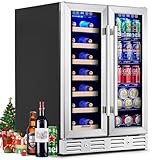
Kalamera’s 24-inch dual-zone unit makes an unusual capacity promise: 21 bottles and 75 cans. That is not a wine cellar — it is a beverage center that happens to store wine properly, and it is the right cabinet for a household where sparkling water, beer, and soda outnumber the wine bottles by a wide margin. It suits entertainers, garage-and-patio setups, and anyone who has been trying to make a wine fridge double as a drinks fridge and found it wanting.
Key specifications as the listing describes them:
- Width: 24 inches
- Capacity: 21 bottles plus 75 cans
- Zones: two, dual-zone cooling
- Install type: 24-inch cabinet footprint
- Price tier: mid-range
The reason this configuration works is that cans and bottles have different temperature optima and different space efficiency. A can of soda wants to be near 38-40°F; a red wine wants 60-65°F. A dual-zone cabinet lets you park the can zone cold and the bottle zone warm, and because cans stack densely on flat shelves, 75 of them occupy a fraction of the volume that 75 bottles would. The result is a cabinet that feels far more full than a bottle-only unit of the same width.
The mid-range positioning buys you build quality and shelf hardware rather than capacity. At this tier you typically get better door seals, sturdier shelf fronts, and a cabinet designed to be run continuously for years rather than occasionally. Those are the parts that fail first on cheap units: door gaskets lose their spring and the compressor starts running longer to compensate, which is the beginning of a slow decline in performance that owners often blame on the fridge “getting old.”
The obvious limitation is bottle count. Twenty-one bottles is a working rotation, not a collection. If you are buying wine by the case and laying it down, this is the wrong cabinet — look at the 52-bottle class units further down this list. If you want cold drinks and a dozen decent bottles within reach of the kitchen or patio, this is arguably the most useful cabinet in this roundup.
Pros
- 75-can capacity is exceptional for a 24-inch cabinet
- Dual zones let drinks and wine hold genuinely different temperatures
- Mid-range build quality on seals and shelf hardware
- Standard 24-inch footprint fits most under-counter openings
- Ideal for entertaining, patios, and garage setups
Cons
- 21-bottle capacity is modest for anyone building a cellar
- Bottle zone competes with can storage for shelf space
- Mid-range price for a cabinet that stores relatively little wine
- Not the right choice if wine, not beverages, is the priority
Compared with the Velieta 24 Inch Dual Zone, both occupy the same 24-inch footprint, but Velieta is positioned as a premium built-in wine-and-beverage cabinet with a glass door and a high-output compressor, while Kalamera optimizes for can volume at a mid-range price. If you are remodeling and want the fridge to look integrated, Velieta earns its premium. If you just want a lot of cold cans and a wine shelf, Kalamera is the more efficient spend.
4. Velieta 24 Inch Dual Zone Wine and Beverage Refrigerator – Best for Built-In Kitchen Installs

This is the cabinet you buy when the fridge is part of the design. Velieta’s 24-inch dual-zone wine and beverage refrigerator is built around a powerful compressor and a glass door, and it is designed to work either built into cabinetry or standing freestanding. It suits a kitchen remodel, a butler’s pantry, or a bar area where the appliance is visible and needs to hold its setpoint in a room that gets warm.
Key specifications as the listing describes them:
- Width: 24 inches
- Zones: two, dual-zone cooling
- Door: glass, for visibility without opening
- Cooling: high-output compressor
- Install type: built-in or freestanding
- Price tier: premium
The premium here is doing real work. Built-in capability means the cabinet is engineered so that heat is rejected through the front rather than the back and sides — a freestanding fridge dropped into a cabinet cavity starves its condenser, runs continuously, and dies young. If you are cutting an opening in a cabinet run, that design difference is not optional; it is the difference between a fridge that lasts and one that does not. A glass door is a second, subtler benefit: you can see what you have without standing with the door open, and door-open time is one of the largest drivers of temperature swing in any wine fridge.
The strong compressor matters most in exactly the scenario where built-ins live: an enclosed kitchen that gets warm in summer. Compressor-based cooling holds a setpoint against a warm ambient far more reliably than thermoelectric cooling, which can only pull a limited number of degrees below room temperature. In a 90°F kitchen, a thermoelectric unit may struggle to hold the mid-50s at all, while a compressor cabinet will cycle normally.
What you give up at this tier is nothing functional — you give up money. A premium built-in costs meaningfully more than a comparable-capacity freestanding cabinet, and if your install is freestanding anyway, you are paying for capability you will not use. Be honest about which one you are doing before you buy.
Pros
- True built-in capable design with front-venting for cabinet installs
- High-output compressor holds setpoints in warm rooms
- Glass door reduces how often and how long the door is open
- Flexible: works built in or freestanding
- Premium door seals and hardware hold up to daily use
Cons
- Premium pricing is a real premium
- You pay for built-in capability you may not use
- Glass doors let in light — keep it away from direct sun
- Heavier than freestanding equivalents, so install is a two-person job
Compared with the Kalamera 24 Inch Dual Zone, the footprint is identical and the price tiers are one step apart. Kalamera stores far more cans; Velieta stores wine more carefully and installs far more cleanly. Compared with the Ca’Lefort 24 Inch 52-Bottle, Velieta is the wine-and-beverage generalist while Ca’Lefort is the dedicated wine cabinet with more than double the bottle capacity in the same 24-inch width — the choice between them comes down to whether you want cans in the cabinet at all.
5. Ivation 33 Bottle Dual Zone Wine Cooler with Lock – Best for Lockable, Longer-Term Bottle Storage
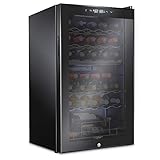
Ivation’s 33-bottle dual-zone wine cooler is aimed at a slightly different buyer than the budget units above: someone storing bottles for months rather than days, who wants the cabinet to behave like a small wine cellar and who wants it locked. The integrated lock is the headline differentiator. It suits shared houses, rental properties, offices, and anyone with teenagers or roommates who treat an unlocked fridge as a public utility.
Key specifications as the listing describes them:
- Capacity class: 33 bottles
- Zones: two, dual-zone cooling
- Security: integrated lock
- Positioning: large freestanding wine cellar for red, white, and sparkling
- Price tier: mid-range
What mid-range buys here is consistency. A cabinet intended for longer-term storage needs to hold a setpoint with minimal swing, because slow temperature cycling is one of the few things that genuinely affects wine over months. Cheap units often overshoot and undershoot as the compressor short-cycles; better controllers and better insulation narrow that band. If you are laying bottles down for a year, that stability is the feature you are paying for, more than the lock.
The lock also changes how you use the fridge. A locked cabinet can hold a genuinely reserved section — bottles you are not going to open on a Tuesday — without requiring a separate room. That is a small thing that, in practice, is the reason a lot of people end up buying a second wine fridge.
The 33-bottle class rating carries the same caveat as every other unit here: it assumes standard Bordeaux shapes. Mixed collections of Burgundy, Riesling, and Champagne bottles will fit fewer. Plan for roughly 26-28 bottles if your collection skews to wider shapes, and check the shelf pitch before you buy if you store sparkling regularly, since sparkling bottles need more vertical clearance than still wine.
Pros
- Integrated lock is rare at this capacity and price point
- Tighter temperature control suits months-long storage
- 33-bottle class handles a two- to three-case rotation
- Dual zones accommodate red, white, and sparkling simultaneously
- Freestanding cabinet is straightforward to place and move
Cons
- Mid-range price for capacity that budget units also advertise
- Freestanding only — no built-in option
- Bottle count drops with wider bottle shapes
- The lock is a deterrent, not a security device
Compared with the ROVSUN 33 Bottle Dual Zone, capacity is a wash and the difference is intent: Ivation adds the lock and positions itself as a cellar for longer storage, while ROVSUN is built around everyday wine-and-beverage use. If the cabinet lives in a shared space or holds bottles you do not want raided, Ivation justifies the step up. If it lives in your own kitchen and cans are part of the plan, save the money.
6. Winado 28-Bottle Dual Zone Compressor Wine Cooler – Best for Compressor Cooling at the Lowest Cost

Winado’s 28-bottle dual-zone unit is the value play for one specific reason: it uses compressor cooling. Compressor and thermoelectric wine fridges look similar in photographs and behave very differently in a real room, and the compressor version is the one that holds a setpoint when the ambient temperature climbs. This cabinet suits a garage, a utility room, or a warm kitchen where a thermoelectric unit would struggle.
Key specifications as the listing describes them:
- Capacity class: 28 bottles
- Zones: two, dual-zone cooling
- Cooling: compressor
- Install type: freestanding mini fridge
- Price tier: budget
To understand why this matters, think about how each technology works. A compressor fridge moves heat out of the cabinet the way a kitchen refrigerator does, so it can hold a setpoint well below room temperature regardless of how warm the room gets. Thermoelectric cooling uses a solid-state heat pump that can only pull a limited number of degrees below ambient — typically in the range of 25-40°F — and its efficiency falls as the room warms. In a 95°F garage, a thermoelectric wine fridge may not be able to reach 55°F at all. A compressor unit will.
The cost of that capability is noise and vibration. Compressors cycle on and off, which produces a low hum you will notice in a quiet living space, and the compressor itself introduces a small amount of vibration that a thermoelectric unit does not. For long-term storage of fine wine, vibration is generally considered undesirable. For everyday drinking stock, it is a non-issue — and the trade is worth it, because temperature stability matters far more than vibration in practice.
As a freestanding mini fridge, this cabinet needs clearance behind and beside it. Compressor units reject heat through the back and sides, and a cabinet with no airflow will run long duty cycles. Give it the manufacturer’s specified rear gap and keep the sides unobstructed, and it will hold temperature for years.
Pros
- Compressor cooling at a budget-tier price
- Holds setpoints in warm rooms where thermoelectric units cannot
- 28-bottle class is a practical size for a starter collection
- Dual zones for red and white simultaneously
- Simple freestanding install
Cons
- Compressor cycling produces an audible hum in quiet rooms
- Small amount of vibration, which purists avoid for long-term aging
- Budget-tier fit and finish
- Freestanding only, with no lock
Compared with the NutriChef PKCWCDS275, the two sit at the same price tier and similar capacity, but they are opposite philosophies: Winado is compressor-based, NutriChef is built around a digital, airtight design. In a climate-controlled interior room, either works and NutriChef’s quieter operation may win. In a warm garage or an unconditioned space, Winado’s compressor is the only one of the two that will hold the setpoint you asked for.
7. Tylza 15 Inch Under-Counter Dual Zone Wine Fridge – Best for Under-Counter Installs with a Lock
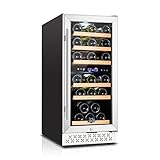
Tylza’s 15-inch under-counter dual-zone wine fridge solves a narrower problem than most units here: it fits a 15-inch cabinet opening, holds 30 bottles, and includes a safety lock. It suits a kitchen with a slim under-counter gap, a bar cart footprint, or a butler’s pantry where a 24-inch appliance would not fit and where the contents should be secured.
Key specifications as the listing describes them:
- Width: 15 inches
- Capacity class: 30 bottles
- Zones: two, dual-zone cooling
- Security: safety lock
- Install type: under-counter
- Price tier: mid-range
The interesting part of this spec sheet is the capacity-to-width ratio. Thirty bottles in a 15-inch cabinet is denser than most 15-inch units manage, and density comes from shelf geometry — narrower shelf pitch and a layout that assumes standard Bordeaux shapes. That is efficient when your bottles are standard and frustrating when they are not. If you store a lot of Champagne or wide-shouldered Burgundy, budget for fewer bottles than the rating suggests.
Under-counter placement changes the ventilation rules. An under-counter fridge is in a cavity, and the cavity has to breathe. Check whether the opening has a vented toe kick or an open back; if it is fully enclosed, the cabinet will reject heat into its own cavity and run hot. This is the single most common installation mistake with under-counter wine fridges, and it shows up as a fridge that “never gets cold enough” rather than as an obvious failure.
The safety lock is a genuine differentiator at this size. Fifteen-inch under-counter fridges are often installed in family kitchens at a height children can reach, and a lock keeps small hands out of a cabinet full of glass. It also makes the fridge usable in a rental or shared kitchen without worrying about who is helping themselves.
Pros
- 30-bottle class in a 15-inch width is a dense, efficient layout
- Safety lock suits family kitchens and shared spaces
- Mid-range build quality on seals and shelves
- Under-counter design keeps the appliance out of the way
- Dual zones handle mixed red and white storage
Cons
- Dense shelf pitch limits oversized bottle shapes
- Requires a vented cabinet opening to perform properly
- Mid-range price for a small cabinet
- Narrow interior makes it awkward to load with two people
Compared with the ROVSUN 15 Inch Dual Zone, the widths match and the intent splits: ROVSUN is the cheaper freestanding slim cabinet, Tylza is the under-counter unit with a lock and a slightly higher bottle count. If you are cutting a cabinet opening and want the door secured, Tylza is the right pick. If the fridge is going to stand in a corner, ROVSUN does the job for less.
8. NutriChef PKCWCDS275 Dual-Zone Wine Cooler – Best for Overflow and Secondary Storage
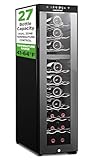
NutriChef’s PKCWCDS275 is a 27-bottle dual-zone wine cooler with digital touch-button control and an airtight sealing design. It suits the buyer who already has a main wine fridge or a cellar and needs a second, quieter cabinet for overflow — bottles that do not fit, everyday drinkers, or a rotation kept at serving temperature near the kitchen.
Key specifications as the listing describes them:
- Capacity class: 27 bottles
- Zones: two, dual-zone cooling
- Controls: digital touch-button control
- Sealing: airtight seal design
- Price tier: budget
The airtight seal is worth thinking about, because door gaskets are the part of a wine fridge that fails first and the failure is quiet. A gasket that has lost its spring lets humid room air into the cabinet; the compressor runs longer to hold temperature, and in a humid climate the extra moisture can encourage mold on labels. Digital touch controls are a small convenience but a real one — precise setpoint entry beats guessing with a dial, and it makes it easier to confirm the cabinet is holding where you left it.
As a secondary cabinet, this unit’s job is different from a primary cellar’s. It does not need to be beautiful, it needs to be quiet, cheap to run, and stable enough that a bottle left in it for a few months is unaffected. Budget-tier dual-zone cabinets handle that role well, and buying one for overflow is usually smarter than buying an oversized primary fridge you did not need.
The limitation is capacity growth. Twenty-seven bottles in the budget tier is a fine second cabinet and a poor first cellar if you intend to keep buying by the case. If your collection is expanding, jump to the 52-bottle class units instead of buying two 27-bottle cabinets — two cabinets mean two compressors, two power draws, and two sets of seals to maintain.
Pros
- Budget-tier price makes a second cabinet affordable
- Airtight sealing design helps hold temperature and humidity
- Digital touch controls give precise setpoints
- Dual zones for mixed red and white storage
- Compact enough to fit where a 24-inch unit will not
Cons
- 27 bottles is limited as a primary cellar
- Budget-tier hardware and trim
- No lock
- Two of these cost more than one larger cabinet
Compared with the Winado 28-Bottle Dual Zone Compressor, capacity is nearly identical and price tier matches. Winado’s advantage is compressor cooling, which matters in a warm room; NutriChef’s advantage is the airtight, digitally controlled design, which matters in a climate-controlled one. Pick by where the cabinet will live, not by the spec sheet.
9. FOVOMI 52-Bottle Dual Zone Wine Fridge – Best for Growing Collections

FOVOMI’s 52-bottle dual-zone wine cooler is the first cabinet on this list sized for a real collection. Fifty-two bottles is roughly four and a half cases, which is enough to hold a mixed selection, keep some bottles resting, and still have something open. It suits buyers who have outgrown a 30-bottle cabinet and do not want to manage two appliances.
Key specifications as the listing describes them:
- Capacity class: 52 bottles
- Zones: two, dual-zone cooling
- Install type: freestanding cabinet
- Price tier: premium
The reason to move up to this class is not just count — it is the ratio of usable capacity to temperature stability. Larger cabinets hold more air, and more air means the setpoint recovers more slowly after the door opens but also drifts less during the moment it is open. In practice, a 52-bottle cabinet with a good seal is a more stable storage environment than a 27-bottle cabinet with the same hardware, simply because the thermal mass of the contents buffers it.
At this capacity, shelf layout becomes the deciding factor. Count the shelves and check the pitch: a 52-bottle rating usually assumes a mix of shelf levels holding standard Bordeaux bottles lying down, and you should expect to lose 15-25% of that count if your collection is heavy on Burgundy, Riesling flutes, or sparkling. If sparkling is a significant part of your collection, look for at least one shelf position with enough clearance for a bottle standing or lying with more vertical room.
Premium pricing at this size buys heavier insulation, better controllers, and shelf hardware that will not sag under load. Sagging shelves are a real failure mode in large cabinets: a loaded shelf that bows drops bottles onto the shelf below and can crack labels or glass. Metal-fronted or reinforced shelves are worth prioritizing at 50+ bottles.
Pros
- 52-bottle class holds four-plus cases without a second appliance
- Larger interior air volume improves temperature stability
- Dual zones cover red, white, and sparkling simultaneously
- Premium-tier insulation and controller
- One cabinet, one power draw, one set of seals to maintain
Cons
- Premium pricing
- Advertised bottle count assumes standard Bordeaux shapes
- Freestanding cabinet takes up meaningful floor space
- Heavy when loaded — plan the final position before filling it
Compared with the Ca’Lefort 24 Inch 52-Bottle Dual Zone, capacity is identical and the difference is the footprint. Ca’Lefort packs 52 bottles into a 24-inch width, which is a denser and more demanding engineering job and generally means tighter shelf pitch. FOVOMI’s cabinet is the roomier layout that is easier to load and more forgiving with odd bottle shapes. If your space is constrained to 24 inches, choose Ca’Lefort; if you have room, FOVOMI is the friendlier cabinet to live with.
10. Ca’Lefort 24 Inch 52-Bottle Dual Zone Wine Cooler – Best for Large Collections in a Fixed 24-Inch Footprint

Ca’Lefort’s 24-inch dual-zone wine cooler holds 52 bottles in a standard under-counter width. That is the tightest capacity-to-width ratio in this roundup, and it suits a specific buyer: someone with a 24-inch opening — under a counter, at the end of a cabinet run, or in a built-in niche — who needs serious capacity rather than a drinks fridge.
Key specifications as the listing describes them:
- Width: 24 inches
- Capacity class: 52 bottles
- Zones: two, dual-zone cooling
- Install type: 24-inch cabinet footprint
- Price tier: premium
Getting 52 bottles into 24 inches means the shelf geometry is doing a lot of work. Shelves will be closely pitched, which is efficient for standard Bordeaux shapes and restrictive for anything wider or taller. Before buying, measure your most awkward bottle — a Champagne bottle with a wide body, or a magnum if you store them — and check it against the shelf spacing. Magnums take roughly two standard slots each and often will not fit on a fixed-pitch shelf at all.
The premium tier at this size buys the engineering that makes the density workable: reinforced shelves, a controller that holds setpoint despite the door being opened frequently in a busy kitchen, and insulation that keeps the compressor from running constantly in a tight cabinet. A densely packed cabinet has less air to buffer temperature changes, so the hardware has to be better to achieve the same stability as a roomier unit.
The practical advantage over a wider freestanding cabinet is placement. A 24-inch unit can go under a counter, into a niche, or at the end of a cabinet run, which means it can live in a kitchen rather than a utility room. If your collection is growing and your floor space is not, that is the trade this cabinet makes.
Pros
- 52-bottle class in a standard 24-inch width
- Fits under-counter openings and cabinet niches
- Dual zones for red, white, and sparkling
- Premium-tier insulation and controller for dense loading
- Keeps a large collection in the kitchen rather than a back room
Cons
- Premium pricing
- Closely pitched shelves limit wide and oversized bottles
- Dense packing leaves less air to buffer door-open temperature swings
- Requires proper cabinet ventilation to perform as designed
Compared with the Velieta 24 Inch Dual Zone, the width is identical and the purpose differs: Velieta is a wine-and-beverage cabinet with a glass door and a built-in design, while Ca’Lefort is a dedicated wine cabinet with substantially more bottle capacity. If you want cans in the cabinet, choose Velieta. If you want bottles — a lot of them — in a 24-inch space, Ca’Lefort is the one.
How to Choose
Dual-zone wine fridges are sold on a handful of numbers, and most of those numbers mean less than they appear to. Here is what actually determines whether a cabinet keeps your wine stable.
Start with real capacity, not the advertised count
Bottle ratings are calculated in standard Bordeaux-shaped bottles: roughly 3 inches in diameter and just under 12 inches tall. That is the narrowest common shape. Burgundy and Pinot bottles run 3.4-3.6 inches across, Champagne bottles 3.5-3.7 inches, and a magnum about 4.7 inches. Because capacity scales with the square of diameter, a cabinet rated for 33 Bordeaux bottles may hold only 26-28 if your collection skews wide, and 20-24 if it is heavy on Champagne. As a rule, subtract 20% from the advertised number for a mixed collection and 30% for a sparkling-heavy one.
Also check how the shelves are arranged. Some cabinets achieve their rating with a mix of flat shelves and angled display rows; the angled rows look good and hold fewer bottles. Count the flat shelf positions and multiply by the bottles per shelf — that is your realistic working capacity.
Decide between compressor and thermoelectric cooling
This is the single most consequential choice, and it is invisible in product photos.
| Factor | Compressor cooling | Thermoelectric cooling |
|---|---|---|
| Typical settable range | About 40-65°F, largely independent of room temperature | Typically limited to 25-40°F below ambient |
| Behavior in a 90°F room | Holds setpoint normally | May not reach 55°F at all |
| Typical rated power | 85-140 W, running a 30-45% duty cycle | 60-90 W, running continuously |
| Estimated daily energy use | 0.7-1.4 kWh/day | 1.4-2.2 kWh/day |
| Temperature swing | Roughly ±1-2°F around setpoint | Roughly ±3-5°F, widening with room temperature |
| Noise character | Cycling hum, roughly 35-45 dB(A) when running | Steady fan and electronics noise, often quieter overall |
| Vibration | Some, from the compressor | Essentially none |
| Service life drivers | Compressor duty cycle and condenser cleanliness | Power supply and fan; degrades with high ambient heat |
The short version: buy compressor if the fridge lives anywhere that gets warm, if you want a genuine 40s-to-60s range, or if you care about energy use. Buy thermoelectric if the cabinet lives in a climate-controlled room, if silence and zero vibration matter more than range, and if you are willing to accept a narrower achievable temperature band.
Work out the running cost before you buy
A wine fridge runs continuously, so the energy difference between designs compounds. Here is a worked comparison using typical figures and a household electricity rate of $0.16 per kWh — substitute your own rate, since it varies widely by region.
| Step | Compressor unit | Thermoelectric unit |
|---|---|---|
| Average draw | 110 W × 35% duty cycle = 38.5 W | 70 W continuous = 70 W |
| Daily energy | 0.92 kWh | 1.68 kWh |
| Annual energy | 337 kWh | 613 kWh |
| Annual cost at $0.16/kWh | About $54 | About $98 |
| Eight-year cost | About $432 | About $784 |
That is a difference of roughly $350 over eight years — often more than the price gap between a budget and a mid-range cabinet. Energy use is not a rounding error in this category, and it is the reason a slightly more expensive compressor unit is frequently the cheaper appliance over its life.
Get the ventilation and clearance right
Every wine fridge is a heat pump, and heat has to go somewhere. Freestanding units reject heat through the back and sides and need clearance — commonly 2 inches at the rear and 1-2 inches at the sides, with open space above. Built-in units are engineered to reject heat through the front, which is why they cost more and why a freestanding fridge dropped into a cabinet cavity is a warranty problem waiting to happen.
Under-counter installs need particular attention: check that the opening has a vented toe kick or an open back. A sealed cavity traps warm air and the compressor runs long duty cycles forever. This is the most common installation mistake with dual-zone wine fridges and the hardest to diagnose later, because the symptom is a fridge that “never quite gets cold enough” rather than one that fails outright.
Map the shelf layout to your actual bottles
Look for shelf pitch of at least 3.5 inches for standard Bordeaux bottles lying down, 4-4.5 inches if you store Burgundy or Champagne, and more if you want sparkling upright. Removable shelves give you flexibility to create a tall bay for oversized bottles, which is worth more than an extra bottle of rated capacity. Fronts matter too: metal-fronted or reinforced shelves resist sagging under a full load, and sagging is a real failure mode in 50-bottle cabinets.
Set temperatures that match what you drink
Dual zones are only useful if you use them with intention. Sensible setpoints: sparkling 40-45°F, crisp whites 45-50°F, rich whites 50-55°F, light reds 55-60°F, full-bodied reds 60-65°F. For long-term storage rather than serving, 55°F is the conventional target, with humidity around 55-75%. If you are storing rather than serving, run both zones near 55°F and treat the dual zones as a way to keep sparkling cold without chilling your reds.
Match the cabinet to your situation
| Your situation | What to prioritize | Suggested pick |
|---|---|---|
| First wine fridge, tight budget, wine plus cans | Budget dual zone with flexible shelf layout | ROVSUN 33 Bottle Dual Zone |
| Apartment or galley kitchen, only 15 inches free | Narrow footprint, freestanding | ROVSUN 15 Inch Dual Zone (26 Bottle) |
| Entertainer, far more cans than bottles | High can capacity plus a wine zone | Kalamera 24 Inch Dual Zone |
| Kitchen remodel with a cabinet opening | Front-venting built-in design, glass door | Velieta 24 Inch Dual Zone |
| Shared house or rental, contents should be secured | Integrated lock, tight temperature control | Ivation 33 Bottle Dual Zone with Lock |
| Garage or unconditioned room | Compressor cooling, no exceptions | Winado 28-Bottle Dual Zone Compressor |
| Slim under-counter gap, family kitchen | 15-inch under
Affiliate disclosure. As an Amazon Associate we earn from qualifying purchases at no extra cost to you. Prices accurate as of the date shown. Best Dual-Zone Wine Fridges for Stable StorageCheck price on Amazon More ways to save on Amazon 
AMD Ryzen 5 vs Intel Core i5: Which Should You Buy?The short answer: for most new builds, the AMD Ryzen 5 9600X... 
Best XLR Dynamic Microphones for Clear, Focused AudioThe Shure SM58 is the best XLR dynamic microphone for most people.... 
Best Women’s Leather Handbags: Styles Worth BuyingIf you want one leather bag that handles a commute, a grocery... 
Best Wet-Dry Vacuums for Workshop UseThe best wet dry vacuum for most workshop use is the STANLEY... 
Best VR Escape Room Systems for Event BusinessesFor a commercial event business in 2026, the best VR escape room... 
Best Versace Sunglasses for Style and UV ProtectionThe best Versace sunglasses for most people are the Versace VE 2198... 
Best Vacuums for Furniture and UpholsteryFor most homes, the best vacuum for furniture and upholstery is a... 
Best Tripods for Laser Levels and TransitsFor most laser-level and transit work, the best tripod is a heavy-duty... 
Best Total Stations for Land Surveying ProfessionalsThe best overall pick for most land surveying professionals rebuilding a total... 
Best Talking Drums for Clear, Powerful SoundThe best talking drum for most players is the Meinl African Talking... |