
The best computerized telescopes for easy stargazing are the Celestron NexStar 5SE for a balanced beginner setup, the Sky-Watcher Heritage Virtuoso GTi 130P for portable value, and the Celestron NexStar 8SE for the most visual detail before the mount becomes the limiting factor.
Our top picks
 Celestron
- The Celestron NexStar 102SLT is a computerized telescope…
- This telescope for adults and kids to be…
- The NexStar 102SLT aperture gathers enough light to…
 Celestron NexStar 8SE Computerized Telescope
- The NexStar 8SE pairs Celestron’s legendary orange tube…
- The large 8" aperture gathers enough light to…
- FULLY AUTOMATED GoTo MOUNT WITH NEXSTAR+ HAND CONTROL:…
 Celestron NexStar 127SLT Maksutov-Cassegrain Computerized GoTo Telescope
- The Celestron NexStar 127SLT offers a database of…
- With a large, 127mm aperture, the NexStar 127SLT…
- The ideal telescope for adults and kids to…
| Product | Key specs | |
|---|---|---|
| Celestron | The Celestron NexStar 102SLT is a computerized telescope… This telescope for adults and kids to be… The NexStar 102SLT aperture gathers enough light to… | Check price |
| Celestron NexStar 8SE Computerized Telescope | The NexStar 8SE pairs Celestron’s legendary orange tube… The large 8" aperture gathers enough light to… FULLY AUTOMATED GoTo MOUNT WITH NEXSTAR+ HAND CONTROL:… | Check price |
| Celestron NexStar 127SLT Maksutov-Cassegrain Computerized GoTo Telescope | The Celestron NexStar 127SLT offers a database of… With a large, 127mm aperture, the NexStar 127SLT… The ideal telescope for adults and kids to… | Check price |
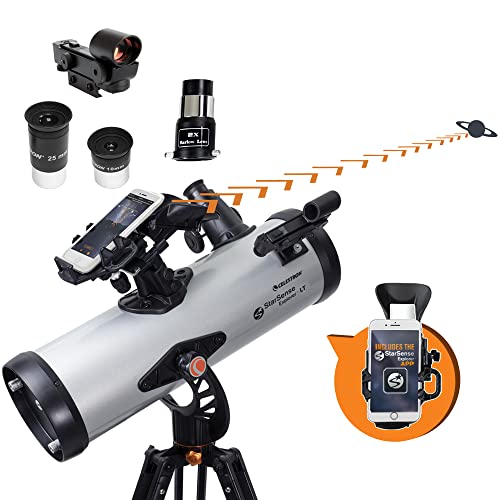 Celestron StarSense Explorer LT 114AZ Newtonian Smartphone Celestron StarSense Explorer LT 114AZ Newtonian Smartphone | No experience needed! Just dock your phone, launch… Unlike other astronomy apps, StarSense Explorer uses sky… TONIGHT’S BEST TARGETS, INSTANTLY: The app generates a… | Check price |
As an Amazon Associate we earn from qualifying purchases at no extra cost to you.
Quick picks by observing situation
| Situation | Best fit | Why it makes sense | Main limitation |
|---|---|---|---|
| First computerized telescope, mostly visual | Celestron NexStar 5SE | 125 mm aperture, simple alt-azimuth GoTo mount, useful database, and a manageable tube | Single-arm mount is not ideal for long-exposure imaging |
| Small storage space or frequent travel | Sky-Watcher Heritage Virtuoso GTi 130P | Compact tabletop Dobsonian design with Wi-Fi GoTo and a 130 mm mirror | Needs a sturdy table and manual repositioning if power or electronics fail |
| Maximum visual performance for a beginner | Celestron NexStar 8SE | 203 mm aperture gathers roughly 2.6 times as much light as a 125 mm telescope | Heavier, more expensive, and more sensitive to vibration and poor alignment |
| Casual viewing from a balcony or yard | Celestron NexStar 4SE or 5SE | Compact tubes and computer assistance make repeated short sessions practical | Small apertures show less faint detail than an 8-inch instrument |
| Beginner astrophotography ambitions | Equatorial GoTo mount with a small refractor | Tracks in right ascension and can be guided for longer exposures | More setup, balancing, polar alignment, and accessory cost |
What “computerized” actually means
A computerized telescope uses motors and a hand controller or phone app to locate targets. Most beginner models use an alt-azimuth mount: the telescope moves left-right and up-down. After alignment, it can select objects from a database and automatically track them as Earth rotates.
That is excellent for the Moon, planets, double stars, star clusters, and brighter nebulae. It does not mean the telescope can identify every object under light-polluted skies, and it does not eliminate the need to level the tripod, enter the correct time and location, or choose recognizable alignment stars.
Database size is less important than database usability. A list of 40,000 objects sounds impressive, but many entries are too faint for a small telescope or require dark skies. For beginners, a reliable alignment routine, a good planetarium app, and a stable mount matter more than the difference between 30,000 and 40,000 entries.
Head-to-head: the leading beginner-friendly options
Celestron NexStar 5SE: the balanced choice
The NexStar 5SE combines a 125 mm Schmidt-Cassegrain optical tube with a motorized alt-azimuth mount. Celestron’s NexStar system has a database of more than 40,000 objects, and the mount can be used with traditional two-star alignment or assisted alignment accessories such as StarSense AutoAlign, depending on the configuration.
Its long focal length is helpful for lunar and planetary observing. The closed Schmidt-Cassegrain tube is also less exposed to dust than an open truss design. The trade-off is a narrower field of view than a short refractor or tabletop Dobsonian, so large targets such as the Pleiades may not fit comfortably in one view.
For visual observing, the mount is generally comfortable with the supplied optical tube and modest accessories. Avoid adding a heavy camera, guide scope, and large finder: the single-arm design becomes more susceptible to vibration and slow settling.
Sky-Watcher Heritage Virtuoso GTi 130P: portable value
The Virtuoso GTi 130P uses a 130 mm parabolic Newtonian reflector on a compact tabletop GoTo mount. Its Wi-Fi control allows a compatible phone or tablet to select targets, while the open tube gives it a relatively wide field of view for browsing star fields and deep-sky objects.
Its alignment process is less forgiving of an unstable surface. Place it on a solid table, point the tube approximately level before starting, and keep the phone’s location and time settings correct. The mount’s approximately 5 kg payload rating is generous for visual use, but that figure includes the telescope, finder, eyepiece, and any accessories.
The open tube is also more vulnerable to stray light, dust, and accidental contact with the primary mirror. Store it with both caps fitted, and never wipe the mirror as part of routine cleaning.
Celestron NexStar 8SE: the visual-performance pick
An 8-inch, or 203 mm, Schmidt-Cassegrain gathers substantially more light than a 5-inch telescope and resolves finer planetary detail when atmospheric conditions allow. It is the strongest choice here for visual views of globular clusters, galaxies, planetary nebulae, and subtle lunar features.
The calculation explains the difference: light-gathering area is proportional to aperture squared. Comparing 203 mm with 125 mm gives (203 ÷ 125)2, or about 2.6 times the light-gathering area before accounting for coatings and obstructions.
The limitation is the mount. The 8SE optical tube is close to the practical payload ceiling of its single-arm mount once a diagonal, eyepiece, finder, and dew shield are installed. Focusing can cause noticeable shake, and windy conditions may lengthen settling time. It is a strong visual telescope, but not an ideal platform for serious deep-sky astrophotography.
Meade ETX90: compact, but more specialized
The Meade ETX90 is a compact 90 mm Maksutov-Cassegrain with computerized tracking in its GoTo configurations. Its long focal length suits the Moon, planets, and double stars, while its small tube is convenient for storage.
Because the aperture is smaller and the field of view is narrow, it is less versatile for large nebulae and broad star fields. It can be a sensible choice when portability matters more than faint-object performance, but buyers should verify current availability, included controller, and power accessories before purchasing because ETX packages have varied over time.
Alignment: the beginner’s make-or-break step
- Set the tripod or base firmly. Leveling does not need surveying accuracy, but a tilted or unstable base makes tracking and pointing worse.
- Install fresh batteries or an external power supply. Low voltage can cause motor resets and erratic slewing.
- Enter location, date, and time carefully. Daylight-saving errors and an incorrect time zone can place alignment stars in the wrong part of the sky.
- Choose two or three bright stars you can identify. A two-star or three-star alignment normally gives better pointing across the sky than relying on a single reference.
- Center each star with the highest-power practical eyepiece. Finish with small, deliberate adjustments in the same direction used by the mount’s final approach.
- Test a bright target before entering a long observing list. If the object is far outside the eyepiece, restart the alignment rather than repeatedly correcting the mount.
Assisted systems such as Celestron StarSense can reduce the star-identification burden, but they still need a clear view of enough sky and correct time and location information. Buildings, trees, clouds, and nearby lights can defeat an otherwise good automatic alignment.
Tracking accuracy: visual observing versus astrophotography
For visual observing, a computerized alt-azimuth mount only needs to keep the target near the center of the eyepiece. Small errors are usually tolerable, especially at low and medium magnification. At high magnification, vibration and backlash become more noticeable than the database or alignment technology.
Astrophotography has stricter requirements. An alt-azimuth mount introduces field rotation during exposures, even when the object appears centered. Short exposures of the Moon and planets can work well, but long-exposure nebula and galaxy imaging generally requires an equatorial mount, accurate polar alignment, careful balancing, and often autoguiding.
A useful boundary is this: use an 8SE or similar alt-azimuth telescope for lunar and planetary imaging, and choose a separate equatorial GoTo mount with a small refractor if deep-sky imaging is the main goal. Do not judge a visual telescope by whether it can carry a camera; payload margins that feel adequate at the eyepiece can be too small for stable imaging.
Payload limits and practical loading
| System | Optical aperture | Approximate mount payload | Practical use |
|---|---|---|---|
| Celestron NexStar 5SE | 125 mm | About 4.5 kg / 10 lb class | Visual observing with the supplied tube and light accessories |
| Celestron NexStar 8SE | 203 mm | About 5.5 kg / 12 lb class | Visual observing; keep imaging equipment minimal |
| Sky-Watcher Virtuoso GTi 130P | 130 mm | About 5 kg / 11 lb | Visual use with a compact eyepiece set and finder |
| Meade ETX90 | 90 mm | Package-dependent | Compact visual observing and basic lunar or planetary imaging |
Payload figures are not permission to load the mount to the limit. Include the diagonal, eyepiece, finder, dew shield, phone adapter, camera, cables, and counterweights in the total. For comfortable tracking, a visual setup should leave margin below the stated capacity; an imaging setup benefits from an even larger margin.
Ownership realities and common mistakes
- Power is a consumable concern. Internal AA batteries can drain quickly in cold weather and may cause tracking errors. A regulated external 12-volt supply or suitable rechargeable pack is often more dependable.
- Tripod stability matters more than extra database entries. Extend the thickest leg sections first and avoid placing the mount on a flexible deck or lightweight camping table.
- Do not clean optics unnecessarily. Cap the telescope after use, use a blower for loose dust, and avoid touching corrector plates or mirrors. Frequent wiping can create more damage than ordinary dust.
- Allow the tube to reach outdoor temperature. A warm telescope taken into cool air can develop internal or external condensation and may show unstable images.
- Expect alignment to be repeated. Many mounts lose their model when switched off or moved manually. Treat alignment as a normal setup step, not a fault.
- Check the weather before carrying equipment outside. Cloud, wind, dew, and rapidly changing conditions matter more than small differences in optical specifications.
Bottom line
Choose the Celestron NexStar 5SE if you want the safest all-round introduction to computerized stargazing. Choose the Sky-Watcher Virtuoso GTi 130P when compact storage, wide-field viewing, and a lower-cost setup are priorities. Choose the Celestron NexStar 8SE when visual detail matters most and you can accept a heavier system with less mount margin. If entry astrophotography is the central goal, skip the temptation to buy the largest optical tube and start with a small telescope on a properly sized equatorial GoTo mount.






