Key takeaways
- Compare the best clinical laboratory centrifuges for sample preparation by speed, RCF, tube capacity and timer controls, with published specs side by side.
A clinical laboratory centrifuge is the workhorse behind most sample preparation. Before a blood sample can be analyzed, before serum can be separated from cells, and before a urine sediment can be examined, the sample has to be spun at a controlled speed for a controlled length of time. The centrifuge that does that job well is the one whose speed range, force, tube capacity and timer match the samples a laboratory handles every day.
Our top pick: ONiLAB Lab PRP Benchtop Centrifuge. Runner-up: SCILOGEX SCI-412 Clinical Lab Centrifuge. This guide compares published specifications only: every speed, force, capacity and timer figure below comes from the manufacturer listing for that model, so the four centrifuges can be compared on the same terms. No centrifuge here is presented as suitable for a specific medical decision, and any use in a regulated clinical setting should follow the rules and protocols that apply to that laboratory.
At a Glance
| Product | Best for | Key specification |
|---|---|---|
| ONiLAB Lab PRP Benchtop Centrifuge | Everyday serum and plasma separation | 300-5000 RPM, 2600 xg, 6 tubes up to 15 mL |
| SCILOGEX SCI-412 Clinical Lab Centrifuge | Clinical vacutainer workloads | 300-4500 RPM, 2490 xg, 8 x 15 mL or 12 vacutainer tubes |
| CGOLDENWALL 80-2 Electric Lab Centrifuge | Higher tube counts per run | 4000 RPM, 2325 xg, 12 tubes up to 20 mL |
| CALU LUKY Lab Benchtop Centrifuge | Compact low-volume benches | 4000 RPM, 1790 xg, 6 tubes up to 20 mL |
How to Choose
1. Match the speed range to the separation
Speed is stated in revolutions per minute, or RPM. Low-speed clinical centrifuges generally cover a range from around 300 RPM up to 4000 or 5000 RPM, and that range covers serum separation, plasma separation, urine sediment preparation and cell pelleting. A wider speed range gives a laboratory more room to run different protocols on one machine, while a fixed top speed of 4000 RPM is enough for the most common routine separations. Check the listing for the minimum speed as well as the maximum, because gentle spins for fragile samples start at the low end of the range.
2. Read the relative centrifugal force, not just the RPM
Relative centrifugal force, stated as a multiple of gravity and written as xg, is the force the sample actually experiences, and it depends on both the speed and the radius of the rotor. Two centrifuges spinning at the same RPM can produce different forces if their rotors are different sizes. For that reason, laboratory protocols are usually written in xg rather than RPM. The models in this guide list maximum forces between 1790 xg and 2600 xg, and the listing for each model states the figure plainly. When a protocol calls for a specific force, match the xg value first and use RPM only as the way to reach it.
3. Count the tubes, and check the tube sizes
Capacity is stated as the number of tubes the rotor holds and the size of those tubes. A six-tube rotor suits a small bench that processes samples a few at a time, while a twelve-tube rotor suits a busier bench that batches samples. Just as important is which tube sizes the rotor accepts. Clinical work uses 15 mL conical tubes, 10 mL, 7 mL and 5 mL collection tubes, and 1.5 mL microtubes, and the listings here state which of those sizes each rotor accepts, including whether adapters are supplied. A rotor that accepts only one tube size will limit the work a bench can do.
4. Look at the timer and the controls
A timer that runs from 30 seconds to 99 minutes covers short spin-downs and longer separations alike, and a continuous mode is useful for runs that need to be stopped by hand. Digital controls with an LCD display let an operator set speed by RPM or by g-force and read the running time at a glance, while a simple dial control is straightforward and has fewer settings to learn. Two of the models here add stored programs, so a repeated protocol can be started with one key instead of being entered again each time.
5. Check the motor and the noise level
A brushless DC motor is the standard choice in modern benchtop centrifuges because it runs without brushes that wear out, which keeps maintenance simple over the life of the machine. Noise matters on a shared bench: the ONiLAB listing states a noise level of 56 dB, which is quiet enough for a room where people work and talk. Listings that do not state a noise figure should be read alongside the size of the machine, since a larger and heavier unit usually damps vibration better than a very light one.
6. Confirm the safety features
A centrifuge rotor stores a large amount of energy while it spins, so the safety features in the listing deserve attention. The features to look for are a lid lock that prevents the lid from opening while the rotor is moving, automatic lid release when the run ends, an imbalance detector, and an overspeed detector. The SCILOGEX SCI-412 listing notes certification marks including CE, cTUVus and FCC, and states that its rotor has passed a containment check. Certification marks do not replace a laboratory’s own safety checks, but they show the model has been put through independent conformity assessment.
7. Measure the bench space and the power supply
Benchtop centrifuges vary in footprint and weight, from compact units around 11 pounds to clinical units around 20 pounds. Measure the bench before ordering, and leave clearance around the machine for airflow and for the lid to open fully. Power is another detail to confirm: the models here are listed for 110 volt supply in the United States, and the SCILOGEX model also lists a 110 to 240 volt range. A unit listed only for a different voltage would need a transformer, which adds cost and complexity to a bench.
Our Picks
ONiLAB Lab PRP Benchtop Centrifuge — ASIN B09K74JRRF
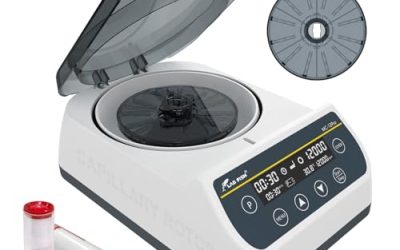
The ONiLAB DM0506 is a digital benchtop centrifuge built around a brushless DC motor and a fixed-angle rotor. The listing states a speed range of 300 to 5000 RPM with a maximum relative centrifugal force of 2600 xg, and the rotor holds six tubes with adapters for 15 mL, 10 mL, 7 mL and 1.5 to 5 mL tubes. The LCD display shows speed by RPM or by g-force, the timer runs from 30 seconds to 99 minutes or in continuous mode, and two stored programs can be started with one key. The listing also states automatic lid-lock release after a run, a sound alert, and a noise level of 56 dB. Dimensions are listed as 11.8 by 9.5 by 7.1 inches, and the unit weighs 11.4 pounds.
Best for: laboratories that need one digital benchtop centrifuge for routine serum, plasma and urine sample preparation with repeatable settings.
Consideration: the rotor holds six tubes per run, so a bench that batches larger numbers of samples will need more runs than a twelve-tube model.
SCILOGEX SCI-412 Clinical Lab Centrifuge — ASIN B008VIM0W4
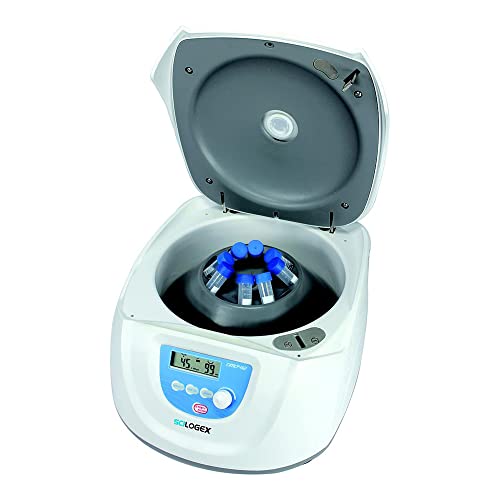
The SCILOGEX SCI-412, model DM0412, is a clinical centrifuge designed for the separation of serum, plasma, urea and blood samples in hospital and research laboratories. The listing states a speed range of 300 to 4500 RPM, a maximum relative centrifugal force of 2490 xg, and a rotor that holds 8 x 15 mL tubes or 12 x 10 mL, 7 mL and 5 mL vacutainer tubes with adapters and plugs. The timer runs from 30 seconds to 99 minutes or in continuous operation, and the brushless motor accepts 110 to 240 volt supply. The listing notes CE, cTUVus and FCC marks, and the unit weighs about 14 pounds.
Best for: clinical benches that run vacutainer tubes in larger batches and need a model built and marked for hospital and research laboratory use.
Consideration: the top speed of 4500 RPM is lower than the 5000 RPM top speed of the ONiLAB model, so protocols written for the highest speeds need to be checked against the 2490 xg maximum force.
CGOLDENWALL 80-2 Electric Lab Centrifuge — ASIN B00I2O5Y20
The CGOLDENWALL 80-2 is a low-speed benchtop centrifuge with a twelve-tube rotor. The listing states a maximum speed of 4000 RPM, a maximum centrifugal force of 2325 xg, and a capacity of 12 tubes of 20 mL, with 15 mL, 10 mL and 7 mL tubes also listed as accepted. The timer runs from 0 to 120 minutes or in continuous operation, the lid is transparent so the rotor can be seen during a run, and the unit runs on 110 volt supply. The listing states a noise level under 70 dB and a power draw of 80 watts.
Best for: benches that need to process twelve tubes in a single run, including larger 20 mL tubes, without moving to a larger floor-standing machine.
Consideration: speed is set with a dial rather than a digital display, so the exact speed is read from the dial position rather than from a numeric readout.
CALU LUKY Lab Benchtop Centrifuge — ASIN B0CRKPJZSD

The CALU LUKY benchtop centrifuge is a compact low-speed unit for small benches. The listing states a maximum speed of 4000 RPM, a maximum relative centrifugal force of 1790 xg, and a capacity of 6 x 20 mL tubes. The speed dial runs from 0 to 4000 RPM, the timer runs from 0 to 60 minutes or without a time limit, and the unit runs on 110 volt, 60 Hz supply with a power draw of 25 watts. The listing describes the unit as compact and quiet enough for an office, classroom or laboratory bench.
Best for: small benches, teaching laboratories and low-volume sample preparation where six tubes per run is enough and bench space is limited.
Consideration: the 1790 xg maximum force is the lowest of the four models here, so protocols that call for a higher force should be checked against this figure before choosing this unit.
Which One Is Right for You?
For a general clinical bench that runs serum and plasma samples every day, the ONiLAB DM0506 is the strongest all-round choice: it has the widest speed range, the highest listed force, digital controls with stored programs, and a quiet 56 dB noise level. A bench that processes vacutainer tubes in larger batches should look at the SCILOGEX SCI-412 instead, because its rotor is built around 15 mL conical tubes and 10 mL, 7 mL and 5 mL vacutainer tubes, and its certification marks suit a hospital setting.
A bench that needs to spin twelve tubes at once, especially 20 mL tubes, fits the CGOLDENWALL 80-2, which trades digital controls for a larger rotor and a longer 120 minute timer. A small bench with limited space and low sample volumes fits the CALU LUKY unit, which is compact, light on power, and simple to operate. In every case, the deciding figures are the force the protocol requires, the tube sizes the bench uses, and the number of tubes per run.
Frequently Asked Questions
What speed should a clinical centrifuge run at for blood samples?
The listing figures for the models here range from 300 to 5000 RPM, and the force that matters is the relative centrifugal force in xg. Blood separation protocols are commonly written in xg, and the centrifuge should be set to reach the force stated in the protocol for that sample type. Always follow the protocol that applies to the laboratory and the test being run.
What is the difference between RPM and RCF?
RPM is how fast the rotor turns, while RCF is the force the sample experiences, stated as a multiple of gravity. RCF depends on both the speed and the radius of the rotor, so two centrifuges at the same RPM can produce different forces. Protocols are usually written in RCF because it describes the force on the sample directly.
How many tubes should a laboratory centrifuge hold?
Six-tube rotors suit small benches and low sample volumes, while twelve-tube rotors suit busier benches that batch samples. The tube sizes matter as much as the count: a rotor should accept the 15 mL conical tubes and the 10 mL, 7 mL and 5 mL collection tubes the bench actually uses, with adapters where needed.
Do these centrifuges need a special power supply?
The models in this guide are listed for 110 volt supply in the United States. The SCILOGEX SCI-412 also lists a 110 to 240 volt range. Check the voltage stated in the listing for the exact model being ordered, and confirm the bench has a suitable outlet before the unit arrives.
What safety features should a laboratory centrifuge have?
Look for a lid lock that keeps the lid closed while the rotor spins, automatic lid release when the run ends, an imbalance detector, and an overspeed detector. Tubes should always be balanced in opposite positions in the rotor, and the lid should never be forced open during a run.
Can one centrifuge handle both blood and urine samples?
A low-speed benchtop centrifuge with a speed range from around 300 RPM to 4000 or 5000 RPM and a force up to about 2600 xg covers the common preparation steps for blood, serum, plasma and urine sediment. The limiting factors are the tube sizes the rotor accepts and the force the protocol calls for, so both should be checked against the listing.
Bottom Line
The best clinical laboratory centrifuge for sample preparation is the one whose force, tube capacity and timer match the samples a bench handles most often. The ONiLAB DM0506 leads on speed range, force and digital controls; the SCILOGEX SCI-412 leads on vacutainer capacity and clinical certification marks; the CGOLDENWALL 80-2 leads on tubes per run; and the CALU LUKY unit leads on compact size and simplicity. Compare the published figures for the exact model being ordered, confirm the tube sizes and the voltage, and choose the machine that fits the bench rather than the one with the largest numbers on the listing.
Disclosure: As an Amazon Associate, this site earns from qualifying purchases.
More from Amazon
Programs that pair well with the guide above. Offers and eligibility are set by Amazon and may change.
Free shipping on eligible items, Prime Video and more. Eligible new members can start with a free trial.
Start a Prime free trialAudiobooks and podcasts to listen to on the go. Eligible new members can start with a free trial.
Try Audible freeAd-free music streaming. Eligible new subscribers can start with a free trial.
Try Music Unlimited freeA free business account with business pricing and bulk-buying tools for work, shop or home office.
Create a business accountAs an Amazon Associate we earn from qualifying purchases.