Key takeaways
- The best industrial counting scales for freight preparation: two verified picks that count parts and verify box quantities before your freight ships out.
Counting scales sit in an awkward corner of the shipping department. They are not glamorous, they rarely get a dedicated bench, and yet a single miscounted carton — 480 fasteners in a box labeled 500 — can trigger a chargeback, a refused shipment, or a very long phone call with a customer who counted by hand. The job of a counting scale in freight preparation is simple to describe and surprisingly easy to get wrong: weigh a known sample of identical parts, let the scale work out the average piece weight, then count an entire box in seconds instead of minutes. Done well, it turns quantity verification from a bottleneck into a thirty-second checkpoint before the pallet gets wrapped.
A note on how this guide was built, because it matters for this niche: the picks below were selected from published Amazon listing specifications, not from detailed research. Every capacity, readability, and feature mentioned comes from the product’s own listing page. That constraint produces a short list, and we would rather be honest about that than pad it. The independently verified pool of industrial counting scales — scales whose Amazon pages actually publish a counting function rather than merely weighing — is small. Two scales met that bar: one is a genuine freight-bench platform scale with a built-in counting feature, and the other is a compact counting scale better suited to small-parts verification. They cover different ends of the freight-prep workflow, and the sections after the picks explain in detail how to judge whether either one fits your operation — and what to check if neither does.
As an Amazon Associate, we earn from qualifying purchases.
Quick answer
For verifying full cartons and heavier freight at the packing bench, the Brecknell PS330 is the pick: a 330 lb capacity bench/platform scale whose listing publishes a built-in basic counting feature with a dedicated Count key, positioned for checking box quantities in shipping and receiving. For counting small parts — hardware, fittings, components — before they are boxed and staged for shipment, the MOCCO DT-580 is the pick: an 88 lb capacity scale whose listing publishes PCS piece counting at 1 g readability, which is the finer resolution small, light parts demand. Choose by the weight of what you actually count: whole cartons point to the Brecknell, handfuls of small parts point to the MOCCO.
Key takeaways
- A counting scale is only as good as its average piece weight: the larger and more consistent your sample count, the more trustworthy the total, especially for very light parts.
- Capacity and readability pull in opposite directions. A 330 lb freight scale verifies cartons; a 1 g readability counting scale verifies small parts. Most freight-prep errors come from using one tool for the other’s job.
- Both picks publish their counting function on their Amazon listing pages — the Brecknell via a basic Count key feature, the MOCCO via PCS piece counting — which is the minimum bar for a scale to appear here.
- Neither scale replaces a freight scale for rating shipments. Counting scales verify how many; carrier-rated shipping scales determine how much it costs. Many benches need both.
The picks
1. Brecknell PS330

The Brecknell PS330 is the freight-bench option in this guide, and its listing makes the intended role plain: a bench and platform scale with a 330 lb capacity, positioned for checking box quantities in shipping and receiving. That capacity matters more than it might seem. Freight preparation deals in finished cartons — cases of product, boxed assemblies, packed returns — and a scale that tops out at 50 or 100 lb forces staff to split cartons or skip verification entirely. At 330 lb, the PS330 swallows a full carton, a packed tote, or a small crate without drama, and the stainless platform, published at 15.3″ × 12.3″, gives cartons a stable, wipe-clean surface in a department where tape, dust, and the occasional leaking return are facts of life.
The counting side is deliberately simple: the listing publishes a built-in basic counting feature operated with a Count key. That word “basic” is worth respecting rather than glossing over. This is not a parts-counting workstation with stored piece weights and barcode integration; it is a shipping scale that can also count, which is exactly the right tool for the most common freight-prep counting task — confirming that a sealed or about-to-be-sealed carton holds the quantity the paperwork claims. Power flexibility helps it fit real benches: it runs on AC or 4 × AA batteries, so it can live at a fixed pack station or move to wherever a pallet is being built. If your counting work is mostly “does this box really contain 24 units,” the PS330 is built for that question.
Specs
- Capacity: 330 lb
- Counting: built-in basic counting feature with Count key, published for checking box quantities in shipping/receiving
- Platform: stainless steel, 15.3″ × 12.3″
- Form factor: bench/platform scale
- Power: AC or 4 × AA batteries
See the Brecknell PS330 on Amazon
2. MOCCO DT-580
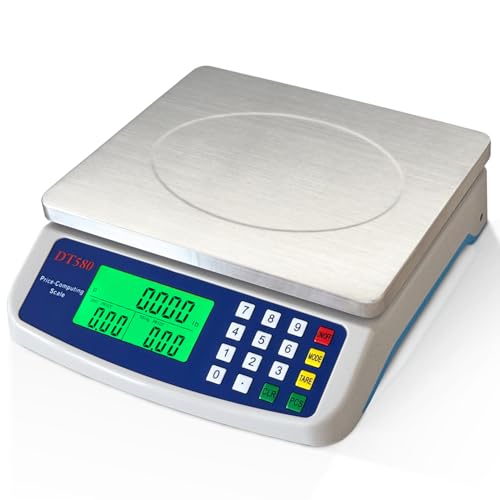
The MOCCO DT-580 covers the other end of freight preparation: the small-parts stage, where counting accuracy is won or lost long before a carton reaches the platform scale. Its listing publishes PCS piece counting and describes it as an industrial counting scale, with a capacity of 40 kg / 88 lb and — the figure that matters here — 1 g readability. Readability is the smallest weight change a scale can display, and for counting it is decisive. A scale counting 2-gram screws needs to resolve tiny differences reliably; 1 g readability gives the DT-580 a fighting chance with light hardware, fittings, and electronic components that a coarse freight scale would count badly or not at all.
Honesty about positioning is important with this pick. The DT-580 is also sold as a price-computing scale, and its 88 lb ceiling means it is not a freight scale in the platform sense — nobody should be verifying palletized cartons on it. Its role in freight preparation is upstream: counting small parts accurately into bags, kits, and inner boxes so that the quantities being staged for shipment are right before they are sealed. Used that way — small parts, sensible sample sizes, quantities verified at the kitting stage — it earns its place in a freight-prep workflow. Used as a carton scale, it would be the wrong tool, and this guide will not pretend otherwise.
Specs
- Capacity: 40 kg / 88 lb
- Counting: PCS piece counting, published on the listing; described as an industrial counting scale
- Readability: 1 g
- Also marketed as: price-computing scale
- Best role: small-parts counting for shipment preparation, not full freight weighing
See the MOCCO DT-580 on Amazon
How to choose
Start with what you actually count. Freight preparation involves two very different counting jobs that are constantly confused with each other. The first is carton verification: confirming that a finished box contains the stated number of units before it is sealed, labeled, and handed to a carrier. The items are usually identical, reasonably heavy, and already packed — this is platform-scale work, and capacity is the headline spec. The second is parts counting: verifying loose components — fasteners, fittings, connectors, hardware kits — before they are bagged or boxed. Here the items are light, the counts are high, and readability is the headline spec. Write down which job causes your errors today. If receivers keep reporting short cartons, you need the first tool. If kits keep going out with the wrong screw count, you need the second.
Understand the capacity–readability trade-off. Scale engineering forces a compromise: as capacity rises, the smallest readable increment usually gets coarser. A scale that can weigh 330 lb cannot typically resolve single grams, and a scale that resolves 1 g cannot typically weigh a 200 lb crate. For counting, readability sets a floor on the lightest part you can count reliably — a common rule of thumb is that a single part should weigh at least several times the scale’s readability, and the total sample should weigh much more than that. This is why the two picks in this guide are complements rather than competitors, and why a single “do-everything” counting scale for freight prep is mostly a marketing idea.
Get the sample count right. Counting scales do not count pieces directly; they weigh a sample you provide — say 10, 25, or 50 pieces — compute an average piece weight, and divide the total load weight by that average. Every error in the sample is multiplied across the whole batch. Three practices protect you. First, use the largest sample you can reasonably count by hand; a 50-piece sample averages out individual part variation far better than a 5-piece sample. Second, make sure the sample parts are representative — mixing two production runs of a molded part with slightly different weights quietly corrupts the average. Third, re-sample when anything changes: a new supplier, a new batch, a part revision. For very light parts near the scale’s readability limit, increase the sample size further or count into a tared container so the container’s weight never enters the math.
Check the counting function is real, not implied. Many scales sold for shipping weigh perfectly well and count not at all, and some listings use “counting” loosely. Before buying any scale for this job, confirm the listing itself publishes a counting mode — a Count key, a PCS function, or an explicitly stated piece-counting feature. Both picks here clear that bar on their own pages. If a listing cannot say how the scale counts, assume it does not.
Fit the scale to the bench, not the brochure. Consider where the scale will live. A platform scale at the pack station needs a platform large enough for your biggest carton and a surface that survives daily abuse — stainless steel, as on the PS330, cleans up well. Power matters too: battery operation (the PS330 runs on AC or 4 × AA cells) lets a scale travel to the pallet instead of forcing the pallet to travel to the scale. For a small-parts station, footprint and a clear, quick counting workflow matter more than raw size. Finally, remember what counting scales do not do: they do not produce carrier-rated weights for billing, and they do not print freight labels. Treat them as the verification step in a workflow that may also include a rated shipping scale and your normal labeling process.
Who should skip
Skip both of these picks if your operation needs inventory-system integration — stored piece weights for hundreds of SKUs, barcode scanning, or counts pushed directly into a warehouse management system. Neither listing positions its scale as that kind of connected counting workstation, and bolting manual transcription onto a high-SKU operation creates the errors you were trying to eliminate. Also skip the MOCCO DT-580 if your counting involves finished cartons or anything approaching freight weights; its 88 lb capacity and small-parts design are the wrong tool for that job. Skip the Brecknell PS330 if your pain point is counting very light components — a basic counting feature on a 330 lb platform scale is for carton verification, not gram-level parts work. And if your real problem is freight rating — disputes over billed weight — neither scale addresses it; that is a job for a carrier-rated shipping scale, not a counting scale.
FAQ
How accurate is counting by weight, really?
It depends almost entirely on part consistency and sample quality. For uniform, manufactured parts — screws, bolts, molded components — a well-sampled counting scale routinely lands within a piece or two on counts in the hundreds, which is why the method is standard practice. Accuracy degrades when parts vary in weight (castings, parts with variable moisture content, mixed batches) or when individual parts are so light that their weight approaches the scale’s readability. The fix is procedural, not technological: bigger samples, representative parts, and re-sampling when stock changes. For high-value or contract-critical quantities, many operations count by weight and then spot-check one carton by hand per batch — cheap insurance.
What sample size should I use when counting?
Use the largest sample you can count by hand without introducing your own errors — for most parts, 25 to 50 pieces is a sound default, and 100 is better for very light items. The reasoning is statistical: individual parts vary slightly in weight, and a larger sample averages that variation down, so the computed average piece weight sits closer to the truth. A 10-piece sample of a part that varies by a few percent can produce a total that drifts noticeably by the time you reach a 1,000-piece box. If counts keep coming out slightly off, doubling the sample size is the first thing to try before blaming the scale.
Can a counting scale replace my shipping scale for freight?
No — they answer different questions. A counting scale verifies quantity: how many units are in the box. A shipping scale determines the weight used for carrier rating and billing. Freight preparation done properly uses both: count to verify the contents, weigh to rate the shipment. A platform counting scale like the PS330 can certainly weigh cartons as part of that workflow, but if billed-weight disputes are your issue, you need a scale intended and rated for shipping weights. Buying a counting scale to solve a rating problem, or a shipping scale to solve a quantity problem, leaves the original problem untouched.
Why does readability matter more than capacity for small parts?
Because counting errors are relative to the smallest weight the scale can resolve. If a part weighs 3 g and the scale’s readability is coarse, a single part may not register a full display increment, and the average piece weight the scale computes will be distorted — an error then multiplied across every piece in the batch. A 1 g readability scale, like the MOCCO DT-580 in this guide, gives light parts enough resolution to count credibly. Capacity, by contrast, only limits the total load. For small-parts counting, a modest-capacity scale with fine readability will outperform a high-capacity scale with coarse readability every time, which is why the two specifications must be matched to the job rather than maximized in the abstract.
Final verdict
Freight preparation rewards boring reliability: the right number of units in the box, every time, verified in seconds. The verified pool for this niche is genuinely small, and this guide has kept it that way rather than padding the list with scales whose listings never publish a counting function. Between the two picks, the decision is a workflow question. If your errors happen at the carton — short boxes, disputed quantities at receiving — the Brecknell PS330 is the right shape of tool: 330 lb of platform capacity with a published basic counting feature for checking box quantities where the freight actually moves. If your errors happen earlier, at the kitting bench, where light parts are counted into kits and inner boxes, the MOCCO DT-580’s published PCS counting and 1 g readability address the stage where accuracy is decided. Match the scale to the stage that fails, sample generously, and re-sample when stock changes — the procedure matters as much as the purchase.
Product and ASIN Reference
| Product | ASIN |
|---|---|
| Brecknell PS330 | B08DT2M7Z2 |
| MOCCO DT-580 | B0CW3JY6TF |
More from Amazon
Programs that pair well with the guide above. Offers and eligibility are set by Amazon and may change.
Free shipping on eligible items, Prime Video and more. Eligible new members can start with a free trial.
Start a Prime free trialAudiobooks and podcasts to listen to on the go. Eligible new members can start with a free trial.
Try Audible freeAd-free music streaming. Eligible new subscribers can start with a free trial.
Try Music Unlimited freeA free business account with business pricing and bulk-buying tools for work, shop or home office.
Create a business accountAs an Amazon Associate we earn from qualifying purchases.