
The best ballistic plate carriers for fit and mobility are the ones that match your plate cut, hold the plates tightly against your torso, and keep the cummerbund from shifting when you walk, work, or wear the carrier for several hours.
For most buyers, a medium carrier built around 10×12-inch commercial plates is the simplest starting point. Choose a SAPI-compatible carrier instead when you already own military-pattern plates or need a more precise torso fit. Among established designs, the Crye Precision JPC 2.0 is a strong all-round choice, the Spiritus Systems LV-119 favors modular fitting and configuration, and the Ferro Concepts FCPC V5 suits users who want a more structured, load-bearing platform.
Our top picks
 VOTAGOO GEAR 500D Quick Release Modular Plate
- Premium Durable Construction: Crafted from heavy-duty 500D nylon…
- Universal Comfort Fit: Adjustable shoulder straps and elastic…
- Quick-Release Safety System: Equipped with 4 durable quick-release…
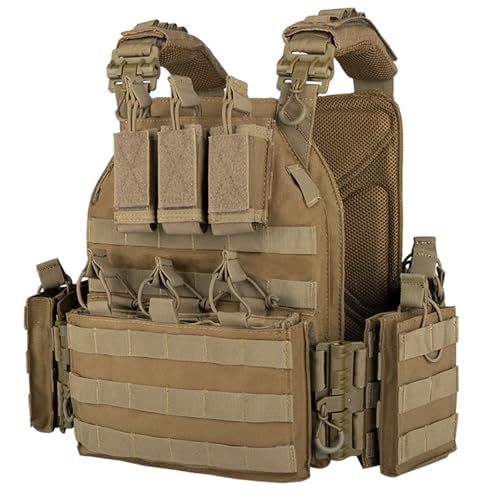 vAv YAKEDA Tactical Outdoor Carrier Vest
- 【HIGH QUALITY】 1000D Nylon,The special structure of the…
- 【Quick to Release】 Padded and reinforced shoulder straps…
- 【MOLLE Module System】3” by 6” patch panels at…
As an Amazon Associate we earn from qualifying purchases at no extra cost to you.
Quick picks by situation
| Situation | Best carrier type | Why it fits the use case | Trade-off |
|---|---|---|---|
| Lowest practical weight | Minimalist plate carrier, such as a JPC-style design | Less fabric and fewer integrated pouches reduce bulk | Less built-in storage and structure |
| Frequent configuration changes | Modular carrier, such as the Spiritus LV-119 | Front, rear, shoulder, and cummerbund components can be matched separately | More fitting decisions and higher total cost when components are purchased separately |
| Heavier load or extended wear | Structured carrier, such as the Ferro Concepts FCPC V5 | More supportive harness and load-bearing options can reduce movement | Usually heavier and warmer than a minimalist design |
| Existing military-pattern armor | SAPI-cut carrier in the correct size | Designed around the plate’s tapered shoulders and squared dimensions | Less forgiving if you later switch to different plate dimensions |
| Occasional emergency storage | Simple 10×12-compatible carrier | Easy to configure without paying for features that remain unused | May not be ideal for daily movement or a large equipment load |
10×12 plates versus SAPI cuts
Plate sizing is the decision that matters most. “10×12” generally describes a nominal rectangular plate approximately 10 inches wide and 12 inches tall. Actual dimensions can vary by manufacturer, and curved corners or pronounced curvature may change how the plate sits in the carrier.
SAPI plates use a military-style size system and a tapered upper profile. A medium SAPI plate is nominally about 9.5 inches wide by 12.5 inches tall, but the shape is not interchangeable with every 10×12 plate. Large and extra-large SAPI plates are wider and taller, so the carrier must be selected by the plate’s stated size rather than by a visual estimate.
| Plate format | Common nominal dimensions | Carrier requirement | Typical fitting issue |
|---|---|---|---|
| 10×12 commercial | 10 × 12 in; verify the maker’s actual measurement | Carrier pocket explicitly rated for 10×12 plates | Plate may be too thick, too curved, or too short for the retention flap |
| Medium SAPI | Approximately 9.5 × 12.5 in | Medium SAPI pocket | A generic 10×12 pocket may leave excess space at the shoulders |
| Large SAPI | Approximately 10.25 × 13.25 in | Large SAPI pocket | Can be too tall or wide for a medium carrier |
| Small SAPI | Approximately 8.75 × 11.75 in | Small SAPI pocket | Oversized pockets can allow vertical or lateral movement |
Measure the plate itself, including thickness, before buying. A carrier pocket that is technically the right width can still fail if the plate is unusually thick. After insertion, the plate should not rattle, slide down, or expose a large gap beneath the retention flap. Do not force an oversized plate into a pocket: excessive tension can distort the carrier and make removal difficult.
How the fit should feel
The front plate should cover the central chest without riding so high that it restricts the neck or so low that it leaves a large gap between the plate and the lower edge of the rib cage. The rear plate should sit at a similar height. Exact positioning depends on body shape, plate geometry, and the manufacturer’s instructions, so use those instructions rather than a universal measurement as the final authority.
Adjust the shoulder straps first, then the cummerbund. If the shoulders are tightened to compensate for a loose waist, the carrier can pull upward and place too much pressure near the neck. If the cummerbund is too loose, the plates move independently of the torso. If it is too tight, breathing and arm movement can become uncomfortable during extended wear.
Cummerbund adjustability: the overlooked mobility feature
A hook-and-loop cummerbund is quick to adjust and works well when one person uses the carrier. Tubular or shock-cord systems can provide more flexible expansion, particularly when adding side plates or wearing different layers. First-and-second-line style systems with multiple adjustment points offer the best range, but they add bulk and setup time.
Look for adjustment that allows at least several inches of usable change without leaving a long, loose tail inside the carrier. A cummerbund should meet at the front without forcing the front plate pocket to bow outward. Check adjustment while standing, sitting, bending, and raising both arms. A setup that feels secure while standing can shift noticeably when seated in a vehicle or working at a desk.
MOLLE layout and weight distribution
MOLLE webbing is useful only where you can reach it. Front MOLLE is convenient for small utility pouches, but stacking several heavy items high on the chest increases forward pull. Side-mounted pouches can interfere with the arms or catch on doorways. Rear MOLLE is better for items that do not need immediate access, although a heavily loaded back can press uncomfortably against a seat.
Keep the heaviest items close to the centerline and as high as practical without obstructing the upper chest. Balance the left and right sides. A simple setup with two loaded magazines, a compact medical kit, and a small utility pouch may be more mobile than a fully covered carrier, even when both use the same plates.
As a planning example, two 1.5-pound loaded magazines, a 1-pound medical pouch, and 1.5 pounds of other equipment add about 5.5 pounds before accounting for the carrier and plates. That additional load is concentrated away from the torso’s center, so it can feel more tiring than the same mass carried close to the body.
Carrier comparisons
Crye Precision JPC 2.0
The JPC 2.0 is a widely used minimalist-style carrier with a relatively low-bulk profile, integrated plate retention, shoulder adjustment, and MOLLE-compatible areas. It is a good choice when mobility and a restrained equipment load matter more than maximum padding or built-in storage. Confirm the exact pocket size and whether your chosen configuration supports the plate format you own.
Spiritus Systems LV-119
The LV-119 is a modular system rather than one fixed configuration. Front and rear bags, shoulder straps, and cummerbunds can be selected to suit the user’s plates and preferred level of support. Its strength is adaptability: someone with changing requirements can replace one component instead of replacing the entire carrier. The downside is that the final fit and cost depend on choosing compatible components.
Ferro Concepts FCPC V5
The FCPC V5 is aimed at users who want a more structured carrier with substantial options for communications, placards, and additional equipment. Its design can be advantageous when the carrier will regularly carry more than just plates and a few small pouches. The added structure may improve load stability, but it can also feel warmer and less flexible than a stripped-down carrier.
Ownership realities: what wears first
- Hook-and-loop panels: lint, dust, and repeated adjustment gradually reduce grip. Keep them covered when stored.
- Elastic magazine cells: frequent stretching can reduce retention before the main fabric shows damage.
- Shoulder and cummerbund stitching: inspect load-bearing seams for loose threads, fraying, or distortion.
- Plate pockets: abrasion and sharp plate edges can wear the interior, especially when plates are repeatedly removed.
- Moisture and salts: sweat can stiffen fabric and corrode metal hardware. Follow the manufacturer’s cleaning instructions, air-dry completely, and avoid storing the carrier damp.
Common mistakes include buying by shirt size, mixing SAPI and 10×12 terminology, loading every MOLLE row, and leaving plates inside during long-term storage without checking for moisture. A carrier is not a substitute for correctly rated armor: verify the plate’s certification, threat rating, condition, and expiration or replacement guidance separately.
Bottom line
Choose the best ballistic plate carriers by starting with the plate, not the brand. Pick a correctly sized 10×12 or SAPI pocket, prioritize a cummerbund with enough adjustment for your clothing layers, and use MOLLE space sparingly so the load stays balanced. The JPC 2.0 is a sensible mobility-first option, the LV-119 is the flexible modular choice, and the FCPC V5 is better suited to a more structured, heavily configured setup.






