The best armored motorcycle riding pants for most riders are AA-rated textile or single-layer denim pants with CE Level 2 knee armor, adjustable hip armor, and a boot-friendly tapered lower leg; choose AAA textile or reinforced riding jeans when maximum abrasion protection matters more than airflow and casual comfort.
The right pair depends on four decisions: how much road protection you need, whether you ride in hot or wet conditions, how often you wear the pants, and whether they must fit over motorcycle boots. Motorcycle trousers are not all certified to the same standard, and “armored” can describe anything from basic knee inserts to a fully certified protective garment.
Our top picks
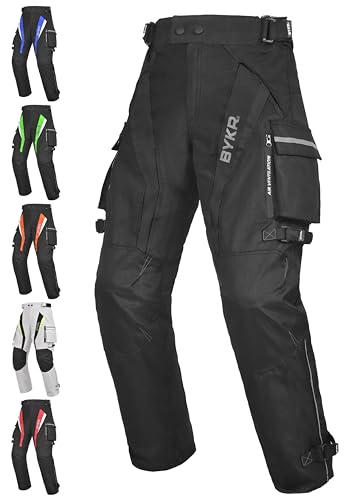 BYKR Motorcycle Pants for Men & Women
- Featuring abrasion resistant cordura fabric with double layered…
- Enhanced with reflective accents, BYKR motorsports pants increase…
- Engineered with premium micro mesh fabric lining and…
BYKR Motorcycle Pants for Men & Women- Featuring abrasion resistant cordura fabric with double layered…
- Enhanced with reflective accents, BYKR motorsports pants increase…
- Engineered with premium micro mesh fabric lining and…
BYKR Motorcycle Pants for Men & Women- Featuring abrasion resistant cordura fabric with double layered…
- Enhanced with reflective accents, BYKR motorsports pants increase…
- Engineered with premium micro mesh fabric lining and…
| Product | Key specs | |
|---|---|---|
| BYKR Motorcycle Pants for Men & Women | Featuring abrasion resistant cordura fabric with double layered… Enhanced with reflective accents, BYKR motorsports pants increase… Engineered with premium micro mesh fabric lining and… | Check price |
| BYKR Motorcycle Pants for Men & Women | Featuring abrasion resistant cordura fabric with double layered… Enhanced with reflective accents, BYKR motorsports pants increase… Engineered with premium micro mesh fabric lining and… | Check price |
| BYKR Motorcycle Pants for Men & Women | Featuring abrasion resistant cordura fabric with double layered… Enhanced with reflective accents, BYKR motorsports pants increase… Engineered with premium micro mesh fabric lining and… | Check price |
| BYKR Motorcycle Pants for Men & Women | Featuring abrasion resistant cordura fabric with double layered… Enhanced with reflective accents, BYKR motorsports pants increase… Engineered with premium micro mesh fabric lining and… | Check price |
As an Amazon Associate we earn from qualifying purchases at no extra cost to you.
First, understand the two safety ratings
CE garment classes: A, AA, and AAA
Under EN 17092, the garment class describes the pants as a complete protective item, including abrasion resistance, seam strength, tear resistance, and impact-area design. The classes are not simply a ranking of the armor inserts.
| Garment class | Typical use | Protection trade-off | What to look for |
|---|---|---|---|
| A | Urban commuting, low-speed use | Lightest and coolest, but least abrasion coverage | CE label, secure knee armor, hip armor if available |
| AA | Daily road riding and touring | Strong balance of protection, comfort, and mobility | CE Level 2 knees, adjustable armor, reinforced seat and knees |
| AAA | Fast road riding and maximum abrasion protection | Heavier, warmer, and often less flexible | Full-length reinforcement, secure armor, strong seams |
| B | Abrasion-resistant garments without impact protectors | Does not provide the complete armor package | Only suitable when compatible armor can be added |
| C | Garments designed mainly to hold impact protectors | Not necessarily abrasion protection by themselves | Check whether separate over- or under-pants are required |
For most riders buying one pair, AA is the practical target. AAA makes more sense for frequent highway riding, spirited riding, or anyone willing to accept extra heat and stiffness. A-rated pants can be reasonable for short urban trips, but they should not be mistaken for the same level of coverage as AA or AAA trousers.
Armor levels: Level 1 versus Level 2
EN 1621-1 covers limb armor such as knees and hips, while EN 1621-2 covers back protectors. CE Level 2 armor allows less transmitted impact force than Level 1 under the standard test, but it is generally thicker and may be warmer or more noticeable.
Prioritize Level 2 knee armor for regular road use. Hip armor is valuable because many pants leave the hips exposed to direct impact, yet it is often sold as an optional insert. A CE-marked garment without hip armor is not automatically defective; it simply provides less impact coverage than a fully equipped pair. Confirm which protectors are included, their certification, and whether they stay centered when you sit on the motorcycle.
Denim versus Cordura textile
Single-layer and lined riding jeans
Protective jeans use denim blended with aramid, UHMWPE, or another high-strength fiber. Single-layer designs are usually the easiest to wear away from the motorcycle and can achieve AA or, in some constructions, AAA certification. They are comfortable for commuting, but their protection depends heavily on the weave, blend, seam construction, and coverage area—not simply on the word “aramid.”
Lined jeans place a separate abrasion-resistant layer behind ordinary denim. They can offer good protection for less money, but the lining may feel warm, snag on boots, or shift away from the knee during a slide. Check that the protective layer extends over the seat, hips, knees, and lower legs rather than stopping at the pockets.
Cordura and other technical textiles
Cordura-branded nylon and comparable motorcycle textiles usually provide better weather versatility, pocket capacity, and ventilation options than jeans. A textile pant may include waterproof membranes, removable thermal liners, zippered vents, and wide adjustment zones. Those features are useful for touring and changing weather, but membranes and multiple layers add bulk.
“Cordura” alone is not a safety rating. A pair made from a high-denier textile can still have a lower garment class than a well-designed single-layer jean. Compare the EN 17092 class and the actual reinforced zones before comparing fabric names.
| Characteristic | Protective riding jeans | Technical textile pants |
|---|---|---|
| Common certification range | A to AAA | AA to AAA |
| Typical weight, size medium | 1.2–1.8 kg | 1.5–2.5 kg; more with liners |
| Heat management | Moderate; lined versions run warmer | Best when vents are open or liners removed |
| Weather resistance | Usually limited unless treated or lined | Often available with waterproof membranes |
| Off-bike appearance | Closest to ordinary jeans | More visibly motorcycle-specific |
| Useful pockets and adjustment | Usually limited | Generally better, especially for touring |
The weight ranges are typical market ranges, not guarantees. A waterproof textile pant with a thermal liner can exceed them, while lightweight AAA trousers may be closer to the lower end.
Best choice by riding situation
| Rider situation | Best starting point | Why | Watch out for |
|---|---|---|---|
| New rider on a limited budget | AA textile or lined riding jeans | Useful protection without buying separate seasonal pants | Verify included Level 2 knee armor and hip pockets |
| Daily warm-weather commuter | Single-layer AA jeans with stretch | More wearable at work and less bulky | Dark fabric, ventilation, and wash instructions |
| Long-distance or four-season rider | AA or AAA textile pants with removable liners | Better rain, temperature, and storage flexibility | Membrane breathability and liner bulk |
| Maximum abrasion priority | AAA textile or AAA-rated riding jeans | Highest certified garment class | Reduced airflow, stiffness, and lower comfort off the bike |
| Rider using bulky touring boots | Textile pants with long zippered cuffs | More room to pass over the boot shaft | Short cuffs that ride above the boot collar |
How each style fits over motorcycle boots
Boot compatibility is determined by the cuff, not the thigh or waist measurement. Slim riding jeans often fit inside short urban boots but may not pass over adventure or touring boots. A straight or relaxed lower leg, ankle zipper, gusset, or hook-and-loop cuff is more useful than a wide upper leg.
- Inside-the-boot fit: Choose a narrow, smooth cuff with no bulky armor or exposed zipper teeth. Tuck only if the boot manufacturer allows it and the pants cannot bunch behind the knee.
- Over-the-boot fit: Look for at least 30–40 cm of usable cuff opening, depending on the boot shaft. Measure the boot circumference at the point where the pants will sit, then compare it with the fully opened cuff.
- Adventure boots: Prefer external cuffs with a gusset and hook-and-loop adjustment. A tapered jean cuff may not clear the buckles or shin plate.
- Seated fit: Bend your knees on the motorcycle. The hem should still overlap the boot and the knee armor should remain centered, without pulling the waist down or exposing skin.
Fit, ownership, and maintenance details that listings omit
Try pants in your normal riding posture, not only while standing. A pair that feels loose at the waist can pull the knee armor above the patella when seated. Adjustable armor pockets are a major advantage: they allow the protector to sit over the knee joint rather than above it. Do not size up so much that the armor can rotate away from the impact area.
Expect the seat, inner knees, and cuff edges to wear first. These areas rub against the saddle, tank, frame, and boot hardware. Stretch panels can also lose shape before the main fabric does. Inspect stitching, belt loops, knee-pocket seams, and the area around the boot zipper at the start of each riding season.
Wash according to the garment label, usually with mild detergent and no fabric softener. Remove armor before washing when instructed, close hook-and-loop fasteners, and air-dry rather than using high heat. Heat can damage elastic panels, coatings, and waterproof membranes. Do not cut out an uncomfortable liner or alter a certified reinforcement panel; modifications can change the tested construction.
Replace pants after a crash if the abrasion zones, seams, or armor pockets have dragged on the road, even when damage looks cosmetic. Armor that has cracked, permanently deformed, or lost its retention should also be replaced. Keep spare armor inserts dry and flat, and check their dates or replacement guidance where the manufacturer provides it.
Bottom line
Choose AA protective riding jeans for the best balance of everyday wear and road protection. Choose AA or AAA textile pants for weather, touring, and easy over-boot fit. Choose AAA when abrasion performance outweighs comfort and airflow. Whatever the fabric, confirm the EN 17092 class, select Level 2 knee armor when possible, add hip armor, and test the complete pants-and-boots combination while seated on your motorcycle.