The best fireproof safe for most households in 2026 is a UL Class 350-rated model with at least one hour of protection, a capacity of 0.8–1.2 cubic feet, a digital keypad plus key override, and bolt-down capability — a profile that covers documents, small electronics, and emergency cash for typically $150–$400. But the right pick depends on what you’re protecting, how long a fire needs to be resisted, and whether burglars or water are the bigger threat. Here’s how to match specs to your situation.
Our top picks
 SentrySafe 1-Hour Fireproof Safe
- Fireproof safe is UL Classified to endure 1…
- Waterproof safe is ETL Verified for 24 hours…
- Set your own digital combination fire safe with…
 SentrySafe Fireproof Waterproof Safe Dial Combination 1.23
- The safe is UL Classified to endure 1…
- The home safe is ETL Verified for 24…
- Combination safe features 4 live-locking bolts, steel construction,…
 SentrySafe Fireproof Safe Box with Key Lock
- Lifetime after-fire replacement guarantee
- Fire safe box is UL classified for fire…
- Fire resistant safe has a privacy key lock…
| Product | Key specs | |
|---|---|---|
| SentrySafe 1-Hour Fireproof Safe | Fireproof safe is UL Classified to endure 1… Waterproof safe is ETL Verified for 24 hours… Set your own digital combination fire safe with… | Check price |
| SentrySafe Fireproof Waterproof Safe Dial Combination 1.23 | The safe is UL Classified to endure 1… The home safe is ETL Verified for 24… Combination safe features 4 live-locking bolts, steel construction,… | Check price |
| SentrySafe Fireproof Safe Box with Key Lock | Lifetime after-fire replacement guarantee Fire safe box is UL classified for fire… Fire resistant safe has a privacy key lock… | Check price |
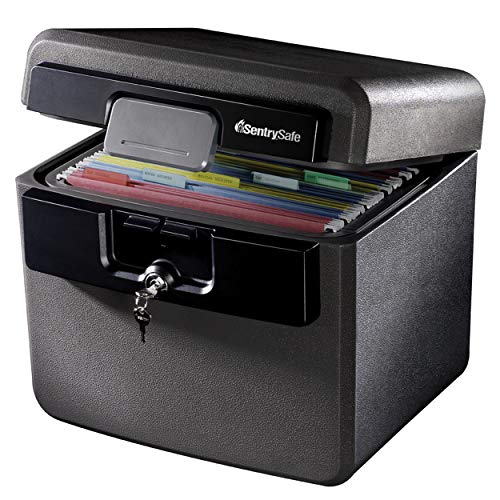 SentrySafe Black Fireproof and Waterproof Safe | UL Classified to withstand high temperatures for up… Spacious interior fits hanging file folders and is… Durable key lock helps prevent unauthorized access and… | Check price |
As an Amazon Associate we earn from qualifying purchases at no extra cost to you.
What the Fire Rating Actually Tells You
Fire ratings describe two things: how long the safe survives a standardized furnace test, and the internal temperature ceiling it maintains. For paper documents, look for UL Class 350 certification — the interior stays below 350°F while the exterior is heated to 1,700°F+ for the rated duration (typically 30, 60, or 120 minutes). For USB drives, hard drives, and backup media, you need Class 125 or 150 ratings, because electronics fail at much lower temperatures; a “fireproof” document safe will still cook a flash drive.
Duration matters more than most buyers expect. The average house fire burns a single room for under 20 minutes before suppression, but whole-structure fires in rural areas — where storm-season buyers in wildfire-adjacent regions are shopping — can exceed an hour. Match the rating to your realistic worst case, not the average case.
Comparing the Top Models by Situation
| Safe | Fire Rating | Capacity | Weight | Lock | Water Protection | Typical Price Range |
|---|---|---|---|---|---|---|
| SentrySafe SFW123GDC | UL Class 350, 1 hr | 1.23 cu ft | ~101 lbs | Digital + key | ETL verified, 24 hrs in 8″ water | $200–$280 |
| First Alert 2092DF | UL Class 350, 1 hr | 1.3 cu ft | ~145 lbs | Digital + key | Waterproof seal | $250–$330 |
| SentrySafe SFW205CWB | UL Class 350, 1 hr | 2.05 cu ft | ~125 lbs | Combination dial | ETL verified | $300–$400 |
| Steelwater AMSWEL-500 | 120 min fire | 0.82 cu ft | ~143 lbs | Digital + bypass key | Moderate gasket seal | $350–$450 |
| Honeywell 1104 chest | UL Class 350, 30 min | 0.39 cu ft | ~73 lbs | Key lock | ETL verified submersion | $100–$150 |
| Gardall MS119 / AMSEC BF1512 | UL RSC burglary + 1–2 hr fire | ~1.2 cu ft | 200–400+ lbs | Group II combination or electronic | Varies | $1,200–$2,500+ |
For grab-and-go evacuation readiness: the fire chest
If your plan is to grab documents and leave during an evacuation order — wildfire, hurricane — a small chest like the Honeywell 1104 makes more sense than a bolted-down box. It holds letter-size folders flat, seals against floodwater, and weighs enough to stay put but not so much you can’t load it in a car. The trade-off: 30-minute fire rating and almost no burglary resistance.
For documents plus cash and small valuables: the mid-size floor safe
The SentrySafe SFW123GDC is the default answer for most families — digital lock, bolt-down kit, letter-size interior with a shelf, and both fire and water verification. The First Alert 2092DF offers similar specs with slightly more interior room.
For serious burglary protection plus fire: a composite safe
Consumer “fireproof safes” resist casual theft but their thin steel and plastic-heavy bodies won’t stop a determined burglar with a pry bar. If you’re storing jewelry, significant cash, or heirlooms, step up to a UL RSC-rated composite safe from Gardall, AMSEC, or similar — fire insulation sandwiched in thick steel, weighing hundreds of pounds. These cost 4–8x more but the burglary protection is real, not cosmetic.
Decision Matrix: Match Your Situation to a Safe
| Your situation | Best fit | Key spec priority |
|---|---|---|
| Renter, paperwork only, tight budget | Fire chest (0.3–0.5 cu ft) | Portability, 30-min UL rating |
| Homeowner, documents + cash + passports | 1–1.3 cu ft digital safe | 1-hr UL 350 + bolt-down + water seal |
| Wildfire/hurricane evacuation zone | Fire chest kept near exit | Waterproof, carry handle, under 80 lbs |
| Hard drives, USBs, media backup | Media-rated insert or Class 125 safe | Internal temp under 125–150°F |
| Jewelry, large cash, collectibles | Composite burglary/fire safe | UL RSC rating, 200+ lbs, floor-anchored |
| Guns alongside documents | Fire-rated gun safe | 90–120 min rating, 600+ lbs |
Lock Types: What Matters in Practice
- Digital keypad: Fastest access (important for emergencies), but runs on batteries — check them twice a year, and keep the mechanical override key somewhere outside the safe.
- Mechanical dial: No batteries, decades-long reliability, but slower to open and harder to use under stress.
- Key lock: Simple and cheap on fire chests; the key itself becomes the security weak point.
- Biometric: Convenient but adds a failure point; choose models with keypad backup.
Ownership Realities Listings Don’t Mention
Moisture is the hidden problem. Fire safes insulate using moisture-laden material — that’s literally how they keep interiors cool. The sealed environment traps humidity, which can cause mold on paper and corrosion on metal items. Add a rechargeable desiccant canister or silica packs inside, and crack the door open monthly for an hour. Store cash and documents in sealed plastic bags regardless of the water rating.
Bolt it down or it walks away. Most safes under 150 lbs can simply be carried out — burglars will take the whole box. Anchor it to the floor (concrete anchor kits for slab, lag bolts for wood) and note that bolting slightly compromises the waterproof rating on some models; check whether the manufacturer includes gasket washers for the bolt holes.
Weight vs. floor. A 100–150 lb safe is fine on any floor. Once you pass 400–600 lbs (composite safes, gun safes), ground-floor or slab placement becomes important — a 1,000 lb safe on an upstairs wood floor is a structural question, not a shopping question.
Capacity shrinks fast. A 1.0 cu ft safe sounds generous until you add a document box, a desiccant, USB drives, and a small jewelry tray. Plan for roughly 30% more interior volume than your current contents need.
Installation: Five Steps
- Choose a location out of sight (closet floor, basement corner) — a visible safe invites attack.
- Avoid exterior walls in wildfire zones; interior rooms burn later and cooler.
- Verify the floor material, then use the manufacturer’s anchor hardware for it.
- Test the lock, bolt mechanism, and override key before loading contents.
- Load contents in sealed bags, add desiccant, and note the combination/key location for a trusted person.
FAQ
Is a fireproof safe also waterproof?
Not automatically. Fire and water protection are separate tests — look for ETL-verified water ratings (submersion or water-resistant) in addition to the fire rating, especially for hurricane and flood zones.
Will a 30-minute fire rating be enough?
For urban areas with fast fire response, usually yes. For rural homes or wildfire zones, 60–120 minutes is the safer bet.
Can I store hard drives and USBs in a standard document safe?
No — media fails at 125–150°F, well below the 350°F ceiling of a paper-rated safe. Use a media-rated insert or a Class 125 safe for digital backups.
Do I need a locksmith to install it?
Not for consumer safes — bolting down is a drill-and-anchor DIY job. For heavy composite safes (300+ lbs), professional delivery and anchoring is worth the cost both for safety and to avoid damaging floors.