Key takeaways
- Listening is legal for anyone. Transmitting on amateur bands requires an FCC license. The entry-level Technician license is a 35-question multiple-choice exam with no Morse code.
- Genuine emergencies. FCC rules allow any means of communication when there is an immediate threat to life or property and no other method works, but radios used this way are much more useful if you have practiced on the air.
- Not for GMRS or FRS. Many dual-band ham radios can tune GMRS and FRS frequencies, but they are not certified for those services. If your family will not get ham licenses, a certified GMRS handheld is the legal alternative.
The best handheld ham radio for emergencies in 2026 is the Yaesu FT-65R for most people: a rugged, simple 5-watt dual-band radio that local emergency nets and repeater groups know well. Step down to a Baofeng UV-5R or BTECH BF-F8HP for a cheap go-bag spare, step up to the BTECH UV-Pro for phone-linked APRS on a budget, and choose the Yaesu FT-5DR, Kenwood TH-D75A or Icom ID-52A Plus if you want digital voice, GPS and position reporting. Before buying, though, understand what a handheld can and cannot reach, because that shapes the choice more than any feature list.
Our top picks


As an Amazon Associate we earn from qualifying purchases at no extra cost to you. Ratings are shown as listed on Amazon.
Realistic Range: What 5 Watts Gets You
| Scenario | Typical range with stock antenna | With a better antenna |
|---|---|---|
| Handheld to handheld, flat suburb (simplex) | 1 to 3 miles | 2 to 5 miles |
| Handheld to handheld, hilltop or open water | 5 to 10 miles | 10 miles or more |
| Handheld through a local repeater | 20 to 50 miles | Wider, depending on repeater height |
| Through linked repeater or digital networks | Regional to worldwide | Only while repeaters and internet links stay up |
The single cheapest upgrade for any handheld is a longer antenna, such as a 15 to 18 inch whip or a roll-up J-pole hung high. Going from 5 watts to 8 watts adds less range than raising your antenna a few feet. Also note that repeaters run on commercial power with battery or generator backup that may only last hours to days in a regional outage, so practice simplex contacts too.
The Radios Compared
| Radio | Bands | Max power | Digital/extras | Weather sealing | Typical price range |
|---|---|---|---|---|---|
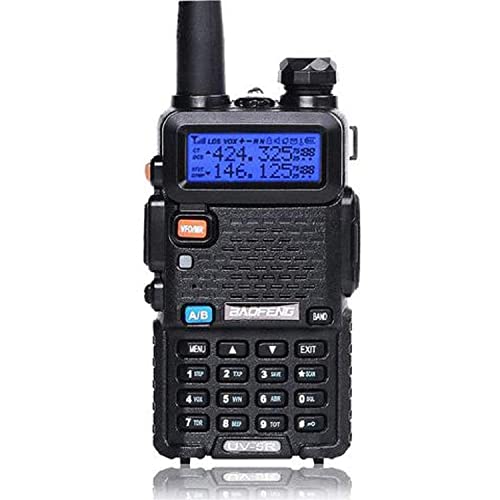
| Baofeng UV-5R | 2 m / 70 cm | about 5 W | FM only, 128 memories | None rated | $20 to $35 |
| BTECH BF-F8HP | 2 m / 70 cm | 8 W | FM only, US support | None rated | $60 to $75 |
| BTECH UV-Pro | 2 m / 70 cm | 5 W | Bluetooth, GPS, APRS via phone app, USB-C | Basic splash protection | $90 to $130 |
| Yaesu FT-65R | 2 m / 70 cm | 5 W | FM only, 200 memories, loud speaker | IP54 | $110 to $200 |
| Yaesu FT-5DR | 2 m / 70 cm | 5 W | C4FM digital, GPS, APRS, Bluetooth | IP54 | $450 to $550 |
| Kenwood TH-D75A | 2 m / 1.25 m / 70 cm | 5 W | D-STAR, APRS, GPS, Bluetooth, USB-C | IP54 | $650 to $750 |
| Icom ID-52A Plus | 2 m / 70 cm | 5 W | D-STAR, GPS, Bluetooth, color screen | IPX7 submersible | $650 to $750 |
Picks by Role
The everyday emergency radio: Yaesu FT-65R
The FT-65R has the qualities that matter when hands are cold and wet: big keys, a loud speaker, a splash and dust rating, a 1,950 mAh lithium-ion battery and a reputation for solid receivers that reject interference from nearby pagers and commercial transmitters better than budget radios. It does not do digital modes, which is fine because most emergency nets and ARES groups still run plain FM. Its transmit audio is sometimes described as a bit thin, so speak across the microphone rather than directly into it.
The go-bag spare: Baofeng UV-5R or BTECH BF-F8HP
These radios made ham radio affordable, and a pair of them programmed with your family’s frequencies is a sensible backup. Their weaknesses are real: weak front-end filtering that can overload near strong signals, a confusing keypad menu and no weather sealing. Program them with free CHIRP software and a USB cable rather than by keypad. The BTECH BF-F8HP is the same platform with more power, a larger battery and US-based support.
Best budget smart radio: BTECH UV-Pro
The UV-Pro pairs to your phone over Bluetooth for programming and for APRS position and text messaging through apps, and it charges by USB-C, which means the same cable and power bank as your phone. That shared charging is a genuine emergency advantage. It is newer and less proven over many years than the Yaesu.
Digital voice and position reporting
If your local group runs Yaesu System Fusion repeaters, the Yaesu FT-5DR fits best, adding GPS and APRS so others can see where you are. If your area has D-STAR repeaters, the Icom ID-52A Plus offers a sharp color display, IPX7 submersion rating and D-STAR messaging and image sending. The Kenwood TH-D75A is the choice for APRS-heavy users and anyone who wants the 1.25 m band, with D-STAR included. Check your local repeater directory before choosing a digital mode.
Decision Matrix
| You are… | Buy |
|---|---|
| New licensee joining a local net or CERT team | Yaesu FT-65R |
| Building family go-bags on a tight budget | Two BTECH BF-F8HP or UV-5R radios |
| Want phone integration and USB-C charging | BTECH UV-Pro |
| Joining ARES with Fusion repeaters | Yaesu FT-5DR |
| Need a radio that survives a dunk in floodwater | Icom ID-52A Plus |
| Heavy APRS tracking for search and rescue support | Kenwood TH-D75A |
Battery Planning for a Multi-Day Outage
Ham operators plan with a 5/5/90 duty cycle: 5 percent transmitting, 5 percent receiving audio, 90 percent standby. A 5 W handheld draws roughly 1.5 A on transmit, about 0.15 A receiving audio and well under 0.1 A in standby with battery save on. On a 2,000 mAh battery that works out to roughly 10 to 14 hours of monitoring. For a three-day event, plan on at least two spare batteries, an AA battery case if your radio offers one, or a USB-C model that can run from a power bank. Dropping to low power (1 W or less) for nearby contacts can more than double runtime.
License Rules You Need to Know
- Listening is legal for anyone. Transmitting on amateur bands requires an FCC license. The entry-level Technician license is a 35-question multiple-choice exam with no Morse code.
- Genuine emergencies. FCC rules allow any means of communication when there is an immediate threat to life or property and no other method works, but radios used this way are much more useful if you have practiced on the air.
- Not for GMRS or FRS. Many dual-band ham radios can tune GMRS and FRS frequencies, but they are not certified for those services. If your family will not get ham licenses, a certified GMRS handheld is the legal alternative.
Setup Steps Before a Storm
- Program your nearest three repeaters, the local ARES or Skywarn net frequencies, the national simplex calling channels (146.520 MHz and 446.000 MHz) and, if your radio receives them, NOAA weather channels.
- Label memory channels with plain names so family members can use them under stress.
- Check in to a weekly net to confirm your radio and antenna actually reach the repeater from home.
- Store spare batteries at partial charge and top them up before hurricane or tornado season.