Key takeaways
- Charge in direct sun, not behind glass. A car dashboard or windowsill cuts output and can overheat the battery.
- Store at partial charge, top up seasonally. Lithium cells in small lanterns age fastest when left fully drained for months.
- Inflatables wear at the valve first. Keep the valve clean and avoid deflating with sandy hands.
- Rinse salt and sand off panels. A scratched or hazy panel window charges noticeably slower.
- Use low mode by default. Most lanterns last five to ten times longer on low than on high, and low is plenty once your eyes adjust.
The best solar camping lanterns in 2026 are the LuminAID PackLite Max 2-in-1 for the best balance of brightness, battery and phone charging, the MPOWERD Luci Outdoor 2.0 for the lightest packable option, the Goal Zero Crush Light for a durable collapsible pick, and the Goal Zero Lighthouse 600 paired with a small folding panel when you need real room-filling light for camp or a power outage. Built-in solar lanterns trade brightness for independence, so the right pick depends on whether you value never needing an outlet or lighting a whole tent.
Our top picks


As an Amazon Associate we earn from qualifying purchases at no extra cost to you. Ratings are shown as listed on Amazon.
Built-In Panel or Panel-Ready?
Solar lanterns fall into two groups. Lanterns with an integrated panel recharge anywhere you can set them in the sun, but the panel is only a few square inches, so the battery and brightness stay small. Panel-ready lanterns like the Goal Zero Lighthouse 600 have no panel of their own; they charge from USB or a separate folding panel, which lets them carry far larger batteries. The table shows how big that gap is.
| Lantern | Solar type | Max brightness | Battery | Weight | Phone charging | Water resistance | Typical price range |
|---|---|---|---|---|---|---|---|
| MPOWERD Luci Outdoor 2.0 | Built-in | 75 lumens | about 1,000 mAh | about 4 oz | No | IP67 | $20 to $30 |
| Goal Zero Crush Light | Built-in | 60 lumens | small Li-ion | about 4.5 oz | No | Weather resistant | $20 to $30 |
| LuminAID PackLite Max 2-in-1 | Built-in | 150 lumens | 2,000 mAh | about 9 oz | Yes, USB out | IP67 | $40 to $60 |
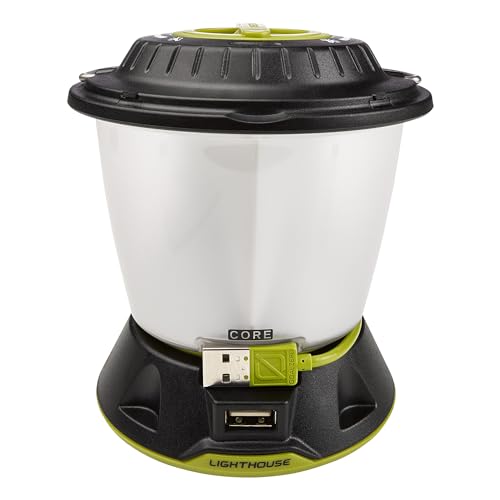
| Goal Zero Lighthouse 600 | Panel-ready (separate panel) + hand crank | 600 lumens | 5,200 mAh | about 1.1 lb | Yes, USB out | Weather resistant | $60 to $80 |
| BioLite AlpenGlow 500 (not solar) | USB-C only | 500 lumens | large Li-ion | about 1.2 lb | Yes, USB out | Splash resistant | $70 to $90 |
How Long Do They Take to Charge in the Sun?
A small integrated panel produces roughly 0.5 to 1 watt in direct sun. Here is what that means in practice.
| Lantern | Battery energy (approx.) | Solar source | Full charge in good sun | Light per sunny day on low |
|---|---|---|---|---|
| Luci Outdoor 2.0 | about 3.7 Wh | Built-in panel | about 7 to 10 hours | A full evening and night |
| LuminAID PackLite Max | about 7.4 Wh | Built-in panel | about 12 to 14 hours (often 2 days) | Several evenings on low |
| Lighthouse 600 | about 19 Wh | 10 to 20 W folding panel | about 2 to 4 hours | Multiple nights, plus phone top-ups |
The practical lesson: integrated-panel lanterns are ideal for nightly camp light and as a no-maintenance emergency light in a kit, while a panel-ready lantern charges faster and does far more, but only if you also own and carry the panel.
Picks by Use
Best overall solar lantern: LuminAID PackLite Max 2-in-1
The PackLite Max inflates into a soft cube that diffuses light evenly, packs flat to about an inch thick and floats. Its 150-lumen high mode is enough to cook and read by, and the 2,000 mAh battery can send a little emergency charge to a phone through its USB port. It charges by USB too, so you can start a trip full and let the sun maintain it.
Lightest and cheapest: MPOWERD Luci Outdoor 2.0
Luci lanterns have been a backpacking and disaster-relief favorite for years because they weigh about as much as a deck of cards, collapse flat and shrug off rain. At 75 lumens, one Luci lights a two-person tent or a small table; for a family campsite, plan on two or three. Buying several for an emergency kit is inexpensive.
Most durable collapsible: Goal Zero Crush Light
The Crush Light uses a semi-rigid accordion body instead of inflating, so there is no valve to leak or seam to puncture. It is dimmer than the PackLite Max but very tough for a lantern this size, and it hangs from a built-in loop.
Brightest solar-capable option: Goal Zero Lighthouse 600
At 600 lumens with a directional mode that lights only half the room to save power, the Lighthouse 600 is the lantern to choose for car camping and home outages. It has a hand crank for emergency top-ups, a USB port to charge phones and pairs directly with Goal Zero’s Nomad folding panels or any comparable 5 V USB panel.
If you can skip solar: BioLite AlpenGlow 500
Many reviewers consider the AlpenGlow the nicest light of any camp lantern, with warm, adjustable tones and color modes. It has no solar input of its own, though a USB-C panel can charge it, so treat it as a USB lantern.
Decision Matrix
| Situation | Choose |
|---|---|
| Backpacking, every ounce counts | Luci Outdoor 2.0 |
| Emergency kit that must work after a year in a closet | LuminAID PackLite Max (top up by sun before use) |
| Kids or rough handling | Goal Zero Crush Light |
| Family car camping or multi-day power outage | Lighthouse 600 + folding panel |
| Ambient light, USB charging is fine | BioLite AlpenGlow 500 |
Ownership Tips
- Charge in direct sun, not behind glass. A car dashboard or windowsill cuts output and can overheat the battery.
- Store at partial charge, top up seasonally. Lithium cells in small lanterns age fastest when left fully drained for months.
- Inflatables wear at the valve first. Keep the valve clean and avoid deflating with sandy hands.
- Rinse salt and sand off panels. A scratched or hazy panel window charges noticeably slower.
- Use low mode by default. Most lanterns last five to ten times longer on low than on high, and low is plenty once your eyes adjust.