Key takeaways
- Alert standby. A radio that wakes itself for warnings is far more protective than one you have to remember to switch on, especially for storms that arrive overnight.
- Battery chemistry and size. Lithium-ion packs of 2,000 mAh and up hold charge for months on a shelf. Small NiMH packs self-discharge faster, so top them up monthly.
- Disposable battery fallback. AA or AAA compartments are the real long-outage insurance. Lithium primaries last for years in storage and work in cold weather.
- Crank feel. A sturdy, full-length crank handle matters when you need a few minutes of power in the dark. Flimsy folding cranks are the most common part to break.
- Charging port. USB-C is more convenient, but plenty of strong radios still use micro-USB. Store the matching cable with the radio.
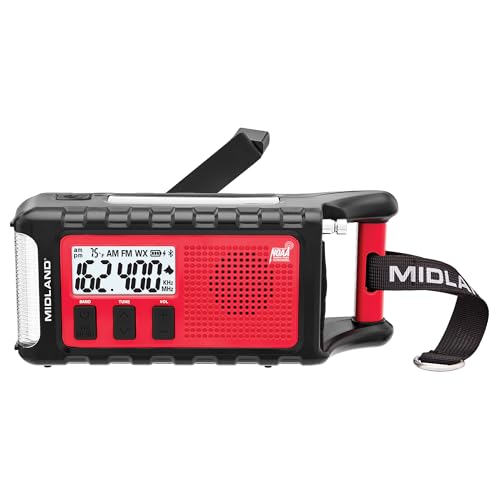
The best emergency radios with solar charging in 2026 are the Midland ER310 for most households, the Kaito KA500 if you want shortwave and the widest set of power options, and the Eton FRX3+ or FRX5BT if you value a compact build and better speaker. The solar panel on all of them is a slow trickle charger, not a primary power source. Knowing exactly how slow is what separates a radio that keeps you informed through a three-day outage from one that goes quiet on day two.
Our top picks


As an Amazon Associate we earn from qualifying purchases at no extra cost to you. Ratings are shown as listed on Amazon.
What the Solar Panel Can and Cannot Do
Every radio in this category carries a small photovoltaic strip on its top or handle, usually a few square inches in size. In direct midday sun these panels deliver somewhere around 0.3 to 0.6 watts, and less once you account for heat, angle and charging losses. That sounds abstract, so here is the math for a typical radio with a 2,600 mAh lithium-ion cell like the Midland ER310.
| Step | Figure | What it means |
|---|---|---|
| Battery energy | 2,600 mAh x 3.7 V = about 9.6 Wh | Total stored energy when full |
| Usable solar input | about 0.3 W in full sun | After angle and conversion losses |
| Sun hours to fill from empty | 9.6 / 0.3 = about 32 hours | Four to six clear days, not one afternoon |
| Radio draw at moderate volume | about 0.3 to 0.5 W | Roughly one hour of listening per hour of strong sun |
| Phone top-up from a full radio | about 3 to 4 Wh delivered | Roughly 20 to 30 percent of a modern phone |
The takeaway: solar keeps a radio alive for news and alerts during a long outage if you leave it in a sunny window every day, but it will not run the radio all evening and charge your phone too. Start every storm season with the internal battery full from USB, and treat solar and the hand crank as ways to slow the drain.
Quick Comparison of the Leading Solar Emergency Radios
| Model | Bands | Internal battery | Other power | NOAA alert | Typical price range |
|---|---|---|---|---|---|
| Midland ER310 | AM, FM, NOAA | 2,600 mAh Li-ion | Crank, USB, disposable-battery backup | Yes, alert standby | $50 to $70 |
| Kaito KA500 | AM, FM, shortwave, NOAA | 600 mAh NiMH pack | Crank, USB/DC, AA batteries | Yes, tone alert | $45 to $65 |
| Eton FRX3+ | AM, FM, NOAA | Li-ion pack | Crank, USB, disposable-battery backup | Yes, alert standby | $50 to $65 |
| Eton FRX5BT | AM, FM, NOAA plus Bluetooth speaker | Li-ion pack | Crank, USB | Yes, alert standby | $75 to $95 |
| FosPower A1 | AM, FM, NOAA | 2,000 mAh Li-ion | Crank, USB, disposable-battery backup | No standby alert | $25 to $35 |
Picks by Situation
Best for most homes: Midland ER310
The ER310 pairs the largest lithium battery in its price class with a weather alert standby mode, which means the radio can sit silently and switch itself on when the National Weather Service broadcasts a warning. It is splash resistant (IPX4), has a bright flashlight and SOS strobe, and accepts disposable batteries as a fallback. The trade-offs are a busy button layout and an older micro-USB charging port, so keep the right cable in your kit.
Best for long outages and listening range: Kaito KA500
The KA500 is the radio to choose if you want to hear more than local stations. Shortwave lets you pick up distant broadcasts when regional transmitters are down. It also has the most ways to stay powered: solar, crank, USB or DC input and standard AA cells. Its built-in rechargeable pack is small, so think of the AA compartment as its real reserve and store a sealed pack of lithium AAs with it.
Best compact all-rounder: Eton FRX3+
Eton has built crank and solar radios for years, and the FRX3+ is the brand’s balanced middle option: alert standby, glow-in-the-dark locator, USB phone charging and a size that fits in a go-bag side pocket. Its solar strip is small even by category standards, so it leans more heavily on the crank.
Best if the radio doubles as a daily speaker: Eton FRX5BT
The FRX5BT adds Bluetooth playback and a larger speaker, which is useful if the radio will live in a kitchen or camper and get used year-round. Regular use is actually a preparedness advantage: a radio you touch every week is a radio whose battery you know is healthy.
Budget backup: FosPower A1
The A1 covers AM, FM and the seven NOAA weather channels with a crank, solar strip and phone-charging port at a low price. It lacks an alert standby mode, so you must turn it on to hear warnings. It is a reasonable second radio for a car or office drawer, not the primary alert device for a household.
Decision Matrix
| Your situation | Best fit | Why |
|---|---|---|
| Tornado or flash-flood zone, need overnight alerts | Midland ER310 or Eton FRX3+ | Alert standby wakes the radio automatically |
| Hurricane coast, outages of a week or more | Kaito KA500 plus spare AA cells | Most power paths, shortwave if local stations drop |
| Rural area with weak AM/FM reception | Kaito KA500 | Shortwave and a longer telescopic antenna |
| Want one device used every day | Eton FRX5BT | Bluetooth speaker keeps it in regular use |
| Second radio for car or workplace | FosPower A1 | Low cost, full NOAA coverage |
Features That Matter More Than the Panel
- Alert standby. A radio that wakes itself for warnings is far more protective than one you have to remember to switch on, especially for storms that arrive overnight.
- Battery chemistry and size. Lithium-ion packs of 2,000 mAh and up hold charge for months on a shelf. Small NiMH packs self-discharge faster, so top them up monthly.
- Disposable battery fallback. AA or AAA compartments are the real long-outage insurance. Lithium primaries last for years in storage and work in cold weather.
- Crank feel. A sturdy, full-length crank handle matters when you need a few minutes of power in the dark. Flimsy folding cranks are the most common part to break.
- Charging port. USB-C is more convenient, but plenty of strong radios still use micro-USB. Store the matching cable with the radio.
Ownership Realities
Lithium cells degrade fastest when stored full and hot, so do not leave a radio on a dashboard or in a sun-baked window for months between storms. A cool closet with the battery around half to full and a monthly check is ideal. Before each season, run the radio for an hour, confirm it receives your local NOAA transmitter, test the weather alert button and wipe the solar panel, since dust and film on the plastic window can cut its output noticeably. If a radio uses AA or AAA backups, remove those cells during storage to prevent leakage damage.
FAQ
Can I charge my phone fully from a solar emergency radio?
Not realistically. A full radio battery typically gives a modern phone a partial top-up, enough for a few calls or texts. For phone charging during an outage, a separate power bank or a portable solar panel is a better tool.
How many crank turns do I need?
Expect roughly one minute of steady cranking to produce several minutes of radio at moderate volume, with results varying by model and how fast you turn. Cranking is best for short news checks, not extended listening.
Do I still need a dedicated weather radio?
If your solar radio has alert standby and receives all NOAA channels, it can serve as your weather radio. If it does not, a plug-in alert radio by the bed is still worth having.