Our Top Picks
As an Amazon Associate we earn from qualifying purchases.
A battery operated emergency radio solves a specific problem that other emergency radios do not. When severe weather arrives at night, the warning that matters most is the one that reaches a sleeping household on its own. A desktop alert radio sits plugged in, listens to the NOAA Weather Radio network around the clock, and switches to battery power the moment the mains supply fails, so a tornado warning, a flash flood warning or a civil emergency message is still announced even while the house is dark and the power is out. That battery operation is not a convenience feature here. It is the whole reason the category exists.

This guide takes a deliberately different angle from handheld emergency radios. There is no hand crank and no solar panel in the picks below, and none of the models here is a pocket receiver built for a go-bag. Instead, both radios are stationary alert monitors designed to live on a kitchen counter, a bedside table or an office desk. Each one runs on ordinary replaceable AA batteries as its backup power source, each one decodes S.A.M.E. county-specific alert data so it only sounds for the areas the owner programmes into it, and each one carries Public Alert certification as stated on its product page. The job is continuous, unattended monitoring at home, with batteries bridging every outage.
Two radios are compared. The Midland WR120B is the compact, focused alert monitor: S.A.M.E. programming for up to 25 counties, a loud siren, a trilingual display and a built-in alarm clock in a small desktop body. The Sangean CL-100 is the fuller-featured tabletop alternative: it adds AM and FM broadcast reception with RBDS information, a larger scrolling display, dual alarms and an external alert output for accessories such as flashing lights. The buying guide comes first, because the differences between these two machines are about alert behaviour, battery arrangements and everyday features rather than about reception alone, and understanding those differences makes the right choice much easier.
Disclosure: This article contains affiliate links. If you buy through these links, we may earn a commission at no additional cost to you.
How to Choose a Battery Operated Emergency Radio
Begin with S.A.M.E. county filtering. NOAA broadcasts alerts for wide areas, and a radio that sounds for every warning in a large region will train its owners to ignore it. S.A.M.E., which stands for Specific Area Message Encoding, lets the owner programme county codes into the radio so it reacts to alerts for the places that actually matter: the home county and perhaps the counties where family members live or work. Both radios in this guide store up to 25 county codes, as stated on their product pages. A household that only needs its own county can programme a single code and sleep through warnings issued for distant areas, while a household near a county border can add the neighbouring codes and stay covered in both directions.
Understand what the batteries are for. In this category the radio normally runs from its AC adapter, and the AA batteries are the reserve that takes over during an outage. That arrangement has two practical consequences. First, the batteries must be installed before they are needed, because an alert radio with an empty battery compartment is silent exactly when it is needed most. Second, the batteries need a replacement rhythm: they sit inside the radio for long periods, so they should be checked on a regular schedule and replaced before they age out. Both models below use AA cells, three in the Midland and four in the Sangean, which keeps the reserve cheap to maintain and easy to restock from any household battery drawer.
Check the alert outputs, not just the siren. A siren figure in decibels describes volume, but households differ in how a warning needs to be delivered. The Midland WR120B combines its siren with voice and display alert options and colour-coded indicator lights that show the severity level at a glance. The Sangean CL-100 adds an external alert output jack, which its page describes as a connection point for accessories such as flashing lights or an additional siren, a feature that matters in homes where a sleeper may not respond to sound alone. Decide how the warning has to reach the people in the house, then check that the radio provides that route.
Decide whether broadcast radio matters. The WR120B is a dedicated weather alert monitor: its reception is centred on the NOAA channels, and it does not present itself as a general entertainment radio. The CL-100 adds AM and FM reception with RBDS, so it can serve as the household’s everyday tabletop radio and clock as well as its alert monitor. Neither approach is wrong. A dedicated monitor is simpler and leaves nothing between the owner and the alert settings. A combined unit earns its counter space every day, which makes it more likely to stay plugged in, powered and ready in the room where people actually spend time.
Place the radio where the signal and the people are. An alert radio only works if it can receive the NOAA transmitter and be heard by the household. Both models use telescopic or built-in antenna arrangements suited to indoor use, and reception is usually strongest near a window and away from large metal objects. Bedside placement suits the night-time warning job, while a central hallway or kitchen placement may cover more of the house during the day. Wherever the radio lives, its county codes, its alert preferences and its batteries should be set up in calm weather, because the middle of a storm is the wrong time to learn a menu system.
Midland WR120B NOAA Emergency Weather Alert Radio
ASIN: B00176T9OY — View on Amazon
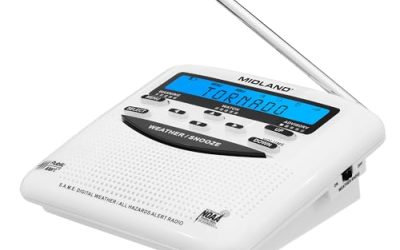
The Midland WR120B is the reference design for this category, and its product page describes exactly the arrangement this guide is about: a desktop NOAA weather alert radio that runs from its AC power adapter and carries battery backup for outages. The page states that the radio uses three AA alkaline batteries for emergency power back-up in the event of a power outage, and lists its power source as corded electric and battery. That dual arrangement means the WR120B monitors continuously while the mains supply is healthy and keeps monitoring on its AA cells when the supply fails, which is the core promise of a battery operated emergency radio for the home.
Alert handling is the WR120B’s strength. The page describes S.A.M.E. localized programming with a 25-county memory system, so the radio can be set to react only to alerts for the counties the owner selects. It covers more than 60 emergency alerts, according to the page, spanning weather hazards and civil emergency messages broadcast through the NOAA network. When an alert arrives, the page lists a 90 dB siren, voice alert and flashing LED warning systems, giving the household sound, spoken information and a visual signal in the same event. The display is trilingual, and alert levels are colour-coded, so the severity of a warning can be read at a glance before the details are heard.
Everyday details are kept deliberately simple. The page lists a built-in clock with alarm and snooze, and gives the body dimensions as 6.0 x 1.5 x 5.0 inches with a weight of one pound in the product information, so the radio sits comfortably on a nightstand without dominating it. The model number is WR120B, which is the identifier to check when comparing listings, because Midland sells several weather radios with similar names. There is no AM or FM broadcast reception presented as a feature of this model, and that focus is part of its appeal: the settings an owner touches are the alert settings, the county codes and the clock.
Choose the WR120B when the requirement is a dedicated warning device and nothing more. It suits a bedside table in a storm-prone region, a hallway console in a family home, or a desk in a small office that needs its own alert coverage. Its battery arrangement is the simplest in this guide to maintain, with three common AA cells forming the entire reserve, and its alert outputs cover the common household cases of sound, voice and light. Households that also want everyday broadcast listening from the same box should look at the Sangean below, but households that want the warning job done with the least possible complexity will find the WR120B matched precisely to that brief.
Sangean CL-100 NOAA Weather Alert Table-Top Radio
ASIN: B003QHXZM4 — View on Amazon
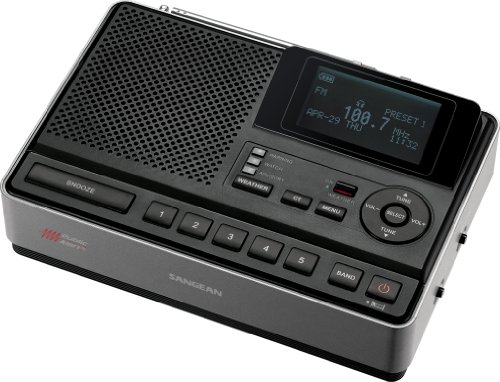
The Sangean CL-100 takes the same battery backed alert-monitor idea and builds a fuller tabletop radio around it. Its product page describes a Public Alert Certified weather radio that receives NOAA reports covering severe weather advisories, civil emergencies, hazards and evacuation details, with S.A.M.E. programming that stores up to 25 county codes so alerts sound for the owner’s chosen areas. The page lists the power source as battery powered and corded electric, and the product information states that four AA batteries are required, which form the reserve that keeps the alert function alive when mains power is lost. The model number is CL-100, and the item weight is listed as 1.1 pounds.
Where the CL-100 separates itself is in its everyday feature set. The page describes AM and FM-RBDS reception alongside the weather alert function, so the radio displays station information such as programme service names, time and date where broadcasters provide it, and it can serve as the household’s regular tabletop radio between emergencies. The display is a scrolling LCD that presents alert message text, and the radio stores alert information so a warning that arrives while the house is empty can still be read later. Dual alarms and a clock function complete the bedside and kitchen roles, and an EEPROM back-up preserves preset stations, as stated in the product title on the page.
The alert output options also go a step further. The page describes a built-in external alert output jack for accessories such as aids for the hearing and visually impaired, flashing lights, or an indoor and outdoor siren and alarm. For a household where a standard siren may not wake or reach everyone, that output turns the CL-100 into the trigger point for a wider warning arrangement rather than the whole arrangement by itself. A headphone connection and auxiliary input are also listed in the product information, along with a 3.5mm audio hardware interface, which support private listening and everyday use.
Choose the CL-100 when the alert radio will share a counter or nightstand with the household’s everyday listening. It suits a kitchen where the radio plays through the day and stands guard at night, a bedroom where the dual alarms and scrolling display earn their place, and any home that wants the external alert output for a flashing light or an additional siren. Its four AA reserve is one cell more than the Midland’s arrangement, and its broader feature set means a slightly longer setup session with county codes, presets and alert preferences. In exchange, it is the more complete household appliance of the two, while keeping the same essential promise: NOAA alerts, filtered by county, delivered on battery power when the mains supply is gone.
Comparison Table
| Product | ASIN | Alert System as Stated | Battery Arrangement as Stated | Broadcast Reception as Stated | Alert Outputs as Stated |
|---|---|---|---|---|---|
| Midland WR120B | B00176T9OY | S.A.M.E. localized programming, 25-county memory, 60+ emergency alerts | AC adapter with 3 AA alkaline batteries for emergency back-up | NOAA weather channels | 90 dB siren, voice alert, flashing LED, colour-coded alert levels |
| Sangean CL-100 | B003QHXZM4 | S.A.M.E. and Public Alert Certified, up to 25 county codes stored | Corded electric and battery powered, 4 AA batteries required | NOAA, AM, FM-RBDS | Siren and display alerts, external alert output jack for accessories |
Frequently Asked Questions
What does battery operated mean for a desktop emergency radio?
It means the radio carries its own battery reserve that takes over when mains power fails. Both radios in this guide normally run from an AC adapter and switch to AA batteries during an outage, the WR120B using three AA cells and the CL-100 using four, as stated on their product pages. The alert monitoring continues on battery power, so a warning issued during a blackout is still announced.
What is S.A.M.E. and why does it matter?
S.A.M.E. stands for Specific Area Message Encoding. It is the system NOAA uses to tag alerts with the counties they apply to. A radio with S.A.M.E. programming, such as both models in this guide, can be set with the owner’s county codes so it only sounds for relevant alerts instead of every warning broadcast across a wide region. That filtering is what makes an alert radio practical to live with overnight.
How often should the backup batteries be replaced?
On a fixed schedule rather than after a failure. The batteries sit inside the radio for long periods while the adapter does the daily work, so they should be checked regularly and replaced while they are still healthy, following the radio maker’s guidance. Keeping a spare set of AA cells in the same drawer as the radio makes the replacement a two-minute job instead of a shopping trip during storm season.
Can one of these radios wake a heavy sleeper?
That depends on the alert outputs the household uses. The WR120B combines a 90 dB siren with voice and flashing LED alerts, as stated on its page. The CL-100 adds an external alert output jack described on its page as suitable for accessories such as flashing lights or an additional siren, which gives households that need more than sound a way to extend the warning. Placement near the bed and correct county programming matter as much as volume.
Do these radios receive regular AM and FM stations?
The Sangean CL-100 does: its page lists AM and FM-RBDS reception alongside the NOAA alert function. The Midland WR120B is presented on its page as a dedicated NOAA weather alert radio with an alarm clock, focused on alert monitoring rather than broadcast entertainment. Households that want one box for both jobs should choose accordingly.
Where is the best place to keep a battery operated emergency radio?
Where it can receive the NOAA signal clearly and be heard by the people it protects: a bedside table for night warnings, or a central kitchen or hallway position for daytime coverage. It should stay plugged in with its batteries installed, its county codes programmed and its alert preferences set, so that it is already working before severe weather is forecast.
Conclusion
The best battery operated emergency radio is a stationary guardian rather than a portable companion, and the two radios in this guide divide that role cleanly. The Midland WR120B (B00176T9OY) is the focused choice: S.A.M.E. programming for up to 25 counties, a three AA battery reserve, a siren with voice and LED alerts, and a simple alarm clock in a compact desktop body. The Sangean CL-100 (B003QHXZM4) is the fuller household radio: the same county-filtered NOAA alert coverage and Public Alert certification, a four AA reserve, AM and FM-RBDS listening, a scrolling alert display and an external alert output for accessories.
Whichever model is chosen, the ownership habits decide whether it works on the night it is needed. Programme the county codes in calm weather, keep fresh AA batteries installed and a spare set nearby, and leave the radio plugged in and listening in the room where its warning will be heard. A battery operated emergency radio asks for very little attention in return for the one service nothing else in the house provides: an official warning, delivered on battery power, while the storm is still on its way.
More from Amazon
Programs that pair well with the guide above. Offers and eligibility are set by Amazon and may change.
Free shipping on eligible items, Prime Video and more. Eligible new members can start with a free trial.
Start a Prime free trialAudiobooks and podcasts to listen to on the go. Eligible new members can start with a free trial.
Try Audible freeAd-free music streaming. Eligible new subscribers can start with a free trial.
Try Music Unlimited freeA free business account with business pricing and bulk-buying tools for work, shop or home office.
Create a business accountAs an Amazon Associate we earn from qualifying purchases.