Our Top Picks

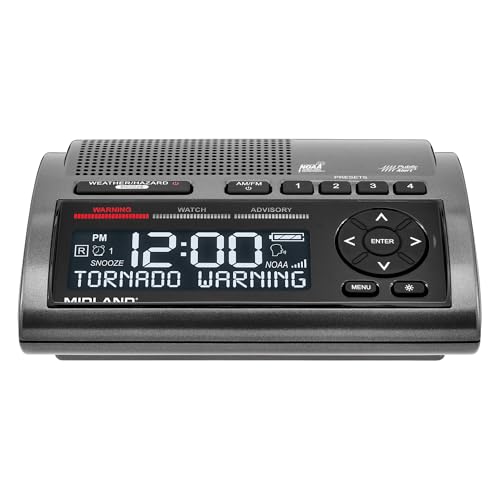
A weather radio only helps if the person using it can hear the alert, read the display, and work the controls without a manual in hand. For older adults, that means large text, a loud siren, simple setup a family member can finish in one visit, and backup power that does not depend on finding fresh batteries in a dark drawer. The five radios below were chosen on those terms: straightforward S.A.M.E. desktop models for the nightstand, a clock radio that feels familiar, and two crank radios with plain dials for homes where the power goes out often.
As an Amazon Associate, we earn from qualifying purchases.
Table of Contents
- Quick Answer
- The 5 Best Weather Radios for Seniors
- How to Choose a Weather Radio for an Older Adult
- Who Should Skip These Picks
- FAQ
- Final Verdict
Quick Answer
For most seniors, the Midland WR120B is the easiest safe choice: county-specific S.A.M.E. alerts, color-coded warning lights, and a loud siren on AC power with AA backup. The Midland WR400 adds the biggest, easiest-to-read color display. The Sangean CL-100 works like a familiar alarm clock radio. For outage-prone homes, the Midland ER310 and Kaito KA500 recharge by hand crank and sunlight, so dead batteries never silence them.
The 5 Best Weather Radios for Seniors
1. Midland WR120B — Best Overall for Simple, Reliable Alerts
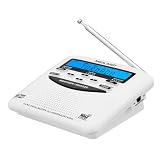
The WR120B is the radio most often recommended for an older parent’s nightstand, and the reason is restraint. It does one job — monitor NOAA broadcasts and sound the alarm for your county — with a setup menu that a son, daughter, or neighbor can complete once and never revisit. S.A.M.E. programming accepts up to 25 counties, so the radio stays quiet for storms two counties away and only speaks up for warnings that actually apply. Three color-coded indicator lights separate warnings, watches, and advisories at a glance, which helps when reading small text quickly is hard. Alerts can be set to voice, tone, or display-only, and the display supports English, Spanish, and French. It runs on household current with three AA backup batteries, and an external alert jack accepts add-on strobe lights or bed shakers later if hearing changes.
Specs:
- Alert system: S.A.M.E. localized programming, up to 25 counties
- Alert indicators: color-coded warning, watch, and advisory lights
- Alert modes: voice, tone siren, or display only, user-selectable
- Display: backlit LCD, English, Spanish, and French
- Power: AC adapter with 3 AA battery backup
- Extras: external alert output jack, alarm clock with snooze, Public Alert certified
2. Midland WR400 — Best Big Display and Alarm Clock Combo
The WR400 suits seniors who want one device on the nightstand instead of two. Its color display is the largest and easiest to read in this group, showing alert type and county in big text, and the built-in alarm clock wakes to radio or buzzer just like a standard clock radio. S.A.M.E. programming covers up to 25 counties, and alert types can be switched on or off individually, which reduces startling overnight alarms for minor advisories. A USB port on the back charges a phone during an outage, a genuinely useful touch for keeping a lifeline charged. It runs on AC power with four AA backup batteries, and accepts an external antenna for homes with weak NOAA reception. The trade-off is size: it is the bulkiest pick here, so it belongs on a nightstand or counter rather than a shelf.
Specs:
- Alert system: S.A.M.E. localized programming, up to 25 counties
- Display: large color display with adjustable backlight
- Radio: AM/FM plus all 7 NOAA weather channels
- Power: AC adapter with 4 AA battery backup
- Extras: USB phone charging port, dual alarm clock, external antenna jack, Public Alert certified
3. Sangean CL-100 — Best for Anyone Who Wants a Familiar Clock Radio
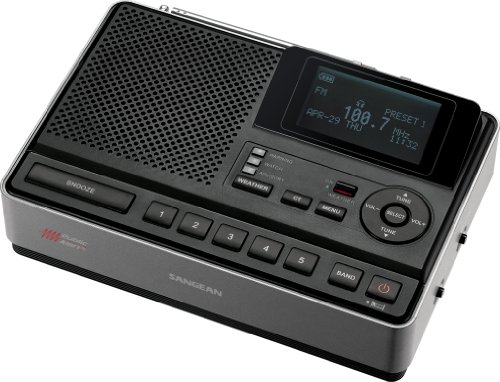
The CL-100 hides its weather radio inside the shape of an ordinary tabletop clock radio, which lowers the learning curve for seniors who resist new gadgets. The graphic LCD is wide and high-contrast, the dual alarm works with radio or buzzer, and AM/FM listening with station presets covers everyday use between storms. Underneath, it is a fully certified S.A.M.E. radio: up to 25 programmable county codes, three indicator lights for warning, watch, and advisory, and memory that stores up to 20 alert messages so a missed overnight warning can be read in the morning. An external alert output jack allows a flashing light or siren accessory to be added. Power comes from the wall adapter with four AA batteries as backup, and stored settings survive outages thanks to non-volatile memory. Its speaker is modest, so very hard-of-hearing users should pair it with the alert jack accessories.
Specs:
- Alert system: S.A.M.E. technology, up to 25 programmable county codes
- Alert memory: stores up to 20 alert messages for later review
- Display: 128 x 64 graphic LCD with wide viewing angle
- Radio: AM/FM-RBDS with 5 AM and 5 FM presets, dual alarm clock
- Power: DC adapter with 4 AA battery backup
- Extras: external alert output jack, Public Alert certified, about 7.2 x 5.2 x 2.5 inches
4. Midland ER310 — Best Crank Radio When the Power Fails

Desktop radios go silent once their backup batteries drain, and long outages are exactly when older adults living alone most need information. The ER310 answers that with three ways to recharge: a top solar panel, a hand crank, and a USB input topping up its rechargeable battery pack, so it can be kept ready without ever buying batteries. It scans the seven NOAA channels, locks onto the strongest signal, and sounds an alert tone when a warning is issued; note that it uses tone alerting rather than county-by-county S.A.M.E. filtering, so it may announce warnings for nearby counties too. A built-in flashlight with an SOS strobe helps with nighttime trips down a dark hallway, and the USB output can add a partial charge to a phone. Controls are button-based with a clear digital display, though the menus run deeper than the desktop picks, so a family member should do the first setup.
Specs:
- Bands: AM/FM plus all 7 NOAA weather channels with alert
- Alert style: NOAA weather scan with tone alert (no S.A.M.E. county filtering)
- Power: rechargeable battery pack, solar panel, hand crank, USB charging input
- Extras: LED flashlight with SOS strobe, USB phone charging output, ultrasonic dog whistle
- Display: backlit digital display with battery indicator
5. Kaito KA500 Voyager — Best Analog Dials, Nothing to Program

Some seniors never want to touch a menu, and the KA500 is built for them. Tuning is done with physical dials and a band switch — AM, FM, shortwave, and the NOAA weather band — and the weather alert mode simply listens for the NOAA alert tone. Five power sources keep it running almost indefinitely: a tilting solar panel, a hand crank dynamo, a rechargeable battery pack, three AA batteries, or an AC/USB input. A flashlight and a swing-up reading lamp are built in, and the USB output can charge a phone in a pinch. The honest limits: there is no S.A.M.E. filtering and no digital display, so alerts cover whatever the local NOAA transmitter announces, and precise station finding takes a steadier hand than a preset button. For a technophobe in a storm-prone area, that simplicity is the point.
Specs:
- Bands: AM, FM, shortwave (SW1/SW2), and NOAA weather band with alert tone
- Tuning: analog dials and band switch, no menus or programming
- Power: solar panel, hand crank dynamo, rechargeable battery pack, 3 AA batteries, AC/USB input
- Extras: LED flashlight, swing-up reading lamp, USB phone charging output
- Build: water-resistant housing with telescopic antenna
How to Choose a Weather Radio for an Older Adult
Start with the alert itself. A senior who sleeps without hearing aids needs volume and, ideally, lights: color-coded indicators and an external alert jack for a strobe or bed shaker matter more than extra radio bands. Next, look at the display. Large, high-contrast text beats a feature-packed small screen every time, and a backlight that stays readable at night is worth more than a dozen presets.
Setup burden is the third filter. S.A.M.E. county programming is a one-time task — a family member can enter the county code during a visit — but the daily controls should be a volume knob and one or two buttons. If the senior will not tolerate menus at all, an analog crank radio like the KA500 trades precision for zero learning curve.
Finally, match power to the home. In a house that rarely loses power, AC with AA backup is enough and simplest. Where outages last days, crank and solar charging remove the battery problem entirely. Whatever you choose, place the radio where the senior sleeps, test the alert on NOAA’s weekly test day, and write the county code on a card taped to the back.
Who Should Skip These Picks
Seniors who are deaf or severely hard of hearing should not rely on any radio’s speaker alone; look instead at alert radios bundled with strobe lights and pillow shakers, covered in a separate guide on this site. Anyone in a deep rural valley with weak NOAA reception should confirm local transmitter coverage first, and consider a model with an external antenna jack like the WR400. If the senior is comfortable with a smartphone, a weather app plus a basic radio may serve better than a premium desktop unit. And if the household already owns a Public Alert certified radio that passes its weekly test, there is no need to replace it just for newer features.
FAQ
How loud does a weather radio need to be for a senior?
Loud enough to wake a sleeper in the next room is the practical test, and all three desktop picks here sound a full siren plus voice message. For seniors with significant hearing loss, volume alone is not the answer: choose a model with color-coded alert lights and an external alert jack, like the WR120B or CL-100, so a strobe light or bed shaker can be added.
Do weather radios need to be programmed for a specific county?
Desktop S.A.M.E. radios like the WR120B, WR400, and CL-100 work best after a one-time setup: enter the county code, pick the local NOAA channel, and choose which alert types sound. It takes a few minutes and only needs doing once. Crank radios like the ER310 and KA500 skip programming entirely, but they announce every warning the transmitter sends, including some for neighboring counties.
What happens to these radios during a power outage?
The desktop models switch automatically to their AA backup batteries and keep monitoring, though the backlight may dim to save power. The ER310 and KA500 recharge by hand crank and solar panel, so they can run indefinitely in a long outage. Check backup batteries twice a year, ideally when the clocks change.
Can a family member set the radio up for a senior?
Yes, and that is the recommended approach. Program the county code, set alert preferences, run the weekly NOAA test together, and tape an instruction card to the back: how to silence an alert, replay a message, and who to call. After that, daily use is just volume and one button.
Final Verdict
Buy the Midland WR120B for the typical senior household: simple, county-specific, and loud, with lights reinforcing every alert. Choose the WR400 if eyesight is the main concern, or the Sangean CL-100 if a familiar clock radio shape will actually get used. For homes with long outages, keep the Midland ER310 or the dial-driven Kaito KA500 charged and ready. Any of the five beats relying on a phone that may be silenced, uncharged, or out of coverage when the warning arrives.
Product and ASIN Reference
| Product | ASIN |
|---|---|
| Midland WR120B NOAA Weather Alert Radio | B00176T9OY |
| Midland WR400 Deluxe NOAA Weather Alert Radio | B071HFV836 |
| Sangean CL-100 Weather Alert Table-Top Radio | B003QHXZM4 |
| Midland ER310 Emergency Crank Weather Radio | B015QIC1PW |
| Kaito KA500 Voyager Emergency Weather Radio | B003A21DQA |
More from Amazon
Programs that pair well with the guide above. Offers and eligibility are set by Amazon and may change.
Free shipping on eligible items, Prime Video and more. Eligible new members can start with a free trial.
Start a Prime free trialAudiobooks and podcasts to listen to on the go. Eligible new members can start with a free trial.
Try Audible freeAd-free music streaming. Eligible new subscribers can start with a free trial.
Try Music Unlimited freeA free business account with business pricing and bulk-buying tools for work, shop or home office.
Create a business accountAs an Amazon Associate we earn from qualifying purchases.