Key takeaways
- Door closer: the pneumatic closer leaks over time and the door slams or fails to latch. It is replaceable.
- Weatherstrip and sweep: they flatten or crack within several years.
- Screens: retractable screens can jam. Keep the track clean.
- Finish: south and west exposures fade faster. Wash occasionally with mild soap.
For most homes, the best full view storm door is a Larson full-view model with retractable screen and Low-E glass, such as the Larson Tradewinds or Platinum, because Larson leads on screen options, energy efficiency and warranty. Andersen’s 3000 and 4000 series suit buyers who want cleaner lines and stronger corners, and Pella’s Rolscreen full-view is the premium pick for hardware and security. One important caution for storm-prone areas: a storm door is a weather and comfort product, not an impact-rated hurricane door.
Our top picks



As an Amazon Associate we earn from qualifying purchases at no extra cost to you.
Quick comparison of the best full view storm doors
| Pick | Best for | Key specs (per maker listings) | Price range |
|---|---|---|---|
| Larson Tradewinds Full-View | Best overall value | Aluminum frame, full-view glass, retractable-screen options | Mid |
| Larson Platinum Interchangeable | Best feature set | Interchangeable glass and screen, premium hardware | Upper-mid |
| Larson Split Fullview Low-E | Best energy efficiency | Low-E glass, split panel | Mid |
| Larson Williamsburg Full-View | Best solid-glass look | Aluminum, single large glass panel | Mid |
| Andersen 3000 Series Full-View | Best clean look and durability | Aluminum frame, reinforced corners, black and other finishes | Mid to upper |
| Pella Rolscreen Full-View | Best premium and security | Rolling screen hidden in frame, upgraded hardware | Premium |
Best overall value: Larson Tradewinds Full-View
Bob Vila’s roundup names the Larson Tradewinds as its best full-view aluminum door. The design pairs a large pane of glass with an aluminum frame, in a style that fits most entryways. Larson is also one of the few brands that offers a retractable screen as a standard-style option, so you can open the glass in spring and still keep insects out.
Who it suits: homeowners who want a sensible, mid-priced door that is easy to find and install. Main trade-off: the basic frame is lighter than premium doors, so check the hinge and closer quality.
Best feature set: Larson Platinum Interchangeable
Pura Vida’s review gave this door its Editor’s Choice. The interchangeable design lets you switch between glass and screen panels without taking the door off. This suits climates with mild springs and cold winters.
Best energy efficiency: Larson Split Fullview Low-E
Low-E glass reflects heat while allowing light in, which cuts solar heat gain in summer and helps hold warmth in winter. A split design provides a separate lower glass or screen section for ventilation. Talk of the House calls it the most energy-efficient door on its list. Check the NFRC label for the U-factor and solar heat gain coefficient.
Best solid-glass look: Larson Williamsburg Full-View
Family Handyman recommends the Williamsburg if you want a single, solid glass panel. It maximizes the view of a decorative entry door. The trade-off is that a fixed glass panel offers no screened ventilation unless you choose a model with a screen option.
Best clean look and durability: Andersen 3000 Series Full-View
Bob Vila’s overall favorite is the Andersen 3000 Series. Andersen’s aluminum full-view doors emphasize clean lines and stronger frame corners, and they come in finishes such as black. It is a good choice if you want a crisp look in front of a modern entry door.
Main trade-off: fewer screen options than Larson in the same price range.
Best premium and security: Pella Rolscreen Full-View
Pella’s full-view door hides a rolling screen in the frame, so the glass area stays unobstructed when the screen is retracted. Retailers place it in the premium tier. Pella also provides stronger hardware and finishes, which matters if you want a heavier, more secure feel.
Storm door vs storm-rated door: what the label does and does not mean
A storm door adds a second layer to your entry door, helping against rain, wind-driven debris and temperature swings. It does not replace an impact-rated entry door in hurricane zones. In Florida and other coastal areas, building codes may require products with a Miami-Dade or Florida Product Approval for impact protection. Glass in standard storm doors can break under flying debris. If you are in a hurricane area, treat the storm door as an everyday accessory and plan on shutters or an impact-rated entry for the real storm.
Before a storm, many homeowners remove the glass panel, replace it with a screen or latch the door securely so it cannot whip in high winds. Check your manufacturer’s manual for the right procedure.
How to measure for a full view storm door
- Measure the width of the door opening at the top, middle and bottom between the brickmold edges. Use the smallest figure.
- Measure the height on the hinge side and latch side. Standard doors are about 80 to 81 inches tall, and standard widths are 32, 34 and 36 inches.
- Check the swing so hinges match your entry door. Left-hand or right-hand hinges are determined from outside the house.
- Look at the trim for clearance. Brickmold or uneven walls may need a filler strip.
- Check clearance for hardware to make sure handles on both doors do not collide.
Order the width that fits the smallest measurement, and verify the maker’s rough-opening range, as many models are field-trimmed by up to an inch.
Energy and glass comparison
| Glass type | Benefit | Watch for |
|---|---|---|
| Single-pane clear | Lowest cost | Little insulating value |
| Single-pane Low-E | Reduces solar heat gain and fading | Adds cost |
| Dual-pane Low-E (in some models) | Best insulation | Heavier door, higher cost |
| Tempered glass | Breaks into small pieces, safer | Required by code in many places |
What wears out first
- Door closer: the pneumatic closer leaks over time and the door slams or fails to latch. It is replaceable.
- Weatherstrip and sweep: they flatten or crack within several years.
- Screens: retractable screens can jam. Keep the track clean.
- Finish: south and west exposures fade faster. Wash occasionally with mild soap.
Which full view storm door should you buy?
| Your situation | Pick |
|---|---|
| Balanced budget and features | Larson Tradewinds |
| Want switchable glass and screen | Larson Platinum |
| Hot or cold climate, energy focus | Larson Split Fullview Low-E |
| Prefer one clear glass panel | Larson Williamsburg |
| Modern look, black finish | Andersen 3000 Series |
| Premium hardware, hidden screen | Pella Rolscreen |
Frequently Asked Questions
Is a full view storm door worth it?
Yes if you want light, a clear view of your entry and added insulation. It also protects your main door from weather and sun. It is less useful where you need impact-rated protection.
Will a storm door protect against hurricanes?
No. Standard storm doors are not impact-rated, and glass can break from flying debris. Use shutters or impact-rated doors for hurricane protection.
Does a storm door save energy?
It can, mainly by reducing air leakage and adding a layer of glass. The effect is larger on older, drafty entry doors and with Low-E glass.
Can I install a storm door myself?
Many homeowners do it in a few hours with basic tools, following the maker’s instructions. If the opening is out of square or you have a brick surround, consider a professional.
What is the difference between full view and mid view?
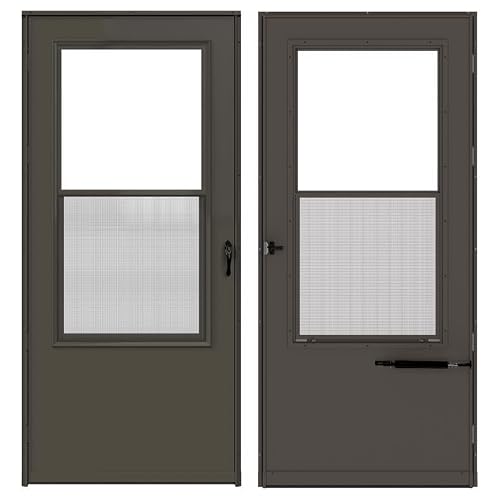
Full view doors have a large glass area from near the bottom rail to the top, while mid view doors have a smaller panel and a decorative or kick panel. Full view maximizes light and sightlines.