Key takeaways
- Pro: Three charging methods (crank, solar, USB) maximize uptime flexibility.
- Pro: Consistently strong NOAA reception even in rural settings per owner reports.
- Con: Orange colorway can show dirt and scratches more visibly than darker models.
When a hurricane knocks out the grid or a winter storm buries your neighborhood in snow, your smartphone becomes useless within hours. A hand crank radio gives you a lifeline to NOAA weather alerts, AM and FM broadcasts, and local emergency instructions when every other communication channel has gone dark. The concrete problem is simple: you need to know if a tornado warning is heading your way, whether to evacuate, or when it is safe to go outside, and you need that information without depending on cell towers, satellites, or a working wall outlet.
What separates a genuinely dependable unit from a cheap disappointment comes down to three things: how long the battery actually sustains reception, how clearly the radio pulls in distant or weak signals, and how intuitive the controls feel when you are operating by flashlight in the dark. Owner feedback consistently shows that the cheapest options often have flimsy crank mechanisms, poor AM sensitivity, or battery capacities that deliver far less runtime than advertised. At the higher end, added features like solar panels and large rechargeable cells make a real difference in multi-day outages. This guide compares the eight most popular models available in 2026 on published specifications, current pricing, and aggregated owner reports so you can match the right radio to your emergency plan.
Our top picks




As an Amazon Associate we earn from qualifying purchases at no extra cost to you.
Quick Picks
| Product | Best for | Price |
|---|---|---|
| FosPower NOAA A1 | Overall reliability and brand trust | $29.98 |
| Solar Radio Emergency 12000mAh | Longest runtime for extended outages | $53.99 |
| Hand Crank Radio with LED Flashlight | Tightest budget entry point | $18.99 |
| Leaton Hand Crank Emergency Radio | Balanced features at mid-range cost | $35.27 |
| Hand Crank Emergency Radio 7400mWh | Solar charging and compact size | $27.48 |
| Emgykit Hand Crank Radio | Simple NOAA and AM/FM access | $19.99 |
| Emergency Radio with Flashlight & Reading Lamp | Indoor use and reading light combo | $25.42 |
| Esky Emergency Hand Crank Radio | Most built-in survival features per dollar | $18.99 |
How We Picked
We narrowed this list by weighing four criteria that owner complaints and praise consistently circle around: battery capacity and charging flexibility, NOAA and AM band reception quality, build durability of the crank mechanism and casing, and overall value relative to price. A radio with a large battery but a crank that strips after two uses is not worth recommending. Conversely, a unit with excellent signal pull-in but no backup charging method beyond cranking leaves you stranded during prolonged emergencies. We prioritized models that balance at least three of these factors, and we flagged any recurring quality-control concerns visible in owner feedback.
The 8 Best Hand Crank Radio in 2026
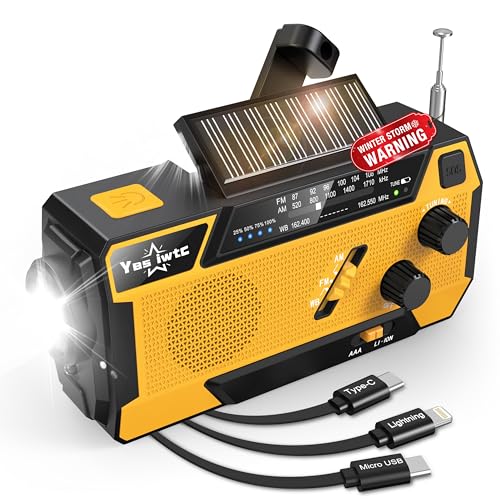
FosPower NOAA Emergency Weather Radio A1
FosPower has built a reputation as one of the most recommended brands in this category, and the A1 model continues that track record. The 7400mWh cell supports several hours of continuous NOAA monitoring on a single charge, while the solar panel and USB input give you three ways to keep it alive during a multi-day outage. Owners frequently praise the clear audio output and the intuitive button layout that works well in low light.
- Pro: Three charging methods (crank, solar, USB) maximize uptime flexibility.
- Pro: Consistently strong NOAA reception even in rural settings per owner reports.
- Con: Orange colorway can show dirt and scratches more visibly than darker models.
Skip it if you need the absolute longest runtime and budget allows you to reach a larger-cell alternative.
Solar Radio Emergency Hand Crank 12000mAh
At 12000mAh, this unit carries the largest battery in our lineup by a significant margin, making it the obvious choice for anyone preparing for outages that could stretch past three days. Owner feedback highlights its ability to double as a power bank for phones, which extends its practical value well beyond radio reception. The signal pull-in is described as noticeably strong, particularly on the AM band where cheaper units struggle.
- Pro: Largest battery capacity in this list for sustained multi-day use.
- Pro: Can charge external devices, adding utility during power outages.
- Con: Highest price here, and the added capacity increases size and weight.
Skip it if you are stocking a small emergency kit where every gram counts and a shorter runtime is acceptable.
Hand Crank Radio with LED Flashlight
At $18.99, this is the lowest-cost option that still covers the essential trio of NOAA, AM, and FM bands plus a built-in flashlight. The 2000mAh battery is the smallest capacity represented here, so plan on recharging via crank more frequently. Owners who purchased it as a secondary backup unit for a car kit or a child’s room generally report adequate performance for short-term use.
- Pro: Lowest price point with all critical broadcast bands covered.
- Pro: Compact and light enough for a glove compartment or bug-out pouch.
- Con: Small battery limits continuous listening time and may not power the flashlight for hours.
Skip it if you expect to rely on a single radio for more than a day or two without access to other power.
Leaton Hand Crank Emergency Radio
The Leaton sits in the sweet spot between capacity and cost, packing 10000mAh at a price well below the largest-battery competitor. It covers NOAA, AM, and FM, and owners describe the build quality as solid for the money. The 10000mAh cell is the second-largest in this roundup, meaning realistic multi-day standby between full charges without relying exclusively on hand cranking.
- Pro: Near-top battery capacity at a mid-range price point.
- Pro: Full NOAA, AM, and FM coverage with a clean control layout.
- Con: Brand recognition trails FosPower, which may affect long-term spare part availability.
Skip it if brand support and community documentation matter more to you than raw battery size per dollar.
Hand Crank Emergency Radio 7400mWh Solar
This model lists 7400mWh (equivalent to 2000mAh at standard voltage), putting its battery in the lower tier of this group. Where it gains is the solar panel integration, which lets you top off the cell during daylight hours without any manual effort. Owners in sunny climates report that solar charging alone can sustain intermittent listening over several days. At $27.48, it sits between the budget units and the mid-range picks.
- Pro: Solar panel adds a passive charging method that works unattended.
- Pro: Reasonable price for a unit that includes both solar and crank inputs.
- Con: Battery capacity is modest, so the solar and crank inputs do most of the heavy lifting.
Skip it if you live in a region with long overcast stretches where solar input would be unreliable.
Emgykit Hand Crank Radio with AM/FM/NOAA
The Emgykit is a no-frills NOAA and AM/FM receiver at just under twenty dollars. It lacks a published battery capacity in its listing, which is a red flag for anyone trying to estimate runtime before committing. Owner feedback is mixed: some find it perfectly adequate for occasional storm-season checks, while others report the crank feels loose after repeated use and the AM band is noticeably weaker than the NOAA channels.
- Pro: Covers all three essential bands at one of the lowest prices available.
- Pro: Lightweight and portable for a car emergency kit.
- Con: No published battery capacity and mixed reports on crank mechanism durability.
Skip it if you need dependable long-duration listening or if crank build quality is a priority.
Emergency Radio with Flashlight and Reading Lamp
This model differentiates itself with a dual-light system: a forward-facing flashlight plus a broader reading lamp that illuminates a small area without blinding anyone nearby. NOAA, AM, and FM are all included, and the $25.42 price places it in the lower-middle tier. Owners appreciate the reading lamp for nighttime use during outages when you need ambient light rather than a focused beam.
- Pro: Dual flashlight and reading lamp covers both navigation and stationary tasks.
- Pro: Full NOAA/AM/FM band coverage at an accessible price.
- Con: No published battery specification, making runtime planning harder.
Skip it if you prefer to know exact capacity before purchasing or if you only need a radio without lighting features.
Esky Emergency Hand Crank Radio
Esky packs a surprising number of features into the same $18.99 price as the basic LED Flashlight model: 7400mWh (2000mAh) battery, three LED flashlight modes, a built-in SOS alarm, and solar charging alongside the hand crank. For anyone assembling a single emergency kit item that covers radio, light, signal, and basic power needs, the value density here is the highest in the group. Owners mention the SOS alarm as a genuinely useful inclusion for those living in remote areas.
- Pro: Most feature-rich unit at the lowest price tier, including SOS alarm and solar.
- Pro: Three LED flashlight modes add practical versatility beyond the radio function.
- Con: Smaller battery means you will rely on cranking or solar more often than with larger-cell models.
Skip it if you want maximum listening time between charges and plan to use the radio for extended continuous monitoring.
Buying Guide
Battery Capacity and Charging Redundancy
Battery capacity determines how many hours of continuous listening you get without touching the crank. In this lineup, published figures range from 2000mAh on the budget models up to 12000mAh on the top-capacity unit. A rule of thumb from owner reports: each 1000mAh supports roughly eight to ten hours of NOAA monitoring at moderate volume, but that drops if the flashlight runs simultaneously. Always look for at least two charging methods beyond the crank alone. Solar panels are useful but depend on weather and daylight; a USB input lets you recharge from a power bank or car adapter when one is available. Units that list no capacity at all leave you unable to plan how long they will last, so treat that as a gap in transparency.
NOAA Band Reception and Alert Function
NOAA Weather Radio broadcasts on seven VHF frequencies covering your local National Weather Service forecast office. Reception quality depends on antenna design, internal tuner sensitivity, and the radio’s ability to lock onto weak signals. Owner complaints about poor reception cluster around the AM band specifically, but NOAA channels vary more by antenna length and housing material. If the unit includes an alert or SAME-function that wakes the radio when a warning is issued for your county, that is a meaningful upgrade over manually scanning channels. Verify that your local NWS transmitter falls within the range of the model you choose, as sensitivity differences matter most in areas far from a broadcast tower.
Crank Mechanism Durability and Ergonomics
The hand crank is the feature that separates emergency radios from every other battery-powered device, and it is also where build quality fails most visibly. Owners reporting crank problems describe stripped gears, loose tolerances that reduce charging efficiency, and handles that snap under pressure. A few practical checks: look for metal gear assemblies mentioned in the listing or product images, read owner comments about performance after months or years of occasional use, and prefer models where the crank requires moderate rather than aggressive turning. The goal is that a two-minute crank gives you several minutes of listening time, not that you are working up a sweat for marginal results.
Our Verdict
Top pick: The FosPower NOAA A1 offers the best combination of brand reliability, three charging methods, solid published capacity, and consistent owner satisfaction at $29.98. It is the radio most people should buy if they are choosing one unit for a household emergency kit.
Budget pick: The Esky at $18.99 delivers the widest feature set per dollar, including solar charging, multiple flashlight modes, and an SOS alarm, making it ideal for someone who wants coverage across several small tasks rather than maximum radio runtime.
Condition where another wins: If your outage scenarios routinely extend past two days and you cannot guarantee sunlight or USB access, the 12000mAh Solar Radio Emergency at $53.99 is the only unit here with enough stored capacity to go that distance on cranking and passive charging alone.
FAQ
Do hand crank radios work without batteries?
They can power on and receive broadcasts using the dynamo generator built into the crank mechanism, but most models also contain a rechargeable lithium cell that stores energy for continuous listening. Without any battery, you would need to keep cranking constantly, which is impractical for overnight monitoring.
How long do I need to crank to get useful listening time?
Published guidance from owners typically indicates that one minute of steady cranking provides five to ten minutes of radio playback at moderate volume. Actual results vary based on the gear ratio inside each model, battery charge level, and whether the flashlight or other accessories are drawing power simultaneously.
Can I use a hand crank radio to charge my phone?
Some models, particularly those with larger capacity cells and USB output ports, include a power-bank function that can trickle-charge a phone. The units in this lineup with 10000mAh and 12000mAh batteries are the most likely candidates; smaller-cell models generally lack enough stored energy to make phone charging practical.
Is a hand crank radio better than a battery-powered radio for emergencies?
A hand crank radio never runs out of power because you supply it manually, whereas a battery radio depends on spare cells you may not have when you need them. The ideal setup includes both, but if you can own only one device, the crank option removes the single point of failure that batteries represent during prolonged grid outages.