Key takeaways
- MPPT controllers extract more energy than PWM controllers, particularly in cool weather and with higher-voltage arrays; reviewers generally prefer them for larger systems.
- Choose a controller rated for your array voltage and current, with margin.
- Use correctly sized wire, fuses or breakers between the panels, controller and battery, and follow the maker’s wiring diagram.
- Series wiring raises voltage, parallel wiring raises current; the right choice depends on the controller and shading pattern.
- Because RV solar systems involve battery and fire risk, have a qualified RV technician or electrician install or inspect any wiring you are not confident handling.
For a roof-mounted RV setup, a Renogy 200W monocrystalline panel or a Renogy starter kit suits most owners, Go Power suits those who want an RV-focused brand with strong support and parts access, and a portable folding panel from Renogy, Jackery or EcoFlow suits campers who park in shade and want to aim the panel at the sun. Match panel wattage to your daily energy use and battery bank, not to a headline number.
Our top picks


As an Amazon Associate we earn from qualifying purchases at no extra cost to you.
RV Solar Options at a Glance
| Option | Best for | Key points reported by makers and outlets | Limits |
|---|---|---|---|
| Renogy 200W monocrystalline (roof) | Roof-mounted general use | SmartRVHub cites 21 percent efficiency and a 25-year warranty | Fixed to the roof; shade hurts output |
| Renogy N-Type line | Efficiency | Maker lists up to 23 percent efficiency and a 25-year output warranty | Higher tier |
| Renogy 100W 12V starter kit | First-time installers | Reviewer’s top starter pick | Small output |
| Renogy 400W kit | Boondocking | Suggested step-up for full-time off-grid use | Needs roof space and thicker wiring |
| Renogy 200W portable | Portable, most people | OutdoorGearLab calls it the best portable for most people | Needs storage and aiming |
| Go Power kits | RV-specific, support | Known for customer support and parts; a 100W kit gives roughly 400 to 500 Wh per day | Less panel per dollar |
| Jackery SolarSaga | Pairing with Jackery power stations | Popular with Jackery owners | Costs more per watt than some rivals |
| EcoFlow 220W bifacial | Higher portable output | One source says it outperforms Jackery’s 200W panel | Best with EcoFlow ecosystem |
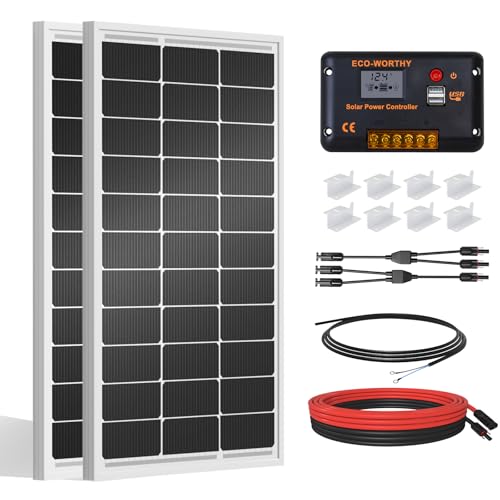
| ECO-WORTHY | Budget watts | Cited as offering more panel per dollar | Less polished support |
Start With Your Energy Budget
List what you run each day: lights, a fan, a fridge, a water pump, laptops, phone chargers, a TV. Estimate watt-hours per day for each. Light users may need 400 to 800 Wh daily, while those running a compressor fridge, a laptop and a fan may need more. A rough rule is that a 100-watt panel produces several hundred watt-hours on a good sunny day, depending on location, season and tilt. The Go Power 100W kit figure above reflects that.
Next, check the battery. Lead-acid, AGM and lithium (LiFePO4) batteries all store solar power, but solar helps only if the battery can hold what the panels produce. A panel array bigger than the battery can absorb is wasted, and a small array can never fully recharge a large bank.
Roof Panels, Portable Panels or Both
Roof-mounted panels
These charge while you drive and while you are parked, with no setup each day. They suit full-timers, long-term travelers and anyone who dislikes handling equipment. The drawback is that they cannot follow the sun, and roof shade from trees or air conditioners can cut output.
Portable folding panels
Portable panels can sit in the sun while the RV is shaded. They are good as a supplement, for tent-and-van setups or for use with power stations from Jackery or EcoFlow. They take time to set up, need storage space and carry some theft risk when left outdoors.
Hybrid approach
Many travelers use a modest roof array for baseline charging and add a portable panel when needed.
Panel Technology and Efficiency
Monocrystalline panels dominate RV use because they offer higher efficiency in limited roof space. Renogy states up to 23 percent efficiency for its N-Type line. Efficiency matters because roofs are small; a more efficient panel gives more watts per square foot. Flexible panels weigh less and bend to curved roofs but typically run hotter and may have shorter life than rigid glass panels, and are usually seen as a niche option for weight-sensitive rigs.
Charge Controllers and Wiring
- MPPT controllers extract more energy than PWM controllers, particularly in cool weather and with higher-voltage arrays; reviewers generally prefer them for larger systems.
- Choose a controller rated for your array voltage and current, with margin.
- Use correctly sized wire, fuses or breakers between the panels, controller and battery, and follow the maker’s wiring diagram.
- Series wiring raises voltage, parallel wiring raises current; the right choice depends on the controller and shading pattern.
- Because RV solar systems involve battery and fire risk, have a qualified RV technician or electrician install or inspect any wiring you are not confident handling.
Roof Space, Weight and Mounting
Measure usable roof area, avoiding vents, air conditioners and antennas. Rigid 100W panels are roughly a few feet long, and a 200W panel needs about double that space. Check your RV’s roof weight limit in the owner’s manual. Use mounting brackets and a sealant compatible with your roof material (EPDM, TPO or fiberglass), and seal penetrations carefully to prevent leaks. Cable entry glands keep water out. If you are unsure about drilling into the roof, a professional installer can reduce the risk of leaks.
Starter Kits Versus Building Your Own
Kits bundle panels, controller, cables and brackets, which makes them attractive for first-time installers. Renogy’s 100W starter kit is a reviewer favorite. A custom build lets you pick a better controller, thicker wire and a larger array, and may cost less per watt, but demands more research. Go Power offers RV-specific kits with an emphasis on support.
Budget Tiers
- Budget: ECO-WORTHY and entry-level Renogy panels or kits.
- Mid-range: Renogy 200W panels, Renogy 400W kits, Go Power kits and 200W portable folding panels.
- Premium: Renogy N-Type panels, EcoFlow bifacial portable panels and large kits paired with lithium batteries and inverters.
Pick X If… Decision Table
| Pick | If you want | Trade-off |
|---|---|---|
| Renogy 100W starter kit | A simple first system | Limited output |
| Renogy 200W roof panel | Efficient general use | Fixed angle |
| Renogy 400W kit | Boondocking capacity | Roof space and wiring |
| Go Power kit | RV-specific support | Less power per dollar |
| Renogy 200W portable | Flexible placement | Setup each stop |
| Jackery SolarSaga | Matching a Jackery station | Cost per watt |
| EcoFlow bifacial | Higher portable output | Ecosystem fit |
| ECO-WORTHY | More watts for less | Less support |
Alternatives
- Generator or inverter generator: reliable on cloudy days, but noisy and needs fuel.
- DC-DC charger from the vehicle alternator: charges the house battery as you drive.
- Shore power: simplest, but ties you to campgrounds.
Several roundups cited here are affiliate-style and do not publish independent test data, and owner surveys are anecdotal, so rely on maker datasheets for wattage, voltage and warranty details.
Real-World Output and Seasonal Planning
A panel’s rated wattage assumes ideal laboratory conditions. In practice, output is reduced by heat, dust, roof tilt, shade and wiring losses. Winter days are shorter and the sun sits lower, so a system sized for summer may feel thin in December. Travelers who stay in northern regions or heavily wooded campsites often plan for lower daily yield and keep a backup charging method.
Ways to Improve Yield
- Park with the roof facing open sky, avoiding tree shade where possible.
- Keep panels clean; dust, pollen and bird droppings reduce output.
- Use tilt brackets or a portable panel angled toward the sun when conditions allow.
- Minimize wire length and use properly sized cable to reduce voltage drop.
- Cut unnecessary loads, such as replacing incandescent bulbs with LEDs.
Monitoring Your System
A battery monitor or controller display tells you how much power is coming in and how much the battery holds. Watching these numbers for a week gives a more honest estimate of your needs than any online calculator. Many controllers from Renogy and others offer a Bluetooth app for logging.
Warranty and Support
Makers list panel warranties of around 25 years for power output, with shorter coverage for controllers and accessories. Support quality varies, and Go Power is often praised for responsiveness and available replacement parts. Read warranty terms for how shading, installation errors and physical damage are handled.
Frequently Asked Questions
How many solar panels does an RV need?
It depends on your daily energy use and battery capacity. Light users may be fine with 100 to 200 watts, while full-time boondockers often use 400 watts or more. Add up your daily watt-hours first.
Can solar run my RV air conditioner?
Typically not with a small roof array. Air conditioners draw large amounts of power and need a big battery bank, a large inverter and substantial solar capacity. Consult an RV electrical professional before attempting it.
Do I need an MPPT or PWM controller?
MPPT controllers are more efficient and favored for larger systems. PWM controllers are cheaper and can suit very small setups. Match the controller to your panels and battery voltage.
Are portable panels better than roof panels?
Neither is universally better. Roof panels are convenient and always working, while portable panels let you place them in sun while the RV is parked in shade. Many travelers use both.
Will solar work on cloudy days?
Output drops sharply under clouds, often to a fraction of the rated value. Plan for backup charging through a generator, vehicle alternator or shore power.
Can I install RV solar myself?
Many owners do, especially with kits. However, roof sealing and battery wiring carry leak and fire risks, so follow the maker’s diagrams, use proper fuses and consider a professional if you are unsure.
More from Amazon
Programs that pair well with the guide above. Offers and eligibility are set by Amazon and may change.
Free shipping on eligible items, Prime Video and more. Eligible new members can start with a free trial.
Start a Prime free trialAudiobooks and podcasts to listen to on the go. Eligible new members can start with a free trial.
Try Audible freeAd-free music streaming. Eligible new subscribers can start with a free trial.
Try Music Unlimited freeA free business account with business pricing and bulk-buying tools for work, shop or home office.
Create a business accountAs an Amazon Associate we earn from qualifying purchases.