Key takeaways
- Provides reliable situational awareness for smaller boats and…
- Ensures dependable visibility of near‑ and mid‑range targets…
- Delivers sharp, accurate target definition both close and…
The best marine radar systems for coastal and offshore navigation balance range, target separation, and power draw differently: compact solid-state dome radars like the Garmin GMR Fantom 18x and Raymarine Quantum 2 excel for coastal use on boats under 40 feet, while high-power open-array pulse-compression systems like the Furuno DRS6A X-Class and Simrad HALO 3000 are better for offshore passage-making where 48-72 nautical mile range and superior target separation matter.
Our top picks


 Simrad Marine Electronics
- Provides reliable situational awareness for smaller boats and…
- Ensures dependable visibility of near‑ and mid‑range targets…
- Delivers sharp, accurate target definition both close and…

As an Amazon Associate we earn from qualifying purchases at no extra cost to you.
Dome vs. Open-Array: The Core Trade-Off for Small Boats
Choosing between a dome (radome) and an open-array radar is the first decision, and it determines mounting, weight aloft, and performance in weather.
Dome Radar (18″ – 24″ Radome)
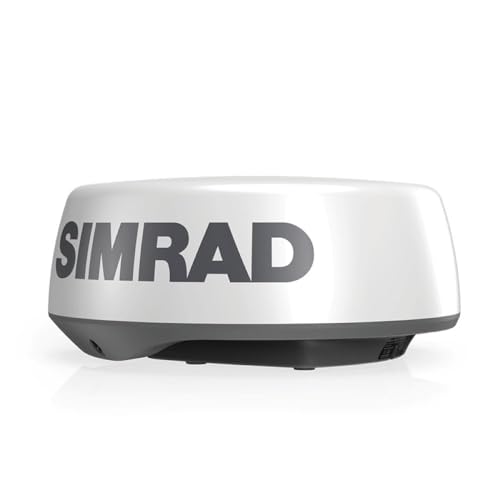
Dome systems enclose the antenna in a single white dome. They use solid-state CHIRP pulse compression, have no magnetron to warm up, and transmit at lower peak power (40W to 50W). For most coastal cruisers, center-console fishing boats, and sailboats under 40 feet, this is the right form factor.
- Pros: Light weight (16-21 lbs), low power draw (20-40W typical), instant-on, excellent close-range target separation (down to 15-20 feet with Doppler models), simple pedestal mount.
- Cons: Limited maximum range (typically 48nm), wider horizontal beamwidth (4.0 to 5.2 degrees) which means less separation of distant targets, lower performance tracking birds or weak targets at long range.
- Best for: Coastal navigation, collision avoidance in fog, entering harbors, navigating ICW and reefs, boats with limited hardtop space or sailboat masts.
Open-Array Radar (3ft – 6ft Array)
Open-array systems expose a rotating bar antenna. Modern units are also solid-state pulse compression but with much larger antennas and higher effective power (up to 300W solid-state, equivalent to 25kW magnetron). They require a stronger pedestal and more power.
- Pros: Narrow beamwidth (1.1 to 2.3 degrees) for superior target separation at distance, maximum range of 72-96nm, much better long-range storm and bird detection, faster rotation rates for high-speed tracking.
- Cons: Heavy (55-85 lbs for 4ft array plus pedestal), high power draw (50-90W transmitting, 4-7A at 12V), requires robust mounting and higher installation height, higher cost.
- Best for: Offshore fishing, bluewater cruising, overnight passages beyond 20nm from shore, boats over 35 feet that can support the weight and power.
Spec Comparison: Range, Beamwidth, and Power Draw
Marketing range figures are misleading. A 48nm dome and 72nm open-array will both see a large cargo ship at 15-20nm in practice. What changes is target separation and the ability to see small, weak targets in sea clutter. Beamwidth determines if two boats 200 feet apart at 3 miles appear as one or two returns.
| Model (Type) | Max Range | Beamwidth (Horizontal) | Target Separation / Range Resolution | Power Draw (Transmit / Standby) | Weight |
|---|---|---|---|---|---|
| Garmin GMR Fantom 18x (18″ Dome) | 48 nm | 5.2 degrees | ~18 ft | 25W / 10W (2.1A / 0.8A @ 12V) | 13.9 lbs |
| Raymarine Quantum 2 (18″ Dome, Doppler) | 24 nm | 4.9 degrees | ~19 ft | 20W / 7W (1.7A / 0.6A @ 12V) | 12.3 lbs |
| Simrad HALO20+ (20″ Dome, Doppler) | 36 nm | 4.6 degrees | ~16 ft | 32W / 11W (2.7A / 0.9A @ 12V) | 16.1 lbs |
| Furuno DRS4DL (24″ Dome) | 36 nm | 4.0 degrees | ~20 ft | 38W / 12W (3.2A / 1.0A @ 12V) | 17.6 lbs |
| Furuno DRS6A X-Class (4ft Open-Array) | 96 nm | 1.9 degrees | ~12 ft | 75W / 18W (6.3A / 1.5A @ 12V) | 62 lbs (array + pedestal) |
| Simrad HALO 3006 (6ft Open-Array) | 72 nm | 1.1 degrees | ~10 ft | 85W / 20W (7.1A / 1.7A @ 12V) | 79 lbs (array + pedestal) |
Doppler models (Quantum 2, HALO20+, GMR Fantom) color-code incoming vs. outgoing targets, which is a major safety gain for coastal traffic without needing to interpret relative motion manually. For offshore use, raw beamwidth and antenna length matter more than Doppler.
Decision Matrix: Which Radar Fits Your Situation
Match your boat, typical distance from shore, and electrical system to the right category.
| Your Situation | Recommended Type | Why |
|---|---|---|
| Boat under 30ft, day trips within 10nm, single battery bank under 200Ah | 18″ Solid-State Dome (Quantum 2, HALO20+, Fantom 18x) | Lowest power and weight; 24-48nm is more than enough; Doppler prevents collision in busy harbors. |
| 30-40ft sailboat or center console, mixed coastal/offshore to 25nm, overnight anchorages | 24″ Dome or Compact 3ft Open-Array (Furuno DRS4DL, Garmin GMR Fantom 54) | Best compromise: better 4.0-degree separation for squall lines without the 60+ lb aloft weight. |
| 40ft+ sportfisher or trawler, regular runs 30-100nm offshore, needs bird mode | 4ft – 6ft Open-Array (Furuno DRS6A X-Class, Simrad HALO 3000 series) | Narrow beamwidth finds birds and weather at 5-8nm; tracks weak targets in heavy seas. |
| Limited radar arch/mast height under 10ft above water | Dome only | Radar horizon is limited by height; an open-array’s extra range is wasted without height. |
| No generator, heavy reliance on house batteries at anchor | Solid-state dome with low standby draw | Saves 40-60Ah per night vs. open-array if left in standby for anchor watch. |
Power Draw Calculation: Can Your Battery Bank Handle It
Manufacturers list watts, but owners need amp-hours. Use this quick calculation for a typical 12V system.
Formula: Amps = Watts / 12.6V. Amp-hours per hour = Amps x usage factor.
Worked Example: Overnight coastal passage, 10 hours, Garmin Fantom 18x vs. 4ft open-array in 50% transmitting / 50% standby watch mode:
- Fantom 18x: Transmit 25W (2.0A), Standby 10W (0.8A). Average draw = (2.0 + 0.8) / 2 = 1.4A. For 10 hours = 14Ah consumed.
- Furuno DRS6A 4ft: Transmit 75W (6.0A), Standby 18W (1.4A). Average draw = (6.0 + 1.4) / 2 = 3.7A. For 10 hours = 37Ah consumed.
- A 200Ah AGM house bank should not be drawn below 50% (100Ah usable). The open-array alone uses 37% of usable capacity overnight, before lights, plotter, autopilot, and VHF. On a small sailboat without engine charging, that forces you to run the engine or shut radar off. This is why offshore boats pair open-array radar with 300Ah+ lithium or a generator.
Tip: Solid-state radars have no magnetron warm-up, so you can use timed transmit or anchor-watch zone guard modes to cut consumption by 60% without losing safety.
Range Is About Height, Not Just Power
Radar is line-of-sight. Maximum detection range to another vessel or storm cell is limited by the radar horizon:
Radar Horizon (nm) = 1.23 x ( sqrt(height of radar in feet) + sqrt(height of target in feet) )
An 18″ dome mounted 12 feet above water seeing a small boat with 8 feet of freeboard: 1.23 x (3.46 + 2.82) = 7.7nm maximum, regardless of whether the radar claims 48nm or 96nm. To see a tanker with a 60ft superstructure, that same radar sees to 13.8nm. Raising the dome from 12ft to 20ft on a flybridge adds nearly 2nm of horizon. This is why a high-mounted dome often outperforms a low-mounted open-array in the real world.
Durability and Ownership Realities
Solid-state dome and open-array radars are largely maintenance-free compared to older magnetron units, but these parts still cause problems in salt environments.
- What wears first: The pedestal drive belt and slip ring. Salt spray intrusion corrodes the array motor bearings on open-array units after 3-5 seasons if the weep holes are blocked. Dome seals can crack from UV; inspect the base gasket annually and re-bed with marine sealant if you see white salt crust.
- Consumables to budget: None for the radar itself, but factor a 10-15A fused dedicated circuit, tinned marine-grade cable (voltage drop over 30ft of 14AWG can shut down a 6A open-array), and a compatible multifunction display. Most current radars require a matching MFD from the same brand family (Garmin, Raymarine Axiom, Simrad NSSevo3S, Furuno NavNet TZtouch3).
- Cleaning: Never use harsh solvents or pressure washers on the radome. Wash with fresh water and mild soap only. Waxing a dome adds no performance and can trap salt. For open arrays, rinse the pedestal underside where salt accumulates.
- Common mistakes: Mounting the radar directly above a VHF antenna (creates blind sectors), not leveling the pedestal (causes false sea clutter on one side), leaving Doppler velocity mode off in crowded waterways, and running high transmit power at the dock which can interfere with nearby boats’ radars.
Our Picks by Use Case in 2026
Best for Small Boats and Coastal Cruising: Raymarine Quantum 2 or Simrad HALO20+
Both are 18-20″ Doppler domes with excellent close-range resolution and color Doppler for collision avoidance. The Quantum 2 draws under 20W and integrates seamlessly with Raymarine Axiom plotters and has Wi-Fi connectivity to reduce cabling. The HALO20+ offers slightly better range and VelocityTrack. Expect general market pricing in the $1,600 to $2,300 range for the dome alone, plus MFD.
Best Mid-Range Compromise for 30-40ft Boats: Garmin GMR Fantom 18x/24x
Garmin’s Fantom dome line offers 40W solid-state with MotionScope Doppler and up to 48nm range with very fast 48 RPM rotation in close range. It is light enough for a T-top but powerful enough to track squalls at 10nm. Typical street range $2,000 to $2,900.
Best for Offshore and Sportfishing: Furuno DRS6A X-Class 4ft or Simrad HALO 3004/3006
If you regularly run 30+ miles out and need to find birds over bait schools, the 4ft to 6ft open-array is non-negotiable. Furuno’s X-Class offers exceptional bird mode and Fast Target Tracking with a proven NavNet ecosystem for serious offshore work. Simrad’s HALO 3000 series provides similar performance with dual-range operation. These are $5,500 to $8,500 systems plus installation and require a stable arch or hardtop.
For a storm-alert use case, a dome radar’s ability to paint rain and squall cells at 8-12nm with Doppler motion is often more valuable than extreme offshore range. If you boat primarily within sight of land and worry about sudden fog or thunderstorms, put your budget into Doppler and good integration with your chartplotter and AIS rather than maximum range.
Installation Checklist Before You Buy
- Confirm your MFD compatibility: Garmin radars only work with Garmin plotters, Raymarine with Raymarine, Simrad/B&G/Lowrance (Navico) are cross-compatible, Furuno with Furuno.
- Measure mounting height and ensure 360-degree clear view, at least 3 feet separation from VHF/AIS antennas and compass.
- Size your power cable for 5% voltage drop or less at max transmit current, with a dedicated breaker near the battery.
- Update radar and MFD software via the manufacturer’s app before first use to enable latest Doppler and bird-finding algorithms.
Frequently Asked Questions
Do I need radar if I have AIS and chartplotter?
Yes for coastal and offshore safety. AIS only shows vessels transmitting AIS. Radar shows everything that reflects – small boats without AIS, buoys, land, debris, and rain. For storm navigation, radar is the only onboard sensor that shows real-time precipitation cells.
Is Doppler radar worth the extra cost for coastal use?
For coastal navigation in traffic, yes. Doppler highlights moving targets in red/green and filters clutter, reducing the need to manually interpret relative motion. Offshore, narrow beamwidth matters more than Doppler.
How much range do I actually need?
Most recreational use happens inside 12nm. A 24-36nm dome covers this with margin. You need 48nm+ only if you want to track large weather systems offshore or see landfall from 20nm out. Remember, horizon height limits detection more than the radar’s rated range.