Key takeaways
- Ten emergency food kits compared for a two-week plan: 84 to 192 servings, 25-year designs, plus 72-hour bags and add-ons, with serving math per day.
For a literal two-week supply, the 4Patriots 2-Week kit (84 servings) and the Ready Hour 2-Week kit (114 servings) are the two listings that match the duration directly. The 4Patriots 4-Week kit stretches to two weeks for two people, the Starter kit sits close behind, and the rest of this list are add-ons or short-term bags. Servings are not the same as full meals, so we compare serving counts against 14 days and flag every title that does not say what is inside. The Ready America entries are backpacks, not bulk food, and we mark them that way. Compare each kit with the sizing steps further down this page.
Quick picks
Our top picks



As an Amazon Associate we earn from qualifying purchases at no extra cost to you.
- Closest to the keyword: 4Patriots 2-Week or Ready Hour 2-Week.
- Two people, two weeks: 4Patriots 4-Week.
- Add-ons: Ready Hour Breakfast Bucket and Mega Protein Kit.
- Not two-week kits: the 72-hour kits and the Ready America backpacks.
Compared at a glance
| Model | Key point from title | Best for |
|---|---|---|
| 4Patriots 2-Week | 84 servings, 25-year design | Literal two-week plan |
| 4Patriots 4-Week | 192 servings | Two people, two weeks |
| Ready Hour 2-Week | 114 servings, flood-safe container | Largest two-week count |
| 4Patriots 72-Hour | 20 servings, not two weeks | Grab-bag layer |
| Ready Hour Breakfast Bucket | 128 servings, breakfast only | Pantry building block |
| Ready America 70280 | Two-person 3-day backpack | Evacuation bag |
| 4Patriots Starter | 88 servings, duration unstated | Entry-level supply |
| Ready America 70287 | Tornado 3-day backpack | Storm shelter bag |
| Ready Hour Mega Protein | 72 servings freeze-dried meat | Protein add-on |
| READYWISE 72-Hour | 30 servings, not two weeks | Car or office kit |
The ten kits in detail
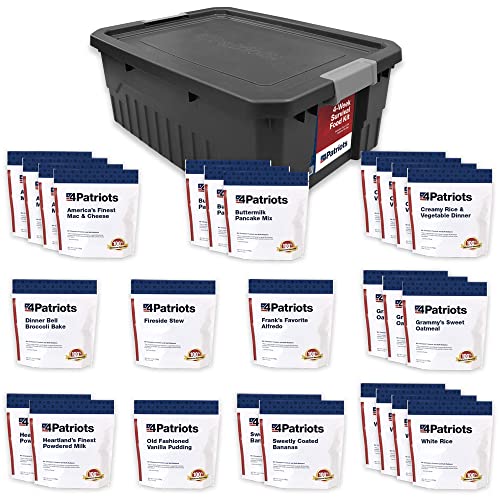
4Patriots 2-Week Survival Food Kit (84 Servings)
This is one of only two listings that name two weeks in the title: a 4Patriots food kit with 84 servings and a 25-year design life. Spread over 14 days, 84 servings works out to six servings a day, which could be one person eating several small servings or two people on very light rations. The title does not give calories per serving, so check the listing before treating it as a full diet. It is the most literal match for this guide. Check the listing for the menu and for any allergens, and keep the original packaging with the receipt.
Pros
- Two-week label in the title
- 25-year shelf life stated in the title
Cons
- Calories per serving not in the title
- Six servings a day is thin for a household
Who it’s for: one person, or a pair on tight rations, planning a literal two-week supply.
4Patriots 4-Week Survival Food Kit (192 Servings)
The four-week version of the 4Patriots kit lists 192 servings, again with a 25-year design life. Over 28 days that is about 6.9 servings a day; over 14 days for a household of two it is also about 6.9 servings per person per day. That makes it a two-week option for two people or a one-month option for one. The title does not give calories or meal contents, and storage conditions affect shelf life in practice, so read the listing’s storage guidance. Confirm the box dimensions before you clear storage space, since four weeks of food takes a real corner of a closet.
Pros
- 192 servings give flexibility across household sizes
- Same brand and shelf-life claim as the two-week kit
Cons
- Calories and menu not in the title
- Larger and heavier to store
Who it’s for: couples who want two weeks of food each, or one person planning a month.
Ready Hour 2-Week Emergency Food Supply (114 Servings)
Ready Hour lists a two-week emergency food supply with 114 servings in a portable, flood-safe container, made of freeze-dried meal entrees with a 25-year shelf life. Over 14 days that is about eight servings a day, the most generous figure of the two-week labeled kits. Freeze-dried meals need clean water for rehydration, so plan water in addition to food. Calories and the meal list are not in the title, so open the listing for the menu and allergen details. Write the purchase date on the lid so you can rotate stock over time, and read the storage guidance on the listing.
Pros
- 114 servings, the largest of the two-week labels
- Container described as flood-safe in the title
Cons
- Needs water to prepare the meals
- Menu and allergens not in the title
Who it’s for: households who want the biggest two-week serving count and a sealed container.
4Patriots 72-Hour Survival Food Kit (20 Servings)
This 4Patriots kit is a 72-hour pack with 20 servings, and it is not a two-week supply. At three days, 20 servings is roughly six or seven servings a day. It is included here as a short-term layer: a grab-bag or car kit that sits alongside a bigger stock. The title keeps the 25-year design claim. If your plan is a literal two weeks, you would need several of these, and a larger kit is likely a better fit. Keep it with your other three-day gear in a single grab spot, and replace any items as they near their dates.
Pros
- Compact size for a car or go-bag
- Same 25-year design claim as larger kits
Cons
- Only covers three days
- Not enough on its own for two weeks
Who it’s for: anyone building a grab-bag or adding a short-term layer to a larger stock.
Ready Hour Breakfast Bucket (128 Servings)
Ready Hour sells a breakfast bucket with 128 servings, in a flood-safe container, with a 25-year shelf life. The title says breakfast, so it is not a complete food supply: lunches and dinners would still need to come from elsewhere. At 128 servings, it could cover breakfast for a household for weeks, which is useful as a building block. Check the listing for what the breakfast items are and how much water each serving needs, and compare it with the kits that include complete entrees. Pair it with a lunch and dinner kit so you do not run short, and check how much water each serving needs.
Pros
- Large serving count for breakfast
- Flood-safe container in the title
Cons
- Breakfast only, not a full diet
- Water needed for preparation
Who it’s for: households building a pantry in layers who already have lunch and dinner sorted.
Ready America 70280 Two-Person 3-Day Backpack
Ready America’s 70280 is a two-person, three-day survival backpack with food, water, first aid and disaster supplies, for home, car and outdoor use. It is not a two-week food kit: it is a go-bag, and the food portion is only a part of it. For a two-week plan it fills a different role, which is quick evacuation. The title does not list the food quantity, so open the product page for the contents list and check the expiry dates on what is included. Check expiry dates on each item inside before relying on the pack, and replace anything past its date.
Pros
- Bundles food, water, first aid and supplies
- Two-person pack for home, car or trail
Cons
- Not a two-week kit
- Food quantity not stated in the title
Who it’s for: households that need an evacuation bag and not a bulk food store.
4Patriots Emergency Starter Food Kit (88 Servings)
The 4Patriots Emergency Starter Food Kit lists 88 servings and a 25-year design life, with no duration in the title. At 14 days, 88 servings is about 6.3 servings a day, close to the 84-serving two-week kit. The word starter suggests an entry-level supply, so check the product page for what the kit contains and how many days its maker says it covers. Compare it side by side with the 84-serving two-week version before choosing, and note which one lists a menu. Read the contents list to make sure it suits your household, and note how many days its maker says it covers.
Pros
- 88 servings, slightly more than the 84-serving kit
- 25-year design claim in the title
Cons
- Duration is not stated in the title
- Contents and calories not listed
Who it’s for: buyers comparing starter kits who will check the contents list first.
Ready America 70287 Tornado Two-Person 3-Day Backpack
Ready America’s 70287 is a tornado-themed two-person, three-day backpack with food, water, first aid, blankets, tools and safety gear. It is a storm shelter or evacuation pack, not a bulk food kit, and it does not satisfy a two-week plan on its own. The extra tools and blankets set it apart from the 70280, although the title does not itemize them. Keep it near a storm shelter, read the contents on the product page, and check the dates on the food, water and batteries. Check the dates of the batteries and any other items inside, keep the pack where you can reach it quickly, and read the contents list for tools.
Pros
- Tools and blankets mentioned in the title
- Aimed at storm and disaster use
Cons
- Three-day scope only
- Not a two-week food supply
Who it’s for: households in tornado-prone areas that want a shelter-ready bag.
Ready Hour Mega Protein Kit (72 Servings)
Ready Hour’s Mega Protein Kit lists 72 servings of freeze-dried chicken and beef with a 30-year shelf life, the longest figure on this list. It is a protein add-on, not a complete diet, so it would supplement grain, vegetable and fruit supplies. Spread over 14 days it is about five servings a day, but with only meat. Check the listing for the menu, sodium content and allergen notes, and plan water for rehydration. Add a vegetable and grain supply so the diet is balanced, check the sodium content on the product page, and confirm the pouch size and the way each pouch is prepared.
Pros
- Real freeze-dried chicken and beef per the title
- 30-year shelf life stated
Cons
- Meat only, so it does not cover a full diet
- Needs water to prepare
Who it’s for: households that already have grains and vegetables and want a protein layer.
ReadyWise 72-Hour Survival Kit (30 Servings)
READYWISE lists a 72-hour survival kit with 30 servings, which is ten servings a day over three days. It is not a two-week supply. At 30 servings it is a short-term kit, and the title does not say how many people it feeds or describe its contents. It makes sense as a car or office kit. If you want two weeks of food, you would need several of these, and a kit with a larger serving count is simpler. Do not count it toward a two-week plan unless you stack several, and confirm the contents on the product page.
Pros
- Ten servings a day over three days
- Compact enough for a car or desk
Cons
- Three-day scope only
- Contents not described in the title
Who it’s for: commuters or small households that want a short-term kit in a car or office.
How we picked these
We started with emergency food listings that mention a duration or serving count, and then sorted them by how well they match two weeks, keeping the off-duration ones as labeled add-ons. Prices and star ratings are left out because they move constantly. Nobody on the team used or measured these units. The basis is published specifications, manufacturer documentation and buyer reviews, and calorie data is not in any of the titles, so treat the serving counts as seller figures, not nutrition guidance.
What to look for in a two-week emergency food kit
Serving math for 14 days
Divide the serving count by 14 to find servings per day, then divide again by the number of people. The 84-serving kit gives 6 a day; the 114-serving kit gives about 8; the 192-serving kit gives about 13.7 a day for one household, or about 6.9 per person if two people share it. If a serving is small, you will need more than one per meal, so treat these as floor figures, not targets.
Calories and balance
Titles list servings, not calories, so open the product page and look for calories per serving, protein, sodium and a full ingredient list. Breakfast-only and protein-only kits are not complete diets, so plan grains, vegetables and fruit around them. Check allergens carefully, and if anyone in the household has dietary restrictions, confirm ingredients before the day you need them.
Shelf life and storage claims
A 25-year or 30-year label is a design target under good conditions, not a guarantee. Look for the stated storage temperature, whether the container is sealed, and the best-by date on arrival.
Water, cooking and storage
Freeze-dried meals need clean water, so include water in the plan. Keep kits in a cool, dry place away from direct heat. If you use a stove, use it outdoors or in well-ventilated space, never in a sealed room, because fuel-burning stoves can produce carbon monoxide. Add a manual can opener, utensils and a way to heat water if the meals call for it, and store a few extra water containers.
Worked example: three people, two weeks
- People times days: 3 x 14 = 42 person-days.
- At three servings per person-day you need 126 servings.
- Option: the 114-serving kit plus a breakfast or protein add-on to reach the target.
- Check allergens and add water before you call it done.
Mistakes buyers make
The most common mistake is counting servings as meals when a serving may be small. Another is buying a 72-hour kit and assuming it stretches to two weeks. People also forget the water needed to prepare freeze-dried food, stash buckets in a hot garage, or skip reading the allergen list. Some stock a single food type, like breakfast, and find themselves with gaps. Finally, many never open the kit once to confirm the contents suit their household, and almost nobody practices preparing the food before they need it. A dry run with one pouch shows how much water it uses and whether anyone dislikes the taste.
Verdict
The Ready Hour 2-Week kit has the largest two-week serving count, while the 4Patriots 2-Week kit is the most direct alternative. For two people, the 4Patriots 4-Week kit covers two weeks with room to spare. Treat the breakfast and protein buckets as add-ons, and the 72-hour kits and backpacks as grab-bags. Whatever you pick, plan water and a way to heat it, check allergens, and keep a note of the storage conditions.
Related guides
- Portable Power Stations For Cpap During Power Outages
- How Long Does A Portable Generator Run On A Tank Of Fuel
- How To Prepare For A Power Outage Checklist And Gear
Frequently asked questions
How many servings does a two-week emergency food supply need?
Multiply people by days by servings per day. Two people for 14 days at three servings a day is 84 servings, but a listed serving may be smaller than a real meal, so check calories per serving on the product page. Many households double the count to be safe. Remember to count children, older adults and pets in the household.
Is a 25-year shelf life realistic?
It is a designed figure under ideal storage conditions, usually cool, dry and dark. Heat, humidity and damaged packaging can shorten it, so store kits in a cool interior space, not a hot garage. Rotate smaller items if you can, and check the listing for the maker’s storage instructions and best-by dates.
Is water needed for freeze-dried food kits?
Yes, usually. Freeze-dried entrees and many dried meals need clean water to prepare, so plan water separately. A common preparedness guideline is about a gallon per person per day for drinking and basic hygiene, with extra for cooking. Check each listing for how much water the meals call for and whether they can be eaten dry.
Are 72-hour kits enough for two weeks?
No. They cover about three days and are meant for evacuations or short outages. You could buy several to approach two weeks, but a purpose-made two-week kit is simpler. Many people keep one 72-hour bag for leaving home and a larger kit for staying put, and use the two together.
What should be checked before buying an emergency food kit?
Look at calories per serving, allergens, sodium, preparation method, container size and whether it is flood-safe. Check whether meals need a stove, boiling water or only cold water, and never run a stove or heater indoors without ventilation. Households with special diets or small children should confirm ingredients on the product page before relying on it.