Key takeaways
- Wired rears: Best value and simplest signal path. Use in-wall-rated cable if it will be concealed inside a wall, and follow local building rules. Measure the route—not just the straight-line distance—before buying cable.
- Wireless transmitter kit: Reduces the long signal cable crossing the room, but adds a transmitter, a receiver or amplifier near the back speakers, power cords, and possible pairing or interference troubleshooting.
- Wireless all-in-one systems: Convenient when the matching components are designed to work together. They can limit future upgrades, and “wireless” usually still means power cables at the speakers or subwoofer.
Best 5.1 Home Theater Systems for Any Room Size
The best 5.1 home theater system depends on the room: choose a compact, low-output package for spaces under 150 square feet, a conventional receiver-and-speaker setup for 150–300 square feet, and larger speakers with a capable subwoofer for rooms above 300 square feet. For most buyers, a Denon AVR-S570BT paired with five matching passive speakers and a powered subwoofer is the most adaptable starting point; wireless rear-speaker kits are worth considering when running cable is impractical, not because they eliminate setup.
Room size first: what to buy
Square footage is a useful starting point, not a guarantee of sound level. Open-plan rooms, high ceilings, hard floors, and distance from the speakers all increase the demands on a system. The wattage figures below are manufacturer-style or commonly specified ratings, not a promise that every channel can deliver its maximum power simultaneously. Receiver power is also not directly comparable across brands unless the measurement conditions match.
Our top picks
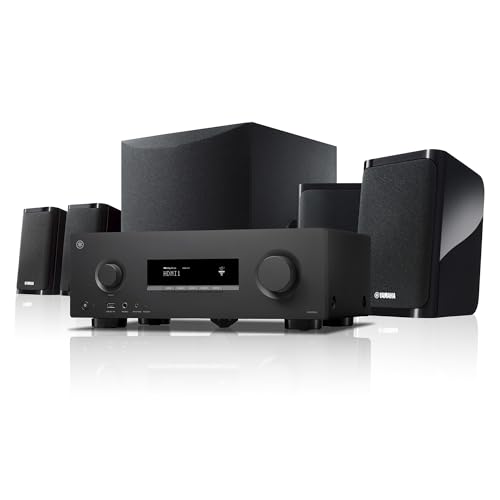


As an Amazon Associate we earn from qualifying purchases at no extra cost to you. Ratings are shown as listed on Amazon.
| Room and use | Practical system type | Typical power guidance | Rear-speaker connection | Setup allowance |
|---|---|---|---|---|
| Under 150 sq ft; apartment or small den | Compact 5.1 package with five small speakers and powered subwoofer | About 50–100 W per receiver channel; subwoofer commonly 100–200 W | Wired is simplest if the sofa is near the screen; wireless kit if the room cannot be crossed with cable | 1–2 hours, including placement and calibration |
| 150–300 sq ft; living room or media room | AV receiver plus five bookshelf or compact tower speakers and powered subwoofer | About 70–120 W per channel under stated test conditions; subwoofer commonly 150–300 W | Wired for dependable, low-cost installation; wireless transmitter kit where cable routing is difficult | 2–3 hours for wiring, receiver setup, and listening checks |
| Over 300 sq ft; open-plan or large room | Receiver with higher-output matching speakers and a larger powered subwoofer | Look for a receiver specified around 80–150 W per channel, checking how many channels are driven; subwoofer commonly 300 W or more | Wired is generally the more reliable choice over long distances | 3–5 hours, especially if cable concealment or extra calibration is needed |
These ranges are selection guides, not minimum requirements. A well-positioned, efficient speaker can play loudly with less power than a less-sensitive model. For large rooms, prioritize speaker sensitivity, a subwoofer suited to the room, and a receiver that can drive all five channels—not a headline wattage alone.
Best picks by situation
Best flexible choice for a typical living room: Denon AVR-S570BT with a matched 5.1 speaker set
The Denon AVR-S570BT is a 5.2-channel AV receiver with support for modern 4K video features and Bluetooth. Pair it with five speakers from the same product line and a powered subwoofer; examples of established speaker ranges include Polk Audio’s Monitor series and ELAC’s Debut series. This modular approach suits roughly 150–300 square feet because you can select bookshelf speakers for a modest room or larger models for a more open space. The trade-off is that speakers, subwoofer, and speaker wire are separate purchases, and the receiver needs cabinet ventilation.
Budget broadly from several hundred dollars for a basic receiver-and-speaker combination to over $1,500 for larger, more capable components. The total varies substantially with speaker size and subwoofer choice.
Best compact, straightforward package: a 5.1 system from a major speaker maker
For a small room or a buyer who wants a coordinated set, look at compact 5.1 packages from established manufacturers such as Klipsch or Polk Audio. A package keeps the five speakers visually and tonally coordinated, and smaller satellites are easier to place around a sofa. Check the included receiver carefully: some packages include one, while others require a separate AV receiver. Compact speakers can sound constrained at higher volume, and their small subwoofer may not fill a large or open-plan room convincingly.
Best when rear-speaker wiring is the obstacle: receiver plus a wireless rear-speaker kit
Most traditional 5.1 receivers still connect passive rear speakers by wire. A wireless rear-speaker kit, such as a compatible transmitter-and-amplifier system from SVS SoundPath, sends the signal across the room but still requires power at the receiving end and short speaker wires from the receiver unit to each speaker. This reduces the long cable run; it does not make the speakers entirely cable-free. Check compatibility, placement of the transmitter, and whether the kit carries the audio formats your system uses.
Choose this arrangement when a doorway, rental restriction, or finished wall makes a long cable run unacceptable. Otherwise, ordinary speaker wire is cheaper, avoids another powered device, and is generally less vulnerable to wireless interference.
Wired or wireless rears?
- Wired rears: Best value and simplest signal path. Use in-wall-rated cable if it will be concealed inside a wall, and follow local building rules. Measure the route—not just the straight-line distance—before buying cable.
- Wireless transmitter kit: Reduces the long signal cable crossing the room, but adds a transmitter, a receiver or amplifier near the back speakers, power cords, and possible pairing or interference troubleshooting.
- Wireless all-in-one systems: Convenient when the matching components are designed to work together. They can limit future upgrades, and “wireless” usually still means power cables at the speakers or subwoofer.
For a long route, calculate cable length with slack for skirting boards, furniture, and turns. A 15-foot gap between receiver and rear speakers may require 25–30 feet of cable per side once routing is included. This simple measurement can reveal whether a wireless kit is worth its added cost.
Receiver setup: allow time for the parts that matter
- Place the speakers before connecting them. Put the center speaker near the screen, the front left and right speakers around the screen, and the two surround speakers to the sides or slightly behind the listening position. Keep the subwoofer on the floor, with room to adjust its position.
- Connect and label each channel. Match receiver terminals to the speaker labels—front, center, and surround—and keep positive and negative polarity consistent. A reversed connection can weaken bass and disrupt the stereo image.
- Connect video sources and the display. Use the receiver’s HDMI inputs for sources you want to route through it. Confirm the television and receiver settings support the features you intend to use, such as 4K/120 Hz gaming, before assuming any HDMI port will pass them through.
- Run room correction, then verify it. Use the supplied microphone and follow the receiver’s on-screen process. Afterwards, check that all five speakers produce sound, the subwoofer is active, and speaker distances and levels look plausible. Room correction helps, but it cannot fix a speaker hidden behind furniture.
- Set a sensible listening level. Start low, play familiar dialogue and a surround-effects scene, then adjust the center channel and subwoofer to taste. Reserve time for cable management and rerunning calibration if a speaker moves.
For a first installation, plan about two hours for a straightforward wired setup and longer if you are concealing cable or configuring a wireless kit. Receiver menus, HDMI settings, and room-correction measurements—not the physical connections—are often what extend the job.
Costs and ownership details that are easy to miss
Budget for speaker wire, a subwoofer cable if needed, and possibly stands or wall mounts. Entry-level complete systems can land in the several-hundred-dollar range; a separates setup with a stronger subwoofer commonly reaches $1,000–$2,000 or more. Prices vary by configuration and change over time, so compare the complete system rather than a receiver’s price alone.
Dust the speaker grilles and cabinets with a dry microfiber cloth; avoid spraying cleaner onto drivers. Keep the subwoofer’s ventilation clear, and do not push its level until bass sounds strained or rattly. The most common ownership problem is not a failed component but a loose connection, incorrect channel assignment, blocked speaker, or settings change after a device update. Labeling cables at both ends makes future troubleshooting much easier.
Quick decision guide
- Under 150 sq ft, limited budget: Choose a compact matched package; keep the listening position relatively close and avoid oversized towers.
- 150–300 sq ft, likely to upgrade: Start with a 5.1-capable receiver and matched passive speakers. This is the most flexible route.
- Over 300 sq ft or open-plan: Favor larger, efficient speakers and a substantial powered subwoofer; consider a second subwoofer only if the receiver supports it and bass varies greatly around the room.
- Cannot run rear cable: Use a compatible wireless rear kit, while planning for power at the back of the room.
- Want the least configuration: Buy a coordinated package, but verify whether the receiver and all required cables are included.
The best 5.1 home theater system is the one that fits both the room and the installation you can live with. Match speaker scale and subwoofer capability to the space, choose wired rears unless cable routing is a real obstacle, and set aside enough time to label, calibrate, and verify every channel.