Key takeaways
- 300–400W total: suitable for pavement, compact yards, and lighter children. It may slow significantly on grass.
- 400–500W total: the useful middle ground for mixed surfaces and gentle lawns.
- 500–600W total: better for heavier riders and grass, but it can spin the tires, drain the battery quickly, and accelerate more sharply.
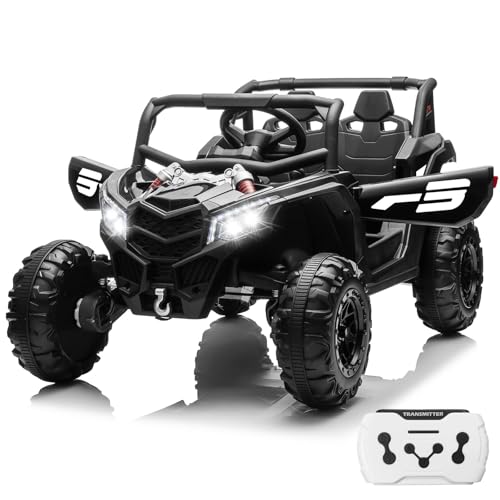
The best 24V kids UTVs are the ones whose motor output, weight limit, seat width, and low-speed control match your child and terrain: choose a 400W-class two-seat UTV for grass and hills, a lighter 300–400W model for pavement, and a 24V model with a parent remote for younger or inexperienced drivers.
Our top picks



As an Amazon Associate we earn from qualifying purchases at no extra cost to you. Ratings are shown as listed on Amazon.
Best 24V kids UTVs at a glance
| Best for | Recommended UTV type | Typical motor output | Typical capacity | Realistic runtime | Typical price range |
|---|---|---|---|---|---|
| Young beginners, mostly pavement | Compact two-seat 24V UTV with parent remote | 2 × 150W to 2 × 200W | 110–130 lb total | 35–60 minutes pavement; 25–40 minutes grass | $220–$350 |
| One child on mixed terrain | 400W-class 24V UTV with rubberized tires | 2 × 200W | 130–150 lb | 30–50 minutes pavement; 20–35 minutes grass | $300–$500 |
| Two children and level grass | Large two-seat 24V ride-on UTV | 2 × 200W to 2 × 250W | 150–220 lb | 25–45 minutes pavement; 15–30 minutes grass | $400–$700 |
| Frequent use or rougher lawns | Heavy-duty 24V UTV with metal frame sections and low gearing | 2 × 200W to 2 × 300W | 150–220 lb | 20–40 minutes pavement; 15–25 minutes grass | $500–$900 |
These are useful planning ranges rather than guarantees. Runtime changes substantially with rider weight, tire pressure, temperature, slope, grass length, and whether the vehicle is carrying one or two children. Product listings also use “24V” to describe the battery system, not the actual power delivered at the wheels.
Our practical picks by situation
Best established-brand choice: Peg Perego Polaris RZR 24V
The Peg Perego Polaris RZR 24V is a sensible choice when you value a recognizable manufacturer, adjustable speed control, and a more finished chassis over the lowest purchase price. It is designed as a two-seat ride-on vehicle and is generally best for children who can follow driving instructions and will use it on relatively firm, level ground.
Its advantages are predictable controls, a sturdy plastic body, a parent-oriented speed limit, and better parts support than many anonymous imported UTVs. The trade-offs are price, substantial size, and a battery that can feel limited when two children drive continuously over grass. Expect roughly 25–45 minutes of active use in mixed conditions, with longer sessions when driving slowly on pavement.
Best value: a 24V two-seat UTV with two 200W motors
Many value-oriented models from brands such as Best Choice Products use a 24V battery and dual 200W motors. These offer more useful grass performance than 12V ride-ons without moving into the weight and cost of large premium models.
Look for a model with a three-speed selector, soft-start acceleration, a parent remote, a seat belt for each position, and a stated load limit of at least 130 pounds. A value UTV is a good match for one child aged about four to six on a lawn or driveway, provided the adult can supervise closely. Build quality varies: inspect the charger connector, steering linkage, wheel hubs, and battery warranty before buying.
Best for two children: a wide 24V UTV with a 150-pound-or-higher limit
If two children will ride together, seat width matters more than the advertised motor count. Choose a bench at least 19–21 inches wide, two separate belts, and enough footwell space that neither child’s shoes interfere with the accelerator or brake controls.
A wide UTV with two 200W or two 250W motors can carry two smaller children on level grass, but its runtime will be noticeably shorter than the same vehicle carrying one child. Do not treat the maximum load as a recommendation for steep slopes. A 180-pound combined load may be within the structural limit but still exceed what the motors can move safely across thick grass.
Motor wattage is not the whole performance story
For these vehicles, motor wattage is best used as a comparison within the same voltage system. A 24V UTV with two 200W motors has a nominal 400W total rating, but actual wheel performance also depends on gearing, controller limits, tire diameter, traction, and battery condition.
- 300–400W total: suitable for pavement, compact yards, and lighter children. It may slow significantly on grass.
- 400–500W total: the useful middle ground for mixed surfaces and gentle lawns.
- 500–600W total: better for heavier riders and grass, but it can spin the tires, drain the battery quickly, and accelerate more sharply.
Do not select a high-power model merely to obtain speed. A slower UTV with progressive acceleration is easier to control near curbs, garden beds, pets, and parked vehicles. The maximum advertised speed for many 24V models is approximately 3–6 mph; that difference feels large to a young driver.
Grass versus pavement: the runtime difference
Pavement usually delivers the longest runtime because the tires roll with less resistance. Short, dry grass may reduce runtime by 20–30 percent, while damp or thick grass can reduce it by 40 percent or more. Slopes and repeated starts have a similar effect.
Here is a simple planning calculation. Suppose a UTV uses a 24V, 7Ah battery:
- Nominal stored energy: 24 volts × 7 amp-hours = 168 watt-hours.
- If the motors and controller average 250 watts while moving, theoretical driving time is 168 ÷ 250 = 0.67 hours, or about 40 minutes.
- Allowing for voltage drop, stops, acceleration, and the need to avoid fully flattening the battery produces a practical figure of roughly 25–35 minutes on grass.
A larger 10Ah battery can improve runtime, but only if the charger and vehicle electronics are designed for it. Never substitute a different-voltage battery or an incompatible lithium pack without manufacturer approval.
Fit the UTV to the child, not just the age label
Age ranges are broad marketing guidance. Measure the child while seated: their back should rest against the seat, knees should remain comfortably bent, and both feet should reach the floor or footwell without stretching. The child should be able to release the accelerator, steer, and understand “stop” before driving independently.
| Child and use case | Useful target | Why |
|---|---|---|
| About 3–4 years, first ride-on | Low speed, parent remote, 110–130 lb limit | Control and stopping matter more than hill performance |
| About 4–6 years, one rider | 300–400W total, 16–19 inch seat, three speed settings | Enough power for firm lawns without excessive acceleration |
| About 6–8 years, mixed surfaces | 400–500W total, 19-inch-or-wider seat, 130–180 lb limit | More room and torque for growing children |
| Two riders | At least 19–21 inch seat width and two belts | Reduces crowding and keeps each rider positioned correctly |
Safety features worth paying for
- Parent remote: lets an adult stop or steer the vehicle if the driver loses control.
- Soft start: prevents a sudden surge when the pedal is pressed.
- Selectable speed: a low setting is useful for first sessions and confined yards.
- Two-point or three-point belts: important when the vehicle turns or crosses uneven ground.
- Thermal protection: helps protect motors and wiring during long, slow operation.
- Sealed switches and covered wiring: reduce problems from dust and occasional splashes.
Use the UTV only on private property, away from roads, ponds, drop-offs, stairs, and traffic. Avoid steep slopes and wet grass, and require appropriate protective gear. An adult should supervise every ride, even when a parent remote is included.
Ownership realities: what wears out first
The battery is usually the first expensive consumable. Lead-acid batteries commonly provide roughly 200–300 full charge cycles when treated well, although heat, deep discharge, and long storage can shorten that figure. Charge after use, disconnect the charger when the charging cycle ends, and store the vehicle indoors in freezing or very hot conditions.
Tires and drive gears are next. Tire tread wears quickly when children spin the wheels on pavement, while grass and sand can pack debris around the axles. Check the wheel nuts, steering hardware, belt anchors, and motor connectors monthly. Clean with a damp cloth rather than a hose; water entering the foot pedal, switches, or battery compartment can create intermittent faults.
A common mistake is continuing to drive after the UTV becomes noticeably slow. That can overheat the motors and controller. Stop, let the vehicle cool, and recharge instead of repeatedly pressing the accelerator on a nearly empty battery.
Bottom line
For most families, the best 24V kids UTV is a 400W-class two-seater with a parent remote, soft-start acceleration, two belts, and a realistic 130–150 pound capacity. Choose the Peg Perego Polaris RZR 24V when brand support and controlled operation justify a higher budget; choose a well-equipped dual-200W value model for occasional driveway and lawn use; and move to a wider, higher-capacity chassis only when two children will actually ride together. Match the vehicle to the terrain and measured fit, because those factors determine satisfaction and safety more reliably than a top-speed figure.