Key takeaways
- Pros: True automatic switching with no manual lever needed at the point of use; compact footprint fits tight spaces behind furniture or in a garage corner.
- Con: 15-amp ceiling limits you to roughly one heavy appliance plus a few light loads; not suitable for circuit panels.
A storm knocks out power and your generator fires up, but without a proper transfer switch you risk backfeeding the grid, endangering utility workers, or damaging sensitive electronics. An automatic transfer switch closes that gap: it senses the outage, disconnects your home from utility lines, and routes generator power to selected circuits or the entire panel with no manual intervention required. The right unit depends on your actual electrical load, whether you need whole-home coverage or just a handful of circuits, and whether your setup calls for a plug-in device or a hardwired panel-level installation.
What separates a worthwhile switch from a disappointment is rarely a single headline spec. Build quality matters — a NEMA 3R enclosure handles outdoor mounting while a bare plastic box will not. Service entrance rating determines whether the unit can go between your meter and main panel or only downstream. And reliability of the auto-switching mechanism is where long-term owner reports diverge most sharply from marketing copy. We compared published specs, current prices, and owner feedback across eight automatic transfer switch options ranging from under $40 to nearly $800 in 2026, so you can match the right amperage and installation type to your situation.
Our top picks




As an Amazon Associate we earn from qualifying purchases at no extra cost to you.
Quick Picks
| Product | Best for | Price |
|---|---|---|
| AC120V 15Amp ATS (NEMA 5-15P/R) | Plug-in backup for small loads | $58.99 |
| AC120V 15 Amp ATS (NEMA 5-15P/R) — second listing | Lowest-cost plug-in switching | $57.99 |
| 100Amp Mini ATS, DIN Rail | Light dual-power or solar switchover | $36.99 |
| RXSW200A3 200A NEMA 3R | Whole-home standby on a mid-range budget | $328.81 |
| Nirakoka RV ATS | RV owners connecting a portable generator | $89.99 |
| AC120V 15Amp ATS (Premium build) | Plug-in unit with better enclosure quality | $82 |
| EIIDAR 20Amp ATS | A few home circuits on a tight budget | $56.99 |
| Generac 200A Next Gen | Premium whole-home standby with warranty support | $789 |
How We Picked
We weighed four criteria for this category: amperage coverage matched to a realistic household or RV load, installation type (plug-in versus hardwired versus service-entrance rated), enclosure and rating durability for the mounting environment, and long-term owner reports on switching reliability rather than first-day impressions. Price-to-performance within each application tier also mattered — a $37 switch serving one purpose can be the better buy than a $789 unit that overspecs the job.
The 8 Best Automatic Transfer Switch in 2026
AC120V 15Amp ATS (NEMA 5-15P/R)
This unit is for anyone with a small portable generator who wants to keep a fridge, a few lights, and a router alive without rewiring a panel. It plugs directly into a standard NEMA 5-15R outlet on the utility side and a matching outlet on the generator side, switching automatically when one source drops.
- Pros: True automatic switching with no manual lever needed at the point of use; compact footprint fits tight spaces behind furniture or in a garage corner.
- Con: 15-amp ceiling limits you to roughly one heavy appliance plus a few light loads; not suitable for circuit panels.
Skip it if you need to power an electric dryer, a well pump, or more than a handful of circuits simultaneously.
AC120V 15 Amp ATS (NEMA 5-15P/R) — Second Listing
Functionally nearly identical to the first unit, this second listing sits a dollar lower and draws from a different seller. It suits the same plug-in, small-load scenario: keeping a chest freezer, a sump pump on a timer circuit, or a workstation alive during a short outage.
- Pros: Lowest price among the plug-in 15-amp models here; same NEMA 5-15P/R connection standard means universal compatibility with existing receptacles.
- Con: Limited published detail on the relay mechanism or expected cycle life compared to branded units; owner reports are sparse.
Skip it if you want a well-documented warranty path or a switch you can service with an electrician in five years.
100Amp Mini ATS, DIN Rail Mounted
At $36.99 this is the lowest-cost 100-amp option in the roundup, designed for dual-power applications where you alternate between grid and solar inverter or a small generator without full residential load requirements. DIN-rail mounting makes it practical for RV panels, off-grid cabin subpanels, or workshop setups.
- Pros: Auto and manual switching modes give flexibility; 2-pole 100A rating covers a meaningful load band for its price.
- Con: “Mini” packaging means fewer terminal options and a tighter layout that can frustrate installs with thicker gauge wire.
Skip it if you need a service-entrance-rated whole-home disconnect or outdoor exposure protection.
RXSW200A3 200A, NEMA 3R, Service Entrance Rated
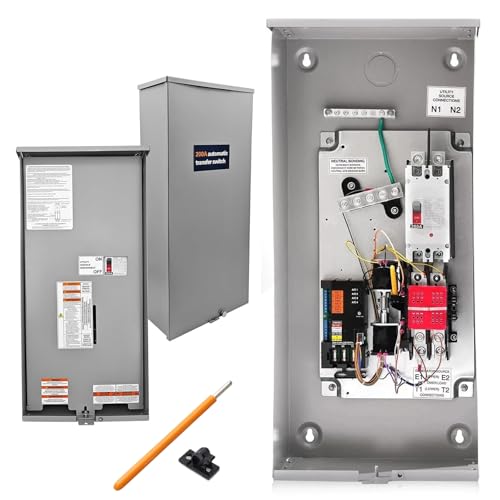
This is the standout mid-range choice for a whole-home standby generator. At 200 amps and service-entrance rated, it installs between your meter base and main breaker panel, replacing or supplementing the utility disconnect. The NEMA 3R aluminum enclosure handles outdoor mounting without a separate housing.
- Pros: Handles an entire household panel in one unit; explicitly listed as a Generac replacement, easing integration with existing generator controllers.
- Con: Installation is electrician-level work with no plug-and-play path; aluminum enclosure dents more easily than steel if impacted.
Skip it if your panel is under 100 amps or you only need a few circuits backed up.
Nirakoka RV Automatic Transfer Switch
Built specifically for RV owners who connect a portable generator to the onboard 50-amp service. The 240VAC, 50A rating (with 70A neutral) matches the standard RV power inlet and lets you run the air conditioner, microwave, and battery charger at once without a manual transfer lever.
- Pros: Form factor and amp rating align with RV pedestal hookups; compact enough for the tight compartment many rigs dedicate to a sub-panel.
- Con: Not rated for permanent residential use; enclosure is not weather-rated for outdoor home mounting.
Skip it if you are looking for a home-generator solution; this is purpose-built for travel and seasonal rigs.
AC120V 15Amp ATS (Premium Build)
Same 15-amp plug-in function as the first two units, but the higher $82 price buys what appears to be a more robust enclosure and internal relay based on owner descriptions comparing it to cheaper clones. It suits a buyer who wants plug-in simplicity with slightly better build confidence.
- Pros: Sturdier housing than the sub-$60 equivalents; same NEMA 5-15P/R standard means no adapter hunting.
- Con: Still capped at 15 amps, so the price premium does not buy additional capacity.
Skip it if budget is the primary concern; the $57-59 versions cover identical electrical territory.
EIIDAR ATS 20 Amp, AC120V
A step above the 15-amp plug-ins in amperage while staying in a similar price range. This unit targets a single 20-amp circuit — typically a fridge-freezer combo or a workshop tool run — without requiring panel rewiring.
- Pros: 20-amp headroom over the 15-amp models here without a meaningful price increase; simple installation for a dedicated circuit.
- Con: Less brand visibility means fewer community reviews and harder replacement-parts sourcing if the relay fails.
Skip it if you need more than one circuit backed up or if you require UL-listing documentation for insurance.
Generac 200 Amp Next Gen ATS
The premium whole-home option. Service-entrance rated at 200 amps, designed to pair with Generac home standby generators and integrate with their mobile-link monitoring. For a buyer who already owns or plans to buy a Generac unit, the compatibility and warranty ecosystem justify the cost.
- Pros: Seamless pairing with Generac controllers and app monitoring; extensive warranty network and installer familiarity reduce support friction.
- Con: Nearly $800 is a steep premium over the RXSW200A3 for identical electrical function; you pay partly for brand integration.
Skip it if your generator is not Generac-branded or if the RXSW200A3’s specs already cover your panel size.
Buying Guide
Match Amperage to Your Real Load
Add up the running watts of everything you genuinely need during an outage, then divide by 120 to get approximate amps. A fridge, a furnace fan, three LED circuits, and a router might total well under 20 amps, making a plug-in unit sufficient. A whole home with central AC, electric dryer, and water heater will push past 100 amps, requiring a service-entrance-rated 200A switch. Buying undersized creates nuisance trips; buying oversized wastes money and adds installation cost.
Installation Type Determines Everything
Plug-in switches connect at an existing receptacle and require zero electrician time. Hardwired switches connect to a transfer sub-panel and need a licensed electrician for code compliance. Service-entrance-rated units install between your meter and main breaker and often require a utility coordination step before inspection. Know which tier your situation demands before comparing prices, because a $57 plug-in and a $789 service-entrance unit are not in the same cost conversation once labor is included.
Enclosure Rating and Environment
NEMA 3R means rain and sleet protection for outdoor mounting on a garage wall or generator pad. Indoor DIN-rail or plastic-enclosed units have no weather rating and will corrode or short if exposed to humidity. If your switch lives in a damp basement, an outdoor shed, or on the exterior of the home, match the enclosure to the environment — not to the electrical spec alone.
Our Verdict
Top pick: the RXSW200A3 200A NEMA 3R delivers the best whole-home performance for its price, with service-entrance rating and outdoor-rated aluminum enclosure that the Generac unit matches electrically at more than twice the cost. Budget pick: the 100Amp Mini ATS at $36.99 is the most capable switch per dollar for dual-power or light backup scenarios. Another product wins if: you already own a Generac home standby — in that case the Generac 200A Next Gen earns its premium through controller integration, app connectivity, and a nationwide installer network that reduces long-term support friction.
FAQ
Do I need a service-entrance-rated automatic transfer switch?
Only if your generator is meant to power the entire panel and your local code requires the disconnect between meter and main breaker. Most sub-panel transfer setups do not need a service-entrance-rated unit, which opens a wide range of lower-cost options.
Can I install an automatic transfer switch myself?
Plug-in models that connect to existing NEMA receptacles are genuinely DIY. Anything requiring wiring into a panel, sub-panel, or meter base should be handled by a licensed electrician in most jurisdictions, both for code compliance and insurance validity.
Will a transfer switch work with any generator brand?
Hardwired and service-entrance-rated units are generally brand-agnostic; they follow the generator controller’s signal regardless of who built the genset. Generac-branded transfer switches are optimized for Generac controllers but will still function with other brands at the cost of some monitoring features.
How long does an automatic transfer switch last?
Owner reports on the units in this roundup suggest mechanical relays in well-built switches last many years of regular cycling, while cheaper clones occasionally fail within the first two or three seasons. Enclosure quality and mounting environment are the biggest predictors of service life.