Key takeaways
- Floor platform scales for freight prep compared by platform size, capacity, readability and indicator, so pallet weights on your bill of lading match the carrier's.
Freight prep lives or dies on one number: the pallet weight you write on the bill of lading. Guess it, or weigh on a scale that is too small for the load, and the carrier’s reweigh turns into a billing adjustment, a disputed freight class, and an awkward call with your customer. The real decision when buying a floor platform scale is matching three figures to your freight — platform size against your pallet footprint, capacity against your heaviest shipment, and readability fine enough that the declared weight holds up at the terminal.
This guide is for small warehouses, e-commerce shippers moving into LTL freight, and workshops that palletize outgoing goods. The four scales below were chosen from the names and specifications on their Amazon product pages, with platform dimensions, capacity, and readability taken from the listings themselves. They cover the standard 48-inch pallet footprint, a higher-capacity option for dense freight, and a larger deck for oversized pallets, so you can match the scale to the freight you actually prepare.
Quick Picks
As an Amazon Associate we earn from qualifying purchases.
| Product | Best for | Key spec from title |
|---|---|---|
| PEC Industrial Floor Scale (48×48) | Standard pallets with legal-for-trade paperwork | 5,000 lb × 1 lb with NTEP indicator |
| SOCOME Industrial Floor Scale (48″x48″) | Dense freight that outgrows 5,000 lb scales | 10,000 lb × 1 lb, diamond-plate deck |
| Liberty Scales Pallet Size Floor Scale (48″ x 48″) | Pallet-jack loading with the included ramp | 5,000 lb × 1 lb with ramp included |
| PEC Industrial Floor Scale (48×60) | Oversized pallets and long freight | 10,000 lb × 1 lb, NTEP certified indicator |
How to Choose
Size the platform to your pallet, with no overhang
A standard GMA pallet measures 48 × 40 inches, which is why 48 × 48 inch platforms dominate this category: the pallet fits either way round with a small margin. Any load hanging off the deck edge reads light and reads inconsistently, because the load cells only register what sits on the platform. If you prepare oversized pallets, long crates, or double-stacked loads that shift the footprint, step up to a 48 × 60 inch deck like the larger PEC in this guide. Measure your biggest regular shipment, not your average one, because the scale has to be right on the day the awkward freight ships.
Buy capacity above your heaviest load, not at it
Capacity works with readability as a pair. A 5,000 lb scale reading in 1 lb steps suits most palletized goods, while the same platform in a 10,000 lb version trades nothing away at freight weights but adds headroom for machinery, stone, or dense parts. Running a scale at its limit load after load is hard on load cells and leaves no margin for the pallet and packaging themselves. Add the pallet weight and your heaviest realistic shipment together, then choose the capacity class above that figure. The SOCOME and the 48×60 PEC here cover the 10,000 lb class for shippers whose freight is outgrowing the standard tier.
Decide whether you need legal-for-trade (NTEP) or internal weights
If you bill customers by weight, resell freight charges based on your scale readings, or need readings that stand up in a dispute, an NTEP-certified, legal-for-trade scale is the safer purchase; the PEC models in this guide list NTEP indicators, and one lists an NTEP-approved scale and indicator combination. If the scale only feeds your own carrier declarations and internal checks, a non-certified industrial scale can be acceptable, but the declared weight still has to match the carrier’s terminal scale. Read the listing’s certification language carefully, because “NTEP indicator” and a fully NTEP-approved system are not the same claim.
Plan how freight gets on and off the deck
A floor scale is only useful if loading it fits your workflow. Forklifts can set pallets straight down on any of these low decks. Pallet jacks cannot climb a deck edge, so jack-based operations need a ramp — the Liberty here includes one, while other models may need a ramp bought separately or a pit installation. Indicator placement matters too: a wall- or stand-mounted indicator at eye level speeds up prep, and tare functions let you zero out the pallet so the readout is net freight weight. Check the listing for ramp inclusion, indicator style, and cable length before the scale arrives.
The 4 Best Options
PEC Industrial Floor Scale (48×48)
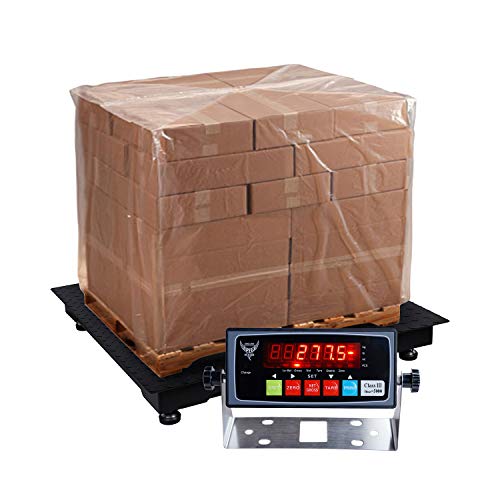
This is the reference configuration for freight prep: a 48 × 48 inch platform sized for standard pallets, a 5,000 lb capacity reading in 1 lb increments, and an NTEP indicator for legal-for-trade use. The listing describes four NTEP-approved alloy load cells, which is the detail that supports consistent readings across the full deck rather than just at the center, and the PEC-IN202 indicator provides tare across the full capacity range with lb/kg readout. For a small warehouse formalizing its freight process, this is the scale that matches how carriers themselves weigh, which is exactly what you want when a reweigh dispute lands.
Specs
- Platform: 48 × 48 in
- Capacity: 5,000 lb × 1 lb
- Indicator: PEC-IN202, NTEP approved, LCD screen
- Load cells: Four NTEP-approved alloy load cells
- Functions: Full-range tare, lb/kg readout
- Part number: PEC-FSNTEP4848
Best for: Shippers who need legal-for-trade pallet weights for billing and carrier declarations.
Watch out for: Confirm whether the configuration you order is the NTEP-approved system or a variant with an NTEP indicator only, and check the listing for ramp inclusion, since pallet-jack loading needs one and it may be a separate purchase.
ASIN: B083ZJBCBP
SOCOME Industrial Floor Scale (48″x48″)

The SOCOME doubles the working capacity of the standard tier to 10,000 lb while keeping the same 48 × 48 inch footprint, which suits freight that is dense rather than bulky: machinery parts, tile, metal stock, and double-stacked cartons. The listing describes a carbon steel frame with a diamond-plate surface, four adjustable feet for leveling on imperfect warehouse floors, and an LED display with tare, plus connections for computers and printers so weights can flow into your shipping paperwork. Its stated weighing range starts at 11 lb, so it will not double as a parcel scale, but within freight weights it reads in 1 lb steps.
Specs
- Platform: 48 × 48 in
- Capacity: 10,000 lb × 1 lb (from 11 lb)
- Deck: Carbon steel, diamond-plate surface
- Display: LED, with tare function
- Feet: Four adjustable leveling feet
- Connectivity: Computer and printer connection per listing
Best for: Warehouses whose pallets regularly exceed what a 5,000 lb scale should carry.
Watch out for: The listing does not present this model as an NTEP legal-for-trade system, so if you bill by weight, verify the certification status on the product page before relying on its readings commercially.
ASIN: B0FKMWXHHM
Liberty Scales Pallet Size Floor Scale (48″ x 48″)

Liberty’s package is built around the loading step that other listings leave to you: it includes a ramp, so a pallet jack can roll straight onto the 48 × 48 inch deck. The scale reads 5,000 lb in 1 lb increments through four alloy load cells, the deck stands about 4 inches high with an anti-rust coated plate finish, and the indicator handles gross, tare, and zero functions with lb, oz, and kg units. For a shipping area without a forklift, that ramp changes the scale from a two-person wrestling match into a one-person routine, which is what daily freight prep actually needs.
Specs
- Platform: 48 × 48 in
- Capacity: 5,000 lb × 1 lb
- Included: 1 ramp for pallet-jack access
- Deck height: 4 in
- Load cells: Four alloy load cells
- Units: lb / oz / kg, with gross, tare, and zero
Best for: Shipping areas that load by pallet jack and want the ramp in the box.
Watch out for: A ramp consumes floor space on the approach side, so measure your staging area with the ramp laid out; also confirm the indicator mounting hardware in the listing if you plan to wall-mount it.
ASIN: B08CGFPK86
PEC Industrial Floor Scale (48×60)

When freight outgrows the standard footprint — long crates, oversized pallets, or loads that cannot be centered on a 4 × 4 deck — this larger PEC stretches the platform to 48 × 60 inches and raises capacity to 10,000 lb in 1 lb increments. The listing specifies an NTEP certified indicator and legal-for-trade positioning, keeping the paperwork value of the smaller PEC while covering bigger freight. It is the natural step-up for a growing operation that started on a 48 × 48 scale and now turns away or double-handles shipments that do not fit it, and it keeps the same indicator family, so staff training carries over.
Specs
- Platform: 48 × 60 in
- Capacity: 10,000 lb × 1 lb
- Indicator: NTEP certified, legal for trade
- Type: Industrial floor / pallet scale
- Brand line: PEC Scales
Best for: Growing shippers whose freight includes oversized pallets and long loads.
Watch out for: The bigger deck needs a bigger clear floor area and freight delivery access to install; verify the listing’s shipping method and whether a ramp is offered for this size before planning pallet-jack workflows around it.
ASIN: B084DKMX7P
Which One Fits Your Situation
You ship standard pallets and bill customers by weight
Choose the PEC 48×48. Its NTEP-approved configuration is built for readings that have to stand up commercially, the platform matches a GMA pallet exactly, and 1 lb readability keeps your declared weights aligned with what the carrier’s scale will find at the terminal.
Your freight is heavy for its size
Choose the SOCOME. Dense freight hits capacity limits long before it fills a platform, and this scale’s 10,000 lb rating on a standard footprint removes the ceiling without rearranging your shipping area. The printer and computer connections also suit higher daily shipment counts.
You load everything with a pallet jack
Choose the Liberty. The included ramp is the deciding feature, because a floor scale a jack cannot climb becomes a forklift-only island in the middle of your workflow. Its 5,000 lb capacity covers typical palletized goods, and the deck height stays low enough for an easy roll-on.
Your pallets keep getting bigger
Choose the PEC 48×60. The extra foot of deck length swallows oversized pallets and long crates that overhang a 4 × 4 platform, and overhang is where inaccurate weights come from. You also keep NTEP legal-for-trade positioning as your shipment sizes grow.
Common Mistakes
- Letting freight overhang the deck edge, which guarantees a low reading and a carrier reweigh adjustment later.
- Buying capacity at exactly your heaviest load, leaving no headroom for the pallet, packaging, or load-cell longevity.
- Assuming every industrial scale is legal for trade, when only listings that state NTEP approval support billing by weight.
- Forgetting the loading method: a pallet jack cannot climb a deck, so a scale without a ramp or pit plan stalls the whole prep area.
- Skipping leveling and calibration checks after installation, then trusting readings that drift because the deck sits unevenly.
Frequently Asked Questions
What platform size do I need for standard pallets?
A 48 × 48 inch platform is the standard match for a 48 × 40 inch GMA pallet, because the pallet fits in either orientation with margin on every side. All four scales in this guide start at that footprint. Step up to a 48 × 60 inch deck if you regularly prepare oversized pallets or long crates that would otherwise overhang and read light.
What does NTEP legal-for-trade actually mean for my shipping?
It means the scale or its indicator has passed the National Type Evaluation Program’s requirements, so its readings can be used when money changes hands based on weight, such as billing a customer for freight. The PEC models here list NTEP certification. If you only check weights internally, it is less critical, but your declared weights still need to match the carrier’s.
Is 1 lb readability accurate enough for freight?
For pallet freight, yes. Carriers weigh LTL shipments in similar increments, and a 5,000 or 10,000 lb scale reading in 1 lb steps, like every model in this guide, gives declared weights that hold up at terminal reweighs. Finer readability matters for parcels and parts, which is a different class of scale; floor platforms are built for freight weights.
Can I load a floor scale with a pallet jack?
Only with a ramp or a pit installation, because a pallet jack’s forks need a gradual approach and cannot lift a load over a deck edge. The Liberty scale in this guide includes a ramp for exactly this reason. If you choose a model without one, budget for a matching ramp or plan to load by forklift instead.
More from Amazon
Programs that pair well with the guide above. Offers and eligibility are set by Amazon and may change.
Free shipping on eligible items, Prime Video and more. Eligible new members can start with a free trial.
Start a Prime free trialAudiobooks and podcasts to listen to on the go. Eligible new members can start with a free trial.
Try Audible freeAd-free music streaming. Eligible new subscribers can start with a free trial.
Try Music Unlimited freeA free business account with business pricing and bulk-buying tools for work, shop or home office.
Create a business accountAs an Amazon Associate we earn from qualifying purchases.