Key takeaways
- 6-inch tubes: Hold 1.5 to 2 oz of pellets, burn for 1.5 to 2.5 hours. Best for short cooks, quick smoke boosts, or small portable grills where space is limited.
- 12-inch tubes: Hold 4 to 5 oz of pellets, burn for 4 to 6 hours. Best for longer cooks, large pork shoulders, brisket, or overnight cold smoking.
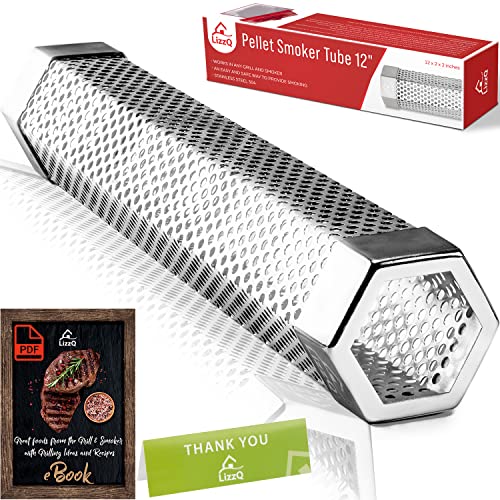
The best pellet tube smokers for longer cooks are 12-inch stainless steel models like the A-MAZE-N 12″ Tube Smoker, LizzQ Premium Pellet Smoker Tube, and Kingsford Stainless Steel Pellet Smoker Tube, because they hold 25-35% more pellets than 6-inch versions and deliver 4 to 6 hours of consistent cold or supplemental hot smoke without needing a refill.
For low-and-slow cooks, pellet tube smokers solve one specific problem: most pellet grills and gas grills do not produce enough smoke at higher temperatures or over multi-hour cooks. A pellet tube smolders wood pellets independently of your grill’s fuel source, so you can add clean smoke to any grill, extend smoke time on a pellet grill, or cold-smoke cheese, nuts, and fish without turning the main burner on.
Our top picks
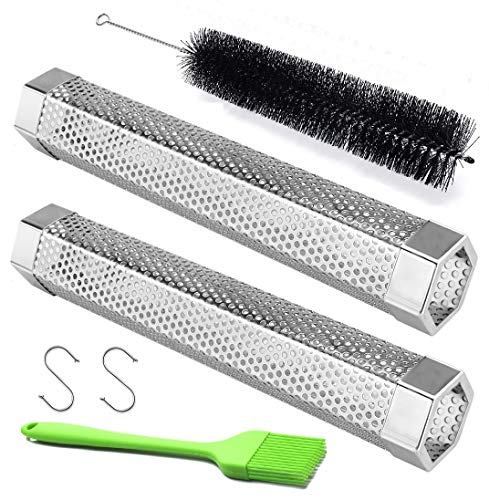


As an Amazon Associate we earn from qualifying purchases at no extra cost to you. Ratings are shown as listed on Amazon.
How to Choose a Pellet Tube Smoker for Long Cooks
Tube length is the single biggest factor for burn time. A longer tube holds more pellets, burns longer, and produces smoke for the majority of a brisket, pork shoulder, or rib cook. Shorter tubes are useful for quick 1 to 2 hour smokes but will burn out mid-cook on anything longer.
1. Tube Length and Pellet Capacity
Most pellet tubes come in two standard lengths:
- 6-inch tubes: Hold 1.5 to 2 oz of pellets, burn for 1.5 to 2.5 hours. Best for short cooks, quick smoke boosts, or small portable grills where space is limited.
- 12-inch tubes: Hold 4 to 5 oz of pellets, burn for 4 to 6 hours. Best for longer cooks, large pork shoulders, brisket, or overnight cold smoking.
There are also specialty options like oval tubes, maze-style trays, and expandable 6-to-12 inch designs. Trays and mazes can burn up to 8-12 hours on sawdust or pellets but produce a lighter, thinner smoke and need a more level surface.
2. Burn Time and Smoke Output
Burn time depends on pellet density, moisture, airflow, and how tightly you pack the tube. On average, pellets burn at a rate of about 0.8 to 1.2 oz per hour in a well-ventilated tube. Hardwoods like hickory and mesquite burn slightly hotter and faster than milder woods like apple or alder.
Smoke output is controlled by airflow, not pellet flavor alone. A tube placed directly over a hotspot or in high airflow will burn faster and produce thinner blue smoke. A tube in a low-airflow corner will smolder slower and create denser white smoke, which can taste bitter if over-applied. For longer, cleaner cooks, aim for thin, almost invisible blue smoke.
3. Material and Build Quality
Look for 304 stainless steel with perforated or diamond-cut holes. Thinner 201 stainless can warp or discolor after repeated high-heat use. Welded end caps last longer than crimped caps, and hexagonal or flat-sided tubes resist rolling on grill grates better than round tubes.
4. Ignition Method
A tube must be properly lit to stay lit for hours. The standard method is:
- Fill the tube upright, tap to settle, fill to the top without over-packing.
- Use a butane torch or propane torch to light one end for 45-60 seconds until flames are visible.
- Let it flame for 5-10 minutes, then blow out the flame so it smolders and produces smoke.
- Lay it on its side on the grill grate once it is steadily smoldering.
Kitchen lighters and matches rarely produce enough sustained heat to keep a pellet tube lit. A torch is the most reliable tool and prevents mid-cook flameouts, which are the most common failure on long cooks.
5. Placement and Grill Compatibility
Placement affects both burn time and coverage. For most setups:
- Pellet grills and offset smokers: Place the tube on the grate, away from the direct heat and away from the temperature probe, typically on the left or rear side. This prevents temperature spikes and keeps smoke circulating.
- Gas grills: Place the tube near the back, on the cooking grate or on the heat deflectors if the grate is too crowded. Keep at least one burner on low for airflow but not directly under the tube.
- Kettle and charcoal grills: Place the tube on the charcoal grate perpendicular to the coals, not directly on top of lit charcoal, to avoid igniting the entire tube at once.
- Electric and vertical smokers: Place the tube on the lowest rack where it gets indirect airflow. Ensure there is at least 2 inches of clearance on all sides.
Most 12-inch tubes fit any grill with at least 18 inches of grate width. For portable grills and small smokers under 300 square inches, a 6-inch tube is often the only option that fits without blocking airflow.
Spec Comparison: Top Pellet Tube Smokers for Longer Cooks in 2026
These models represent the most widely available stainless steel pellet tubes as of 2026. All are reusable and work with standard wood pellets or wood chips mixed with pellets.
| Model / Type | Length | Material | Weight | Pellet Capacity | Estimated Burn Time (Pellets) | Shape / Anti-Roll |
|---|---|---|---|---|---|---|
| A-MAZE-N 12″ Tube Smoker | 12 in (30.5 cm) | 304 Stainless Steel | 9.5 oz (269 g) | 4.5 oz (128 g) | 4 – 5.5 hours | Round with welded cap |
| LizzQ Premium Pellet Smoker Tube 12″ | 12 in (30.5 cm) | 304 Stainless Steel | 10.2 oz (289 g) | 5.0 oz (142 g) | 4.5 – 6 hours | Hexagonal |
| Kingsford Stainless Steel Pellet Smoker Tube | 11.5 in (29.2 cm) | 304 Stainless Steel | 8.8 oz (249 g) | 4.2 oz (119 g) | 4 – 5 hours | Round with flat base |
| Smoke Daddy Big Kahuna Cold Smoke Generator (Tube Style) | 12 in (30.5 cm) | 304 Stainless Steel, heavy gauge | 14.0 oz (397 g) | 5.5 oz (156 g) | 5 – 6+ hours | Hexagonal, thick wall |
| A-MAZE-N 6″ Tube Smoker | 6 in (15.2 cm) | 304 Stainless Steel | 5.1 oz (145 g) | 2.0 oz (57 g) | 1.5 – 2.5 hours | Round |
General market range for these tubes is approximately $15 to $35 for 6-inch models and $18 to $45 for 12-inch heavy-duty models. Expandable and hex designs tend to cost slightly more due to thicker steel.
Which Tube Should You Pick? A Decision Matrix
| Your Situation | Best Choice | Why |
|---|---|---|
| You cook brisket, pork butt, or ribs for 6+ hours and want continuous smoke | 12-inch hex tube (LizzQ or similar heavy-gauge 304 steel) | Longest burn time per fill, stable on grate, less likely to roll or flame out |
| You use a pellet grill that lacks smoke at 225F+ and want a supplement | Any 12-inch tube | Adds smoke during hot cooks without altering grill temperature |
| You cold-smoke cheese, nuts, or fish under 90F | 12-inch tube or pellet maze tray | Produces smoke with almost no heat; maze can run 8-10 hours for overnight cheese |
| You have a small grill, portable grill, or Tailgater (under 300 sq in) | 6-inch tube | Fits without blocking airflow; you can refill once for a 4-hour cook |
| You grill gas or charcoal and want occasional smoke | 12-inch round tube with flat base (A-MAZE-N / Kingsford type) | Easy to light, works on any grate, good balance of capacity and price |
Runtime Calculation: How Much Pellet Capacity Do You Actually Need?
You can estimate burn time before you buy to avoid refilling mid-cook.
Formula: Burn Time (hours) = Pellet Capacity (oz) / Burn Rate (oz per hour)
Worked example for a 12-inch tube on a 5-hour pork rib cook:
- Tube capacity: 4.5 oz
- Average burn rate in moderate airflow: ~1.0 oz per hour
- Estimated runtime: 4.5 / 1.0 = 4.5 hours
- For a 5 to 6 hour cook, you will need to either top off the tube once at the 4-hour mark or use a tube with 5.0+ oz capacity that reaches 5+ hours on a single fill.
If you pack pellets loosely, burn rate increases to ~1.2 oz per hour and runtime drops by about 20%. Packing tighter and using dry, uniform-size pellets can extend runtime by 30 to 45 minutes without changing tubes.
Durability and Ownership Realities
A pellet tube is simple, but a few issues determine whether it lasts one season or several years.
- What wears first: The open end and the weld points around the cap. Repeated torch heating causes discoloration and eventually thin spots. Tubes with heavier gauge steel and full welds resist burn-through longer than thin-walled tubes.
- Consumables: The tube itself is reusable, but you will use 4-8 oz of pellets per long cook. Wood pellets must be food-grade and kept dry. Damp pellets swell, crumble, and will not stay lit.
- Cleaning: Residue builds up inside as creosote and ash. After every 2-3 cooks, burn off the tube empty on high heat for 10 minutes, then tap out ash and brush with a bottle brush. Do not soak in water; trapped moisture causes pellets to jam and prevents ignition next time.
- Common mistakes: Lighting for less than 30 seconds, blowing out the flame too early, over-packing with mixed chips and pellets that block airflow, and placing the tube directly above a gas burner where it re-ignites and burns too fast.
- Storage: Store vertically with both ends open in a dry place. Sealed containers trap humidity and leave soot odor.
Setup for a Longer Cook: Step-by-Step
This setup works for supplemental smoke on a hot cook or standalone cold smoke:
- Ensure pellets are dry and uniform. Sift out dust that can smother the burn.
- Fill the tube to the top, tap twice on a hard surface, top off again. Leave about 1/4 inch of space at the lighting end for airflow.
- Hold the tube vertically with the open end up. Apply a torch flame to the top pellets for 60 seconds until you have a steady flame 1-2 inches tall.
- Let the flame burn for 7-10 minutes. This creates a coal bed that sustains smoldering.
- Blow out the flame gently. You should see consistent smoke and a glowing ember. If smoke stops within 2 minutes, relight and let the flame burn longer.
- Place the tube on the grate on its side, open end facing away from the strongest airflow. Close the grill lid and monitor smoke. Thin blue smoke is ideal.
For cooks longer than 6 hours, prepare a second pre-filled tube so you can swap without opening the lid for more than a few seconds. Swapping is faster and more reliable than refilling a hot tube.
Frequently Asked Questions
Can a pellet tube replace the pellet system in my grill?
No. A pellet tube is a smoke generator only, not a heat source for cooking. It produces smoke at low temperatures and cannot maintain cooking temperatures like 225F or 350F on its own.
Can I use wood chips instead of pellets?
You can mix a small amount of chips with pellets, but 100% chips burn faster and can flame out. Pellets are denser and more consistent for long burns. If you use chips, layer them in the middle of the tube between pellets, not at the lighting end.
Why does my tube keep going out?
Most often it was not lit long enough to form a coal, the pellets were damp, or airflow was too low. Ensure pellets are dry, light for a full minute, let the flame burn for several minutes before blowing out, and place the tube where grill vents provide some airflow.
Is it safe to use a pellet tube in any grill?
Yes, when used as directed, pellet tubes are designed for pellet grills, gas grills, charcoal grills, and electric smokers. Keep it on the grate, not on grease trays, and keep it away from direct open flames to prevent uncontrolled ignition.